Hyundai has unveiled the first made-in-Singapore EV, the ‘IONIQ 5 First 100’ – limited edition and Singapore-exclusive – with special car plate numbers and badges. View it at the Singapore Motorshow 2023. Unveiling video below.
The Hyundai IONIQ 5 will come in Gravity Gold Matte, with Dark Pebble Grey interiors. It will also feature debossed seats for refined detail. The special number plate “EVS” stands for “EV made in Singapore”.
Hyundai and Komoco Motors will further their partnership on a holistic EV ecosystem to cultivate enhanced mobility lifestyles for customers in Singapore.
To commemorate the production of the first made-in-Singapore EV, Hyundai will hold a charity auction featuring 100 units of ‘IONIQ 5 First 100’, in conjunction with the President’s Challenge.
Hyundai has also commenced pre-booking for the purchase of the made-in-Singapore ‘IONIQ 5’ as part of the Hyundai Charity 500 program.
Three rapidly advancing technologies are driving this collective race towards zero-emission e-mobility: wide-bandgap (WBG) devices, more power-dense batteries, and faster charging capabilities.
In this guest commentary, Hwee Yng Yeo from Keysight Technologies shares her insights into the great EV race.
GaN and SiC wide-bandgap power semiconductors facilitate a host of onboard EV power conversion applications. Image credit: Keysight Technologies.
Since its inception on a paper napkin more than a decade ago, Formula E has evolved rapidly as a motorsport with a mission.
Entertainment aside, this electric streetcar racing’s founding mission is to showcase sustainable mobility to the world, and it has done pretty well.
Editor’s Comments
The Electric Vehicle (EV) is the future of the automotive industry and Tesla has this week just become the first carmaker to be valued at US$1 trillion – the sixth American company to hit a trillion-dollar valuation.
The company is now worth more than the next nine most valuable public carmakers combined.
It’s the only motorsport to have ISO 20121 certification for net zero carbon footprint since its first race in Shanghai in 2014.
Getting the Formula E car into pole-position entails a lot of hardware and software technology to extract maximum efficiency from the electric vehicle’s (EV) powertrain and battery.
For the key automotive OEMs, it’s not just about getting their car across the checkered flag first.
With billions of R&D dollars poured into developing better EVs, the goal of participating automakers goes beyond the championship trophy.
Learnings from these high-intensity races are applied to improve electromobility technologies back in the R&D labs.
Three rapidly advancing technologies are driving this collective race towards zero-emission e-mobility:
wide-bandgap (WBG) devices
more power-dense batteries
faster charging capabilities
Efficient power conversion with WBG devices
A lot of power conversion takes place in the EV.
A DC-DC converter for example, steps down the power from the high-voltage EV battery to 12 V, with further conversions to run onboard systems like lighting, radio, and air-conditioning (see the diagram above).
The author of this article is Hwee Yng Yeo, the industry solutions manager for Automotive and Energy at Keysight Technologies.
WBG devices such as Silicon carbide (SiC) and Gallium nitride (GaN) semiconductors are used in transistors to facilitate this power conversion throughout the vehicle.
GaN applications are an emerging technology area, and developers find it hard to validate their design for these high-performance power converters.
Increased frequency and higher power affect the reliability of measurements needed to characterise the device’s performance.
It can be hard to distinguish whether the measured signal is the device’s characteristic or caused by the measurement setup.
Komoco Motors has brought in the new Avante (Singapore & Korean name for the Elantra) to Singapore for a preview in its showroom.
The upcoming seventh-generation Elantra features an edgy and aggressive look based on parametric shapes and textures, which reflects Hyundai’s new design identity.
The world premier press conference will take place at 7 p.m. PT on Mar. 17, at The Lot Studios in West Hollywood, Calif. and will be livestreamed around the world.
The Elantra is Hyundai’s bestselling car globally, with more than 13.8 million Elantra/Avante models sold since its introduction in 1990.
The ‘Immersive Cocoon’ interior layout creates a driver-focused user experience.
The new Elantra returns to its sport sedan roots with a ‘Parametric Dynamics’ design theme.
The new vehicle platform offers a sporty four-door-coupe look with longer, lower and wider proportions.
Teaser video and more details below from the press release.
Google Maps was introduced 15 years ago on 8 February, 2005. First launched on desktop, Google Maps helped users search for nearby businesses and navigate from Point A to B.
Thanks for 15 years of Google Maps!
Today, Google Maps is used by more than one billion people every month around the world.
Every month, Google Maps connects people to businesses more than nine billion times, including more than one billion phone calls and three billion requests for directions.
The new Google Maps icon to celebrate its 15th anniversary.
Before we celebrate the 15th anniversary of Google Maps tomorrow, let’s take a trip down memory lane to see how much ground Maps has covered over the years, both in Singapore and worldwide.
Predictronics is an AI-driven predictive maintenance analytics solutions provider headquartered in Cincinnati, Ohio.
TVS Motor (Singapore)’s US$3.2m investment in Predictronics Corporation comes on the heels of a US$7m investment in Scienaptic Systems last month in July 2019.
TVS Motor (Singapore) Pte. Limited, a wholly-owned subsidiary of TVS Motor Company Limited, India, has signed definitive agreements to invest US$3.2 million in Predictronics Corporation, which specialises in providing end-to-end predictive maintenance analytics solutions.
The new solutions accelerate 5G, automotive cybersecurity and network innovations, helping Singapore businesses speed up technological advancements through collaboration and innovation.
Ee Huei Sin, Vice President / General Manager, General Electronics Measurement Solutions, Keysight Technologies, briefing the company’s solutions for IoT and 5G.
In 2019 and beyond, 5G-enabled technologies have the potential to create major global technology shifts, leading to huge potential for industries worldwide.
Keysight World Singapore 2019 showcased innovations in the following areas.
5G Test Solutions
Automotive Cybersecurity
Data Centre & Telecommunications
Network Visibility
However, before this potential can be harnessed, the technologies must first be thoroughly tested.
Keysight targets these critical testing needs by offering solutions and insights in electronic design, test, manufacturing, and optimisation.
Consumers in Singapore will get to try Gojek’s ride-hailing service with the launch of the beta version of its app, which will be made available for download from iOS and Android app stores in Singapore today.
Update (1 January, 2019):
GOJEK will be extending its ride-hailing services to the whole of Singapore from tomorrow, January 2, 2019. The following is the press statement from GOJEK.
“Following our successful limited service area rollout, GOJEK is excited to announce that we will extend our ride-hailing services to the whole of Singapore with effect from January 2, 2019.
This means that users will be able to use GOJEK to take rides anywhere in Singapore.
Our island-wide rollout is part of our continued beta phase, during which DBS/POSB Bank customers continue to enjoy priority access to the app.
We continue to welcome feedback from driver-partners and riders during this enhanced beta phase, as we work to fine-tune the app and create the best experience for our users.”
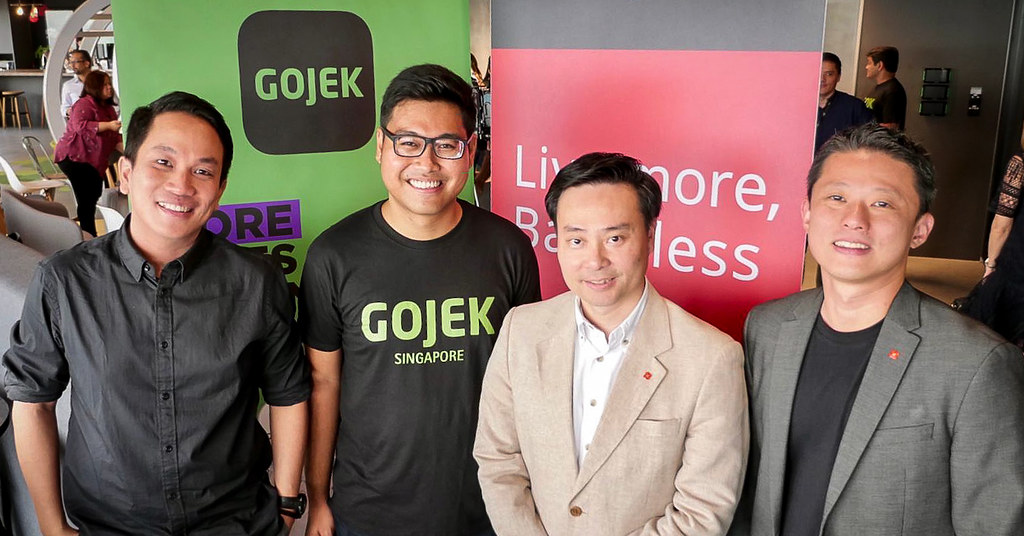
(From left) Gojek President, Andre Soelistyo; Gojek’s Global Head of Transport, Raditya Wibowo; Shee Tse Koon, Group Head of Strategy and Planning, DBS Bank; and Gene Wong, Head of Ecosystems, Consumer Banking Group, DBS Bank.
This marks the start of a gradual roll-out of Gojek’s ride-hailing services across the island as more driver-partners are onboarded over time to feed consumer demand.
“It is with great pride that we begin the roll-out of our services in Singapore. Consumers throughout the country have told us that they want more choice in this sector and with the launch of our beta app, their wait is coming to an end. We are launching in beta for now, while we fine-tune our service to make sure it meets the high standards expected by Singaporeans. As such, we are asking all users, whether drivers or passengers, to provide us with ongoing feedback as we work towards creating the best possible service for the country,” said Gojek President, Andre Soelistyo.
This staggered approach reflects Gojek’s commitment to ensuring a smooth entry into Singapore and an ongoing effort to improve user experience over time.
DBS/POSB customers in Singapore will be the first to enjoy Gojek rides during the beta phase.
During the beta phase, access to the app will be granted in batches to balance ride demand and service capabilities.
DBS/POSB customers in Singapore will be guided by the app to find out how they can be prioritised on the waitlist, and receive a SGD 5 voucher credit for each of their first two rides.
DBS Bank and Go-Jek today announced that the two parties have entered into a regional strategic partnership. Hear views from both companies below.
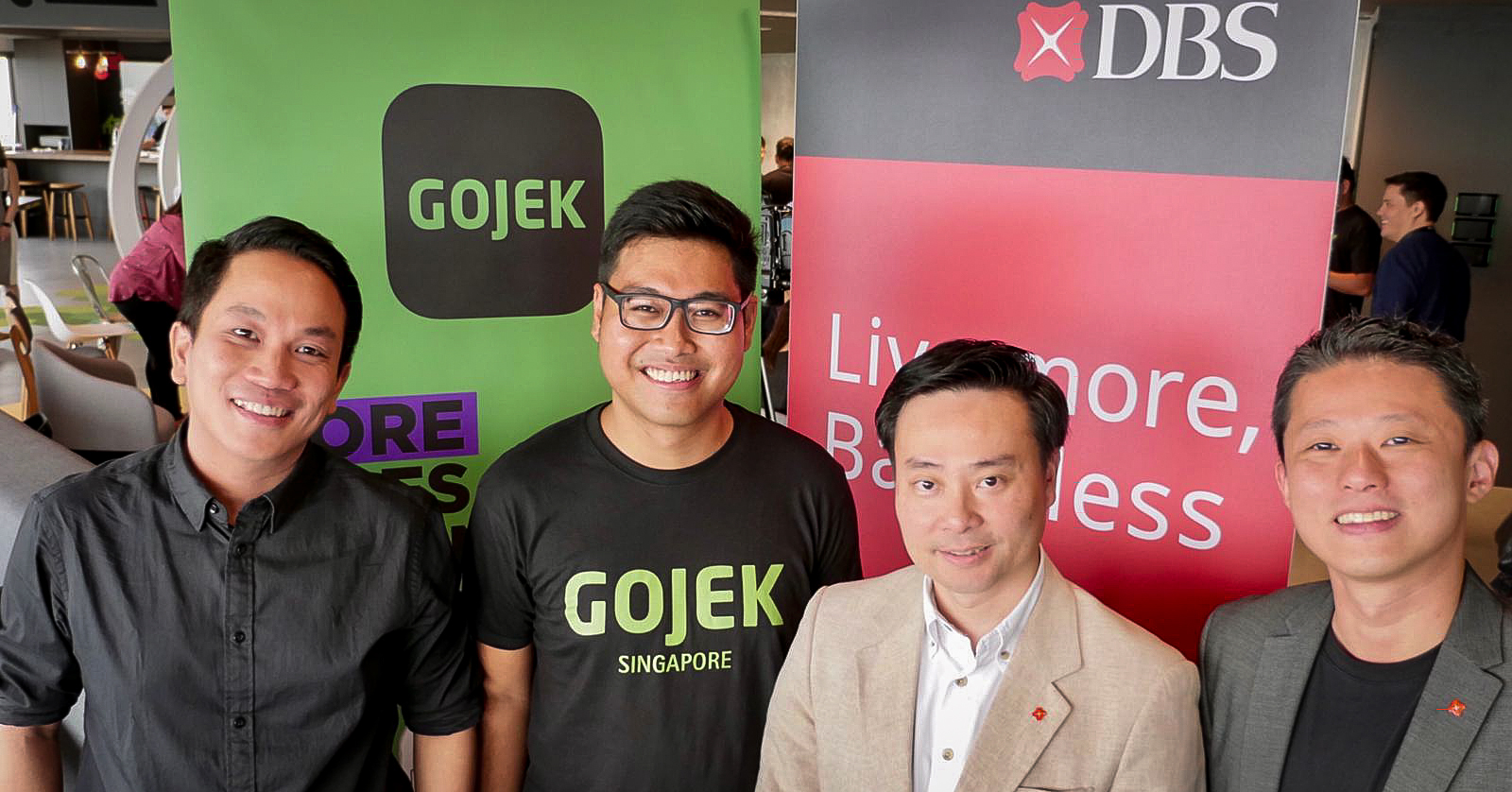
(From left) Go-Jek President, Andre Soelistyo; Go-Jek’s Global Head of Transport, Raditya Wibowo; Shee Tse Koon, Group Head of Strategy and Planning, DBS Bank; and Gene Wong, Head of Ecosystems, Consumer Banking Group, DBS Bank.
The partnership will see the two companies work together on payment services ahead of Go-Jek’s arrival in Singapore and this will soon extend to other countries in Southeast Asia.
“As Singapore’s leader in payments with over four million debit/credit cards in circulation and DBS PayLah! being the nation’s most popular mobile wallet, we are committed to making payments simple, seamless and invisible for our customers. In doing so we are stepping up to partner with like-minded companies like Go-Jek, one of Southeast Asia’s most iconic technology companies, to build inclusive digital ecosystems for our customers,” said Tan Su Shan, Group Head of Consumer Banking & Wealth Management, DBS Bank.
Go-Jek, whose investors include Google, Temasek, Tencent and Meituan Dianping, is set to launch its beta ride-hailing app in Singapore within the coming weeks and as part of this, DBS customers in Singapore will enjoy a slew of exciting privileges.
What kind of privileges can DBS/POSB consumers expect?
DBS/POSB customers in Singapore will be the first to be able to book rides during the beta phase.
Other privileges include an exclusive SGD 10 voucher credit which riders can use for their first two trips (SGD 5 per trip), and future discounts on Go-Jek’s ride-hailing service in the form of promo codes.
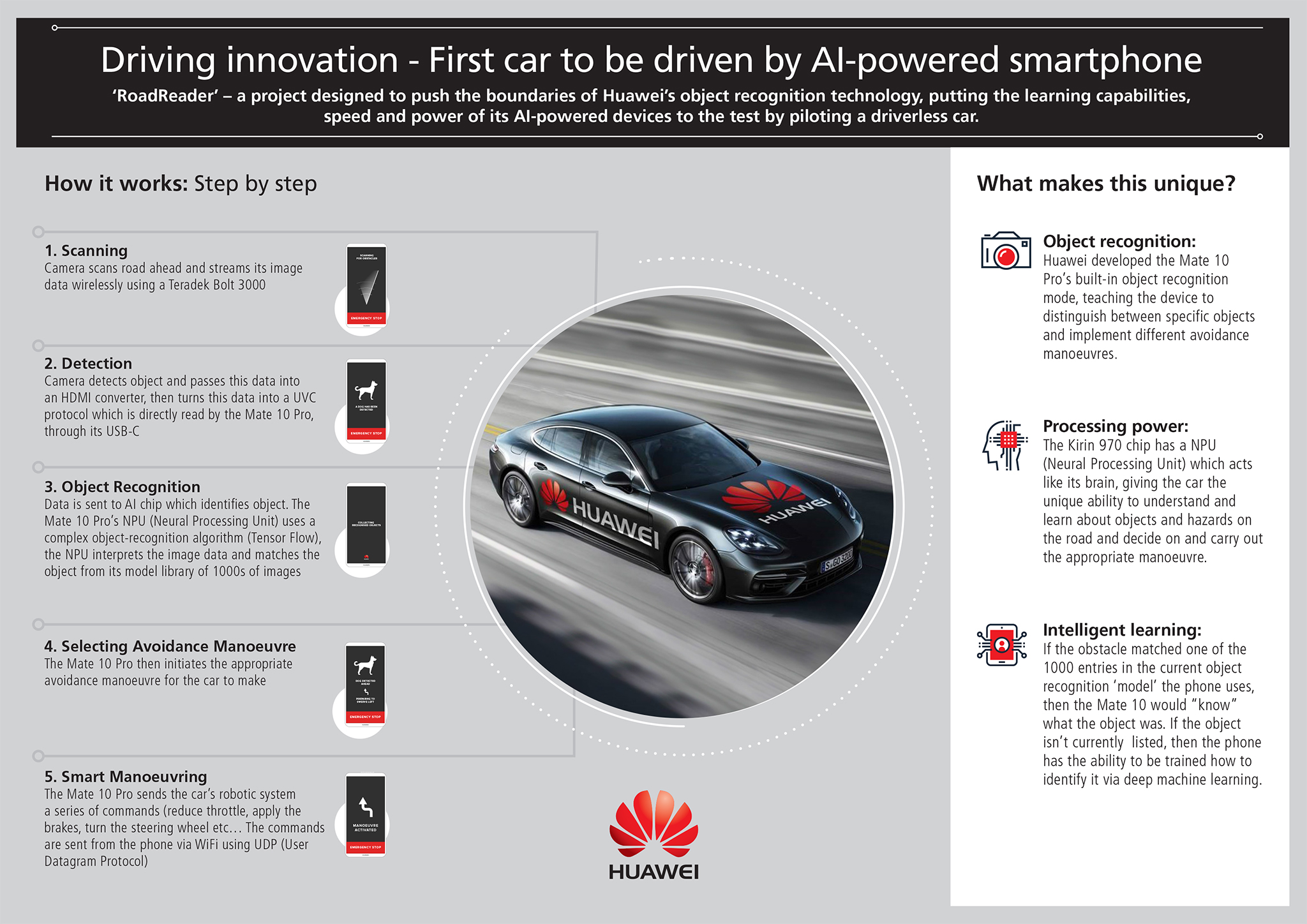
Huawei showcases driverless Porsche Panamera driven by the Mate 10 Pro, leveraging the smartphone’s powerful computer chip and AI (Artificial Intelligence) engine.
Huawei boasts that it is the first mobile device manufacturer in the world to use an AI-powered smartphone to drive a car.
The aim of the “RoadReader” project is to push the boundaries of Huawei’s object recognition technology and put the learning capabilities, speed and performance of its AI-powered devices to the test.
The AI engine in the Huawei Mate 10 Pro transforms the Porsche Panamera into a driverless vehicle that does not just see, but also understands its surroundings.