Archive for the ‘Tech Focus’ Category
Monday, November 22nd, 2021
Fewer accidents and greater road safety are central to the vision for automated vehicles (AVs). Enabling that vision requires greater situational awareness and the ability to inform the car and its drivers what is happening a mile in front of them, foreseeing what’s likely to happen next, and automatically taking preemptive actions.
In this guest commentary, Cheryl Ajluni from Keysight Technologies shares her insights into C-V2X certification.
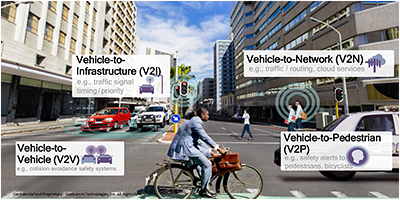
C-V2X Applications (Image courtesy of Qualcomm).
Cellular vehicle-to-everything (C-V2X) technology provides see-through, 360-degree, non-line-of-sight (NLOS) sensing in good, as well as adverse weather conditions to enhance the functionality and safety of autonomous driving (see the cover illustration).
Editor’s Comments
The future of motoring is in the connected/networked smart vehicle.
As demand rises around the world, the connected vehicle market is one of the fastest growing segments of the Internet of Things, potentially generating application revenue of US$273 billion by 2026, according to Machina Research’s forecasts.
C-V2X complements line-of-sight (LOS) sensors such as radar, lidar, camera, with information beyond their reach, and allows the vehicle to make more informed and coordinated decisions.
Whereas LOS sensors cannot indicate vehicle or driver intent, C-V2X conveys intent by sharing sensor data – resulting in a higher level of predictability in traffic situations such as lane changes, variable speeds, or road hazards.
Day one use cases include safety features such as emergency electronic brake light and forward collision warning, ‘do not pass’ warning, blind spot and lane change warning, vulnerable road user, road works warning, and intersection movement assistance.
(more…)
Tags:C-V2X, insights, Keysight, opinions, Tech Focus, technology, V2X, vehTech
Posted in Automobile, Internet of Things, IoT, Keysight, Opinion, Tech Focus, Technology | 4 Comments »
Friday, October 29th, 2021
Three rapidly advancing technologies are driving this collective race towards zero-emission e-mobility: wide-bandgap (WBG) devices, more power-dense batteries, and faster charging capabilities.
In this guest commentary, Hwee Yng Yeo from Keysight Technologies shares her insights into the great EV race.
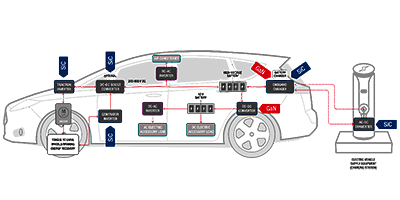
GaN and SiC wide-bandgap power semiconductors facilitate a host of onboard EV power conversion applications. Image credit: Keysight Technologies.
Since its inception on a paper napkin more than a decade ago, Formula E has evolved rapidly as a motorsport with a mission.
Entertainment aside, this electric streetcar racing’s founding mission is to showcase sustainable mobility to the world, and it has done pretty well.
Editor’s Comments
The Electric Vehicle (EV) is the future of the automotive industry and Tesla has this week just become the first carmaker to be valued at US$1 trillion – the sixth American company to hit a trillion-dollar valuation.
The company is now worth more than the next nine most valuable public carmakers combined.
It’s the only motorsport to have ISO 20121 certification for net zero carbon footprint since its first race in Shanghai in 2014.
Getting the Formula E car into pole-position entails a lot of hardware and software technology to extract maximum efficiency from the electric vehicle’s (EV) powertrain and battery.
For the key automotive OEMs, it’s not just about getting their car across the checkered flag first.
With billions of R&D dollars poured into developing better EVs, the goal of participating automakers goes beyond the championship trophy.
Learnings from these high-intensity races are applied to improve electromobility technologies back in the R&D labs.
Three rapidly advancing technologies are driving this collective race towards zero-emission e-mobility:
- wide-bandgap (WBG) devices
- more power-dense batteries
- faster charging capabilities
Efficient power conversion with WBG devices
A lot of power conversion takes place in the EV.
A DC-DC converter for example, steps down the power from the high-voltage EV battery to 12 V, with further conversions to run onboard systems like lighting, radio, and air-conditioning (see the diagram above).

The author of this article is Hwee Yng Yeo, the industry solutions manager for Automotive and Energy at Keysight Technologies.
WBG devices such as Silicon carbide (SiC) and Gallium nitride (GaN) semiconductors are used in transistors to facilitate this power conversion throughout the vehicle.
GaN applications are an emerging technology area, and developers find it hard to validate their design for these high-performance power converters.
Increased frequency and higher power affect the reliability of measurements needed to characterise the device’s performance.
It can be hard to distinguish whether the measured signal is the device’s characteristic or caused by the measurement setup.
(more…)
Tags:EV, Keysight, Tech Focus, technology, vehTech
Posted in Automobile, Brief, Business IT, Interview, Keysight, Opinion, Tech Focus, Technology, VehTech | 2 Comments »
Friday, September 10th, 2021
IoT – or the Internet of Things – has been the buzzword for a while now and businesses are constantly on the lookout for ways to fast track their IoT adoptions and rollouts.
I spoke with Jitender Khurana to find out how a traditional lighting network can be harnessed to rapidly transform a dumb building into a smart IoT-enabled environment.

Jitender Khurana is the Country Head & Managing Director for Singapore and Emerging Markets at Signify. Photo: Signify.
I asked Jitender the key to Signify’s competitive advantage in helping its customers embrace IoT.
Three simple words: “Lighting is ubiquitous,” says Jitender, head honcho for Singapore and Emerging Markets at Signify.
“Lighting is ubiquitous,” says Jitender Khurana, head honcho for Singapore and Emerging Markets at Signify.
But how does that give Signify a leg up in helping businesses embrace IoT more quickly and easily?
Well, the most tedious aspect of rolling out an IoT implementation is typically the deployment of IoT sensors and the network connecting these sensors back to the IoT platform.
Laying the network for both power supply and data tends to be both costly and time-consuming.
For Signify – that network is simply the lighting network that forms the basic infrastructure of any building or facility.
As far as the world leader in lighting is concerned, “Where there’s light(ing), there can be an IoT sensor integrated into the luminaire”.
(more…)
Tags:Business IT, horticulture, interviews, IoT, opinion, Philips, Signify, Singapore, sustainability, UVC
Posted in Business IT, Enterprise IT, Internet of Things, Interview, Interview, IoT, Network, Opinion, Philips, Signify, Tech Focus, Technology | 4 Comments »
Wednesday, May 19th, 2021
Jo De Boeck notes the growing list of Artificial Intelligence (AI) applications as they take up more and more of the resources on Earth to deliver anything from Amazon recommendations to deciphering a virus DNA.
In this guest blog, the EVP/CSO of imec shares his insights into how power-hungry AI can be and the need for an Energy label for AI.

Jo De Boeck is the Executive Vice President & Chief Strategy Officer of imec, an R&D and innovation hub in nanoelectronics and digital technologies, based in Belgium. Photo: imec.
AI has become more intelligent in recent years.
Fuelled by seemingly infinite computational power that is easily available on tap today, it now processes huge amounts of data to recognise patterns every day.
Yet, with each new “trick” that an AI can learn, whether this is differentiating a cat from a dog or getting a robotic arm to figure out a Rubik’s Cube, billions of calculations go into each task.

“We need to talk about an Energy Label for AI,” says Jo De Boeck, EVP & CSO, imec. Photo: imec.
That takes a lot of energy to power up, adding to an already fraught situation with global warming.
Compare this to the human brain.
It can effortlessly complete many of these cognitive feats that AI is accomplishing and celebrated for today, while requiring a small fraction of the energy.
So, while AI can be useful to help save energy by optimising its use, there is energy needed to train an AI model as well. This energy is not insubstantial.
Can this inspire us to develop more energy-efficient AI systems?
Will they bring a net positive in efforts to prevent or reverse permanent environmental damage?
(more…)
Tags:AI, imec, technology
Posted in AI, Opinion, Tech Focus, Technology | No Comments »
Friday, August 21st, 2020
The InfinityGlove contains ultra-sensitive microfibre sensors that can translate hand gestures into in-game commands, allowing users to play first-person shooters such as Battlefield V without the need for a traditional controller or a keyboard.

The InfinityGlove was developed by a team of NUS researchers led by Professor Lim Chwee Teck (left). With him are two members of the research team, Dr Yeo Joo Chuan (centre) and Dr Yu Longteng (right). Photo: National University of Singapore.
Simply flex your index finger to fire your weapon and rotate your wrist clockwise to move forward. Immersive controls have always been a pipedream in the world of gaming but is steadily becoming reality.
Editor’s Comments
This is an interesting and innovative project.
Currently each finger of the glove contains one microfibre sensor that can differentiate two states – straightened or curled – due to the difference in conductivity of the liquid metal within the fibre in the two states.
So the overall status of the glove should be readable as a five-digit binary.
Would be good to add one more to the wrist to include bending of the wrist.
And in the longer term, I can think of two ways of improving the resolution of the sensing.
One would be to implement multiple sensors per strand of microfibre.
Another would be to weave multiple microfibre strands to provide a matrix detection pattern for a snapshot of the state of each sensor.
That could probably come in useful as a grid sensor to monitor the distribution of stresses/deformation on a surface etc.
A team of researchers from the National University of Singapore (NUS), led by Professor Lim Chwee Teck, has developed a smart glove – called ‘InfinityGlove’ – that allows users to mimic a variety of in-game controls using simple hand gestures.
While the concept of controlling a game using your hands is not new, the main problems have always been weight and flexibility.
The current generation of smart glove type controllers available on the market are usually bulky and rigid as they rely on conventional sensors which put the hard in hardware.
The InfinityGlove overcomes existing problems with weight and flexibility by weaving ultra-thin, highly sensitive microfibre sensors into the material of the glove.
These sensors are not only lightweight and accurate, but also fulfil the role of wires thus reducing the need for additional wiring.
Currently the prototype weighs about 40 grams, and is flexible and comfortable.
More details below from the press release.
(more…)
Tags:gaming, healthtech, IoT, NUS, prototype, R&D, research, Singapore, Tech Focus, wearables
Posted in Accessories, Brief, Entertainment, Events, events, Gadgets, gadgets, Gaming, Gaming, Healthcare, Internet of Things, IoT, Medical, Mouse, Online, Opinion, Press Release, Robots, Tech Focus, Technology | 2 Comments »
Friday, May 22nd, 2020
Microsoft Build 2020 was the first time the annual developers’ event was held completely online, because of COVID-19. Here are some interesting snippets from Microsoft CEO Satya Nadella during his keynote address for the conference.

“Already, we’ve seen something like two years’ worth of digital transformation in just two months. And we’ve seen how critical digital technology is in the three phases of this crisis, from emergency response to the recovery phase to the reimagining the world going forward,” said Satya Nadella, Microsoft CEO at Build 2020.
How has developers come together with those on the frontlines in the fight against COVID-19?
Here were some examples that Nadella highlighted.
- At Johns Hopkins University, epidemiologists and software developers created a canonical dashboard to track the spread of COVID-19.
- Adaptive Biotechnologies is using cloud compute and AI to decode the immune system’s response to the virus.
- In the United Kingdom, a cross-section of manufacturers adjusted their production lines to build ventilators for the NHS, using mixed reality to guide workers through the process.
- The NBA is using the power of the cloud and Xbox to engage fans and maintain the joy of the game.
What would developers need to be capable of going forward?
(more…)
Tags:Azure, Build, CEO, GitHub, Microsoft, Office, opinions, Teams, trends, Visual Studio, Windows
Posted in Brief, Business IT, Enterprise IT, Events, events, Interview, Interview, Microsoft, News, Opinion, Seminars, Software, Tech Focus, Windows, Windows 10 | No Comments »
Wednesday, April 29th, 2020
Just as IoT is taking the tech world by storm, ingestible pills enable doctors and researchers to emplace micro sensors in our bodies to monitor sustained measurements for diagnosis or research.
In this guest blog, Nick Van Helleputte and Chris Van Hoof discuss how ingestible or electronic pills can revolutionise the way stomach ailments are diagnosed.
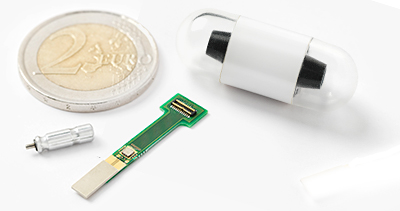
Mock-up of an ingestible pill with prototype transceiver. Image: Imec.
Speak about an electronic pill or a small ingestible machine that can be swallowed by patients to monitor their bodies – and what comes to mind is often swarms of nanobots.
The reality is a little different.
Today, breakthroughs in electronics are making it possible to imagine such ingestibles, which are small enough to be swallowed so they can stay inside a body to monitor, say, a person’s stomach condition over a period of time.
Editor’s Comments
These nifty gadgets open up a whole new frontier in medical diagnosis and research.
Think the Internet of Things (IoT) but applied to the interior of our bodies.
By emplacing sensors within our bodies, doctors and researchers don’t just get a one-off snapshot of the organ of interest.
The sensors can provide sustained monitoring of measurements over a period of time, enabling the identification of trends in the data, or triggering of alerts to flag out anomalies breaching threshold levels.
This means a doctor would be able to more accurately see the changes in a person’s digestive tract, for example, instead of having only a quick look by using a scope or collecting stool samples.
So, instead of a number of nanobots swimming inside a person, ingestibles are miniaturised versions of electronic devices that require low power and have reliable wireless communication to relay the signals that they are reading.
In February 2020, Belgium-based research outfit imec presented the world’s first fully integrated millimetre-scale wireless transceiver for ingestibles or electronic analytical devices that can be swallowed.
This breakthrough, presented at the International Solid-State Circuits Conference (ISSCC) 2020 conference at San Francisco in February, means that in the future, ingestible devices could be easier to be manufactured and be more effective in staying in a stomach to monitor important signs of diseases, such as diabetes, Crohn’s Disease or coeliac.
(more…)
Tags:diagnosis, healthcare, imec, ingestibles, IoT, MedTech, research, sensors
Posted in Brief, Gadgets, gadgets, Healthcare, Internet of Things, IoT, Medical, Opinion, Tech Focus | No Comments »
Monday, April 27th, 2020
The COVID-19 pandemic is spurring the healthcare industry to turn to robots for help. Darrell Adams shares how cobots – collaborative robots – reduce the risk of healthcare workers by minimising in-person contact with patients who are isolated.
* Darrell Adams is the Head of Southeast Asia & Oceania at Universal Robots.

A UR5 cobot collaborating with a healthcare worker.
COVID-19, the global pandemic, took the world by surprise and suddenly the healthcare system has to confront one of the toughest challenges on a global scale.
Millions of Nurses Needed
The global healthcare system is cracking under the strain of this global pandemic.
Yet, a recent report shows that globally, we are in need of 6 million more nurses to achieve global health targets, even without a global pandemic.
This is an alarming number, and it is unlikely that over a short period of time, the demand can be met.
Healthcare workers are working round the clock and the intense workload at the frontline led to exhaustion in many, virus infection in others, and some sadly passed away in their line of duty.
Human Factors and Errors
In the study of human factors and fatigue, factors which contribute to human errors within the confines of human factors include sleep deprivation, shift schedules, repetitive tasks, physically demanding tasks, and of course, stress.
In the medical sector, besides the lack of nurses, the healthcare industry faces other challenges such as a high instance of human error due to a pressurising and non-automated environment, working on shifts, with a substantial amount of time dedicated to administrative tasks, which takes away precious time from patient care.
(more…)
Tags:byline, cobots, healthcare, robots, Tech Focus
Posted in Brief, Enterprise IT, Healthcare, Robots, Tech Focus | No Comments »
Wednesday, March 25th, 2020
Close to 65% of Singaporeans are open to the idea of adopting a digital-only bank, according to the Visa Consumer Payment Attitudes Study.
* All infographics in this story courtesy of Visa.

It comes as no surprise that if consumers were to adopt a digital bank – interest is highest for an existing issuer given the trust already associated with the issuer. Click on infographic to enlarge.
The Visa Consumer Payment Attitudes Study was conducted in October 2019 by ENGINE Insights with 511 Singaporeans aged 18-65 years of age.
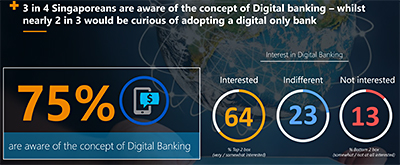
3 in 4 Singaporeans are aware of the concept of Digital Banking – whilst nearly 2 in 3 would be curious of adopting a digital only bank. Click on infographic to enlarge.
This is part of a regional research project conducted in Southeast Asia on 5,000 consumers across seven markets in Southeast Asia.
(more…)
Tags:banking, Fintech, neobanks, payments, Singapore, Tech Focus, technology, Visa
Posted in Brief, Business IT, Figures, Fintech, Infographic, infographics, Press Release, Seminars, Study, Tech Focus, Visa | No Comments »
Friday, March 20th, 2020
Here are some tips from Google on digital wellbeing and how our devices can contribute to our daily happiness.
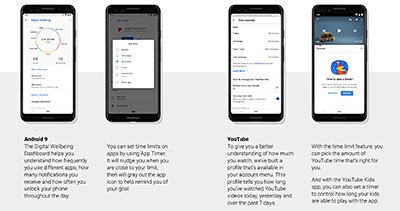
The first step toward digital wellbeing is often understanding more about how you interact with technology in the first place. Tools like the Digital Wellbeing Dashboard in Android 9 Pie and YouTube’s Time Watched offer ways to keep you more informed about your habits.
Despite being one of the wealthiest nations globally, research has shown that Singaporeans are amongst the unhappiest people in the world.
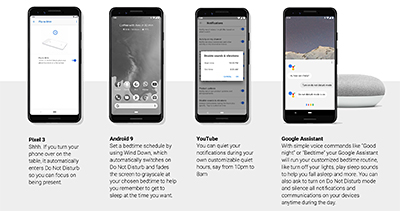
Disconnect when you need to. Take advantage of tools that help make it easier to take a break from your devices, and switch off at the end of each day.
(more…)
Tags:Android, Google, happiness, health, Pixel, tips
Posted in App, Apps, gadgets, Google, Holiday, Infographic, infographics, Internet, Opinion, smartphones, Tech Focus, Tips | No Comments »