Archive for the ‘Technology’ Category
Saturday, May 14th, 2022
Xiaomi has opened its eighth authorised store in Singapore at Waterway Point, with launch promotions of up to 50% off selected AIoT products.

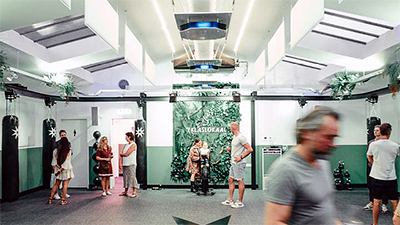
Xiaomi’s 140-square-metre store is situated in Waterway Point, a family and lifestyle shopping mall in Punggol. It is located at B1-41/42 (East Wing) and is open everyday from 11am to 9pm. Photo credit: Xiaomi Singapore.
In the store, consumers can physically try out Xiaomi’s smartphones and the array of AIoT (Artificial Intelligence of Things) products Xiaomi sells, as well as accompanying accessories.
As part of the store’s launch, a series of special promotions are available from 14 – 16 May 2022, while stocks last.
New Store Launch Promotions
To celebrate the store launch, customers can enjoy exclusive discounts and promotions today as well as over the weekend.
(more…)
Tags:AIoT, new arrivals, news, opening, promotions, Singapore, Xiaomi
Posted in Accessories, Appliances, Audio, audioVisual, Events, events, Gadgets, gadgets, Internet of Things, IoT, Launch, Lighting, Monitors, Network, newArrivals, Phones, Promotions, Redmi, Robots, Shopping, Singapore, Smart TV, smartphones, smartwatches, TV, Vacuum Mop, Xiaomi | 4 Comments »
Friday, May 6th, 2022
During Dell Technologies World 2022, Dell Technologies announced that it would expand multi-cloud experiences across cyber recovery, data analytics and its partner ecosystem.

This year’s Dell Technologies World was held in Las Vegas from 2-5 May, 2022.
Dell is strengthening its APEX portfolio with managed services for cyber recovery and is extending its multi-cloud cyber recovery capabilities in public clouds.
“We are making bold moves to deliver solutions that are connected and increasingly digital to create a superior health care experience for consumers. Our strategic collaboration with Dell is helping accelerate the value of our technology investments for our colleagues and consumers,” said Karen S. Lynch, President and CEO, CVS Health.
The company demonstrated software-defined block, file and object storage in public clouds with Project Alpine.
Dell is collaborating with Snowflake, extending its SaaS ecosystem, to help customers connect data from on-premises Dell enterprise storage with the Snowflake Data Cloud.
More details below from the press release.
(more…)
Tags:Business IT, cloud, DELL, enterprise IT
Posted in Announce, Business IT, Cloud, Dell, Enterprise IT, Events, Press Release, Seminars | No Comments »
Thursday, April 28th, 2022
Global retail cryptocurrency platform Luno has obtained in-principle approval (IPA) from the Monetary Authority of Singapore (MAS) to provide Digital Payment Token Services (DPT) in Singapore.

Luno’s global customer base grew by 35% year-on-year and aims to bring cryptocurrency to over 1 billion customers by 2030.
Luno Singapore has been granted in-principle approval from the MAS, under the Payment Services Act (PSA), to provide DPT services in Singapore.
This milestone marks Luno as the first global retail-focused cryptocurrency platform in Singapore to obtain IPA from the MAS, which will enable the accessibility of cryptocurrency in a well-regulated environment that safeguards the interest of consumers.
More details below from the press release.
(more…)
Tags:crypto, DCG, Fintech, Luno, MAS, news, payments, Singapore
Posted in Announce, Fintech, News, Press Release, Singapore | No Comments »
Wednesday, March 30th, 2022
The world is coming to terms with having to live with COVID-19 for a while to come. Apart from population-level vaccination to enhance our resistance against the disease, how can we make our living and working environment safer from the SARS-COV-2 virus that causes the disease?
Jitender Khurana shares how UVC disinfection technology provides an effective means of sanitising the air and surfaces around us in an efficient and sustainable way. Most importantly, it can be implemented at scale without breaking the bank! Jitender Khurana is the Country Head & Managing Director for Singapore and Emerging Markets, Southeast Asia at Signify.
When will life go back to what it was like in pre-pandemic days? Will it ever? Image: Signify.
After more than two years and six million deaths globally, the world is still reeling from the humanitarian and economic fallout of the COVID-19 pandemic. The SARS-COV-2 virus has infected almost half a billion people around the world to date, and continues to cause more than a million new cases of COVID-19 every day.
However, the pandemic shows no sign of slowing down, following the scourge of the Delta variant which swept across the earth, as well as the current Omicron variant.
“For true endemic living, I want to be able to attend concerts, work out at a gym, watch an indoor sports event and visit a public bathroom knowing that the air I’m breathing is safe from the SARS-COV-2 virus. All these aspirations can be fulfilled through air disinfection solutions harnessing UV-C technology – in conjunction with wearing masks, social distancing and vaccination.”
Even though no end is in sight for the pandemic, life and business must go on. Governments and companies need a solution that will provide employees and citizens with a safe working and public environment that is protected from COVID-19.
Like it or not, COVID-19 is not going away and all of us will have to learn how to live, work and play while the SARS-COV-2 virus hangs around us and the disease becomes endemic.
Welcome to the new normal of “Endemic Living”.
The silver lining in the cloud is that we have learnt much since the beginning of the pandemic – about the disease itself, the virus that causes it, the way it spreads, the safety measures and practices that would protect us from infection.
I believe we are ready to embark on this new phase of the pandemic, because we are equipped with the know-how and wherewithal to live safely and normally despite COVID-19. We now know that the reason COVID-19 is so contagious is that it can be transmitted over the air.
(more…)
Tags:commentary, COVID, endemic, opinion, Signify, Tech Focus, technology, UV, UVC
Posted in Appliances, Healthcare, Interview, Opinion, Philips, Signify, Tech Focus, Technology | 6 Comments »
Wednesday, March 16th, 2022
Luno, a wholly-owned subsidiary of Digital Currency Group (“DCG”), has announced the launch of Luno Expeditions, a global, early-stage investment arm to support the best fintech and crypto/web3 founders on their journeys to build the next generation of financial services.

The Luno Expeditions Team (from L to R): Margaux Duterte, Mira Christanto, Jocelyn Cheng, Katharine Suy, and Aditi Khimasis.
Building on DCG’s 7-year track record in early stage crypto investing, Luno Expeditions will now spearhead all of DCG’s early sage investing (seed and pre-seed).
“I am thrilled to join Luno Expeditions as Chief Executive. These are incredibly exciting times in cryptocurrency and the broader fintech ecosystem. We’ve got ambitious plans to build a leading fund designed around the needs of early stage founders. It will be a privilege to work with ambitious entrepreneurs from all over the world, all intent on solving problems and building the next generation of financial service companies,” said Jocelyn Cheng, CEO, Luno Expeditions.
The dedicated team will scale up investments (targeting 200-300 per year) and expand the focus beyond crypto into the broader fintech space, globally.
Luno Expeditions will be led by Jocelyn Cheng, who takes on the role of CEO.
Whilst in stealth mode over the past few months, Luno Expeditions has already invested in over 20 leading crypto and fintech companies globally, including a crypto compliance solution in Israel, an NFT marketplace in the United States, a bank dedicated to women in Pakistan and a ground-breaking remittance solution in Tanzania.
Barry Silbert, founder and CEO of DCG, and Marcus Swanepoel, co-founder and CEO of Luno, are both closely involved in the initiative and will be part of the Investment Committee.
The Luno Expeditions Team
Jocelyn Cheng, CEO
Jocelyn has invested in global startup founders over the last 6 years as Managing Director at the impact investment VC, Global Innovation Fund. She previously held investing roles at CPP Investments, Bain Capital and Goldman Sachs. She holds an MBA from Harvard Business school.
Mira Christanto, Director of Investments
“We know how hard it is to build a company, especially in the fintech space, and with our deep experience building, scaling and operating fintech businesses in some of the hardest markets in the world, we’re looking to support a new generation of entrepreneurs from all over the world to do the same,” commented Marcus Swanepoel, Luno co-founder and CEO.
Before joining Luno Expeditions, Mira was a senior research analyst at the leading crypto firm Messari. She moved full-time to crypto after working for 15 years at institutional investments funds between Wall Street and Hong Kong.
Aditi Khimasis, Head of Legal
Aditi is an experienced legal professional with extensive VC experience both in house and at leading legal firms across a number of emerging and developed jurisdictions. She was previously Legal Counsel at Anthemis Group.
Katharine Suy, Chief Marketing Officer
Katharine is a seasoned crypto marketer who has worked in the industry over the last 5 years. She joins Luno Expeditions with over 15 years experience in digital marketing, content creation and entrepreneurship across UK, Vietnam & Australia.
Margaux Duterte, Investment Analyst
Before joining Luno Expeditions, Margaux worked with fintechs and payment partners across Africa for 3 years at Luno. She previously held finance roles at BNP Paribas and worked in France, Portugal and South Africa. She holds a Masters in Corporate Finance from Paris Dauphine.
Tags:Fintech, investments, Luno
Posted in Announce, Fintech, News, Press Release | No Comments »
Thursday, February 10th, 2022
The fully autonomous vehicles of the not-so-distant future promise tremendous gains in automotive safety and transportation efficiency.
In this guest commentary, Thomas Goetzl from Keysight Technologies shares his insights on how automotive OEMs must move beyond contemporary levels of vehicle autonomy to fulfill this promise.
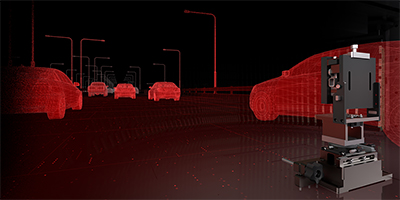
Keysight’s Radar Scene Emulator (RSE) closes the gap between software simulation and roadway testing, and training ADAS and autonomous driving algorithms to real-world conditions.
SAE International (formerly the Society of Automotive Engineers) defines six levels of vehicle autonomy, with Level 0 representing fully manual and Level 5 representing fully autonomous.
Today’s most advanced autonomous vehicle systems rate only Level 3, which means they are capable of making some decisions such as acceleration or braking without human intervention.
“In order to make the leap to the tremendous gains in automotive safety and transportation efficiency that fully autonomous vehicles promise, OEMs will need to overcome a unique set of challenges for testing automotive radar sensors in advanced driver assistance systems (ADAS) and autonomous driving systems, as well as developing new methodologies for training algorithms that conventional solutions are ill-equipped to address,” says Thomas Goetzl, vice president of automotive and energy solutions at Keysight Technologies.
Getting from Level 3 to Level 5 will require many breakthroughs, including closing the gap between software simulation and roadway testing, and training ADAS and autonomous driving algorithms to real-world conditions.
Keysight’s latest innovation, the Radar Scene Emulator (RSE), goes a long way toward bridging these gaps.
Software simulation plays an important role in autonomous vehicle development.
Simulating environments through software can help validate the capabilities of ADAS and autonomous driving systems.
But simulation cannot fully replicate real-world driving conditions or the potential for imperfect sensor response — something that fully autonomous vehicles will inevitably have to contend with.
OEMs rely on road testing to validate ADAS and autonomous driving systems prior to bringing them to market.
While road testing is and will continue to be a vital and necessary component of the development process, it is time-consuming, costly, and difficult to repeat specifically in the area of controlling environmental conditions.
Relying on road testing alone to develop vehicles reliable enough to navigate urban and rural roadways safely 100% of the time would take decades.
(more…)
Tags:insights, Keysight, opinions, safety, Tech Focus, technology, vehTech
Posted in Interview, Keysight, Opinion, Tech Focus, Technology | 2 Comments »
Wednesday, January 19th, 2022
In today’s electronics applications, batteries power nearly all of our portable electronic devices. Batteries also serve as emergency power backup systems on large premises. And all-electric vehicles use large cascading battery packs to meet the expected power for the required performance.
In this guest commentary, Bernard Ang from Keysight Technologies shares his insights on specialised battery testing.

Batteries are the key to our portable/mobile electronic gadgets in this digital era.
Battery packs need the required specific power (W/kg) to be able to dispense enough current to achieve the electric vehicle speed performance.
They also need the required specific energy (Wh/kg) to achieve longer runtime or travel range.
Why is it important to monitor battery temperature?
Most rechargeable batteries today are lithium ion and have an operating range between 15 °C and 35 °C at which their full performance and capacity kicks in.
- If the battery and its ambient temperature is below 15 °C, you may experience sluggish electrochemical reactions within the battery and as a result, lower battery performance and reduced charge capacity.
- If the battery or battery pack operates above 35 °C in ambient temperature, battery degradation can accelerate over time. As a result, you may notice shorter battery life, non-uniform aging due to thermal gradients, greater exposure to safety issues, and higher life cycle costs. At extremely hot temperatures, batteries can break down and cause leakage, smoke, fire, and even explosions.
The power map chart below shows the power limits of your lithium-ion battery or battery packs across the temperature range.
(more…)
Tags:insights, Keysight, opinions, Tech Focus, technology, vehTech
Posted in Accessories, battery, Business IT, Enterprise IT, Keysight, Opinion, Tech Focus, Technology | No Comments »
Friday, December 17th, 2021
In this two-part guest commentary, Carrie Browen and Kevin Kershner from Keysight Technologies share their insights into the future of high speed in-vehicle display and sensor connections. You may find Part 1 here.
For this second half of our commentary, we begin with an introduction of SerDes.
In today’s infotainment systems, it is common for in-vehicle cameras and displays to be connected to the image-processing electronic control unit (ECU) via a SerDes (serializer/deserializer) connection.
Future Prediction
More cameras, more connections, and more sensors with greater accuracy, less weight, and increased safety.
Undoubtedly, there will be a need for an in-vehicle network to seamlessly handle these challenges.
Those in-vehicle networks will need to be tested, they will need to be interoperable, and they will need to be secure.
Today, they are delivered by individual vendors using closed, proprietary standards.
Extending the reach of feature-rich SerDes links can require operating at lower Baud rates and higher order modulations (e.g. PAM-4).
In addition, it will require higher bandwidth Ethernet links as primary interconnects between zones, perhaps with 802.3ch support up to 10 Gbps throughput.
Emerging SerDes standards like mobile industry processor interface (MIPI) A-PHY (MIPI A-PHY is a physical layer specification targeted for ADAS/ADS surround sensor applications and Infotainment display applications in automotive) and Automotive SerDes Alliance (ASA) will be implemented by multiple silicon vendors.
This will create a competitive market that acts to drive down the cost while delivering application specific features.
(more…)
Tags:insights, Keysight, opinions, SerDes, Tech Focus, technology, testing, vehTech
Posted in Automobile, Brief, Internet of Things, Interview, IoT, Keysight, Motoring, Opinion, Tech Focus | No Comments »
Thursday, December 16th, 2021
In this two-part guest commentary, Carrie Browen and Kevin Kershner from Keysight Technologies share their insights into the future of high speed in-vehicle display and sensor connections.
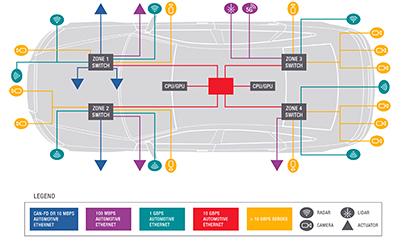
A conceptual diagram of a zone-based in vehicle network architecture. Image: Keysight Technologies.
It is no secret the pace of innovation in the automotive industry is exploding.
If the last 20 years have been linear in the development of electrification, the last two to three years have been exponential.
Bandwidth Requirements
To get a better understanding of the bandwidth requirements, remember that the approximate bit rate of a video stream can be calculated as follows.
- Frame Size = Resolution x Color Depth
- Bit Rate = Frame Size x Frame rate
So, for an ADAS camera capturing a 1080p image, with a color depth of 24-bits and transmitting at 30fps, the bit rate to be supported equals:
- Frame Size = 1920 x 1080 x 24 = 49,766,400
- Bit Rate = 49,766,400 x 30 = 1,493 Mbps
It used to be that a car was a means of getting from A to B.
Now, we can safely say that is not true for the vehicles of today and certainly not for the new vehicles of tomorrow.
Just about every new car on the market has a backup camera, park assist, and blind spot monitoring.
Some offer a 360-degree view.
Other features offer real-time traffic updates, cellular connection to potential hazards, other road users, vehicles, or pedestrians.
There are features that can detect if a driver is distracted or tired.
Meanwhile, the people in the car are often unaware of driving conditions, while they enjoy infotainment systems.
These features are delivered through a mixture of sensors, cameras, and networks.
As demands go up, next-generation advanced driver-assistance systems (ADAS) require camera and radar systems with increasingly high resolution.
(more…)
Tags:insights, Keysight, opinions, SerDes, Tech Focus, technology, vehTech
Posted in audioVisual, Brief, Cameras, Internet of Things, IoT, Keysight, Motoring, Opinion, Tech Focus | No Comments »
Monday, November 22nd, 2021
Fewer accidents and greater road safety are central to the vision for automated vehicles (AVs). Enabling that vision requires greater situational awareness and the ability to inform the car and its drivers what is happening a mile in front of them, foreseeing what’s likely to happen next, and automatically taking preemptive actions.
In this guest commentary, Cheryl Ajluni from Keysight Technologies shares her insights into C-V2X certification.
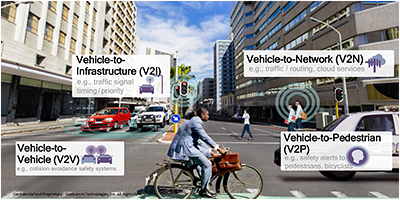
C-V2X Applications (Image courtesy of Qualcomm).
Cellular vehicle-to-everything (C-V2X) technology provides see-through, 360-degree, non-line-of-sight (NLOS) sensing in good, as well as adverse weather conditions to enhance the functionality and safety of autonomous driving (see the cover illustration).
Editor’s Comments
The future of motoring is in the connected/networked smart vehicle.
As demand rises around the world, the connected vehicle market is one of the fastest growing segments of the Internet of Things, potentially generating application revenue of US$273 billion by 2026, according to Machina Research’s forecasts.
C-V2X complements line-of-sight (LOS) sensors such as radar, lidar, camera, with information beyond their reach, and allows the vehicle to make more informed and coordinated decisions.
Whereas LOS sensors cannot indicate vehicle or driver intent, C-V2X conveys intent by sharing sensor data – resulting in a higher level of predictability in traffic situations such as lane changes, variable speeds, or road hazards.
Day one use cases include safety features such as emergency electronic brake light and forward collision warning, ‘do not pass’ warning, blind spot and lane change warning, vulnerable road user, road works warning, and intersection movement assistance.
(more…)
Tags:C-V2X, insights, Keysight, opinions, Tech Focus, technology, V2X, vehTech
Posted in Automobile, Internet of Things, IoT, Keysight, Opinion, Tech Focus, Technology | 4 Comments »






Tech Focus: Making it Safe to Live and Work in Endemic COVID
Wednesday, March 30th, 2022The world is coming to terms with having to live with COVID-19 for a while to come. Apart from population-level vaccination to enhance our resistance against the disease, how can we make our living and working environment safer from the SARS-COV-2 virus that causes the disease?
Jitender Khurana shares how UVC disinfection technology provides an effective means of sanitising the air and surfaces around us in an efficient and sustainable way. Most importantly, it can be implemented at scale without breaking the bank! Jitender Khurana is the Country Head & Managing Director for Singapore and Emerging Markets, Southeast Asia at Signify.
When will life go back to what it was like in pre-pandemic days? Will it ever? Image: Signify.
After more than two years and six million deaths globally, the world is still reeling from the humanitarian and economic fallout of the COVID-19 pandemic. The SARS-COV-2 virus has infected almost half a billion people around the world to date, and continues to cause more than a million new cases of COVID-19 every day.
However, the pandemic shows no sign of slowing down, following the scourge of the Delta variant which swept across the earth, as well as the current Omicron variant.
“For true endemic living, I want to be able to attend concerts, work out at a gym, watch an indoor sports event and visit a public bathroom knowing that the air I’m breathing is safe from the SARS-COV-2 virus. All these aspirations can be fulfilled through air disinfection solutions harnessing UV-C technology – in conjunction with wearing masks, social distancing and vaccination.”
Even though no end is in sight for the pandemic, life and business must go on. Governments and companies need a solution that will provide employees and citizens with a safe working and public environment that is protected from COVID-19.
Like it or not, COVID-19 is not going away and all of us will have to learn how to live, work and play while the SARS-COV-2 virus hangs around us and the disease becomes endemic.
Welcome to the new normal of “Endemic Living”.
The silver lining in the cloud is that we have learnt much since the beginning of the pandemic – about the disease itself, the virus that causes it, the way it spreads, the safety measures and practices that would protect us from infection.
I believe we are ready to embark on this new phase of the pandemic, because we are equipped with the know-how and wherewithal to live safely and normally despite COVID-19. We now know that the reason COVID-19 is so contagious is that it can be transmitted over the air.
(more…)
Tags:commentary, COVID, endemic, opinion, Signify, Tech Focus, technology, UV, UVC
Posted in Appliances, Healthcare, Interview, Opinion, Philips, Signify, Tech Focus, Technology | 6 Comments »