Archive for the ‘Enterprise IT’ Category

Microsoft and Tata Communications join OVCC

Tuesday, May 1st, 2012

Microsoft Corp, Tata Communications, ACT Conferencing, and Kathea have joined the Open Visual Communications Consortium (OVCC).

Official website of the Open Visual Communications Consortium (OVCC).
The OVCC is a group of leading service and solution providers creating the blueprint to deliver high-quality video collaboration that connects any vendor, any network and any device, anywhere.

Six months after the launch of the OVCC in October 2011, there are now 23 members in the independent group.

OVCC members contribute to and implement the OVCC technical and commercial blueprint, using established standards and best practices to accelerate and commercialize business-to-business video communications.

OVCC members are committed to providing video around the world to enable enterprise users to place and receive video calls beyond corporate firewalls and across standards-based and proprietary video platforms.

The first OVCC services are scheduled to launch later this year.

Service providers will develop and implement OVCC technical and commercial specifications based on industry standards, best practices and business approaches to answer the need for interconnection, addressing, signaling, interoperability and service coordination.

Interoperable, high-quality connectivity across networks and devices should allow network providers to profitably and predictably monetize their inter-enterprise video exchanges.

By making interoperability requirements invisible to the enterprise, the OVCC specification enables enterprise users to leverage video conferencing investments and enable more efficient value chains – spanning customers, distributors and suppliers – to improve the speed and efficiency of doing business.

Video collaboration stakeholders interested in closing video connectivity gaps can meet OVCC members in person at TIA in Dallas, Texas, June 5-7, or at CommunicAsia in Singapore, June 19-22.

The State of the Internet 4Q 2011 report from Akamai

Monday, April 30th, 2012

China is now the top source of observed attack traffic. South Korea boasts both highest average connection speed and highest average peak connection speed.

Fourth Quarter, 2011 State of the Internet report released by Akamai Technologies.

Fourth Quarter, 2011 State of the Internet report released by Akamai Technologies.

China, at 13 percent, generated the most attack traffic observed by Akamai. The United States (10%) and Indonesia (7.6%) rounded out the top three.

The findings were in the Fourth Quarter, 2011 State of the Internet report released by Akamai Technologies.

Going into its fifth year, the report incorporates four-year’s worth of trending data, illustrating how Internet connectivity has improved over time.

Based on data gathered from the Akamai Intelligent Platform, the report provides insight into key global statistics such as Internet penetration, mobile traffic and data consumption, origins of attack traffic, IPv6 adoption and global and regional connection speeds.

In the fourth quarter of 2011, more than 628 million unique IP addresses from 236 countries and regions connected to the Akamai Intelligent Platform. This represents 2.1 percent more IP addresses than connected in the third quarter of 2011, and an increase of 13 percent compared to the same quarter a year ago.

The Fourth Quarter, 2011 State of the Internet report includes a new section that will appear annually going forward and that tracks trends since the report’s inception in 2008.

Speed

Cities in the Asia Pacific region enjoy the fastest connection speeds in the world. Out of the 100 fastest cities worldwide, 69 cities were from the region, with 61 in Japan, six in South Korea, as well as Australia and Hong Kong.

24 cities in North America ranked among the top 100, including two in Canada and 22 in the United States.

Seven cities in Europe – including three in Sweden, two in Switzerland and one each in Romania and Latvia – made up the balance.

Globally, high broadband (>5 Mbps) adoption maintained at 27%.

South Korea took the top spot in high broadband adoption, with 83% of the country’s connections to Akamai > 5 Mbps.

Netherlands was second with 67%. US was twelfth (44%) while Singapore languished at 21st (32%).

Brands should leverage on mobile to engage consumers

Wednesday, April 25th, 2012

Mobile creates engagement at every point in the purchasing funnel for the tech-equipped digitally-savvy consumer of the future. Day 2 of the MMAF beckoned brands to create the “aha!” moment for consumers.

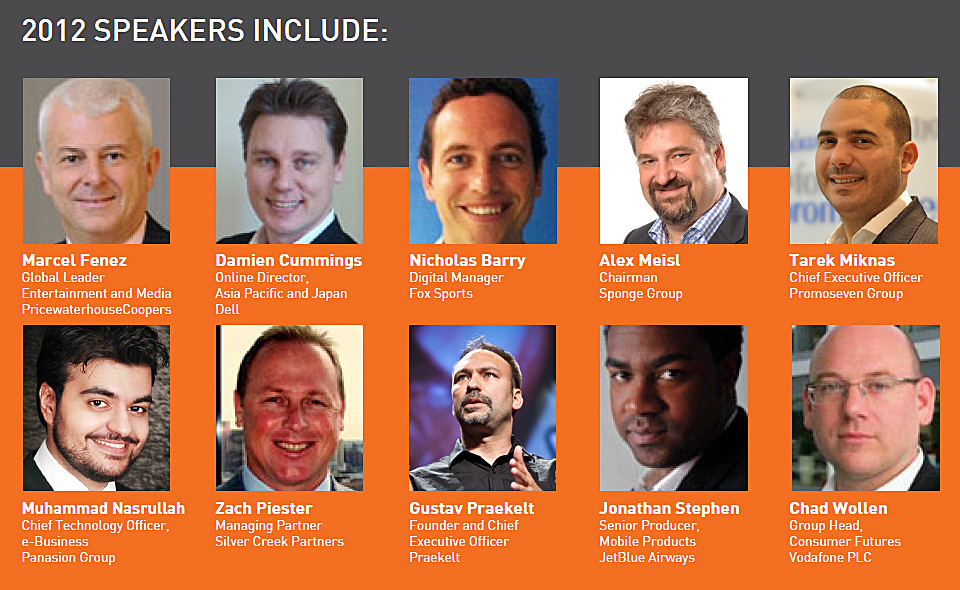
Speakers at the Mobile Marketing Association Forum Singapore 2012

Speakers at the Mobile Marketing Association Forum Singapore 2012

Day two of the annual Mobile Marketing Association Forum Singapore 2012 (MMAF) called for creativity on the part of marketers as mobile takes on a new role in the larger media landscape.

This year’s forum is the fourth time it is being held at the Grand Hyatt in Singapore.

“There is a need to reimagine mobile, creatively and otherwise,” highlighted Barney Loehnis, Head, Digital, Asia Pacific for Ogilvy & Mather.Ashutosh Srivastav, CEO, Mindshare Asia reminded the audience to look at mobile as a central touchpoint, not as a separate platform.

This central position occupied by mobile was reinforced by Michael Bayle, Senior Vice President and General Manager, Mobile, ESPN, who called mobile the bridge that connected fans to all media.

“Integration of other media around mobile helps to create a level of engagement that has always been lacking, letting consumers move effortlessly from online to offline to online,” Loehnis added.The MMAF was sponsored by Amobee, BuzzCity, The Coca-Cola Company, Gemalto, Google Inc., mediba Inc., Microsoft Advertising, Millennial Media, m-Stars, Nokia, Poynt Corp.

It was supported by Infocomm Development Authority of Singapore (IDA), Media Development Authority of Singapore (MDA) and Singapore infocomm Technology Federation (SiTF).

Mobile Marketing Association Forum Singapore 2012

Tuesday, April 24th, 2012

The tech-equipped digitally-savvy consumer of the future is the key to a smarter tomorrow, found delegates to the MMAF on the first day of the two-day seminar from 24-25 April 2012.

Mobile Marketing Association Forum Singapore 2012

Mobile Marketing Association Forum Singapore 2012

Some 300 delegates and speakers gained new understanding of the importance of mobile, the central position of the consumer, and the use of mobile for brand-building.

“Consumers will be less concerned about the distinctions between mobile and digital and Internet, but will simply operate within a converged space,” said Guest-of-Honour, Mr Michael Yap when he delivered his Keynote Address. Mr Michael Yap is Deputy CEO, Media Development Authority of Singapore (MDA).The future of mobile marketing were discussed against the changing digital media landscape of today.

Closely focused on evolving consumer behaviour in the current technological environment and how brands and marketers can engage, inform and influence them, the first day of MMAF offered industry the chance to identify market trends that will shape a smarter future.

Industry and media leaders such as PricewaterhouseCoopers, Google and Nokia presented topics themed around “A Smarter Tomorrow” at the Grand Hyatt in Singapore.

The presentations highlighted how the development of the mobile marketing and advertising industry is contingent on a deeper understanding of tech-equipped digitally-aware consumers, who have come to understand and shape the new emerging media.

“There may be low-end devices, but there are no low-end consumers,” said Srikanth Raju, Head, Ecosystem, APAC, Nokia, referring to how all consumers want compelling experiences, regardless of the device. The next talk was by Marcel Fenez, Global Leader Entertainment & Media, PricewaterhouseCoopers, who eschewed a discussion of technology in favour of talking about what consumers want in terms of content and how they behave.

Against the backdrop of an informative video that included candid comments from consumers from all over the world, Fenez explained that consumers take technology as a given, and that they are more interested in content than in channels.

Nimsoft Monitor Certified on VCE Vblock Infrastructure Platforms

Friday, April 20th, 2012

Nimsoft has announced that Nimsoft Monitor has attained the VCE Vblock Ready certification.

Nimsoft Monitor is a component of Nimsoft Unified Manager, a multi-tenant IT Management as-a-Service solution.

Nimsoft Monitor is a component of Nimsoft Unified Manager, a multi-tenant IT Management as-a-Service solution.

This enables users to confidently leverage Nimsoft IT Management-as-a-Service capabilities to rapidly and cost-efficiently gain full visibility into their Vblock infrastructure—along with the rest of their cloud and non-cloud environments.

“Vblock Infrastructure Platforms offer the ability to substantially drive down technology ownership costs while dramatically improving technology value,” said Sumal Karunanayake, Vice President, Nimsoft, Asia Pacific & Japan.Nimsoft Monitor delivers end-to-end performance and availability monitoring of Vblock Infrastructure Platforms at the hardware, network, storage, computing and application layers.

By addressing the Vblock Infrastructure Platform as a whole—rather than as individual components—Nimsoft Monitor enables enterprises and service providers to quickly discover and address the root causes of issues that can adversely affect critical IT services.

SolarWinds Mobile Admin lets IT staff BYOD

Monday, April 16th, 2012

If you can’t beat them, join them! After years of fighting the tide of consumerisation of corporate IT, IT staff can now cross over to the “Dark Side” and  – bring THEIR own device to work.

Pricing for SolarWinds Mobile Admin software starts at US$695 per license and includes the first year of maintenance. Download the free 30-day evaluation trial online to try it out.

SolarWinds Mobile Admin Version 7

SolarWinds Mobile Admin Version 7

With the consumerisation of IT, employees and (more significantly) CXOs are banging down the doors of the IT departments to be allowed to bring their choice of personal devices to work and to access the Enterprise IT systems with these gadgets.

IT staff can now "Bring Your Own Device" too!

IT staff can now "Bring Your Own Device" too!

A strict No-No in the past, mane enterprises and organisations have given in to the pressure and allowed BYOD (Bring Your Own Devices) into their IT policies.

Now, the IT personnel too can jump on the bandwagon too.

SolarWinds, a provider of IT management software, has acquired Rove and released version 7 of the latter’s Mobile Admin software.

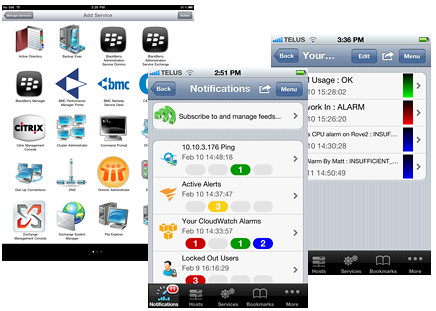
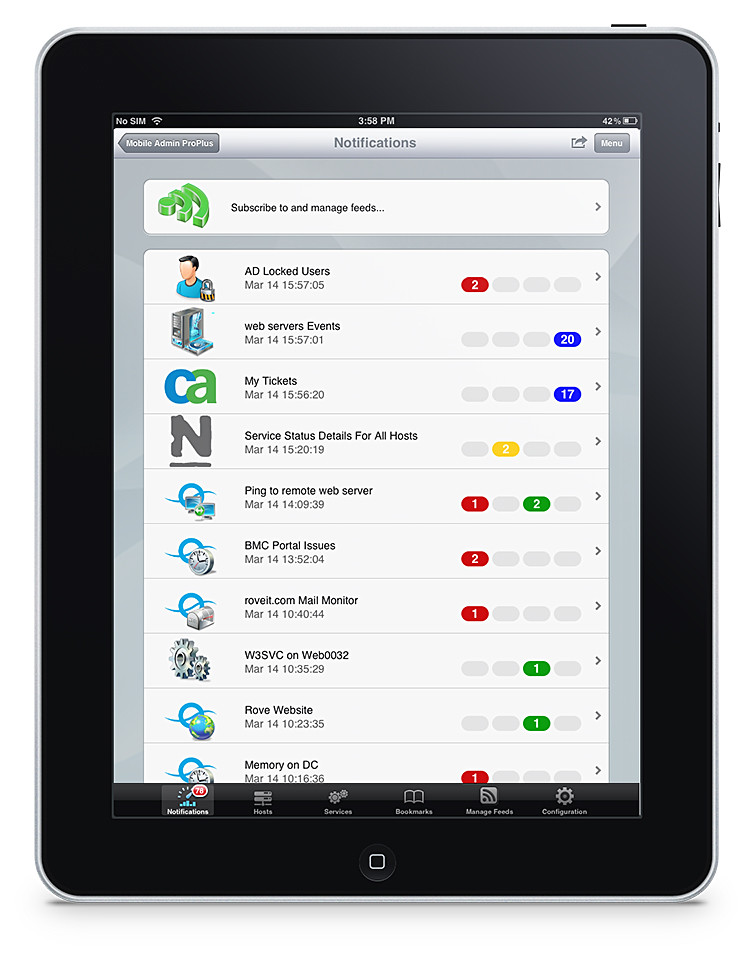
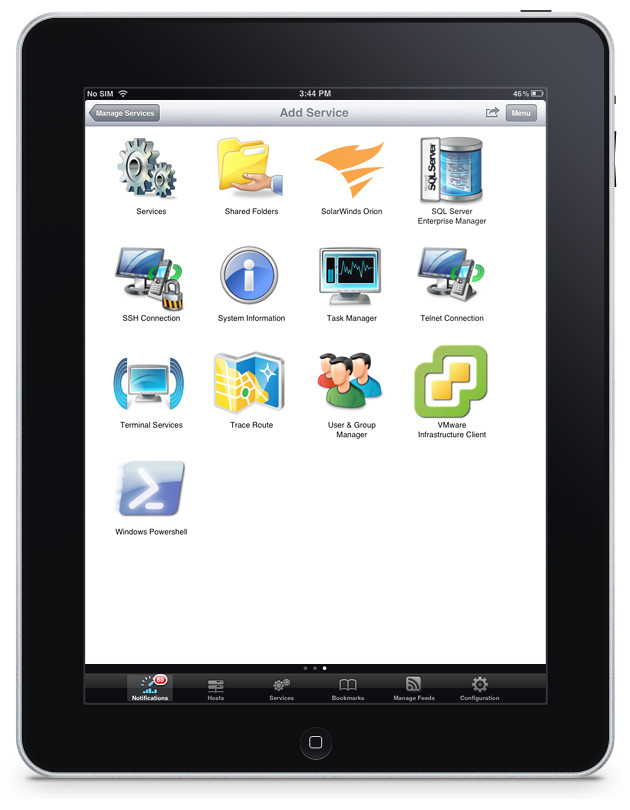
SolarWinds Mobile Admin software is designed specifically for mobile devices, with native applications for the most common mobile operating systems, and an extensive list of remote fix capabilities.

Now IT staff can also work with any device, from anywhere, anytime of the day (or night).

Mobile Admin works on iOS, Android and BlackBerry mobile devices.

Mobile Admin works on iOS, Android and BlackBerry mobile devices.

From the queues of a grocery store, or at the cafe with friends, an IT staff can manage a server on the other side of the world – resetting passwords and rebooting servers.

Mobile Admin is used by thousands of customers to monitor and manage their corporate IT infrastructure from their iPhone, iPad, Android smartphones and tablets, BlackBerry smartphones and PlayBook (OS2), and Kindle Fire.

In addition to dozens of third party systems and services, the latest version of Mobile Admin now adds support for Amazon EC2, Microsoft Active Sync, and SolarWinds network and server management products.

Some of the main features of SolarWinds Mobile Admin 7.0 are listed below.

(more…)

BlackBerry OS vs iOS vs Windows Phone vs Android

Monday, April 16th, 2012

Trend Micro has released the results of its study on the four main mobile operating systems in a report titled “Enterprise Readiness of Consumer Mobile Platforms”.

The security firm found the BlackBerry 7 OS the most secure mobile operating system, followed by iOS 5, Windows Phone 7.5, and Android 2.3.

Summary chart from “Enterprise Readiness of Consumer Mobile Platforms” White Paper by Trend Micro.

Summary chart from “Enterprise Readiness of Consumer Mobile Platforms” White Paper by Trend Micro.

Android 2.3 was used in the study because it was the dominant installed/supplied version of Google’s mobile OS at the time of the research.

Below is an excerpt from the White Paper summarising the findings about the four mobile platforms.

(more…)

Tata Communications first to circumnavigate the globe

Friday, March 23rd, 2012

Tata Communications has completed the world’s first wholly owned cable network ring around the world. The global fibre optic network seamlessly links markets across Asia, Middle East, the U.S. and Europe to meet rising demand for 24/7 commerce. (Update: Click here to view Infographic)

Launch of the TGN-Gulf Landing constitutes part of Tata Communications's global fibre optic network.

Launch of the TGN-Gulf Landing constitutes part of Tata Communications's global fibre optic network.

This is following the official launch of its Tata Global Network – Gulf (TGN-Gulf) and Eurasia (TGN-EA) cables.

The TGN-Gulf cable sub-sea cable system connects the Gulf to Mumbai, India and onward to the rest of the Tata Global Network (TNG).

“Our customers, whether a European auto-manufacturer, an Asian hotel group or a large U.S. financial services firm, need to compete in global markets and are demanding faster and more reliable worldwide connectivity,” says Vinod Kumar, Managing Director and CEO, Tata Communications. The TGN-EA cable connects Europe to India, through Egypt, bringing increased capacity, resilience and enhanced communications links to not only the Middle East, but to the rest of the world. It will initially offer speeds of up to 10Gbps.

Tata Communications is a global communications service provider that owns and operates the world’s largest subsea cable network.

TNG covers nearly 20% of the world’s Internet routes reaching over 240 countries and territories. These countries constitute 99.7 per cent of the world’s GDP.

The completion of the final link across Egypt enables Tata Communications to offer its customers unique access to a wholly-owned express route cable from Europe to India with improved latency, redundancy and scalability.

In conjunction with the company’s recently launched TGN-Gulf these routes will cater to the increasing demand for voice, video and data services in and out of the Gulf region.

“Companies and carriers in developed and emerging economies require the confidence and security delivered by a wholly-owned network such as Tata Communications’ TGN,” added Kumar.The round-the-world ring also offers city-to-city connections in contrast to more traditional networks which only link cable landing stations.

This approach is more cost-effective, flexible and provides a faster time to market delivery, as well as being easier to maintain and manage.

The 9,280 km TGN-EA system which links Europe and India, running across the Mediterranean and the Middle East, uses fibre-optic technology based on microscopic glass fibres as thin as a strand of human hair, and offers customers the lowest levels of latency with RTD around 92 msec with speeds from 2Mbit/s to 10Gbit/s available.

How much data has been created, lost and recovered since the advent of the PC?

Tuesday, March 13th, 2012

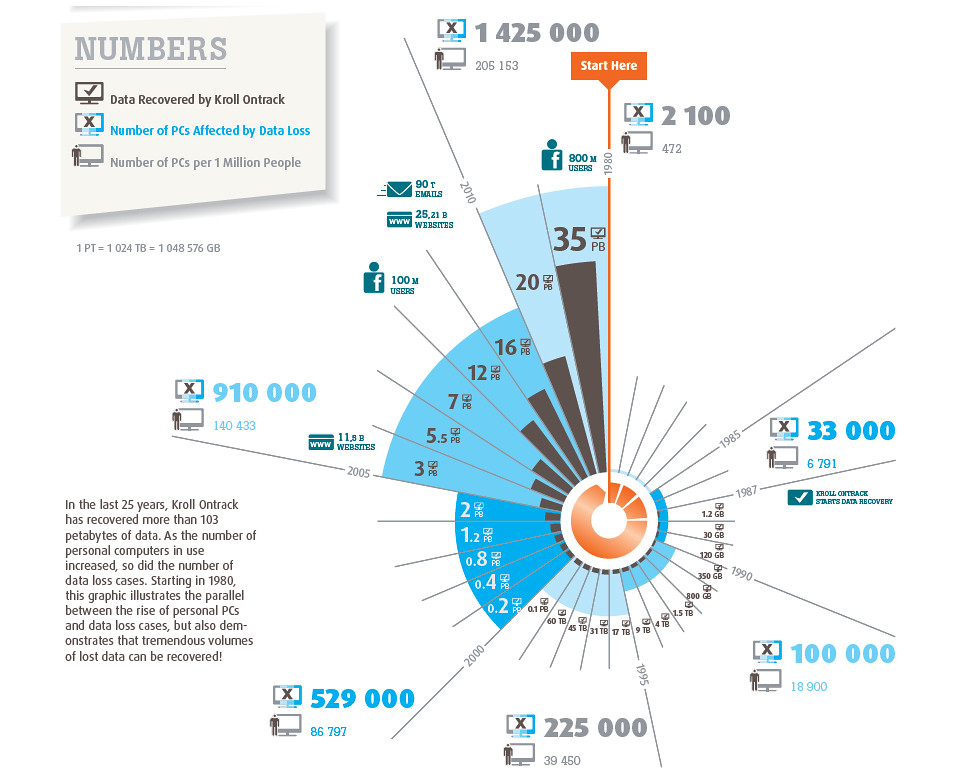
Kroll Ontrack has recovered more than 103 petabytes of data over the past 25 years.

THE DIGITAL ERA: How our life has changed into a digital one; and the creation, loss and recovery of data over time (Source: Kroll Ontrack).

THE DIGITAL ERA: How our life has changed into a digital one; and the creation, loss and recovery of data over time (Source: Kroll Ontrack).


Kroll Ontrack
has released new statistics regarding how the creation of storage technologies and digital information has impacted data loss and data recovery technology since the advent of the personal computer in the 1980’s.

“In the past 25 years, the worst cases Kroll Ontrack has seen have coincided with natural disasters, which included burned, water logged and physically damaged drives,” said Todd Johnson, vice president of operations, Kroll Ontrack.Since the first Kroll Ontrack data recovery lab opened in 1987, more than 103 petabytes (PB) of data has been recovered.

How much is 103 PB of data? That’s equivalent to 25 million USB flash drives, each with 4 GB capacity.

Only 1.2 GB of data was recovered in 1987, whereas the amount of data recovered by Kroll Ontrack in 2011 has skyrocketed to nearly 35 million GB (35 PB).

The number of computers impacted by data loss was estimated to have reached nearly 1.4 million – compared to only 33,000 in 1987.

According to an analysis by Kroll Ontrack, the number of data loss cases over the past 25 years grew in parallel with the total number of personal computers in the world.

“One of the company’s most successful endeavors was the recovery of more than 99 percent of mission-critical data from a melted, crashed and burned drive from the 2003 Space Shuttle Columbia,” revealed Johnson.The analysis also revealed that on average, one in one thousand computers lost data stored on it.

In the 1980’s, at the onset of the so-called PC era, the estimated number of personal computers in use was nearly 7,000 devices per one million people and approximately 33,000 of them suffered data loss.

By the mid 1990’s, the number of computers in use was nearly 40,000 per one million people and data was lost from approximately 225,000 computers.

In 2011, these figures reached more than 200,000 computers and 1.4 million cases of data loss, respectively.

“You cannot go through day-to-day life without interfacing with some form of digital data,” said CK Lee, country manager, Kroll Ontrack Singapore. “As technology advances to include virtualization, cloud, and social media, individuals, businesses and of course data recovery specialists have to evolve to address these storage mediums and the new challenges they present.”According to the latest IDC Digital Universe study, the amount of data more than doubles each year, and in 2012, it will exceed 1.8 zettabytes.

This is the equivalent of 200 billion two-hour long HD movies that one person would have to watch continuously for 47 million years.

As data creation increases, so does data loss.

According to a report by market research firm Gartner, every year at least 25 percent of computer users worldwide experience data loss.

Kroll Ontrack statistics indicate that 29 percent of data is lost as a result of hardware failure and 27 percent is due to human error.

Other causes include software errors (7 percent), computer viruses (7 percent) and natural disasters such as floods or fires (3 percent).

Below is a timeline infographic by Kroll Ontrack charting a brief history of the digital era.

(more…)

WD S25 SAS hard drives for enterprises

Tuesday, March 13th, 2012

Western Digital is now shipping its third-generation enterprise 2.5-inch SAS hard drive family to OEMs. They will be available from select resellers and distributors worldwide next quarter.

The WD S25 SAS hard drives are available in capacities of 300 GB, 450 GB, 600 GB, and 900 GB.

The WD S25 SAS hard drives are available in capacities of 300 GB, 450 GB, 600 GB, and 900 GB.

The WD S25 SAS hard drives offer greater support for performance-optimised, mission-critical enterprise server, storage environments.

“Continuing our commitment to the industry’s fastest-growing segment – 2.5-inch drives – WD is updating our small form factor SAS offering with the advanced technology of our third-generation drive, including a new 900 GB capacity point,” said Darwin Kauffman, vice president of enterprise storage solutions, WD.The 2.5-inch, 10,000 RPM hard drive has a high-speed 6 Gb/s SAS interface — offering IT professionals a more advanced array of reliable, efficient, and high-performance storage.

They are available in capacities of 300 GB, 450 GB, 600 GB, and 900 GB.

The WD S25 line is designed for the most demanding applications such as online transaction processing and multi-tiered networked storage arrays.

A small form factor allows greater system airflow, resulting in lower cooling costs.

The latest WD S25 SAS drives require less than 8 watts to operate and have a 2.0 M hour MTBF rating — the industry’s highest.

WD’s third-generation of 2.5-inch SAS drives are also its first to include support for T10 Protection Information (PI) for advanced data integrity, and the first to provide optional models that feature drive-level self-encryption that meets the Trusted Computing Group’s specification for Enterprise Class A encryption.

Check out the detailed specifications in the factsheet below.

(more…)