Asian cities again claim the fastest connection speeds in the world, with HK maintaining its lead in clocking the highest peak connection speed. Myanmar has pipped Russia to generate the most attack traffic.
 Akamai has released its Q1 State of the Internet report for 2011. It is a leading provider of cloud optimisation services. Based on data gathered from the Akamai Internet Platform, which carries between 15-30 percent of the world’s Web traffic, the report provides insight into key global Internet statistics such as the world’s fastest and slowest regions for connection speed, the most frequent origins of attack traffic, and the highest-performing geographies for mobile connectivity, as well as resulting trends over time.
The main findings from the quarterly State Of The Internet (SOTI) report paints the following picture:
Speed
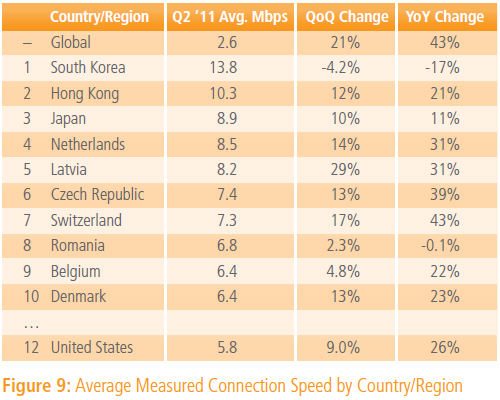
- Global average connection speed increased 23 percent year over year to 2.1 Mbps.
- Cities in Asia have the fastest connection speeds in the World. The 100 fastest cities worldwide is dominated by Asian countries, with 61 cities in Japan, five cities in South Korea, and Hong Kong. Lyse, Norway is the fastest city in Europe, at number 33 out of 100. 18 U.S. cities made the top 100 list, with Riverside in California ranking as the fastest U.S. city, at number 39 out of 100.
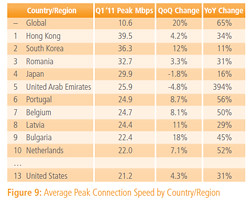 South Korea has the highest level of “high broadband” (> 5 Mbps), with 60% of connections to Akamai at speeds above 5 Mbps.
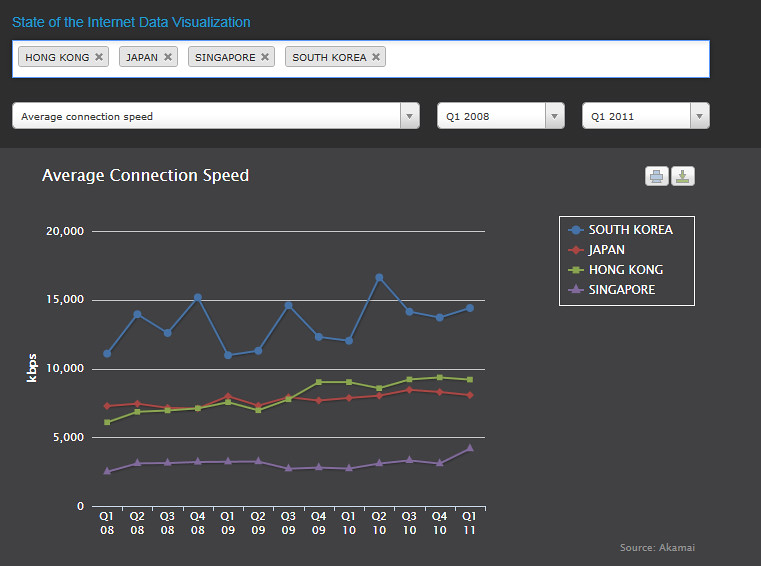
- South Korea has also achieved the highest average connection speed at 14.4 Mbps.
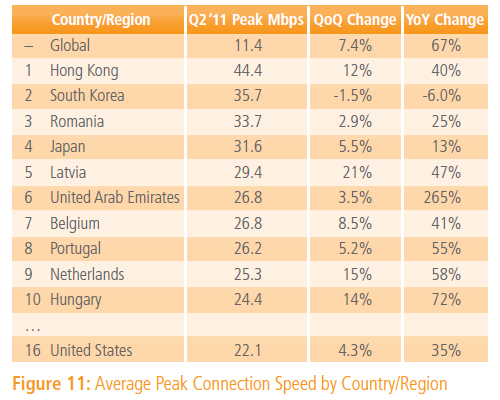
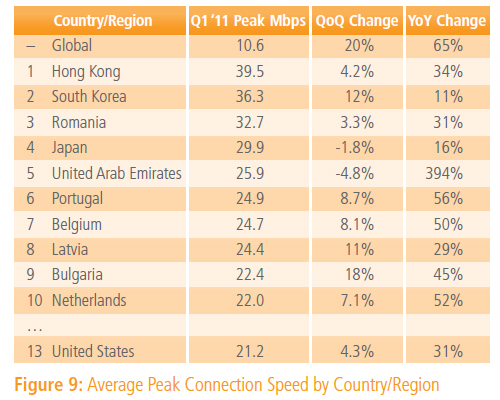
- Hong Kong has maintained its position as having the highest average peak connection speed.
- Other cities in Japan and South Korea continued to hold many of the top spots for highest average and average peak connection speeds by city.
Security
The latest findings reflected in the report show some significant changes in Q1 2011 related to sources of attack traffic. Most notably, Myanmar not only made its first appearance on the list, but also ranked #1 by generating 13 percent of attack traffic during this period.
Russia dropped from top into 4th place, accounting for 7.7 percent of global observed attack traffic, down from 10 percent in the previous quarter. Among other changes, the United States rose from 5th to 2nd, accounting for 10 percent of observed global attack traffic.
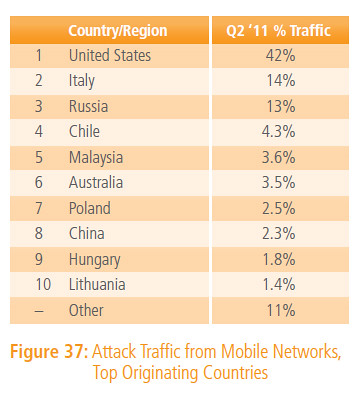
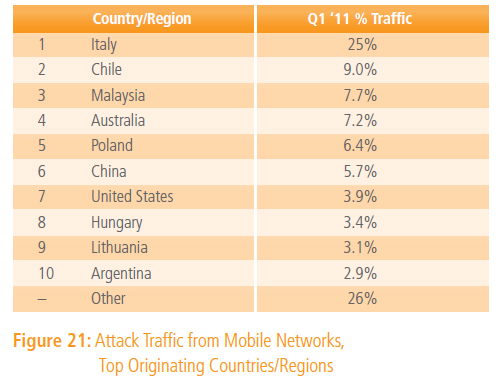
For attack traffic originating from mobile network providers, Italy remained in the top spot, responsible for 25 percent of observed attack traffic in the first quarter.
Mobile Consumption & Connectivity
In the first quarter of 2011, the average measured connection speed for known mobile providers worldwide ranged from a high of slightly more than 6 Mbps to a low of 163 kbps. A service provider from Poland delivered the highest average mobile connection speed in the first quarter 2011, bumping last quarter’s fastest provider from Greece to the number two spot.
 Consumption figures indicate that during Q1 2011, seven percent of the surveyed mobile providers consumed an average of 1 GB of content per month, while 73 percent consumed an average of 100 MB. The remaining 20 percent consumed less than 100 MB.
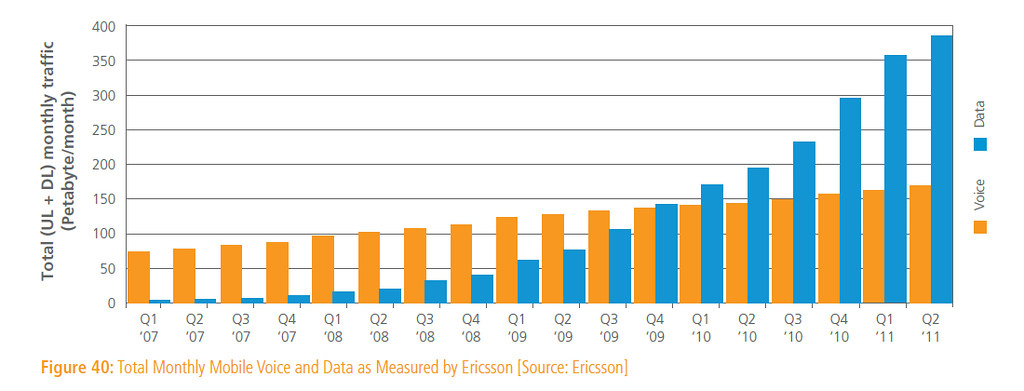
As a result of Akamai’s recently announced partnership with Ericsson, the report now includes data collected by the equipment provider. Overall mobile data traffic, as measured by Ericsson, experienced 130 percent yearly growth in the first quarter, and is now more than double the volume of voice traffic.
Akamai’s SOTI analysis
This is the fourth year that Akamai is publishing its quarterly analysis of Global Connectivity, Attack Traffic and Broadband Consumption.
More than 584 million unique IP addresses from 237 countries/regions connected to the Akamai Platform in Q1 2011. This represents 5.2 percent more IP addresses when compared with the fourth quarter of 2010, and an increase of 20 percent compared to the same quarter a year ago.
Consistent with last quarter’s report, the top ten countries/regions accounted for nearly 70 percent of the total IP addresses, indicating that the majority of the world’s unique IP addresses are concentrated within a relatively small number of geographies. This quarter saw Italy enter the top ten with its 11 percent quarter-over-quarter growth while Canada dropped out of the top ten.
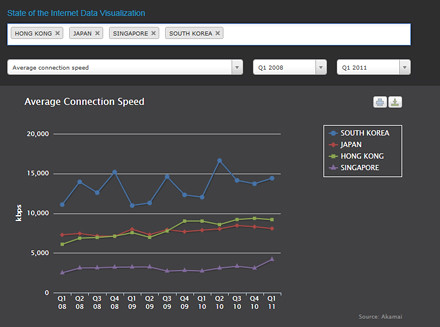
New data visualization tool show trends by geography in several measured categories.
Akamai has also released a new data visualization tool showcasing trends by geography in several measured categories. The tool allows users to generate and print/download graphs highlighting average connection speed, average peak connection speed, and high broadband/broadband/narrowband adoption rates. In addition, the online tool offers quick, easy and customized views of trend data since the report was first published at the beginning of 2008.


 This is backed by its extensive nationwide and global high-speed IP network, and its existing vast customer base to offer high Service Level Assurance, superlative levels of availability, security with high redundancy for its clients.