Archive for the ‘Internet’ Category

Akamai and TM Establish Strategic Partnership for NetStorage Deployment

Tuesday, November 8th, 2011

The partnership will see TM hosting Akamai NetStorage  – a secure managed service for the storage of large volume of data – via its Internet Protocol-based (IP-based) network to customers in South Asia.

Akamai is the leading global service provider for accelerating content and business processes online.Akamai Technologies is a leading cloud platform provider while Telekom Malaysia Berhad (TM) is a New Generation Network service provider in Malaysia.

TM’s IP network is delivered over its diverse international network infrastructure with worldwide Point of Presence (POPs) connectivity.

“The Akamai NetStorage will attract a high voume of Internet traffic to TM’s network, and definitely strengthen Malaysia’s position as a regional Internet hub,” said Rozaimy Abd Rahman, Executive Vice President of TM Global.Akamai NetStorage will be deployed in TM’s Data Center in Cyberjaya, Malaysia, which is targeted for completion by end of 2011. This will be Akamai’s only such storage facility in South Asia.

Historically, Internet users in Asia used to receive large amounts of content such as websites and videos from North America only.

The partnership with TM will allow Akamai to gain storage and co-location capacity in South Asia, and will serve to increase the transit bandwidth on the Akamai Intelligent Platform, Akamai’s cloud-based platform with global reach and local delivery capabilities.

Akamai Intelligent Platform delivers astronomical amounts of Web content on its infrastructure:

  • 1M mobile apps delivered day
  • Over 1 trillion Internet interactions daily
  • 85% of Internet users are a single network hop away
  • More than $200B in online commerce enabled annually
  • Scalable and 100% available

Akamai NetStorage service offers multiple terabytes of storage capacity on demand, automatic failover capability, content replication and connectivity to multiple Internet service providers. It also intelligently monitors network traffic and automatically avoids congestion and overloads for better overall user experience.

“With the collaboration, TM’s customers will be able to enjoy excellent internet connectivity and enhanced surfing experience as the source of content is stored locally here, which will result in seamless network performance,” Rozaimy added.TM has aggressively enhanced, improved and upgraded its IP service platform to further meet the ever demanding customers’ expectations. Earlier this year, the company has embarked into IPv6 capability to address the exhaustion of IPv4 in the region.

TM IP service is equipped with the latest security features such as black hole and clean pipe to secure its IP network against any unwanted threats.

VADS Berhad, a subsidiary of TM, provides global storage and serves as a major hub for data in the region.

As the largest Data Centre provider in the country, TM leverages on its 14 carrier-neutral data centres nationwide which are ISO 27001 certified and which fulfill all Tier 3 standards and Tier 4 ready.

Telekom Malaysia Berhad (TM), Malaysia’s broadband and integrated information and communications group.This is backed by its extensive nationwide and global high-speed IP network, and its existing vast customer base to offer high Service Level Assurance, superlative levels of availability, security with high redundancy for its clients.

It will enable companies to have an IT infrastructure without the complexity of procurement and capital investment.
The State of the Internet 2Q 2011 report from Akamai

Monday, October 24th, 2011

Taiwan has beaten Myanmar and US as the top source of attack traffic on the Internet, while Asian cities maintain their dominance of having the fastest connection speeds in the world, with HK at the pinnacle.

Akamai State of the Internet report Q2 2011

This is the 4th year for the quarterly report.

Akamai has released its Q2 State of the Internet report for 2011. It is a leading provider of cloud optimisation services.

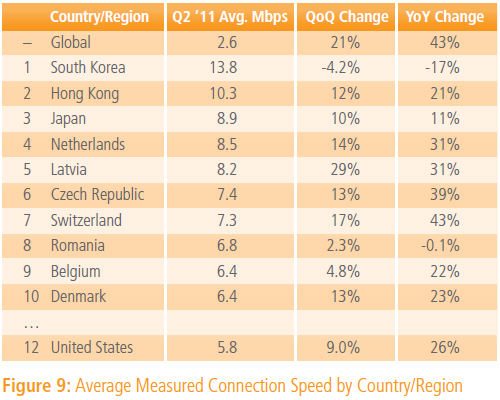
Average Connection Speed by Country/Region

Average Connection Speed by Country/Region

Based on data gathered from the Akamai Internet Platform, which carries between 15-30 percent of the world’s Web traffic, the report provides insight into key global Internet statistics such as the world’s fastest and slowest regions for connection speed, the most frequent origins of attack traffic, and the highest-performing geographies for mobile connectivity, as well as resulting trends over time.

It uses its globally distributed network of servers to gather massive amounts of information on many metrics about the Internet, such as connection speeds, attack traffic, and network connectivity/availability/latency problems, as well as traffic patterns on leading Web sites.

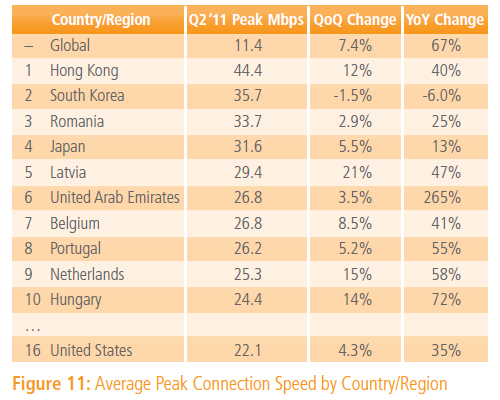
Average Peak Connection Speed by Country/Region

Average Peak Connection Speed by Country/Region

The Q2 report includes data gathered from across Akamai’s Intelligent Internet Platform during the second quarter of 2011 about attack traffic, broadband adoption, and mobile connectivity, as well as trends seen in this data over time.

In addition, this quarter’s report also includes insights into the state of IPv4 exhaustion, the impact of World IPv6 Day, the state of client-side SSL, and smartphone usage trends as observed by Akamai partner Ericsson.

The main highlights from the Q2 report paints the following picture:

Speed

  • Global average connection speed increased 43 percent year over year to 2.6 Mbps. South Korea again had the highest average connection speed at 13.8 Mbps. Singapore was ranked 29th at 4.5 Mbps.
  • Global average peak connection speed was 11.4 Mbps. Hong Kong has maintained its position as having the highest average peak connection speed at 44.4 Mbps. Singapore was 19th at 20.7 Mbps.
  • Globally, high broadband (>5 Mbps) adoption grew to 27%. At 68%, the Netherlands was the highest, pushing S Korea to third position. Hong Kong came in second, while Singapore was 20th at 33% adoption.
  • Gloobal broadband (>2 Mbps) adoption increased to 65%. Singapore was 48th at 67%.
  • Global narrowband (<256 kbps) adoption at 2.9% continued its decline. Lebanon, with its 56% narrowband adoption is the top laggard.
  • Cities in Asia again have the fastest connection speeds in the world. Out of the 100 fastest cities worldwide, 70 were from Asia, with Hong Kong, 59 cities in Japan and 10 cities in South Korea.
  • Brno, Czech is the fastest city in Europe, at number 55 out of 100.
  • 18 US cities made the top 100 list. 9th-placed San Jose’s 13.7 Mbps moved the US into the top 10 for the first time.

Security

Sources of top attack traffic

Sources of top attack traffic

Taiwan was the top source of attack traffic accounting for 10% of overall attack traffic. Myanmar and US together accounted for another 17%. Having made it debut as top attack traffic source in the last quarter, second-placed Myanmar has continued its attack activities showing its entrance into the ranks of top attack traffic sources was not a flash in the pan.

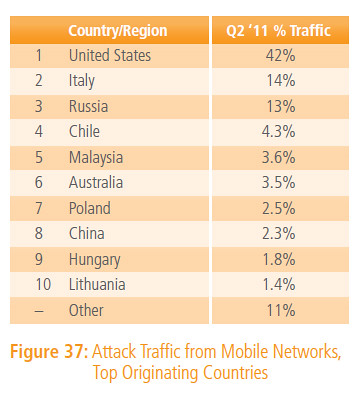
Attack traffic from mobile networks

Attack from mobile networks

With respect to attack traffic originating from mobile network providers, the US vaulted to the top of the list, generating 42% of the observed traffic. Italy has gone down to second place, after its observed attack traffic from was halved compared to the previous quarter. Russia took third place. The top three countries were responsible for almost 70% of observed attacks, while the top 10 countries accounted for nearly 90% of the observed attacks.

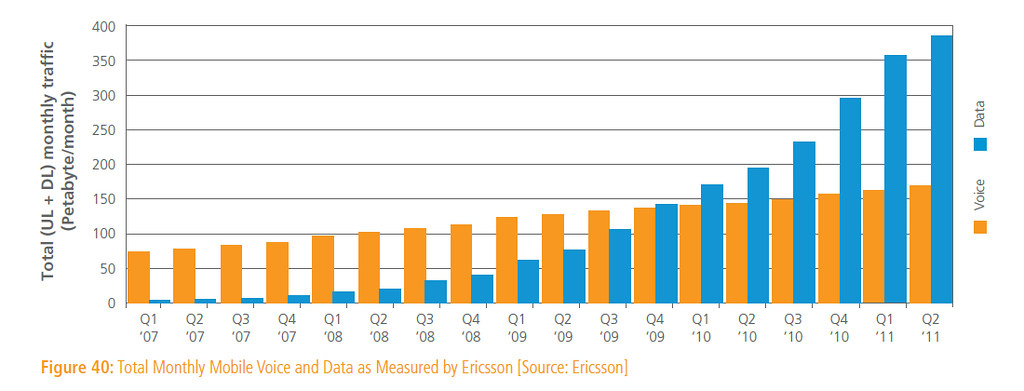
Exponential growth in mobile data traffic is outstripping linear growth of mobile voice traffic.

Exponential growth in mobile data traffic is outstripping linear growth of mobile voice traffic.

Previous SOTI reports from Akamai on tech4tea.com

1st Quarter, 2011 Report (Volume 4, Number 1)
4th Quarter, 2010 Report (Volume 3, Number 4)

The9 establishes Red 5 Singapore to operate Firefall

Friday, October 21st, 2011
NASDAQ-listed The9, an online game developer and operator in China, announced today that it has established “Red 5 Singapore” for conducting online game operations and R&D activities.
Firefall is a team-based MMORPG 3D Sci-Fi action shooter game from Red 5.

Firefall is a team-based MMORPG 3D Sci-Fi action shooter game from Red 5.

In early 2010, The9 announced its acquisition of majority stake in Red 5 Studios Inc, an online game developer located in California, formed in 2006 “The market share and revenue in Asia has a huge impact on the Firefall global operation. This was one of the reasons why we have decided to set up an Asia headquarters for Firefall,” said Mr Zhu Jun, CEO of Red 5 Singapore. “Singapore is strategically-located, demonstrates a thirst for global talent, latest technology and has strong support from the government. The rich resources of talent, friendly government policy and efficiency here have won us over.”by former executives and developers from Blizzard Entertainment.

“Red 5” in this report refers to Red 5 Studios Inc as opposed to “Red 5 Singapore”.

Since the acquisition, The9 has provided support to Red 5 for the game development and preparation work for launch of Firefall – the first team-based action shooter game from Red 5.

Firefall has already attracted interestfrom gamers, media and industry peers across the world.

It is also part of The9’s ‘Global Game for Global Market’ strategy.

Red 5 Singapore will be responsible for the operation of Firefall in all the countries around the globe“We are delighted that The9 Limited has chosen Singapore as its base to spearhead its global strategy. Red 5’s Asian operation in Singapore will create an opportunity for local talent to work with some of the most respected veterans in the games industry,” said Jayson Goh, Executive Director, Infocomms & Media Division of EDB, Singapore. other than North American and European markets, and will first focus on the Asian markets.

The9 and Red 5 will support Red 5 Singapore with talent recruitment, capital investment, technology, as well as other necessary resources.

Red 5 Singapore will develop localized versions of Firefall according to the progress of the game in each country in the Asia region, and will become the Asian operation and development center for Firefall.

Singapore loves Facebook most in the world

Friday, September 30th, 2011

An international analysis on the use of social networks by Experian shows that Singapore users spend the longest time on Facebook in August 2011, with an average of 38 minutes and 46 seconds spent per session.

Country Average time spent per session on Facebook in Aug 2011
Singapore 38 min 46 sec
New Zealand 30 min 31 sec
Australia 26 min 27 sec
UK 25 min 33 sec
France 21 min 53 sec
US 20 min 46 sec
India 20 min 21 sec
Brazil 18 min 19 sec

This is longer than the average time spent per session in countries such as UK, US and Australia.

Experian further reveals that Facebook has managed to sustain its popularity with Singapore Internet users despite the emergence of Google+ this year. The social networking site managed to increase share of visits by 0.39% between August 2010 and August 2011.

Singapore Internet users also showed more interest in YouTube, evidenced by a 3.24% increase in share of visits between August 2010 and August 2011.

Company byte: Akamai Technologies Inc

Tuesday, September 6th, 2011

Akamai (NASDAQ: AKAM) provides cloud-based services for optimizing Web and mobile content and applications, online HD video, and secure e-commerce.

Combining highly-distributed, energy-efficient computing with intelligent software, Akamai’s global platform aims to transform the cloud into a more viable place to inform, entertain, advertise, transact and collaborate.

Akamai has deployed a pervasive, highly distributed cloud optimisation platform with nearly 100,000 servers located in more than 650 cities, in 72 countries and within many of the key networks that make up the internet.

With more than 2,100 employees, annual revenue in 2010 was $1,023.6 million, up 19 percent from the previous year. Follow postings related to Akamai Technologies on tech4tea.com.

Akamai’s product portfolio includes:

Digital Asset Solutions – to manage, store and deliver exceptional digital media experiences across a wide range of platforms/devices around the world. These include Akaimai HD Network, Akamai Media Delivery and Electronic Software Delivery.

Dynamic Site Solutions – to spped up rich interactive content and accelerate all customer-driven transactions. These include Dynamic Site Accelerator and Dynamic Site Accelerator Enterprise.

Application Performance Solutions – enables the public Internet to be the platform for accelerating any critical enterprise application to anyone, anytime, anywhere. Akamai is the leading global service provider for accelerating content and business processes online.These include Web Application Accelerator and IP Application Accelerator.

Advertising Decision Solutions – to enable more relevant online advertising, using Predictive Segments.

Asian cities still the fastest, Myanmar now the most dangerous — says the Akamai Q1 2011 State of the Internet report

Sunday, July 31st, 2011

Asian cities again claim the fastest connection speeds in the world, with HK maintaining its lead in clocking the highest peak connection speed. Myanmar has pipped Russia to generate the most attack traffic.

Q1 2011 State of the Internet analysis from AkamaiAkamai has released its Q1 State of the Internet report for 2011. It is a leading provider of cloud optimisation services. Based on data gathered from the Akamai Internet Platform, which carries between 15-30 percent of the world’s Web traffic, the report provides insight into key global Internet statistics such as the world’s fastest and slowest regions for connection speed, the most frequent origins of attack traffic, and the highest-performing geographies for mobile connectivity, as well as resulting trends over time.

The main findings from the quarterly State Of The Internet (SOTI) report paints the following picture:

SpeedAverage measured connection speed by country/region

  • Global average connection speed increased 23 percent year over year to 2.1 Mbps.
  • Cities in Asia have the fastest connection speeds in the World. The 100 fastest cities worldwide is dominated by Asian countries, with 61 cities in Japan, five cities in South Korea, and Hong Kong. Lyse, Norway is the fastest city in Europe, at number 33 out of 100. 18 U.S. cities made the top 100 list, with Riverside in California ranking as the fastest U.S. city, at number 39 out of 100.
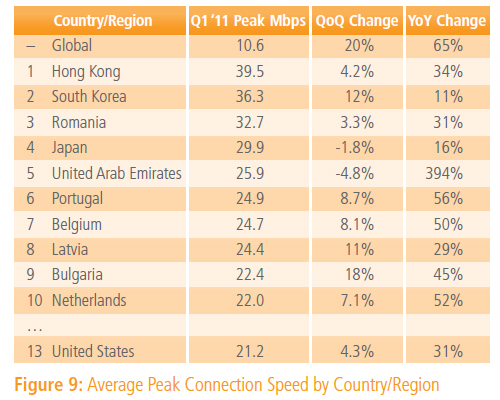
  • Average peak connection speed by country/regionSouth Korea has the highest level of “high broadband” (> 5 Mbps), with 60% of connections to Akamai at speeds above 5 Mbps.
  • South Korea has also achieved the highest average connection speed at 14.4 Mbps.
  • Hong Kong has maintained its position as having the highest average peak connection speed.
  • Other cities in Japan and South Korea continued to hold many of the top spots for highest average and average peak connection speeds by city.

Security

Attack traffic - top originating countries/regions

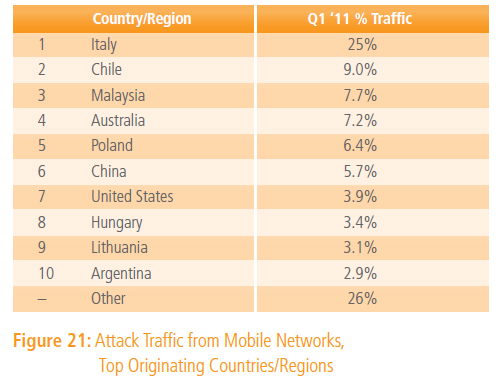
Attack traffic from mobile networks - top originating countries/regions

The latest findings reflected in the report show some significant changes in Q1 2011 related to sources of attack traffic. Most notably, Myanmar not only made its first appearance on the list, but also ranked #1 by generating 13 percent of attack traffic during this period.

Russia dropped from top into 4th place, accounting for 7.7 percent of global observed attack traffic, down from 10 percent in the previous quarter. Among other changes, the United States rose from 5th to 2nd, accounting for 10 percent of observed global attack traffic.

For attack traffic originating from mobile network providers, Italy remained in the top spot, responsible for 25 percent of observed attack traffic in the first quarter.

Mobile Consumption & Connectivity

In the first quarter of 2011, the average measured connection speed for known mobile providers worldwide ranged from a high of slightly more than 6 Mbps to a low of 163 kbps.  A service provider from Poland delivered the highest average mobile connection speed in the first quarter 2011, bumping last quarter’s fastest provider from Greece to the number two spot.

Akamai is the leading global service provider for accelerating content and business processes online.Consumption figures indicate that during Q1 2011, seven percent of the surveyed mobile providers consumed an average of 1 GB of content per month, while 73 percent consumed an average of 100 MB. The remaining 20 percent consumed less than 100 MB.

As a result of Akamai’s recently announced partnership with Ericsson, the report now includes data collected by the equipment provider. Overall mobile data traffic, as measured by Ericsson, experienced 130 percent yearly growth in the first quarter, and is now more than double the volume of voice traffic.

Akamai’s SOTI analysis

This is the fourth year that Akamai is publishing its quarterly analysis of Global Connectivity, Attack Traffic and Broadband Consumption.

More than 584 million unique IP addresses from 237 countries/regions connected to the Akamai Platform in Q1 2011. This represents 5.2 percent more IP addresses when compared with the fourth quarter of 2010, and an increase of 20 percent compared to the same quarter a year ago.

Consistent with last quarter’s report, the top ten countries/regions accounted for nearly 70 percent of the total IP addresses, indicating that the majority of the world’s unique IP addresses are concentrated within a relatively small number of geographies.  This quarter saw Italy enter the top ten with its 11 percent quarter-over-quarter growth while Canada dropped out of the top ten.

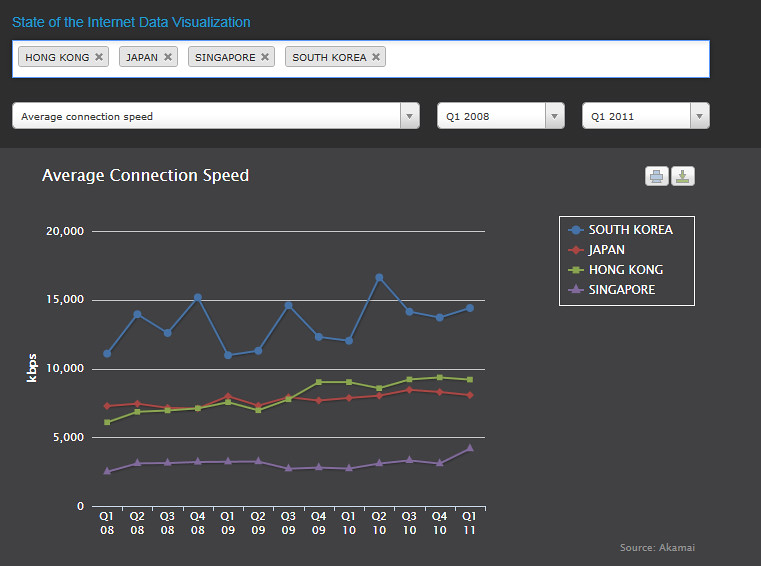
New data visualization tool show trends by geography in several measured categories.

New data visualization tool show trends by geography in several measured categories.

Akamai has also released a new data visualization tool showcasing trends by geography in several measured categories.  The tool allows users to generate and print/download graphs highlighting average connection speed, average peak connection speed, and high broadband/broadband/narrowband adoption rates.  In addition, the online tool offers quick, easy and customized views of trend data since the report was first published at the beginning of 2008.

Akamai helps visualize World IPv6 Day

Tuesday, May 31st, 2011

Akamai has announced that it will provide a real-time data visualization of IPv6 Web traffic served from its global platform on World IPv6 Day on 8 June 2011. The visualization will show the pattern of traffic served during the 24-hour period.

Akamai is the leading global service provider for accelerating content and business processes online.Hundreds of websites and Internet service providers around the world are joining Facebook, Google, Yahoo, Akamai, and Limelight Networks as participants in World IPv6 Day for the first global-scale trial of the new Internet Protocol, IPv6, being organized by the Internet Society.

During World IPv6 Day on 8 June 2011, more than 225 participating organizations from every part of the globe will enable IPv6 on their main services for 24 hours. With IPv4 addresses running out this year, the industry must act quickly to accelerate full IPv6 adoption or risk increased costs and limited functionality online for Internet users everywhere.

World IPv6 Day participants are coming together to help motivate organizations across the industry—Internet service providers, hardware manufacturers, operating system vendors and other web companies—to prepare their services for the transition.

“We see this test flight as an important step towards ensuring the global Internet can continue to grow and evolve so that it can connect billions of new users and devices,” said Leslie Daigle, Chief Internet Technology Officer for the Internet Society.One of the goals of World IPv6 Day is to expose potential issues under controlled conditions and address them as soon as possible. Given the diversity of technology that powers the Internet, the global nature of the trial is crucial to identify unforeseen problems.

The vast majority of users should be able to access services as usual, but in rare cases, misconfigured or misbehaving network equipment, particularly in home networks, may impair access to participating websites during the trial.
“We’ve been working to make Google services publicly accessible over IPv6 since 2008, because we believe it’s critical to the long-term prosperity of the open Internet,” said Erik Kline, IPv6 Software Engineer at Google.
Current estimates are that 99.95% of users will experience no problems connecting to web services on IPv6 Day, and participating organizations will be working together with operating system manufacturers, home router vendors and ISPs to minimize the number of users affected.

The Internet Society is supporting World IPv6 Day as part of its efforts to accelerate IPv6 deployment. IPv6, the successor to the protocol currently used on the Internet, was designed in the late 1990s but has not seen deployment on a global scale. With IPv4 address space running out, the industry cannot afford to wait much longer.

Thailand arrests and charges US citizen for lèse majesté

Friday, May 27th, 2011

The Thai-born US citizen is being charged with insulting the monarchy after he posted material deemed offensive on his blog and put a link to a banned book, authorities said today.

Even though he had committed those acts while he was in the US, Thailand is proceeding against him.

Thailand arrests 54 year old Thai-born US citizenLerpong Wichaikhammat, 54, is also known as Joe W. Gordon and holds dual US and Thai citizenship. He was arrested earlier this week in Korat (Nakhon Ratchasima province in northeast Thailand) by the Department of Special Investigation (DSI) – Thailand’s equivalent of the FBI in the United States.

“He translated articles which are deemed insulting to the monarchy and posted them on his blog. Also he provided a link to a book perceived as critical of the royal family”, divulged police Lieutenant Colonel Kovit Tardmee.

Wichaikhammat is currently being held at Bangkok Remand Prison. He has been denied bail during a hearing on Thursday. A spokesman for the U.S. embassy in Bangkok said he has been receiving consular assistance as of today.

Thailand arrests and charges US citizen for lèse majesté“He was charged with lèse majesté, subversion and uploading or linking to false information under the Computer Crime Act,” an official at Thailand’s Criminal Court told AFP on condition of anonymity.

Wichaikhammat had left Thailand when he was 35 and had returned for medical treatment in November 2009. He had planned to return to the US in December 2011. The US embassy said that it was providing consular assistance to the man.

The monarchy is an extremely sensitive subject in politically divided Thailand, which is preparing for an election on July 3. Lese-majeste, or insulting the monarchy, is a very serious offence in Thailand, with each offence punishable by up to 15 years in prison.

King Bhumibol Adulyadej, 83, the world’s longest-reigning monarch and revered as a demi-god by many Thais, has been in hospital since September 2009, making an appearance only on rare occasions.

Singaporeans vote for their government today

Saturday, May 7th, 2011

Today is polling day for the General Election in Singapore. Citizens vote today for the Members of Parliament who will manage their constituencies and estates, and represent them in Parliament.

The political party with the majority will also form the government for the next five or so years until the next election.

Polling stations across the island nation opened at 8 am local time to voters selecting their representatives in Parliament. The polling stations will remain open for voting until 8 pm tonight.

The neighbourhood school across the road from where I live has been designated as the polling station where residents around my neighbourhood will cast our votes.

As I walked towards the school with the Poll Card in my hands, I couldn’t help but muse that I was holding in my hands about the only tangible manifestation of what being a Singaporean Citizen entails – the right to vote.

Gripped in my hands was my voice. With it, I get to say who I want to represent me in the government. The most wonderful thing about it all is that everybody – whether you’re rich or poor, whether you’re from the establishment or whether you’re disenfranchised – gets exactly one vote. Nobody’s voice is louder than that of another.

The slogan “One man, one vote” has never sunk in so vividly until you walk with this IC-sized slip of paper towards a ballot box, especially since in this election, it can really make a difference as to who gets elected.

A poll card to exchange for a voting slip at the polling station

A poll card to exchange for a voting slip at the polling station

For this election, 2,350,873 citizens will decide who the 87 MPs representing 27 constituencies are. 12 of the constituencies are SMCs (Single Member Constituency) while 15 are GRCs (Group Representation Constituency where the constituency is represented by a team of candidates rather than a single person).
Unlike past elections, where many constituencies are unchallenged by opposition parties and enjoy walkovers even before the polling day, in this election – only one constituency has enjoyed a win without a fight.

The 5-member team headed by Minister Mentor Lee Kuan Yew in Tanjong Pagar GRC was returned into office on Nomination Day when their would-be opponents from the opposition failed to submit their paperwork in time. They were deemed to be 35 seconds late and the 139,771 electors in the constituency – some 6 percent of the overall electorate – will not have the chance to vote in this election.

Nevertheless, there are still 82 parliamentary seats up for grabs and the hustings this election has proven to be more intense than ever before, with the opposition presenting many credible and eminently qualified candidates who were able to enunciate why the voters should support them and what they can do for the nation.

Unsettling for the incumbent party, the voting public – at least based on any casual browsing of social websites on the Internet and overwhelming attendance at opposition rallies – seemed to resonate with opposition candidates.

How did I vote this morning? I voted – wisely.

Polling day for General Election 2011

Asian cities are fast, Russia is dangerous – says the Akamai Q4 2010 State of the Internet report

Thursday, May 5th, 2011

Asian cities have the fastest connection speeds in the world, with HK clocking the highest peak connection speed, and Japan having the highest level of broadband adoption. Russia generated the most attack traffic.

Basically, the Internet has become a faster and more dangerous place.

The State of the Internet report for Q4 2010

The State of the Internet report for Q4 2010

Akamai has released its Q4 State of the Internet report for 2010. It is a leading provider of cloud optimisation services. Based on data gathered from the Akamai Internet Platform, the report provides insight into key global Internet statistics such as the world’s fastest and slowest regions for connection speed, the most frequent origins of attack traffic, and the highest-performing geographies for mobile connectivity, as well as resulting trends over time.

Akamai is the leading global service provider for accelerating content and business processes online.Looking at the two main areas of speed and security, the State Of The Internet (SOTI) report paints the following picture:

Speed

  • Cities in Asia have the fastest connection speeds in the World.
    (top 40 cities are either in Japan or South Korea)
  • Hong Kong has the highest peak connection speed.
  • Japan has the highest level of broadband adoption.
  • Average peak connection speeds on mobile devices rose to 21.2Mbps globally.

Security

  • Russia is the number one country in terms of generating attack traffic, followed by Taiwan (2nd), China (4th), US (5th), Malaysia (25th), HK (47th), and Singapore (48th). 10% of all attack traffic originates from Russia.
  • The Akamai network saw more DDoS attacks in Q42010 than the previous three quarters combined.
  • In terms of mobile-generated attack traffic, the top ten countries are:
  1. Italy
  2. Chile
  3. UK
  4. Poland
  5. Malaysia
  6. China
  7. Russia
  8. US
  9. Hungary
  10. Lithuania

Akamai’s globally distributed network of servers allows it to gather massive amounts of information on many metrics, including connection speeds, attack traffic, and network connectivity/availability/latency problems, as well as traffic patterns on leading Web sites.

Each quarter, Akamai publishes a “State of the Internet” report. The 2010 Q4 report included data about attack traffic, broadband adoption, and mobile connectivity, as well as trends seen in this data over time.