Archive for the ‘Internet’ Category

Launch of Mozilla FireFox 4

Monday, March 21st, 2011

The next major release for the popular browser from Mozilla will be launched tomorrow.

Firefox 4 from MozillaBased on the final beta – Release Candidate 2 – that became available only three days ago on 18 March, Mozilla has announced that this will be the last update where the delta from the previous release is a large one.

Future releases will be more frequent and involve smaller changes. This is in line with other browsers which releases minor updates on a more frequent basis.

The main enhancements involve better standards support, improvements in performance, and a face-lifted user interface.

The current version is at 3.6.

4G network in Singapore as early as this year?

Monday, January 24th, 2011

Not so fast. In theory, it is possible to see 4G implemented in Singapore as early as this year. In reality, when we really see 4G take off in Singapore depends on many factors: roll-out by telcos, launch of smartphones and tablets by device makers, availability of compatible peripherals like dongles, and most important of all, applications to exploit the higher speed.

IDA announced its blueprint for the rollout of a 4G network in Singapore today. But don’t jump for joy yet – it is more a roadmap for early planning by the telcos to implement their versions of the network.

Logo of IDA4G refers to the fourth generation of wireless-mobile standards and can be five to 10 times faster than current 3G networks. Downloading a video will become real fast. Maybe you can play those mean bandwidth-hungry games on your smartphones too.

The two main announcements on the rollout of Singapore’s 4G network address the immediate term from now to 2015, and the subsequent landscape beyond 2015.

Between now and 2015

Today, five companies SingTel, StarHub, M1, QMax and PacketOne hold the rights to use the 2.3/2.5 Ghz spectrum for wireless broadband access. SingTel, StarHub and M1 also holds the rights to use the 900/1800MHz bands for 2G mobile services. In 2005, they had successfully bid for the right to use the spectrums until 2015.

IDA gave the go-ahead for these operators to offer 4G services using their eixsting radiofrequency spectrums. These Telcos can seek approval from IDA to do so and the approval could be completed in a matter of weeks.

IDA did not mention the 700MHz band although it is included in the 4G standard.

Beyond 2015

Beyond 2015, IDA is planning to re-allocate rights to the wireless broadband spectrum. IDA will hold an auction for six lots of 4G wireless spectrum rights next year.

“SingTel is exploring all options available and is working closely with network providers to ensure commercial LTE services can be introduced to our customers in good time,” said a SingTel spokesperson.Thus far, SingTel, StarHub and M1 have announced plans to roll out a 4G technology based on the Long Term Evolution (LTE) standard.

M1 has completed its LTE trials in April 2010 and will be upgrading its network to LTE in 2011.

A StarHub spokesperson said that StarHub is “currently conducting technical trials of LTE.”

4G networks have already been rolled out in the US and a few4G handsets have already been launched by some smartphone makers.

Use of the 4G network in Singapore will probably begin on laptops using dongles. 4G smartphones and tablets will only come later, probably in 2012, but more likely in 2013.

However, the main driving factor of WHEN a 4G network in Singapore will really take off depends on whether consumers or business users can find a compelling need to migrate from an already speedy 3G network to the new network, presumably at an increased cost.

The IDA has gotten off to a good start by laying down the blueprint early for all interested parties to plan their hardware and network investments, as well as to clarify the usage of the relevant spectrums.

The gauntlet is now thrown to the Telcos to work out the detailed standards and spectrum allocation, price plans and services to exploit the broader bandwidth.

Cameron Diaz most likely to lead you astray

Thursday, August 19th, 2010
Photo of Cameraon Diaz

Cameron Diaz is the most dangerous celebrity on the Web.

Do an Internet search on Cameron Diaz and click on one of the search results. Chances are you will land on a malicious site. Security analysts at McAfee has identified one of Charlie’s Angels as the most dangerous celebrity on the Web.

In the rankings of the latest “Dangerous Celebrities” study by McAfee, after Cameron Diaz came movie star Julia Roberts. Next is Jessica Biel, the most dangerous celebrity in the previous study, followed by supermodel Gisele Bündchen and actor Brad Pitt.

Hackers with malicious intent typically use popular celebrities as bait to lure victimes to sites containing malware.

According to MaAfee, maker of antivirus and computer security software, searching for Diaz yields a 10 percent chance of landing on a malicious site. In particular, when “Cameron Diaz and screensavers” was searched, 19 percent of the sites were identified as having malicious downloads. Users searching under “Julia Roberts and downloads” had a 20 percent chance of landing on a site with a malicious download, the company found.

Steve Jobs at All Things Digital Conference in Los Angeles

Wednesday, June 2nd, 2010
Steve Jobs at D8 in Los Angeles on 1 Jun 2010

Steve Jobs at D8 in Los Angeles on 1 Jun 2010

Steve Jobs kicked off the 8th annual All Things Digital Conference in Los Angeles on 1 Jun 2010. The three-day tech event will feature other industry leaders including Microsoft CEO Steve Ballmer, AOL Chief Tim Armstrong and Facebook CEO Mark Zuckerburg. Steve Jobs last appeared in the series of conferences in 2007 alongside Bill Gates.

Here are Steve’s main bullets from his one-and-a-half hour interview with hosts Kara Swisher and Walt Mossberg.

  • Passing Microsoft in valuation was “surreal”.
  • Flash is a technology that’s waning.
  • HTML5 is starting to emerge as a rival to Flash.
  • Gaps on iPhone/iPads caused by HTML5 are getting solved.
  • The market will decide whether iPhone/iPads without Flash is viable.
  • There’s a debate about whether the lost iPhone prototype was left behind at the bar or stolen out of the Apple engineer’s bag.
  • The Foxconn suicides are troubling but the 400,000-employee Foxconn factory is not a sweatshop. Apple is trying to address the situation.
  • Apple has no plans to go into the search business because others do it well.
  • Google started the competition with Apple by moving into the mobile platform with the Android OS.
  • The iPhone OS was conceived for a tablet but the iPhone was rolled out first.
  • Consumers are likely to migrate away from the PC to tablets within the next 5 years due to the evolution of demographics and demand.
  • Rules for approving/rejecting an iPad App:
    • It has to do what it’s advertised to do
    • It has to not crash
    • It can’t use private APIs
    • It can’t defame other people
  • 95% of Apps are approved within 7 days.
  • The current Ad delivery system in the industry sucks and iAd hopes to do it better

Two million Apple iPads in less than 60 days

Tuesday, June 1st, 2010

Apple sold 2 million iPads in less than 60 days since the tablet’s launch on April 3, the company said. It took 2 years for the iPod to reach the 2-millionth mark, and about 4 months to sell its 2 millionth iPhone. In fact, it took the hugely successful iPhone 74 days just to reach the 1-millionth mark.

The Apple juggernaut is rolling on, leaving fellow tech companies in the dust. The shares are rising even as Microsoft, Google, HP, IBM, eBay, Amazon, Yahoo are diminishing in market value.

Apple sells 2 million iPads in less than 60 days

Apple sells 2 million iPads in less than 60 days

The company is hitting the headlines every few days. Apple first launched the iPad in the US on 3 Apr, achieved its first million sales of the iPad on 3 May after merely 28 days, released the iPad to 9 countries worldwide on 28 May, has now announced its two millionth iPad milestone on 31 May, will be speaking at the  All Things Digital D8 Conference in Los Angeles on 1 Jun, and will probably unveil the new iPhone during the WWDC on 7 Jun. The momentum of the steam engine that is Apple does not seem likely to ebb in the near future.

5000 new Apps have already been released for the iPad, while most of the more than 200,000 Apps already on the App Store can be run on the iPad, including those already purchased for the iPhone and iPod Touch.

iPad costs a quarter more in the UK than in the US

Monday, May 31st, 2010

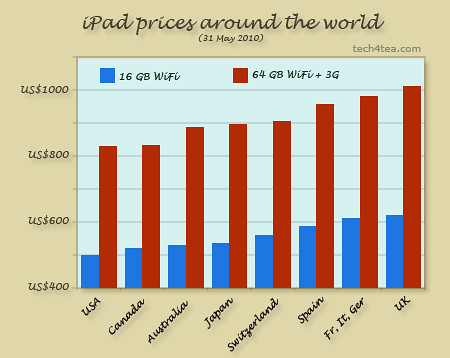
The ipad costs more outside of the US, Reuters said, citing  an Australian CommSec study.

Prices of the iPads were the cheapest in the US, while prices in Europe, especially the UK, were the highest – almost a quarter of the price higher.

Chart of Apple iPad prices across the world

Apple iPad prices varies worldwide

The prices of the entry level 16 GB WiFi only iPad and the top end 64 GB WiFi + 3G version were both collated and converted to the equivalent US Dollars.

The tablet device is targeted at the niche between a laptop and a smartphone, with a form factor suited for surfing the web, watching movies and reading electronic books. It can also run apps designed for the iPhone as well as apps specially customised for it.

The detailed data is tabulated below.

(more…)

Was it the iPad that propelled Apple past Microsoft?

Friday, May 28th, 2010

Curious as to how Apple has upstaged Microsoft in terms of market capitalisation, I plotted the market capitalisation of Apple against Microsoft between 1 June 2009 to 26 May 2010 (at monthly intervals except for the final data point).

Chart of Apple vs Microsoft in terms of market capitalisation

Was it the iPad that helped Apple overtake Microsoft?

Seems like the gap between Microsoft and Apple remained rather constant at  roughly US$60-80 billion until the announcement of the iPad by Steve Jobs on 27 Jan 2010 to a packed audience in the Yerba Buena Center for the Arts in San Francisco.

There was no looking back afterwards as the iPad was launched in April and sold its first million unit on May 3 after merely 28 days. This was less than half the 74 days it took the hugely successful iPhone to sell its first million units.

The gap between Microsoft and Apple closed rapidly until this week, when Apple finally overtook Microsoft in terms of market capitalisation.

At the rate it’s going, it won’t be long before Apple overtakes Exxon Mobil as the most valuable company in the US.

Apple could face inquiry about online music

Wednesday, May 26th, 2010

Brad Stone reports in the New York Times that:

Though the Justice Department’s inquiry is preliminary, it represents additional evidence that Apple, once the perennial underdog in high tech, is now viewed by government regulators as a dominant company with considerable market power.

Apple logoThis is consistent with my earlier observation about how Apple seems on its way to overtaking Microsoft as the biggest IT company in terms of market capitalisation. In April, Apple had already dethroned Microsoft as the most heavily weighted technology stock in the Standard & Poor’s 500 Index.

The US Justice Department has spoken with major music labels and Internet music companies to scrutinise Apple’s tactics in the online digital music market.

The antitrust inquiry is still in the early stages. Investigators seemed to be examining recent allegations that Apple used its dominant market position to get music labels to deny exclusive access to Amazon.com for music about to be released, according to sources who had been briefed on the inquiries and who spoke on condition of anonymity.

(more…)

Apple gaining ground in fight over Flash

Friday, May 21st, 2010

Ben Worthen reports in the Wall Street Journal that:

The punches that Apple Inc. is throwing in its fight against Adobe Systems Inc. are beginning to land, prompting some companies to shift away from Adobe’s video and animation technology and forcing Web designers to work with competing standards.

A US$226 billion behemoth versus US$17.3 billion Adobe – no surprises on who’s going to prevail.

For the moment, the immediate tactical fight is over Flash on iPhones/iPads. For the longer term, the strategic posturing sees Apple defending its sealed garden, while Flash fears the migration away from Flash will spill over outside of Apple’s ecosystem into the general world wide web.

Logo of Adobe Flash

Flash - Some believe it was one big reason why Adobe acquired Macromedia in 2005

We are beginning to see a repeat of the tedium facing web developers and visitors that arose from the browser wars. Different browsers had varying compliance to web standards. Web developers had to develop different versions of their websites optimised for different browsers. For websites that don’t, users will have to use the appropriate browser to enjoy the full intended experience.

Now you’d need one version of your website for Apple iPads/iPhones, and another for the rest of the world who still uses Flash.

Who will prevail?

(more…)