Archive for the ‘Security’ Category

Norton Cybercrime Report: Consumer cybercrime costs Singapore S$1.2 billion

Thursday, September 6th, 2012

Cost per victim goes up this year, with cybercriminals starting to focus their efforts on social networks and mobile devices.

2012 Norton Cybercrime Report, an annual study to understand how cybercrime affects consumers, and how the adoption and evolution of new technologies impacts people’s security.

2012 Norton Cybercrime Report, an annual study to understand how cybercrime affects consumers, and how the adoption and evolution of new technologies impacts people’s security. Click to read detailed report.

The annual Norton Cybercrime Report is one of the world’s largest consumer cybercrime studies, involving 13,000 adults from 24 countries.

“Personal email accounts often contain the keys to your online kingdom. Not only can criminals gain access to everything in your inbox, they can also reset your passwords for any other online site you may use by clicking the ‘forgot your password’ link, intercepting those emails and effectively locking you out of your own accounts,” says Effendy Ibrahim, Internet Safety Advocate & Director, Asia, Norton by Symantec.

The 2012 edition of the study tags the direct costs of global consumer cybercrime at US$110 billion over the past 12 months.

In Singapore, more than 1.4 million people fell victim to cybercrime in the same period, suffering approximately S$1.2 billion in direct financial losses.

This works out to an average of S$812 per victim in Singapore.

The equivalent global average direct cost per victim is only S$244.

Globally, every second, 18 adults become a victim of cybercrime, resulting in more than one-and-a-half million cybercrime victims each day.

Social networks and mobile devices

In Singapore, one in five online adults (20 percent) has been a victim of either social or mobile cybercrime, and 36 percent of social network users have been victims of social cybercrime.

(more…)

COMEX 2012 promotions: Norton by Symantec

Monday, August 27th, 2012

Symantec will be at COMEX 2012 at Suntec Singapore at Level 6, Booth 6251.

Click to view or download Norton promotions during COMEX 2012.

Click to view or download Norton promotions during COMEX 2012.

Looking to protect your computers from attack? Check out Symantec’s COMEX 2012 promotional discounts and freebies for Norton software.

Executive briefing: IBM X-Force on emerging threats in 2012

Tuesday, July 24th, 2012

CIO Asia magazine organised the half-day event at the Raffles Hotel in Singapore. Due to the overwhelming response, the invitation-only briefing was extended from a 10-pax roundtable to a five-table seminar.

IBM X-Force Executive Briefing on Evolving Threat.

IBM X-Force Executive Briefing on Evolving Threat.

IBM promised that attendees would leave the briefing better prepared to protect their organisations against evolving threats in the security landscape.

Organised by CIO Asia magazine at the Raffles Hotel in Singapore.Key personnel from the new Security Systems unit in IBM updated CIOs and key IT managers on the numerous reports of data leaks, Denial-of-Service attacks, and social Hacktivisim in 2011.

The pace of such attack have continued into 2012.

Traditionally, IBM as well as other large companies have already incorporated security considerations in individual solution domains.

However, IBM has taken the additional step to adopt a holistic approach towards ensuring security for all of their solutions.

Its acquisition of Q1 Labs has provided the tools that integrated the security needs and considerations across the hitherto siloed domains.

This security layer straddles the various siloed domains and serves as the bedrock upon which the domain solutions are built.

(more…)

Key findings from RSA Archer GRC Executive Forum

Friday, July 20th, 2012

RSA, The Security Division of EMC, recently released key findings from the RSA Archer GRC Executive Forum held in June, during which governance, risk and compliance (GRC) leaders from 34 leading corporations discussed enterprise risk management strategies and best practices.

Key Findings of the RSA Archer GRC Executive Forum

Key Findings of the RSA Archer GRC Executive Forum

Top executives say GRC Programs must better align to strategic priorities to meet board needs. The results affirm the earlier Carnegie Mellon CyLab 2012 Governance Report.

Some key findings

  • Mounting and multiplied business risks due to growing regulatory requirements and greater business complexity.
  • The need to align GRC to business priorities to get organizational leaders on board.
  • Moving away from a siloed GRC program to one which is unified to make enterprise-wide risk assessment.

It was noted that the shift towards increased regulatory and compliance requirements is being observed across Asia Pacific and Japan as well, with organizations looking to better calibrate their risk assessment frameworks and set guidelines for assessing organisation risks.

The need for business continuity management programs is also gaining traction, with the occurrence of natural disasters in Japan and Thailand prompting organizations to reassess their risk environment.

Read the press release below for more details.

(more…)

BlackBerry Mobile Fusion available in Singapore

Friday, July 20th, 2012

BlackBerry Mobile Fusion is RIM’s next-generation mobile device management solution for Government and Business Customers in Singapore.

It promises to be a secure, reliable, and scalable solution to easily manage BlackBerry, iOS and Android devices.

From left, Ian Gardner, Director, Enterprise Sales, RIM; and Charles Dufourcq, Director, Singapore, RIM sharing the advantages of BlackBerry Mobile Fusion

From left, Ian Gardner, Director, Enterprise Sales, RIM; and Charles Dufourcq, Director, Singapore, RIM sharing the advantages of BlackBerry Mobile Fusion

BlackBerry Mobile Fusion consolidates the management of smartphones and tablets running BlackBerry OS (which includes BlackBerry PlayBook and future BlackBerry 10 devices) as well as Android and iOS.

“For businesses and government, managing a mix of mobile devices on any scale is chaotic. Organizations face pressure to allow employees to bring their own devices into the workplace,” said Charles Dufourcq, Director for Singapore at Research In Motion.

BlackBerry Mobile Fusion provides a single, unified, web–based console to manage the wide range of mobile devices that the employees of an organisation may bring and use for work.

BlackBerry Mobile Fusion integrates the market-leading features and security architecture of BlackBerry Enterprise Server (version 5.0.3), providing advanced IT management and controls, a single outbound security connection (256-bit AES encrypted “BlackBerry VPN”), enforceable IT policies, support for BlackBerry Balance technology, and over-the-air app and software installation capabilities for the management of BlackBerry smartphones and PlayBook tablets (as well as future BlackBerry 10 devices).
(more…)

Norton Mobile Survey 2012: Greater awareness of mobile security needed

Friday, July 13th, 2012

The ownership and use of mobile phones to access the internet and stay connected is fast catching up with the use of computers.

Yet, the awareness of mobile security remains wanting compared to the relative maturity in security awareness for general computer usage.

David Freer, Vice President, Consumer, Asia Pacific and Japan, Symantec

David Freer, Vice President, Consumer, Asia Pacific and Japan, Symantec. Photo taken on a mobile phone.

I was briefed on the results of the Norton Mobile Survey this morning at their offices at Suntec Singapore. A summary of the detailed numbers can be found at the end of this post. Here’s how the survey was conducted.

Ownership and use of mobile phones fast catching up with computers.

Mobile phone Computer
Ownership 91% 92%
Access Internet 88% 69%

This was the same survey which found that “76% of Internet users in Singapore would rather forgo US$1million than give strangers unlimited access to their computers”.

What stood out from the numbers was the disparity between the greater dependence and use of our mobile phones on one hand (see sideboxes), and on the other hand the lagging level of mobile security in their usage.

So we’re doing an awful lot of things on our mobile phones – pretty much the same sort of things we do on our computers – in terms of accessing the Internet and staying connected. (And snapping the cover photo for this article.)

Need for greater awareness of mobile security

Yet almost half of the mobile users in Singapore do not take the simple step of using passwords to protect their phones, even though 61% of Singaporeans acknowledge that mobile threats are real.

What do people actually do on their mobile phones?

Social networking 57%
Read the news 55%
Online messaging 39%
Mobile banking/payments 27%
Location-based tasks, including navigation 25%
Online shopping 19%

In addition, some 30% are not aware that they can remotely track their phone using GPS navigation software.

Is it because we’re still trapped in the age when mobile phones were less capable and we were less dependent on them – and therefore had little to lose if a mobile phone was lost or stolen.

You know, when we had feature phones, the most painful thing about losing the phone was the loss of the contacts on them, and the hassle of having to replace them.

Viruses and malware for feature phones were almost unheard of.

US$1million for complete access to your computer?

US$1million for complete access to your computer?

Now, your smartphone can store a substantial trove of precious PERSONAL photos and videos, work-related documents and apps that access your stockmarket transactions.

The survey found that for the one in three Singaporeans who have had their mobile phone stolen/lost, most of them (78%) mentioned that losing their contact information was the worst part of the experience, with 52% feeling their privacy had been invaded.

To resolve their lost/stolen phone situation, two in three Singaporeans had paid an average of S$424.

The survey found that three in five Singaporeans would rather pay a ransom S$273 to get your phone back.averaging S$273 in order to resolve their lost/stolen phone problem – assuming they were offered the chance.

This is almost double the S$148 “ransom” that half of those surveyed in LAST YEAR’s study were willing to pay.

Dark cloud arising

“Singapore is a very tech savvy nation that is hugely mobile and connected,” said David Freer, Vice President of Norton for Asia Pacific & Japan.

Personally, I believe the concern with lost contact information will diminish rapidly with the convenience of syncing contact and calendar information with cloud-based services, such as iCloud and Google.

These cloud services allow you to reinstate contact lists and calendars in a new smartphone in a matter of minutes.

On the other hand, the tight coupling between the smartphones with cloud services bring with it a much greater problem.

“With greater connectivity to the Internet through mobile devices, cybercriminals are increasingly targeting this platform.

With so much valuable and personal information residing on our mobile devices, mobile users need to have the right security measures in place – both a reliable mobile security solution and personal diligence to back up important information,” added Freer.

By serving as gateways to access huge repositories of information on the cloud, people who lose their mobile phones stand to lose much more than just what’s physically stored on the phone itself.

It’s akin to losing a wallet full of cash viz-a-viz losing a wallet full of cash and a couple of credit cards.

So, if you haven’t enabled remote locking or wiping, anyone losing their phone would also need to change the passwords of all the online services the phone and its apps has been authorised to access.

Emails accounts, Facebook/Twitter accounts, Dropbox are but a few that immediately pop into mind. How many of these can you recall off the top of your head, and in the heat and stress of having realised you’ve just lost your phone?

Norton Mobile Security

Norton Mobile Security for Android devices addresses some of today’s most common mobile issues, including device loss and data protection.

Norton Mobile Survey 2012Norton Mobile Security has anti-theft, anti-malware, locate and remote wipe features.

Norton Mobile Security Lite is available for free in English on the Google Play Store.

For users seeking additional protection, there is the option to upgrade to the full featured Norton Mobile Security for an annual subscription of S$19.90.

Versions for iOS and Windows Phone will be released later this year.

Below is a summary of the main findings of the Norton Mobile Survey 2012.

(more…)

Dell offers end-users power to do more

Wednesday, July 4th, 2012

Dell tackles current trends of workforce mobility and consumerisation of IT by offering a complete end-to-end ecosystem of end-point devices, solutions and services – to bestow maximum productivity to end-users in our fast-paced environment.

Chue Chee Wei, Marketing Director, South Asia and Korea Marketing for Dell.

Chue Chee Wei, Marketing Director, South Asia and Korea Marketing for Dell.

I was invited by Dell to listen to how the computer maker envisages the technology landscape and how it plans to cater to different end-users with very different needs.

Slide 1: Changing technology landscape and end-user profile.

Slide 1: Changing technology landscape and end-user profile.

Chue Chee Wei, Marketing Director, South Asia and Korea Marketing for Dell, gave a quick rundown of how the technology landscape and user profile are trending (see Slide 1).

Slide 2: Transformation of computing

Slide 2: Transformation of computing.

As a result of the changing landscape, work computing is undergoing transformation from the traditional highly-controlled and rigid framework – to one in which employees are given much more flexibility in terms of the devices they can use, the level of access, and the ability to access corporate IT anytime, anywhere (see Slide 2).

The organisational challenges to change and adapt current entrenched enterprise IT frameworks and practices are giving many a CIOs sleepless nights, worrying about potential security compromises on the road to recent phenomenons such as BYOD (Bring Your Own Devices).

Organisational challenges facing the CIO.

Slide 3: Organisational challenges facing the CIO.

Chue sees two main tracks in tackling these organisational challenges – managing technology and managing people (see Slide 3).

Chue’s vision for Dell end-user computing

“End-user computing is about delivering open, capable and affordable solutions for an evolving workforce,” says Chue Chee Wei, Marketing Director, South Asia and Korea Marketing for Dell.

To help enterprises and end-uses surmount these challenges, Dell is also placing much emphasis in enabling this transformation.

The company has taken on a customer-inspired design approach across a complete portfolio of systems, services and solutions.

It strives to ensure a seamless experience across multiple devices, operating systems and applications.

And it aims to provide tailored solutions optimised for management, security and productivity.

Simplify technology & people management, improve productivity.

Slide 4: Simplify technology & people management, improve productivity.

As a result, technology and people management are simplified while productivity is improved (see Slide 4).

Chue emphasised that Dell does a lot more than making computers.

Dell’s solution continuum.

Slide 5: Dell’s solution continuum.

It delivers a solution continuum that spans desktop virtualisation, mobility & collaboration, management, security and cloud, service and support (see Slide 5).

Some of these are provided by companies that were – leaders in their areas of expertise – that Dell has acquired over the years.

Dell’s updated line-up.

Slide 6: Dell’s updated line-up.

Dell’s updated computing line-up

Dell also set up and briefed on its updated line-up of computers (see Slide 6). These comprises a whole range of notebooks and desktops that cater to the computing needs of different end-users.

Of note is that Dell is positioning its high-end XPS ultrabooks – which has traditionally been targeted towards consumers – to attract corporate users looking to use their personal high-spec’ed notebooks for work as well.

This is indeed a shrewd cross-over move by Dell to exploit the BYOD phenomenon.

(Slides provided by Dell. Click to enlarge.)

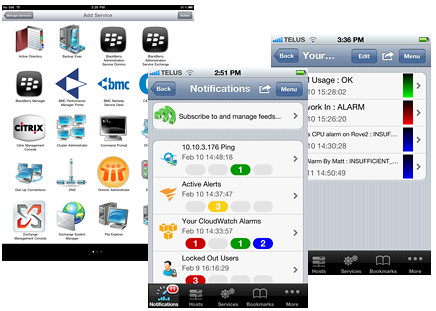
SolarWinds Mobile Admin lets IT staff BYOD

Monday, April 16th, 2012

If you can’t beat them, join them! After years of fighting the tide of consumerisation of corporate IT, IT staff can now cross over to the “Dark Side” and  – bring THEIR own device to work.

Pricing for SolarWinds Mobile Admin software starts at US$695 per license and includes the first year of maintenance. Download the free 30-day evaluation trial online to try it out.

SolarWinds Mobile Admin Version 7

SolarWinds Mobile Admin Version 7

With the consumerisation of IT, employees and (more significantly) CXOs are banging down the doors of the IT departments to be allowed to bring their choice of personal devices to work and to access the Enterprise IT systems with these gadgets.

IT staff can now "Bring Your Own Device" too!

IT staff can now "Bring Your Own Device" too!

A strict No-No in the past, mane enterprises and organisations have given in to the pressure and allowed BYOD (Bring Your Own Devices) into their IT policies.

Now, the IT personnel too can jump on the bandwagon too.

SolarWinds, a provider of IT management software, has acquired Rove and released version 7 of the latter’s Mobile Admin software.

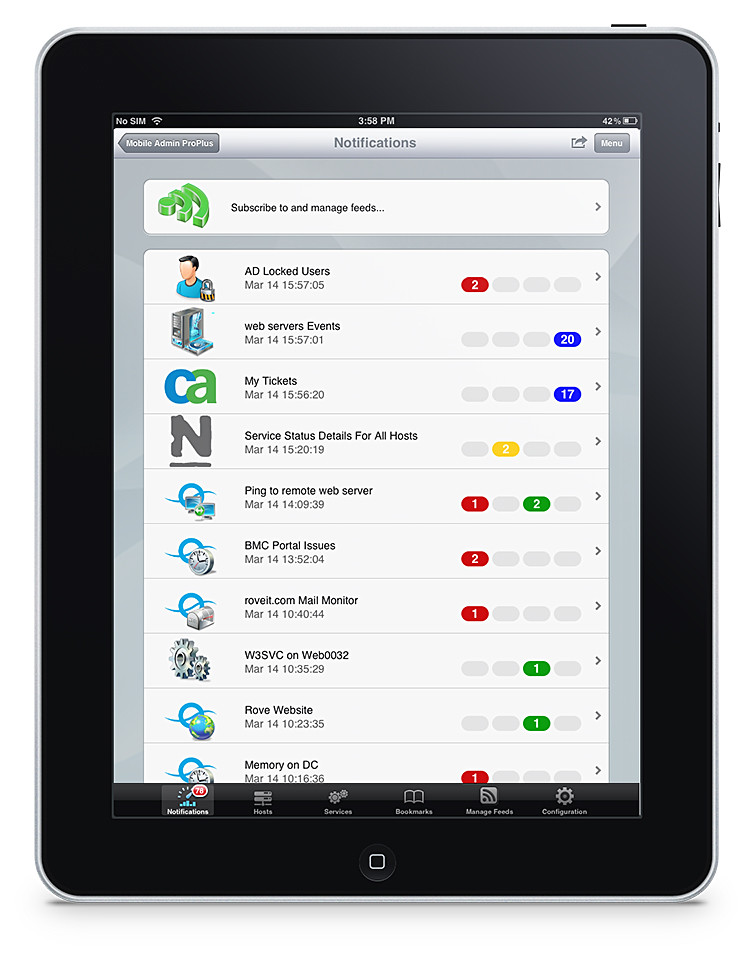
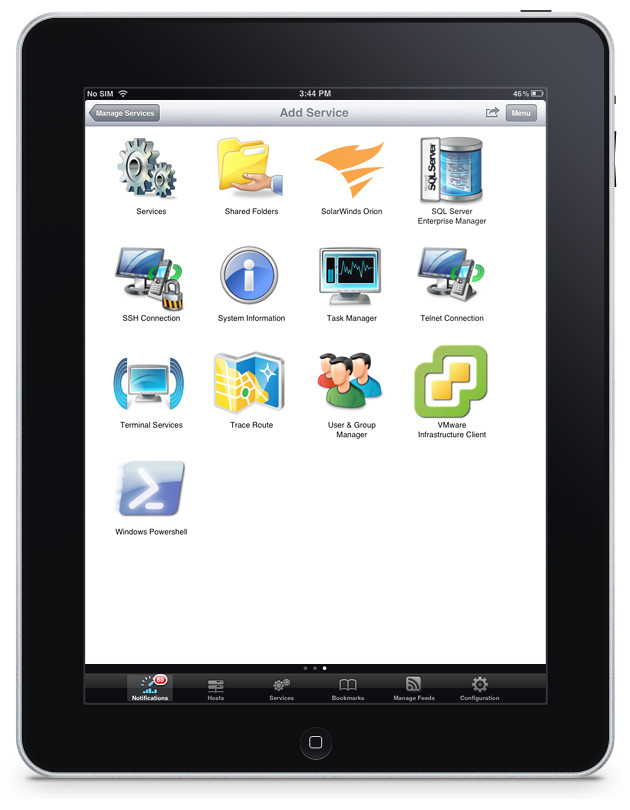
SolarWinds Mobile Admin software is designed specifically for mobile devices, with native applications for the most common mobile operating systems, and an extensive list of remote fix capabilities.

Now IT staff can also work with any device, from anywhere, anytime of the day (or night).

Mobile Admin works on iOS, Android and BlackBerry mobile devices.

Mobile Admin works on iOS, Android and BlackBerry mobile devices.

From the queues of a grocery store, or at the cafe with friends, an IT staff can manage a server on the other side of the world – resetting passwords and rebooting servers.

Mobile Admin is used by thousands of customers to monitor and manage their corporate IT infrastructure from their iPhone, iPad, Android smartphones and tablets, BlackBerry smartphones and PlayBook (OS2), and Kindle Fire.

In addition to dozens of third party systems and services, the latest version of Mobile Admin now adds support for Amazon EC2, Microsoft Active Sync, and SolarWinds network and server management products.

Some of the main features of SolarWinds Mobile Admin 7.0 are listed below.

(more…)

BlackBerry OS vs iOS vs Windows Phone vs Android

Monday, April 16th, 2012

Trend Micro has released the results of its study on the four main mobile operating systems in a report titled “Enterprise Readiness of Consumer Mobile Platforms”.

The security firm found the BlackBerry 7 OS the most secure mobile operating system, followed by iOS 5, Windows Phone 7.5, and Android 2.3.

Summary chart from “Enterprise Readiness of Consumer Mobile Platforms” White Paper by Trend Micro.

Summary chart from “Enterprise Readiness of Consumer Mobile Platforms” White Paper by Trend Micro.

Android 2.3 was used in the study because it was the dominant installed/supplied version of Google’s mobile OS at the time of the research.

Below is an excerpt from the White Paper summarising the findings about the four mobile platforms.

(more…)

US$1million for complete access to your computer?

Thursday, April 5th, 2012

Norton has unveiled the findings of its latest survey which provides insights into Singaporeans’ Internet dependence, the importance of their personal information and their level of understanding when it comes to Internet security.

Say it with numbers - from Norton's survey of Internet Security.

Say it with numbers – from Norton’s survey of Internet Security.

Last year, Norton did an interesting survey that revealed that phone owners in Singapore were willing to pay an average of S$148 to get their lost/stolen phones back, in order to alleviate the stress and inconvenience losing their mobile phones.

This year, Norton found that 76 percent of Internet users in Singapore would rather forgo US$1million than give strangers unlimited access to their computers.

The key findings are highlighted in the info-graphic above, while the details are at the end of this post.

Protection

So what does Symantec have to protect the multitude of PCs, Macs, smartphones and tablets in the modern household?

Norton will be offering Norton 360 Everywhere in the first half of 2012 (Pricing and systems requirements to be announced at launch).

Norton 360 Everywhere promises to be an easy-to-manage, all-in-one security solution that delivers a multi-platform solution for PCs, Macs, Android-based phones and tablets.

Users can customise their security to meet their specific needs, be it against online threats, data loss, and device loss or theft.

The details of the survey is excerpted below.

(more…)