Archive for the ‘Android’ Category

Seagate introduce GoFlexAccess app

Monday, May 23rd, 2011

The free GoFlexAccess app allows the iPhone, iPad and Android smartphones to access media shared on the Seagate’s GoFlex Home network storage system.

Seagate Technology LLCThe free app is now available for download from the iTunes Store and Android Market. The application can be found by searching for “Seagate” or “GoFlex” in either storefront using the computer or the app store on a iPad, iPhone, iPod touch or Android compatible mobile device.

Seagate’s GoFlex Home network storage server is designed as a simple to set up shared storage drive, which provides back up and sharing capabilities within a home network and is also accessible using remote access from a personal computer.
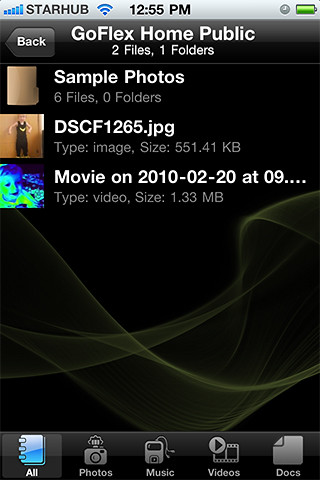
Seagate GoFlexAccess AppSeagate GoFlexAccess App

With the introduction of the GoFlexAccess app, the GoFlex Home network can be accessed from mobile devices as well.
  • The possibilities enabled by the GoFlexAccess  app include:
  • Access photos, movies, music and documents stored in the GoFlex Home network from an iPad, iPhone or Android smart phone.
  • Create slideshows from photos in the network drive and play music at the same time to accompany it.
  • Stream music or video to mobile devices over 3G/4G and WiFi.
  • large number of files and file types.
  • Album art support for music files.
  • Access Excel, PowerPoint, Word documents and PDFs etc.
  • The app features content type filters, to simplify access to content that may contain a large number of files and file types
Capacity SRP
1 TB S$219
2 TB S$319
3 TB S$379

Available in 1TB, 2TB and 3TB capacities, the GoFlex Home storage system allows files to be centrally stored, easily accessed and continuously backed up wirelessly from computers on the home network running either Windows or Mac OS X operating systems.

Storage capactiy of GoFlex Home system can be increased simply by connecting additional drives to the USB port. What’s more, this USB port can be used to wirelessly share a USB printer with all computers on the network.

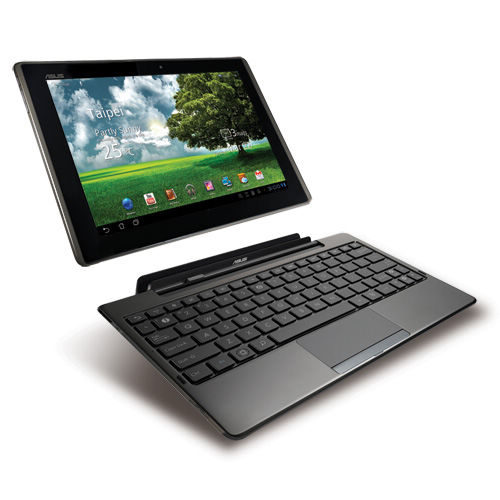
Asus Eee Pad Transformer TF101 arrives in Singapore

Friday, April 29th, 2011
The latest 10.1 inch Android 3.0 tablet from Asus arrived in Singapore today at the launch event at Zirca in Clarke Quay. The 16GB Wi-Fi only version (Eee Pad + Docking keyboard) is priced at S$898.

But as part of its launch promotion, you can get a S$99 discount at S$799. If you choose to purchase only the pad and not the docking station, you can get the 16GB Wi-Fi only version at the launch promotion price of S$699.
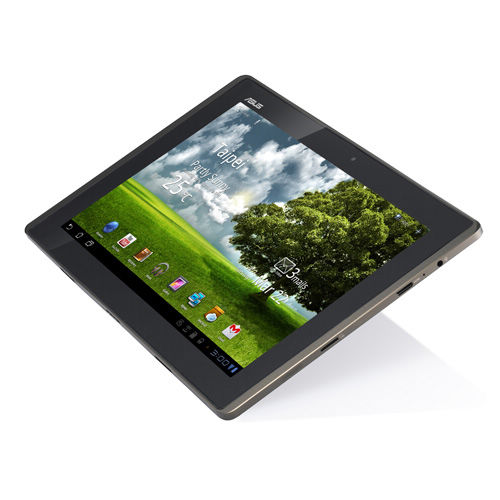
The Asus Eee Pad Transformer TF101 arrived in Singapore on April 29, 2011

The Asus Eee Pad Transformer TF101 arrived in Singapore on April 29, 2011

What are the biggest grouses of tablet users today? No Flash, short battery life, no keyboard, no USB ports and card readers. Asus tries to address all these shortcomings in the Asus Eee Pad Transformer TF101.

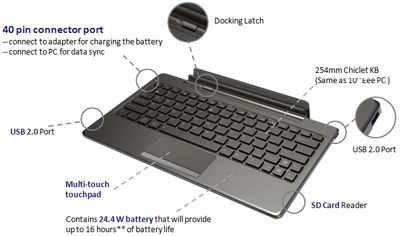
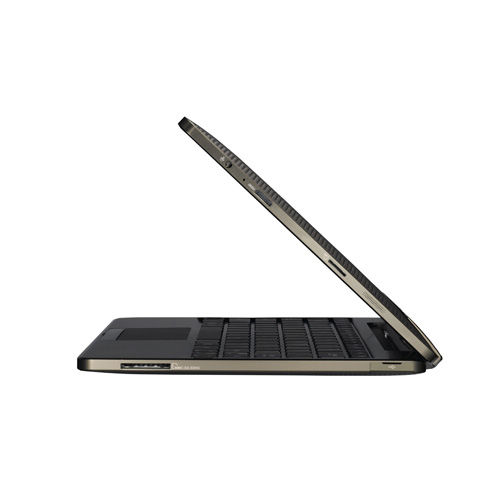
The optional docking station provides a full QWERTY keyboard for work involving intensive typing. It costs S$199 if you purchase it separately, but purchased together with the pad, you need only top up S$100 for it. The docking station makes available an additional 24.4 Wh battery that extends the pad’s 9.5 hours battery life to 16 hours instead.

A card reader (MMC/SD/SDHC) and two USB 2.0 ports are also available on the keyboard. The keyboard also props up the docked pad as a stand.

And finally, Adobe Flash 10.2 is supported, so you can visit all those glitzy sites running Flash animations and video.

The docking station is a full QWERTY keyboard that doubles up as a stand and contains an extra battery to extend the 9.5 hours battery life of the pad to 16 hours. It also contains USB ports and a card reader.

The docking station is a full QWERTY keyboard that doubles up as a stand and contains an extra battery to extend the 9.5 hours battery life of the pad to 16 hours. It also contains USB ports and a card reader.

I played with the Eee Pad on display and found the IPS (In-plane switching) LED backlight screen brilliant and sharp at with 1280×800 pixels packed into the 10.1 inch panel, offering a wide viewing angle of 178 degrees – I could still view the screen display from the side.

The touch screen senses up to 10 fingers for multi-touch - seen here with the Piano app from Android Market.

The touch screen senses up to 10 fingers for multi-touch - seen here with the Piano app from Android Market.

The pad feels slightly heavier than the iPad 2 but comfortable to hold. The book reader app included with the pad was standard fare – offering animated page turning, highlighting and bookmarking etc.

Photos and videos taken with the camera was clear even though the ambient lighting was dark.

Prices and configurations

The 16GB Wi-Fi only tablet is the only configuration available at the moment. Together with the docking station (keyboard), it sells for S$898 at the major retailers in Singapore – Challenger, Best Denki, Harvey Norman etc.

During this launch period, the promotional price for the 16GB Wi-Fi only Transformer sells for S$799 (Eee Pad + Docking station) and S$699 (Eee Pad only). Currently, the docking stations are out of stock and will only be available from the week of May 9 onwards.

The 32GB Wi-Fi only version will also only be available later in May.

“The 3G version is being tested now and will likely be launched in the second or third week of June,” Bernard Wen, Business Operation Manager of Asus Technology told me. “In the meantime, we’ve tested the Pad with USB dongles from SingTel, Starhub and M1 and found that they are all compatible,” he added.

Asus Eee Pad Transformer TF101 launch in Singapore tomorrow

Thursday, April 28th, 2011
Another tablet arrives in Singapore tomorrow – this time from Asus, the Taiwanese company that created the netbook niche. This Android-based tablet tries to redefine the tablet experience by packaging it with a docking keyboard cum extra battery.

Will update on the actual use and feel after the launch event tomorrow.

The Asus Eee Pad Transformer has a 10.1″ LED backlight WXGA (1280×800) screen and a docking QWERTY keyboard which also serves as a tablet stand, provides USB ports  and contains an extra 24.4 Wh battery that extends the 9.5 hours battery life of the tablet to 16 hours.

Asus Eee Pad Transformer TF101 launch in Singapore

The screen is IPS (In-plane switching) Panel which typically has a wider view angle than a traditional LCD screen – Asus boast a wide view angle of 178° for this screen. Apple’s iPad also uses an IPS panel.

The 10.1 inch screen screen is an IPS that provides a wide viewing angle of of 178 degreesThere is a 1.2M pixel front Camera and a 5M pixel rear Camera. The standard range of sensors are included: G-Sensor, Light Sensor, Gyroscope, E-Compass, GPS.
The Transformer is based on the Android 3.0 Honeycomb OS and supports Adobe Flash 10.2. It has an NVIDIA Tegra 2 1.0GHz dual-core CPU which provides multitasking and 1080p video playback.

Memory-wise, it has 1 GB RAM and comes in either 16 or 32 GB versions for permanent storage. Unlimited ASUS Webstorage is included free for a year.

Network-wise, it is fairly standard with WLAN 802.11 b/g/n at 2.4GHz and Bluetooth V2.1+EDR. What is conspicuously missing is a 3G version so you’ll probably need a mobile broadband USB dongle or a Wi-Fi network to access the Internet.

The docking QWERTY keyboard extends battery life to 16 hoursThe docking keyboard comes with two USB 2.0 ports, one card reader (MMC/SD/SDHC) and a touch pad. It can be purchased in the UK for an additional £50 and in the US for an additional US$149 over the base price of the tablet alone.

The tablet itself contains one 2-in-1 Audio Jack (Headphone/Mic-in), one Micro SD Card Reader, and one mini HDMI 1.3a for outputting the display onto an external HD screen. Stereo speakers are built in.

Physically, the tablet measures 271 x 171 x 12.98 mm and weighs 680 g.

The Transformer was first launched in Taiwan on March 25, then in the UK on March 30, and two days ago in the US on April 26. Prices in the US are $100 less than the “equivalent” iPad model.

US Prices

  • 16 GB: US$399
  • 32 GB: US$499
  • Keyboard: US$149

Android compatibility for the PlayBook

Saturday, April 2nd, 2011
Having had only 25,000 apps in BlackBerry App World, RIM’s PlayBook will tap the 150,000 apps in the Android Market to give it a headstart, while ramping up the number of PlayBook specific apps to stand against the staggering 350,000 apps in Apple’s App Store.

RIM launches the PlayBook on April 19RIM will be opening the PlayBook to Android apps to provide customers a wider choice of apps.

Software tools for making Android apps work on the PlayBook will be available this summer, Tyler Lessard, head of RIM’s developer relations told Bloomberg in an interview.

Android is the world’s fastest-growing smartphone platform and is also gaining market share for tablet computers, based on data on global shipments from Strategy Analytics below.

Percentage of global shipments Android iPad
Oct to Dec 2010 22 % 75%
Jul to Sep 2010 2.3 % 95 %

Although developers can port Android apps for the PlayBook, Lessard states that developers should still create programs specifically for the PlayBook to make the most of its multimedia performance and ensure their apps work as well as possible.

Bloomberg reports that “Dozens” of games for the PlayBook will be released this year through Unity Technologies’s Union game development tool.

RIM readies itself for launch of its PlayBook

Friday, April 1st, 2011
RIM positions PlayBook to capture market share from its Apple and Android tablet rivals from the consumer market, even as it opens up for Android app compatibility and ramps up on building its own ecosystem of PlayBook specific apps.

Research In Motion (RIM) whose BlackBerry smartphone was a hit with corporate customers, is also targeting developers of consumer applications, including games and magazines.

The 7-inch tablet will be preloaded with applications such as Tetris – my favourite game on an Apple Macintosh during my college days, and the Kobo e-book reader.

An online version of Pro Football Weekly magazine will also be available for sports aficionados.

The display was superb and performance lightning fastThe PlayBook goes on sale in the US on April 19 and will feature a new operating system, a dual-core processor, and the capability to play applications for Google’s Android platform.

I had the chance to play with a beta release version of the PlayBook when it was first brought to Singapore three weeks ago and the display not only looked great, the processor was lightning fast, multi-tasking 8-10 CPU/graphics-intensive apps without showing any latency.

Although RIM has not been as successful as Apple or Google in attracting independent developers to write consumer apps for the BlackBerry, it is trying to rectify this with the PlayBook.

Hugo Miller from Bloomberg quoted Travis Boatman, senior vice president at Electronic Arts as being impressed with the PlayBook.

“It’s one of the fastest devices out there … You take a good software environment and great hardware, you’ve got a device that designers and developers can create great content on.”

The Redwood City, California-based company will release “Tetris” and “Need for Speed Undercover,” a car racing game, on the PlayBook.

Research In Motion launches the PlayBook on April 19RIM will be opening the PlayBook to Android apps to provide customers a wider choice of apps. There are more than 150,000 apps in the Android Market, compared with more than 25,000 in BlackBerry App World and more than 350,000 in Apple’s App Store.

“We are absolutely targeting the consumer, personal apps market as much if not more because there is such a vast market out there,” Tyler Lessard, head of RIM’s developer relations told Bloomberg in an interview.

Polar Mobile, a Toronto-based developer of apps for magazines including Time, GQ and Sports Illustrated, is building over 100 PlayBook apps including Pro Football Weekly, that will be ready in July, said Polar CEO Kunal Gupta.

Like other newcomers to the tablet scene, the PlayBook will be hoping to chip away at the market share of Apple, the market leader who has enjoyed little competition since the launch of its iPad in April 2010.

Analysts estimate that Apple has shipped more than 15 million iPads so far, and sold about 500,000 of the newly launched iPad 2, over its March 11 debut weekend.

HTC and Acer switch fortunes as smartphones and tablets outmode netbooks and PCs

Thursday, March 31st, 2011
HTC is now valued at 22.2 times reported earnings, compared with 10.6 for Acer. Only in February last year, HTC had a PE ratio of 11 times, while Acer was at 22.

Taipei-based HTC is the world’s largest maker of handsets using operating systems from Google and Microsoft. Acer is the world’s second-largest manufacturer of personal computers.

HTC makes Android and Windows Mobile smartphonesThe wheel of fortune for the two companies seems to have turned as sales of smartphones and tablet computers grew at the expense of notebooks and personal computers.

Prior to the explosive growth, set off by Apple, of the smartphone and tablet sector, Acer had snatched the lead from Asus for a similarly explosive growth in the netbook sector.

From HTC’s low in February last year, it has rallied some 264 percent, while Acer has fallen by 36 percent. According to Kevin Chang from Citigroup, Acer is the biggest seller of consumer notebooks in the developed world.

Acer won the pole position for the netbook market from AsusIn a report dated March 28, Chang wrote that “Consumers are not buying notebooks because they have already spent money on new tablet PCs or on upgrading their handsets from feature phones to smartphones.” He adds that Acer could become “a much smaller company in the next few years,” if tablet PC sales grow to exceed those for notebooks.

Not surprisingly, Chang has a “sell” rating on Acer’s stock and a “buy” recommendation on HTC.

A March 24 report from the Goldman Sachs Group estimates that HTC’s market worth may reach $100 billion in the next three to five years from $30 billion now, as the company ships a possible 200 million smartphones and 30 million tablet computers a year.

HTC’s value has quadrupled since reaching a low of $7.4 billion in February last year, while Acer’s market capitalization has declined to $5.6 billion from a peak of $9.4 billion reached in January 2010.

Amazon beats Apple and Google to music streaming service

Wednesday, March 30th, 2011
Amazon launches the service ahead of rivals Apple and Google who are both preparing to release similar services.

Amazon unveiled Cloud Player – its music streaming service that allows users to buy tracks, store them on the company’s servers and play them on Android smartphones and browsers on computers.

Amazon targets cloud storage for consumersMusic libraries can be uploaded to Amazon’s new Cloud Drive, which provides 5 gigabytes of free memory space. Users who purchase an album from Amazon.com will have their Cloud Drive space upgraded to 20 gigabytes. This can can be used to store music, photos, videos and other digital files.


The service targets users who find it a hassle to download music to their work computer or phones because they find it hard to move music around to different devices.

It is unlikely that the service will win over existing customers of iTunes since Apple’s own music streaming service will likely be launched soon.

Observers believe Amazon’s sights are well beyond the music arena. It is hoping to capture market share of users storing their data online. They want to get – not just music – but the user’s entire hard drives on its cloud.

Apple WWDC 2011 sold out almost immediately

Tuesday, March 29th, 2011
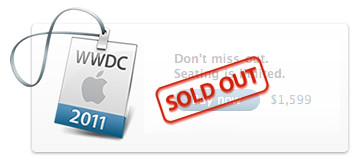
As expected, tickets for the Worldwide Developers Conference (WWDC) this year were sold out even faster than last year’s 8 days. Tickets, priced at US$1,599, were sold out almost immediately when sales commenced.
Apple WWDC 2011 tickets sold out
Slated to be held from June 6 – 10 at San Francisco’s Moscone West, there is much speculation on whether the iPhone 5 will be launched during the conference. There is also chatter on whether the iOS5 and new Mac OS Lion will be released during the conference. 

At any rate, the rapid sell-out of the tickets indicate that the popularity of the Apple ecosystem is showing no signs of losing its momentum, even in the face of competition from Android-based devices and the resurgence of devices based on Windows Phone 7, HP’s webOS and RIM’s BlackBerry Playbook.