Archive for the ‘Phones’ Category

BlackBerry Torch 9800 Review

Monday, April 18th, 2011
RIM touts the Torch as the best BlackBerry ever. I’ve been using one over the last two weeks. Indeed, it’s the best BlackBerry smartphone I’ve played with so far and I certainly prefer it over my wife’s BlackBerry Bold.

The BlackBerry Torch was the first smartphone from Research In Motion (RIM) that shipped with the new BlackBerry OS 6. It has a completely new keyboard implementation – instead of having the physical keyboard and the screen share the face of the device, the Torch allowed the 3.2 inch screen to hog the entire front.
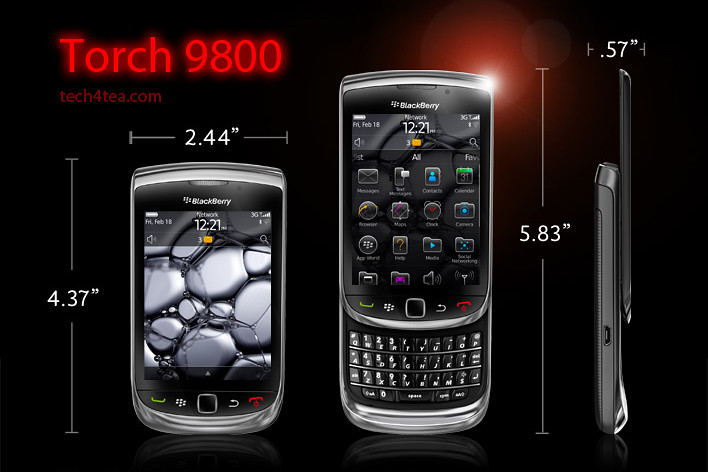
 

BlackBerry Torch 9800 with 6.0 Operating System.

BlackBerry Torch 9800 with 6.0 Operating System.

An on-screen keyboard – which I found rather responsive – can be easily called up in case you need to type something. Need the traditional QWERTY keyboard to do some intensive typing? Slide it out from below the screen and you’re good to go.

It’s a trade-off, whether you have the hard keyboard readily available all the time or hide-in below the screen to make for a bigger screen.

For my usage profile, at least, I liked the balance – I do a fair bit of messaging and typing but I don’t mind having to slide out the keyboard when I need it – since I get a bigger screen real estate – 480×360 pixels on a 3.2 inch capacitive touch screen.

I did find the Bold keyboard slightly easier to type than on the Torch, but both are far more tactile and better than typing on a touch screen.

I suppose those who really have a lot of typing to do would rather have the keyboard available at all times – it depends on your usage profile. The Torch tries to give you both the large screen of the Storm and the popular hard keyboard in a compact body.

The hardware

The form factor is almost identical to many other BlackBerry devices like the Bold. The usual five buttons line the bottom of the screen: BlackBerry call, menu, back, and end buttons and optical trackpad.

The Marvell CPU runs at 624MHz (though the company claims this is a newer generation chip), with 512 MB RAM and 4 GB of storage. You can add up to 32 GB though the microSD slot. The device also comes with 802.11b/g/n WiFi, Bluetooth 2.1 and an AGPS chip.

Photos were rather impressive for a phone camera

Photos were rather impressive for a phone camera

The Torch has a 5 megapixel camera, with an LED flash. Photo quality was rather remarkable for a smartphone camera.  I like the preset scene modes – Party mode for lowlight indoor shooting and Sports mode both yielded impressive results. Video wise, you can shoot clips at 640×480 resolution.

New OS and interface

With the new OS 6, web browsing on the Torch is now quite a pleasant experience using the new Webkit-based browser. Unfortunately, neither Flash nor HTML5 video are supported.

I really love the persistent notification alert bar at the top of the home screen: the small row of icons allows you to see social networking, email, SMS, call, and calendar alerts all in one place. The bar drops down a separate window to show the list of notifications, each of which can be clicked on to bring you to the app.

11 scene modes are available for taking photos under different situations

11 scene modes are available for taking photos under different situations

Another new feature I like is the universal search. Ever wanted to look for something you know is on your phone but can’t recall exactly where it is located and how to get at it? Simply begin typing the relevant search term into the search box and the Torch throws the icon for it right at you – almost instantaneously. It really beats having to wade through the menus and interface looking for contacts, messages, calendar, music or pictures.

has included a powerful universal search alongside a social networking tool which allows you to aggregate RSS feeds and services like Twitter or Facebook into a single view. There are a lot of changes, so we’re going to go step-by-step through what we consider the biggest changes for the BlackBerry platform.

Battery life

As with other BlackBerry devices I’ve tested before, battery seems to last forever. Alright, that’s exaggerating. There were days when I ran Youtube videos and videos from the media folder for extended periods of time and the battery held out. Under normal usage, I only had to recharge the battery every few days.

BlackBerry Torch 2

There’s been numerous leaks about what the upcoming BlackBerry smartphones lined up for 2011. One of them is the Torch 2. Expected to be announced during the BlackBerry World in May and released in the US in July, it looks physically like the Torch, but features a 1.2 GHz processor and a 640×480 resolution on a similarly-sized 3.2 inch screen.

Going by previous BlackBerry release schedules, we’ll probably only see the Torch 2 in Singapore towards the end of the year.

In the meantime, if you’re looking at replacing your current BlackBerry phone, do give the Torch a spin and see if it impresses you enough for you to pick one up as replacement.

BlackBerry Torch 2 sneak peek

Sunday, April 17th, 2011
The BlackBerry Torch 2 is rumoured to be announced during the BlackBerry World in May and then go on sale in the US in July later this year. With the release of the PlayBook tablet next Tuesday in the US, RIM has a few more models in line to keep its fanbase riveted for the rest of the year.

Photo of BlackBerry Torch 2There has been plenty of leaks from RIM (Research In Motion) about upcoming BlackBerry models for 2011. These include the BlackBerry Touch (Monaco/Monza), Bold Touch, Storm 3, Bold (Dakota), Curve (Apollo), and the Torch 2.

Having gotten hold of a Torch 2, BGR reports that the new device looks almost identical to its predecessor but features a significantly more powerful 1.2 GHz processor. Coupled with the BlackBerry OS 6.1 and a 3.2 inch 640×480 VGA display, it will be an exciting gadget to own.

Processor power has been doubled from the current 624 MHz, and the 3.2 inch screen runs at a higher pixel resolution than the 480×360 pixels on the current BlackBerry Torch.

Going by previous BlackBerry release schedules, we’ll probably only see the Torch 2 in Singapore towards the end of the year.

The main specifications of the Torch 2 are listed below:

  • CPU – 1.2 GHz processor
  • Display – 3.2″ VGA (480 x 640) capacitive touchscreen display
  • Radio – Quad-band GSM/GPRS/EDGE ; Tri-band HSPA 14.4Mbps
  • Memory – 8GB storage + 512MB RAM + up to 32GB MicroSD
  • Connectivity – WiFi, Bluetooth, NFC
  • Camera – 5 megapixels
  • Battery – 1300MAh battery
  • Thickness – 14.6mm thick
  • Sensors – magnetometer, digital compass

BlackBerry PlayBook preview in Singapore

Friday, April 15th, 2011
The BlackBerry PlayBook Bus will tour Singapore tonight, showing off a preview of RIM’s 7-inch tablet computer, that is due to be launched in the US on 19 April next Tuesday.
Preview of the BlackBerry PlayBook in Singapore

Preview of the tablet on the BlackBerry PlayBook Bus in Singapore

Keep a lookout for the limo bus driving around town tonight. Sources tell me it will launch from the Tanjong Pagar area. The first time that the BlackBerry PlayBook debuted in Singapore was back in March. But the two devices I played with were still beta release versions.

Tonight, the preview will provide some hands-on for the real McCoy. Perhaps RIM (Research In Motion) will also provide some hints as to when the aspiring challenger to the iPad will be launched in Singapore and at what pricing.

For now, here’re some of the main specs of the BlackBerry PlayBook:

Looks
7″ LCD display, 1024 x 600 WSVGA Multi-touch capacitive screen

Physical feel
0.9 lbs (425g) and 5.1″ x 7.6″ x 0.4″ (130mm x 194mm x 10mm)

Performance
1 GHz dual-core processor
1 GB RAM
Symmetric multi-processing
Full Adobe Flash 10.1 enabled
Built-in support for HTML 5

Configuration
Internal storage of 16, 32 or 64 GB
GPS, Orientation Sensor (Accelerometer), 6-Axis Motion Sensor (Gyroscope), Digital Compass (Magnetometer)
Stereo speakers and stereo microphones
Wi-Fi (802.11 a/b/g/n) connectivity, Wirelessly connect to your BlackBerry smartphone for real time access to: Email, calendar, address book, task list and BBM

Cameras
3 MP high-definition forward-facing camera
5 MP high-definition rear-facing camera
Codec support for superior media playback, creation and video calling
1080p HD video; H.264, MPEG4, WMV HDMI video output
Micro USB and Micro HDMI ports
Video calling with dual video cameras

BlackBerry Tablet OS
Powered by QNX technology, supports POSIX OS, SMP, Open GL, BlackBerry 6, WebKit, Adobe Flash, Java and Adobe Mobile AIR

Adobe Creative Suite 5.5 Web Premium suite

Wednesday, April 13th, 2011

Adobe Creative Suite 5.5 Web Premium suite is a major mid-cycle update to the software for Web designers and developers. The new version give Web professionals the ability to bring high-impact content experiences and mobile apps to the latest form factors across Android, BlackBerry Tablet OS and iOS platforms.

New in the suite are updated versions of Adobe Dreamweaver, Adobe Flash Professional, Adobe Flash Catalyst, Adobe Flash Builder, the all-new Flex framework for mobile devices, Adobe Device Central and Adobe Acrobat X Pro.

Key enhancements include substantive HTML5 advancements in Dreamweaver, new tablet and smartphone application development capabilities in Flash Professional CS5.5 and Flash Builder Premium 4.5, and enhanced cross-browser testing as well as mobile emulation and on-device debugging.

Estimated street price for the Creative Suite 5.5 Web Premium suite is US$2185. It is one of five suite editions of the Creative Suite 5.5 line of software.

Advances in HTML5

Web Premium CS5.5 advances HTML5 authoring tools, enabling Web designers and developers to create browser-based content that gives end-users a seamless and immersive experience across virtually any screen.

New HTML5 support in Dreamweaver CS5.5 includes jQuery mobile framework integration for browser-based content and PhoneGap integration for native and mobile application design and development.

Enhancements to the multiscreen preview panel in Dreamweaver have also been made, supporting the latest in media queries, WebKit engine updates, and CSS3 attributes, enabling side-by-side renderings of what a single design looks like on different form factors.

“With Adobe the jQuery project has spent a significant amount of time researching and developing user interfaces for mobile browsers, the final result being the creation of the jQuery Mobile framework,” said John Resig, founder of the jQuery Project.

Enhanced Flash tooling

New additions in Flash Professional CS5.5 include content scaling so users can easily scale their content on stage to adapt to different screen sizes, which is a huge timesaver.

Flash Professional CS5.5 also includes a new shared assets feature for more streamlined publishing, as well as more than 20 new code snippets for creating mobile and Adobe AIR applications for accelerometer, multitouch gestures, and save/load data.

Enhanced Application Development for Mobile Devices

Adobe CS5.5 Web Premium includes new mobile application development support to deliver rich interactive applications to the latest Android, BlackBerry Tablet OS and iOS devices.

In the updated Flash Builder 4.5, users have new mobile support for ActionScript and mobile Flex projects, as well as improved designer-developer collaboration throughout application development with a new bi-directional workflow with Flash Catalyst CS5.5 and Flash Professional CS5.5.

New capabilities in Adobe Flash Builder 4.5, Flash Professional CS5.5 and the introduction of the Flex 4.5 framework for mobile devices, let designers and developers build mobile applications that run on iPhone, iPad, Android devices and BlackBerry PlayBook. The apps can be easily deployed through the application markets such as Apple’s iTunes App Store, Android Market and BlackBerry App World.

Enhanced Browser Compatibility Testing

To keep Web developers and designers ahead of rapidly changing technology, Web Premium CS5.5 includes new HTML5 emulation and support for the latest mobile devices in Adobe Device Central, software that simplifies the production of innovative and compelling content for mobile phones and consumer electronics devices.

Adobe BrowserLab, a key component of Adobe CS Live online services, has also been updated for cross-browser compatibility testing for the newest browsers to help ensure Web projects are accurately previewed across a spectrum of browsers.

Adobe CS Live online services are free until April 12, 2012.

Company byte: Nokia

Friday, April 8th, 2011

Nokia is a global leader in mobile communications whose products are used by more than 1.3 billion people around the world.

Nokia Corporation, global leader in mobile communicationsNokia Corporation is a Finnish multinational corporation with 132,000 employees in 120 countries and sales in more than 150 countries.

Nokia Corporation, global leader in mobile communications

Nokia Corporation, global leader in mobile communications

First established as a ground wood pulp mill in 1865, Nokia only produced its first electronic device in 1962 – a pulse analyser for nuclear power plants.

Since 1998, it has been the world’s largest manufacturer of mobile phones.

In 2010, it had a global annual revenue of over 42 billion Euros and operating profit of 2 billion Euros.

Information extracted from Wikipedia.

RIM readies itself for launch of its PlayBook

Friday, April 1st, 2011
RIM positions PlayBook to capture market share from its Apple and Android tablet rivals from the consumer market, even as it opens up for Android app compatibility and ramps up on building its own ecosystem of PlayBook specific apps.

Research In Motion (RIM) whose BlackBerry smartphone was a hit with corporate customers, is also targeting developers of consumer applications, including games and magazines.

The 7-inch tablet will be preloaded with applications such as Tetris – my favourite game on an Apple Macintosh during my college days, and the Kobo e-book reader.

An online version of Pro Football Weekly magazine will also be available for sports aficionados.

The display was superb and performance lightning fastThe PlayBook goes on sale in the US on April 19 and will feature a new operating system, a dual-core processor, and the capability to play applications for Google’s Android platform.

I had the chance to play with a beta release version of the PlayBook when it was first brought to Singapore three weeks ago and the display not only looked great, the processor was lightning fast, multi-tasking 8-10 CPU/graphics-intensive apps without showing any latency.

Although RIM has not been as successful as Apple or Google in attracting independent developers to write consumer apps for the BlackBerry, it is trying to rectify this with the PlayBook.

Hugo Miller from Bloomberg quoted Travis Boatman, senior vice president at Electronic Arts as being impressed with the PlayBook.

“It’s one of the fastest devices out there … You take a good software environment and great hardware, you’ve got a device that designers and developers can create great content on.”

The Redwood City, California-based company will release “Tetris” and “Need for Speed Undercover,” a car racing game, on the PlayBook.

Research In Motion launches the PlayBook on April 19RIM will be opening the PlayBook to Android apps to provide customers a wider choice of apps. There are more than 150,000 apps in the Android Market, compared with more than 25,000 in BlackBerry App World and more than 350,000 in Apple’s App Store.

“We are absolutely targeting the consumer, personal apps market as much if not more because there is such a vast market out there,” Tyler Lessard, head of RIM’s developer relations told Bloomberg in an interview.

Polar Mobile, a Toronto-based developer of apps for magazines including Time, GQ and Sports Illustrated, is building over 100 PlayBook apps including Pro Football Weekly, that will be ready in July, said Polar CEO Kunal Gupta.

Like other newcomers to the tablet scene, the PlayBook will be hoping to chip away at the market share of Apple, the market leader who has enjoyed little competition since the launch of its iPad in April 2010.

Analysts estimate that Apple has shipped more than 15 million iPads so far, and sold about 500,000 of the newly launched iPad 2, over its March 11 debut weekend.

HTC and Acer switch fortunes as smartphones and tablets outmode netbooks and PCs

Thursday, March 31st, 2011
HTC is now valued at 22.2 times reported earnings, compared with 10.6 for Acer. Only in February last year, HTC had a PE ratio of 11 times, while Acer was at 22.

Taipei-based HTC is the world’s largest maker of handsets using operating systems from Google and Microsoft. Acer is the world’s second-largest manufacturer of personal computers.

HTC makes Android and Windows Mobile smartphonesThe wheel of fortune for the two companies seems to have turned as sales of smartphones and tablet computers grew at the expense of notebooks and personal computers.

Prior to the explosive growth, set off by Apple, of the smartphone and tablet sector, Acer had snatched the lead from Asus for a similarly explosive growth in the netbook sector.

From HTC’s low in February last year, it has rallied some 264 percent, while Acer has fallen by 36 percent. According to Kevin Chang from Citigroup, Acer is the biggest seller of consumer notebooks in the developed world.

Acer won the pole position for the netbook market from AsusIn a report dated March 28, Chang wrote that “Consumers are not buying notebooks because they have already spent money on new tablet PCs or on upgrading their handsets from feature phones to smartphones.” He adds that Acer could become “a much smaller company in the next few years,” if tablet PC sales grow to exceed those for notebooks.

Not surprisingly, Chang has a “sell” rating on Acer’s stock and a “buy” recommendation on HTC.

A March 24 report from the Goldman Sachs Group estimates that HTC’s market worth may reach $100 billion in the next three to five years from $30 billion now, as the company ships a possible 200 million smartphones and 30 million tablet computers a year.

HTC’s value has quadrupled since reaching a low of $7.4 billion in February last year, while Acer’s market capitalization has declined to $5.6 billion from a peak of $9.4 billion reached in January 2010.

RIM’s First-Quarter forecasts behind estimates

Friday, March 25th, 2011

Research In Motion (RIM), maker of BlackBerry smartphones, has forecast first-quarter revenues and profits that fail to meet analysts’ estimates. Its launch of new models like the Torch has failed to stop a slide in its market share.

The average of analysts’ estimates were compiled by Bloomberg for comparison. Below are the key numbers:

First Quarter Forecast RIM Analysts average estimate
Profit per share $1.47 – $1.55 $1.66
Revenue $5.2 – 5.6 billion $5.65 billion
Gross Margin (% sales after production costs) 41.5% 42.7%
BlackBerrys shipped (4th Qtr) 14.9 million 15 million

In the meantime, Bloomberg quotes Pierre Ferragu from Sanford C. Bernstein & Co as saying that “The company’s sales in the high end have been shrinking for the last 12 months, even if the launch of the Torch has slowed down the trend in the last two quarters.”

Although RIM has traditionally been the darling of large corporations because of its secure messaging, it has seen customers adopting rival devices.

Hugo Miller of Bloomberg reports that JPMorgan Chase, Bank of America and Citigroup are some of the banks that has begun testing iPhones and Android devices late last year, according to at least three people familiar with the trials.

The table below summarises how RIM’s share of worldwide smartphone sales has slipped from a year earlier, compared to its rivals.

Worldwide smartphone marketshare RIM Apple Android
4th Qtr 2010 14% 16% < 11%
4th Qtr 2009 20% 16% 16%

RIM PlayBook debuts in US on April 19

RIM will be launching the PlayBook in the US on April 19, while the company is already taking orders.The company revealed that the tablet would be able to play apps from Google’s Android.

The PlayBook will strive to chip at the huge market share that Apple has enjoyed with its iPad and iPad2.

The iPad has has a full year’s headstart over the PlayBook and has sold over 15 million units so far. Apple also claims that 65 percent of Fortune 100 companies are testing or deploying the iPad, including Procter & Gamble.

This is the same market sector that RIM targets.

Adobe launches Photoshop Express 2.0 for iOS

Thursday, March 17th, 2011

Adobe has announced the release of the free Photoshop Express 2.0 for iOS devices, as well as a new $3.99 Adobe Camera Pack that you can purchase from within Photoshop Express.

Photoshop Express 2.0 (free) and Adobe Camera Pack ($3.99) Adobe Photoshop Express has more than 20 million subscribers on iOS and Android devices. It provides easy-to-use features for capturing, organising, editing and sharing of photos on popular social networks like Facebook, giving users on the road the ability to work on their digital photos on smartphones and tablets.

Adobe Photoshop Express 2.0 for iOS devices can be downloaded free on the Apple iTunes Store. From within the app, you can purchase the new Adobe Camera Pack which includes the following features.

Reduce Noise: Removes and smooths out grain and speckling from photos to improve them.

Self Timer: Set a camera timer to three or 10 seconds to control when a photo is to be recorded.

Auto Review: Provides a quick look at photos taken before saving or deleting it.

Photoshop Express 2.0 requires iOS 4.2 or later. To use the Adobe Camera Pack, customers must have an iPhone 3Gs, iPhone 4, iPod Touch (3rd or 4th generation), or an iPad or iPad 2 (note that Photoshop Express does not include support for the iPad 2 camera at this time).

Adobe Refresh Roadshow in Singapore

Thursday, March 10th, 2011
Two product “evangelists” and the Product Manager of Flash Professional show designers and attendees how to design once but deploy to different hardware and software platforms and screen sizes.

Instead of designing for the standard desktop monitor at standard screen resolutions, end-users are accessing web content using a whole range of devices with different screen sizes/resolutions, and on different hardware and software platforms.

Adobe Refresh Roadshow on 10 Mar 2011 in SingaporeThese devices range from the traditional PC to the whole range of smartphones and more recently the tablets and web TVs.

Richard Galvan, Product Manager - Flash ProfessionalFlash Professional Product Manager, Richard Galvan, went through the trends of the day and predicted that the number of people surfing the Internet using smartphones and tablets will surpass the number using PCs by 2013 – maybe earlier.

He demonstrated how the existing and upcoming versions of Adobe’s Flash Professional and Flex application development platform facilitates the ability to develope apps only once but deploy to devices running different operating systems such as Google’s Android, Apple’s iOS and RIM’s BlackBerry.

Paul Burnett, APAC Evangelist - Adobe Systems IncMichael Stoddart, APAC Evangelist - Adobe Systems IncThe product “evangelists” Paul Burnett and Michael Stoddart also illustrated how the software assisted coders by providing features such as code hints, code completion and code snippets – so much so that even designers could have a go at the coding.

RIM's BlackBerry Playbook  displayed in Singapore for the first time.Some of the sneak peeks of features being explored for future products were also presented. Some of these were first shown in Adobe Max 2010 developer conference in October last year.

The beta version of the BlackBerry Playbook, which made its first appearance during Adobe Max, was also displayed for the first time in Singapore.

Photoshop on a tablet?

Photoshop on a tablet?

Galvan also gave a demo on the recently released Wallaby – an experimental piece of software for converting Flash files into HTML5.

The simple animation he converted were identical before and after conversion – handy for banner ads without audio, video, or ActionScript.

Multi-touch interface for a future version of Photoshop?

Multi-touch interface for a future version of Photoshop?

Galvan believed that Flash and HTML5 were complementary instead of being mutually exclusive. He emphasised that Flash and HTML5 will continue to complement each other into the future, with Flash providing additional features and capabilities to HTML5 based content.

The roadshow was held at the NTUC auditorium at One Marina Boulevard from 8.30am to 5.30pm.