Archive for the ‘Phones’ Category

Flash-to-HTML5 conversion tool from Adobe

Wednesday, March 9th, 2011
At long last, Adobe has released an experimental piece of software codenamed Wallaby that can convert Flash files into HTML5. It’ll be interesting to see how the Flash vs HTML5 rivalry pens out.

HTML5 logoThis tool was first demo-ed at Adobe Max 2010 developer conference in October last year. The cross-platform AIR app is available for free download as a technology preview for developers.

Wallaby allows Flash developers to deployFlash content on Apple iOS devices like iPads and iPhones, which has banned Flash on Steve Jobs’ accusations that it is vulnerable to exploits, battery draining, and prone to frequent crashes.

Flash logoFLA files from Flash can be instantly converted to HTML5 by a simple drag-and-drop. The HTML can then be edited in Dreamweaver or any HTML authoring tool.

Tom Barclay, senior product manager for Flash pointed out that not all elements from Flash files will make it into HTML5. Although the overall look and feel can be ported, much will be discarded in the migration.

The Wallaby Release Notes describe what features are supported, what differences we have already discovered between the various browsers, what device variations have been found, and any currently known issues.
Adobe logo What is thrashed: audio, video, ActionScript, as well as blend modes and filters (apart from simple alpha), dynamic masks, some Text Layout Framework text, and 3D tweens and transforms.

What is supported: vector art and images, classic text, keyframes, MovieClips and graphics, classic motion and shape tweens, rollover buttons, and instance names.

Immediate application of the tool would mainly be for making basic banner ads and animations, especially if the FLA files have already been developed.

iAds ProducerApple had released iAd Producer in December last year. It is a free tool “for online advertisers to create content for Apple’s iAd platform, helping the company to establish HTML5 as a viable alternative to Adobe Flash technology on mobile devices,” wrote Daniel Ionescu of PCWorld.

iAd Producer is a visual HTML5 authoring tool, available to Apple developers for producing advertisements for iOS devices, using a combination of HTML5, Javascript and CSS3.

Apple app (Free): Send Chinese New Year greetings in SMS and email

Wednesday, January 26th, 2011
Choose from a long list of pre-canned Chinese New Year greetings and well-wishes and send them as an SMS or email.

As an alternative or complement to traditional paper Chinese New Year cards, many have been sending well-wishes on SMS on the morning of the actual day, and throughout the day as well. You know – those long wordy festive greetings in Chinese characters that advertise the sender’s fingertip dexterity in churning out those characters on a tiny handphone.

Send SMS/email CNY greetings in Chinese

Look for this icon in the Apps store or its publisher's name "YYH Creative" in English.

This 春节短信 (兔年特别版)free app for Apple devices provides a long list of pre-canned Chinese New Year greetings and well-wishes that you can send as an SMS or email. There’s no english name, do a search for free Chinese New Year apps and look for the icon. The name of its publisher “YYH Creative” is in English though.

The well-wishes are organised into different categories based on recipients (mother, father, teachers, lover, boss) or theme (humour, sincere, classic). Many are customised for the Rabbit year since this will be the Year of the Rabbit in the Chinese horoscope.

There is also a small section for the upcoming Valentine’s Day although I have never sent a pre-canned Valentine’s Day message before.

Apart from sending a selected greeting through SMS or email, it can also be copied onto the clipboard or stored in a shortlist folder. Sent greetings are archived for future reference.

Although this app might be convenient for those who find it too tiresome to type their own New Year well-wishes, I would suggest amending the pre-canned greetings to personalise them.

A little knowledge of Chinese is needed to use this app, since the menus and categories are all in Chinese.

A word of caution to those who know only a little Chinese but want to impress by sending a bombastic greeting in Chinese, get someone to toss a quick glance at the message. A casual browse under the category for greetings to teachers contained one addressing the recipient as a lover, although the rest of the message was indeed written with teachers as the recipient. A typo perhaps?

Overall, a useful app for those trying to minimise RSI on their fingers from pressing out those long Chinese New Year SMS in Chinese characters.

4G network in Singapore as early as this year?

Monday, January 24th, 2011

Not so fast. In theory, it is possible to see 4G implemented in Singapore as early as this year. In reality, when we really see 4G take off in Singapore depends on many factors: roll-out by telcos, launch of smartphones and tablets by device makers, availability of compatible peripherals like dongles, and most important of all, applications to exploit the higher speed.

IDA announced its blueprint for the rollout of a 4G network in Singapore today. But don’t jump for joy yet – it is more a roadmap for early planning by the telcos to implement their versions of the network.

Logo of IDA4G refers to the fourth generation of wireless-mobile standards and can be five to 10 times faster than current 3G networks. Downloading a video will become real fast. Maybe you can play those mean bandwidth-hungry games on your smartphones too.

The two main announcements on the rollout of Singapore’s 4G network address the immediate term from now to 2015, and the subsequent landscape beyond 2015.

Between now and 2015

Today, five companies SingTel, StarHub, M1, QMax and PacketOne hold the rights to use the 2.3/2.5 Ghz spectrum for wireless broadband access. SingTel, StarHub and M1 also holds the rights to use the 900/1800MHz bands for 2G mobile services. In 2005, they had successfully bid for the right to use the spectrums until 2015.

IDA gave the go-ahead for these operators to offer 4G services using their eixsting radiofrequency spectrums. These Telcos can seek approval from IDA to do so and the approval could be completed in a matter of weeks.

IDA did not mention the 700MHz band although it is included in the 4G standard.

Beyond 2015

Beyond 2015, IDA is planning to re-allocate rights to the wireless broadband spectrum. IDA will hold an auction for six lots of 4G wireless spectrum rights next year.

“SingTel is exploring all options available and is working closely with network providers to ensure commercial LTE services can be introduced to our customers in good time,” said a SingTel spokesperson.Thus far, SingTel, StarHub and M1 have announced plans to roll out a 4G technology based on the Long Term Evolution (LTE) standard.

M1 has completed its LTE trials in April 2010 and will be upgrading its network to LTE in 2011.

A StarHub spokesperson said that StarHub is “currently conducting technical trials of LTE.”

4G networks have already been rolled out in the US and a few4G handsets have already been launched by some smartphone makers.

Use of the 4G network in Singapore will probably begin on laptops using dongles. 4G smartphones and tablets will only come later, probably in 2012, but more likely in 2013.

However, the main driving factor of WHEN a 4G network in Singapore will really take off depends on whether consumers or business users can find a compelling need to migrate from an already speedy 3G network to the new network, presumably at an increased cost.

The IDA has gotten off to a good start by laying down the blueprint early for all interested parties to plan their hardware and network investments, as well as to clarify the usage of the relevant spectrums.

The gauntlet is now thrown to the Telcos to work out the detailed standards and spectrum allocation, price plans and services to exploit the broader bandwidth.

Apple stocks drop on Jobs’ absence

Wednesday, January 19th, 2011
As expected, Apple’s stocks dropped 6.15% at 327.05 USD (from last Friday’s close at 348.48 USD) when it opened in the US on Tuesday after the announcement on Sunday of his impending absence. Prices recovered somewhat to close down 2.25% at 340.65 USD.

Steve Jobs last went on extended medical leave from January to June 2009. From the time he began exhibiting signs of weight loss in June 2008 till his return to work in June the following year, Apple shares were down 23.3%.

Apple stocks drop on 18 Jan 2009

Apple stocks drop 6.15% on opening and closed down 2.25%.

Apple's stocks during Steve Jobs' previous medical leave in 2009

Apple's stocks initially dropped before recovering when Jobs returned

Perhaps as an indication of the confidence that Tim Cook gained when he oversaw the day-to-day operations in Jobs’ absence, the shares actually gained some 70% from the time Jobs announced his absence on 14 January 2009 till his return on 29 June that year.

Perhaps there is a slight difference in the two situations. In his memo in 2009, there was an expected date of return – six months down the line – which was fulfilled. This time round, there is no hint on how long the medical leave is expected to be.

In the immediate term, any decline in Apple’s value may be cushioned by the expected positive earnings result to be announced today from the bumper quarter reported on. The strong outlook from the launch of the iPhone with Verizon is likely to provide further support.

Even the clogs for the next versions of iPhone and iPad would have been set in motion by now. The question will therefore be on when Steve Jobs returns and whether an Apple without him would be able to continue on the steam roller of innovation that it has been on in recent years.

RIM’s India concession likely to prompt others

Wednesday, September 1st, 2010
Having given in to demands from the Indian government to open up access to BlackBerry e-mail and instant messenger correspondence, other countries will expect the same concessions to be extended to them.

RIM's logo with flags of countries concerned with security

RIM’s India concession likely to prompt others

The Indian deal sets a precedent and RIM will find it difficult to turn down other countries seeking similar access. Prashant Singhal, head of the telecommunications division at Ernst & Young India Pvt. in New Delhi, told Bloomberg that “with some of the countries where discussions were on or are still on, like Saudi Arabia, governments may go back and ask for security codes, following in India’s footsteps. Most governments are going to ask for the same security solution RIM has offered.”

Motivated by security concerns, both the United Arab Emirates and Saudi Arabia have threatened to ban BlackBerry services unless RIM allowed access to its encrypted client data to the authorities. Turkey and Indonesia have also expressed security concerns about BlackBerry services.

RIM has reiterated last week that the company maintains a “consistent global standard” for lawful access to its messaging system that “does not include special deals for specific countries.”

RIM fell 6% to US$42.84 in the Nasdaq Stock Market yesterday, the biggest decline since June 29, after a Sanford C. Bernstein Ltd. survey found more companies opting for rival devices such as Apple Inc.’s iPhone, reports Bloomberg.

The shares have lost 37% this year while Apple’s share price has increased by 15%.

India to get BlackBerry access

Monday, August 30th, 2010
Indian flag with BlackBerry logo.

India to get BlackBerry access from RIM

The Indian government disclosed that Research In Motion Ltd. (RIM) has given Indian authorities access to BlackBerry e-mail and instant messenger correspondence. This is on the eve of an August 31 deadline for RIM to do so or face a ban on BlackBerry services in India. RIM first agreed to allow monitoring of e-mail on BlackBerry handsets by the Indian government in 2008.

Other countries like Saudi Arabia and the United Arab Emirates have also threatened to shut off BlackBerry services unless RIM provide access to its encrypted client data. These countries are worried the secure comms provided by BlackBerry devices could be exploited by terrorists such as those in the 2008 Mumbai attacks and insurgents from Kashmir and Assam. It could also help criminals evade authorities monitoring their comms for illegal activities.

Nokia Oyj, the biggest mobile-phone maker in the world, has agreed to set up servers in India by Nov 5, to allow security agencies to monitor its customers’ e-mail.

India is also exploring how to track voice-over-Internet protocol services provided by companies like Skype and Google.

RIM’s proposal to placate India would be at the expense of legitimate corporate customers whose privacy will be compromised.

Roger Entner, an analyst with IAG Research Inc. told Bloomberg that in the U.S., the Federal Bureau of Investigation can monitor the mobile e-mail of particular people with authority from a judge, as they do in wiretapping phone calls. American officials would go to a company for access to an employee’s messages or to an Internet service provider for non-corporate e-mail.

According to Bloomberg, India accounts for about 2 percent of RIM’s 46 million customers worldwide. Mike Abamsky, an analyst at RBC Capital Markets in Toronto, puts the number to about 1.1 million. As of June, India had 636 million mobile-phone subscribers, second only to China’s 805 million.

Romal Shetty, executive director of the telecommunications division at KPMG’s Indian unit, opined that “India as a market is small today for BlackBerry phones but the opportunity space for RIM is very, very large. They can’t walk away from a market like India. It’s not something anybody can afford to do.”

India’s telecommunications department will test RIM’s proposal for 60 days to see whether it allows security agencies to tap its messenger and corporate e-mail services.

Research In Motion earns a reprieve from Saudi Arabia’s BlackBerry ban

Wednesday, August 11th, 2010
Blackberry logo superimposed on Saudi Arabia flag

Saudi Arabia postpones BlackBerry ban indefinitely.

Some hints of hope for Research In Motion (RIM), the maker of the popular BlackBerry smartphone, in its aspirations of growth outside of North America.

AFP reported that Saudi Arabia has postponed indefinitely a BlackBerry ban after a deadline passed for finding a solution allowing authorities to monitor its encrypted messages. The state news agency SPA reported that the Communications and Information Technology Commission (CITC) had announced that BlackBerry messenger services would remain online, due to progress in efforts to find a solution to the concerns.

Among the reported solutions is the installation of a local server accessible to Saudi authorities, instead of the data going directly to RIM’s Canadian servers. Local daily Okaz on Monday quoted a technical source at one of the monarchy’s three mobile phone companies as saying the tests on the server and requested programmes have been successful.

More than 700,000 Saudis subscribe to BlackBerry, with most reportedly purchasing the smartphone for personal use.

The telecoms regulator had previously ordered mobile operators to block the BlackBerry feature from Friday last week or face a 1.3-million-dollar fine, after similar moves by other Arab nations. United Arab Emirates had announced that it would ban BlackBerry messenger, email and web browsing from October 11, over concerns that the encrypted communications on BlackBerry smartphones could not be monitored by the government for criminal and terrorist activities.

The UAE’s telecoms regulator said last week that it remained open to discussions to find a “regulatory-compliant solution,” possibly a resolution based on enabling monitoring.

Outside the Arab world, India is mulling a ban and Indonesia is not ruling out the option, although on Thursday it denied the world’s largest Muslim nation was considering a suspension of BlackBerry services.

India plans to set a deadline later this week for operators to allow security agencies access to encrypted BlackBerry messages or face disconnection, the Hindustan Times quoted a home ministry official as saying Tuesday.

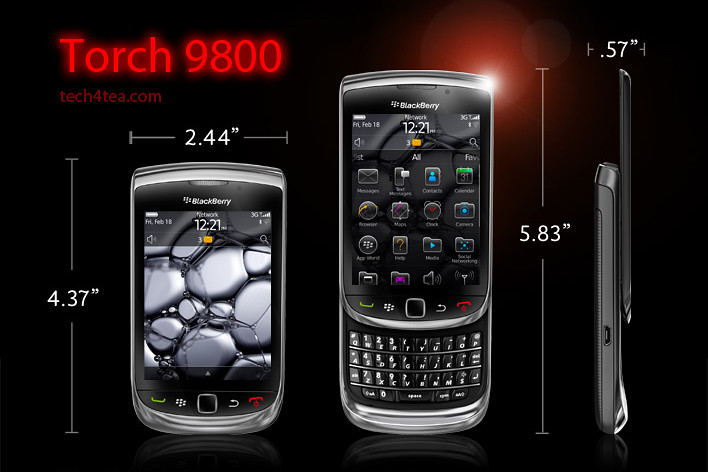
BlackBerry Torch 9800: RIM’s first device based on the 6.0 Operating System

Friday, August 6th, 2010

Finally, an actual BlackBerry based on the 6.0 operating system, which Co-Chief Executive Officer Jim Balsillie promised last month will have consumers “blown away”.

Views and dimensions of BlackBerry Torch 9800

BlackBerry Torch 9800 with 6.0 Operating System.

Bloomberg’s Rich Jaroslovsky summarises the smartphone maker scene succintly at the beginning of his weekly Friday column:

“It’s become fashionable among the digerati to dismiss the BlackBerry as a remnant of yesterday’s technology and lump its maker, Research In Motion Ltd., with Microsoft and Nokia as wireless pioneers who squandered their early advantages and are now sinking toward irrelevance.”

Rich’s assessment for the Torch is that although it provides BlackBerry users with a more modern experience, “it falls well short of Apple Inc.’s iPhone and the many devices that run Google Inc.’s Android operating system, and provides no reason for users of any of those phones to contemplate switching.”

RIM’s application store, called AppWorld, has only about 9,000 offerings, a small fraction of the number available for the iPhone or Android devices. And the BlackBerry’s media-playing capabilities remain basic, even primitive, when compared with some of its rivals.

Sporting the classic BlackBerry form factor, the Torch weighs 161 grams (5.7 ounces) – 18 percent heavier than an iPhone 4.

Typing can be done using either the physical keyboard, which slides out from behind the screen, or by using the on-screen keypad. The 3.2 inch colour touch screen recognises the usual pinch-and-zoom gestures to resize text and images, and you can move from message to message by swiping the screen sideways.

The new interface for the new operating system will also be available to users of BlackBerry’s Bold 9700 and 9650 and Pearl 3G models. Rich reports that “the home screen is well laid out, with a separate screen for frequently used applications; settings and options have been made simpler across the board.”

The biggest improvement seems to be in web-surfing, considering how painful it had been on older BlackBerry models. The browser has been revamped to be faster and to include new features.

Hurdles from foreign governments for BlackBerry’s overseas growth

Monday, August 2nd, 2010

It never rains but pours for Research In Motion (RIM), maker of the BlackBerry smartphone. RIM’s overseas aspirations are confronted with threats from foreign governments to restrict or ban its services as these countries tighten restrictions on mobile e-mail.

BlackBerry logo with flags of foreign governments superimposed.

Potential bans from foreign governments threaten RIM's overseas growth.

With the challenges from Apple and Android-based smartphones checking its growth in North America, Canada-based RIM is looking to countries such as India, Indonesia, Brazil and kingdoms in the Middle East for growth. Bloomberg reports that revenue from outside North America and the U.K. nearly doubled last quarter as US sales, which account for a quarter of revenue, dropped 7 percent.

One of BlackBerry’s main strength over competitor’s smartphones is the security it promises for its encrypted messenging service. But it is precisely this that foreign governments are concerned with, since they are worried that the encrypted communications could be used by criminals and terrorists who are targeting their countries. The foreign governments want some means to monitor the BlackBerry communications in their countries.

All BlackBerry e-mails are handled by the company’s own enterprise servers in Canada, making the devices popular with companies and government officials including Barack Obama, who kept his BlackBerry after becoming U.S. president.

A potential solution is to setup proxy servers in overseas countries so that the foreign governments can monitor the  communications that uses BlackBerrys in their countries.

An official in India has said that the country may ban BlackBerry e-mail use while Saudi Arabia could take similar steps. The Telecommunications Regulatory Authority in the UAE has announced that, from October 11, BlackBerry’s Messenger, e-mail and Web browsing services will be halted.

BlackBerry BlackPad from Research In Motion (RIM)?

Wednesday, July 28th, 2010

At last, I see signs of some movement from Research In Motion (RIM), the maker of the  BlackBerry smartphone, in response to the inroads that its rival are making into the smartphone scene.

Artist impression of a BlackPad.

Is this what a BlackPad will look like?

It is much too early to tell whether this move will help RIM stave off its rivals’ inroads into its market share, but it is at least something. However, I believe RIM needs more than just a new device. Apple is successful because of the entire framework – apps, iTunes, chic branding. RIM is lagging in the Apps arena and does not have any music framework. The only thing it can leverage on is its branding from the success of its BlackBerrys. Even that is fading fast in the face of the popularity of the iPhone. I wonder if people still use BlackBerry as a verb anymore? Assessing company email from the phone is old news. What do people talk about nowadays? Apps – Apple apps and Android Apps.

RIM has acquired the internet rights to blackpad.com, fueling speculation that it is developing a tablet device to challenge Apple’s wildly successful iPad.

According to the Whois database of Internet domain names, the domain name assigned to RIM was created on July 8 and expires Sept. 8, 2011.

Bloomberg reports that there was no record of a trademark application for “blackpad” with the U.S. Patent and Trademark Office as of today.

Apple, the maker of the iPad, claimed in June that it has sold 3 million of the tablet computers within 80 days of launch in the US.

Other device makers are vying to develop tablets following Apple’s success with its iPad, although the concept of tablet computers is not new and had been actively but not as successfully pursued by Microsoft nearly a decade ago.

Hewlett-Packard, which bought smartphone maker Palm earlier this month, applied to the Patent Office on July 9 to register the name Palmpad for computers and computer software. HP said last week it plans to produce a tablet device this year.