Archive for the ‘Figures’ Category

Infographic: Tata Communications global network

Monday, May 21st, 2012

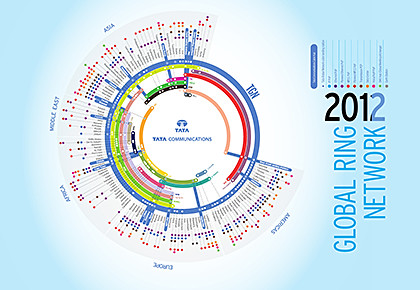
In March, Tata Communications announced that it had completed the world’s first wholly owned cable network ring around the world. Here’s a sundial schematic that charts the global network of Tata Communications circumnavigating the globe.

The infographic shows the locations of earth stations, cable landing stations, points of presence and Global Meeting Exchange hubs. (click to view/download enlarged chart)

This infographic shows the locations of earth stations, cable landing stations, points of presence and Global Meeting Exchange hubs. (click to view/download enlarged chart)

The global fibre optic network seamlessly links markets across Asia, Middle East, the U.S. and Europe to meet the rising demand for 24/7 commerce.

It is part of the Tata Global Network (TGN), which comprises one of the most advanced and largest submarine cable networks, a Tier-1 IP network, with connectivity to more than 200 countries across 400 PoPs, and nearly 1 million square feet of data centre and collocation space worldwide.

The Disaster Recovery Survey 2012: Asia Pacific and Japan

Tuesday, May 8th, 2012

81% of businesses in the Asia Pacific and Japan might NOT be able to recover lost data and systems in the event of a disaster. New independent research sponsored by EMC points to outdated backup and recovery infrastructure.

EMC Research: "The Disaster Recovery Survey 2012: Asia Pacific and Japan"

The survey also found that 71% of all organizations had lost data or suffered systems downtime in the last 12 months.

These findings highlight the need for backup transformation from antiquated technologies that are not suited for today’s data growth or availability expectations.

A move to next-generation backup and recovery solutions ensure continued business operations in the event of a natural disaster, malicious activity or more routine and common disruptions to IT systems.

In fact, the research showed that the causes of systems downtime are often the commonplace disruptions to IT, such as hardware failure or data corruption, rather than natural disasters or other major incidents.

Other key findings are summarised below:

  • Hardware failure (60%), data corruption (49%) and loss of power (44%) were cited as the primary causes of data loss and downtime.
  • 42% of organizations cite loss of employee productivity as the most likely consequence of data loss and downtime.
  • 44% of organizations who store a backup copy offsite for disaster recovery still use tape for recovery, and 37% still use CD ROM (although 62% now use disk-based storage).
  • 83% of these organizations want to replace tape all together, highlighting the need for next generation backup and recovery.

Commissioned by EMC and conducted by independent research company Vanson Bourne, ‘The Disaster Recovery Survey 2012: Asia Pacific and Japan’ looks at the state of backup and disaster recovery in the region to understand how well companies are prepared for data loss and systems downtime.

For the full report, visit EMC’s website here.

Experian says you are overloaded by marketers

Thursday, May 3rd, 2012

An independent research conducted by Experian finds that Singapore consumers are suffering from information overload and no longer respond to blanket marketing.

44% of respondents from Singapore interact with only three or fewer brands.

An independent research conducted by Experian in Singapore.

An independent research conducted by Experian in Singapore.

This is the result of poorly targeted communications from multi-channel marketer.

In addition, 30% of participants said they now IGNORE the emails, direct mail and social media messages they receive from brands because of information overload.

78% of consumers cited that they are very SELECTIVE about what opt-ins, newsletters or updates they sign up for to ensure they are only receiving messages that are relevant to their particular interests.

SG consumers agree that a COMPANY’S WEBSITE is the most valuable source of information they use to look for information about a brand, with 91% stating that it is a relevant or very relevant source.

While 36% of consumers believe the ideal frequency of brand communications is once a month, a quarter of consumers (25%) did not have frequency preferences as long as the communication is RELEVANT.

Giveaways and incentives (65%) is the number one way for brands to engage the SG consumer. Any surprises here?!

The research also shows a clear DISCONNECT between the communications consumers want from brands and the way they are being targeted by marketers.

For example, although MARKETERS listed print media as one of the least important tools for connecting with consumers – 86% of CONSUMER respondents rated it as the second most valued communication medium.

The State of the Internet 4Q 2011 report from Akamai

Monday, April 30th, 2012

China is now the top source of observed attack traffic. South Korea boasts both highest average connection speed and highest average peak connection speed.

Fourth Quarter, 2011 State of the Internet report released by Akamai Technologies.

Fourth Quarter, 2011 State of the Internet report released by Akamai Technologies.

China, at 13 percent, generated the most attack traffic observed by Akamai. The United States (10%) and Indonesia (7.6%) rounded out the top three.

The findings were in the Fourth Quarter, 2011 State of the Internet report released by Akamai Technologies.

Going into its fifth year, the report incorporates four-year’s worth of trending data, illustrating how Internet connectivity has improved over time.

Based on data gathered from the Akamai Intelligent Platform, the report provides insight into key global statistics such as Internet penetration, mobile traffic and data consumption, origins of attack traffic, IPv6 adoption and global and regional connection speeds.

In the fourth quarter of 2011, more than 628 million unique IP addresses from 236 countries and regions connected to the Akamai Intelligent Platform. This represents 2.1 percent more IP addresses than connected in the third quarter of 2011, and an increase of 13 percent compared to the same quarter a year ago.

The Fourth Quarter, 2011 State of the Internet report includes a new section that will appear annually going forward and that tracks trends since the report’s inception in 2008.

Speed

Cities in the Asia Pacific region enjoy the fastest connection speeds in the world. Out of the 100 fastest cities worldwide, 69 cities were from the region, with 61 in Japan, six in South Korea, as well as Australia and Hong Kong.

24 cities in North America ranked among the top 100, including two in Canada and 22 in the United States.

Seven cities in Europe – including three in Sweden, two in Switzerland and one each in Romania and Latvia – made up the balance.

Globally, high broadband (>5 Mbps) adoption maintained at 27%.

South Korea took the top spot in high broadband adoption, with 83% of the country’s connections to Akamai > 5 Mbps.

Netherlands was second with 67%. US was twelfth (44%) while Singapore languished at 21st (32%).

BlackBerry OS vs iOS vs Windows Phone vs Android

Monday, April 16th, 2012

Trend Micro has released the results of its study on the four main mobile operating systems in a report titled “Enterprise Readiness of Consumer Mobile Platforms”.

The security firm found the BlackBerry 7 OS the most secure mobile operating system, followed by iOS 5, Windows Phone 7.5, and Android 2.3.

Summary chart from “Enterprise Readiness of Consumer Mobile Platforms” White Paper by Trend Micro.

Summary chart from “Enterprise Readiness of Consumer Mobile Platforms” White Paper by Trend Micro.

Android 2.3 was used in the study because it was the dominant installed/supplied version of Google’s mobile OS at the time of the research.

Below is an excerpt from the White Paper summarising the findings about the four mobile platforms.

(more…)

Facebook to buy Instagram photo app for US$1 billion

Tuesday, April 10th, 2012

US$100 billion Facebook Inc has agreed to fork out US$1 billion in cash and stock to acquire the photo-sharing application for smartphones. The deal is expected to be completed this quarter.

Is Instagram worth one-hundredth of Facebook?

Is Instagram worth one-hundredth of Facebook?

Facebook is probably looking at attracting the users of mobile devices through its acquisition of Instagram – its biggest acquisition yet.

“Instagram, owned by San Francisco-based Burbn Inc, was valued at $500 million after raising about $60 million last week from investors,” Bloomberg was told.The idea is to attract the advertisers interested in reaching the mobile users.

Instagram started out as the top free photo-sharing app on Apple’s App Store with more than 30 million users.

Only last week, the company introduced the app for Android devices as well.

Instagram has only 13 employees so the offer works out to some US$76 million per employee, according to the Los Angeles Times.

“We need to be mindful about keeping and building on Instagram’s strengths and features rather than just trying to integrate everything into Facebook. That’s why we’re committed to building and growing Instagram independently,” – Zuckerberg wrote on his Facebook fanpage.Instagram was launched in October 2010 by Kevin Systrom and Mike Krieger with a seed funding of about US$500,000.

It subsequently raised US$7 million in 2011, when it had 1.75 million users, according to Bloomberg.

California-based Facebook is the biggest social-networking service today and intends to raise US$5 billion in its initial public offering (IPO) – which is to date the biggest IPO for an Internet company, valuing it at US$100 billion.

Facebook’s CEO, Mark Zuckerberg, said it plans to let Instagram retain its independence, in an effort to reassure Instagram users and potential advertisers.

US$1million for complete access to your computer?

Thursday, April 5th, 2012

Norton has unveiled the findings of its latest survey which provides insights into Singaporeans’ Internet dependence, the importance of their personal information and their level of understanding when it comes to Internet security.

Say it with numbers - from Norton's survey of Internet Security.

Say it with numbers – from Norton’s survey of Internet Security.

Last year, Norton did an interesting survey that revealed that phone owners in Singapore were willing to pay an average of S$148 to get their lost/stolen phones back, in order to alleviate the stress and inconvenience losing their mobile phones.

This year, Norton found that 76 percent of Internet users in Singapore would rather forgo US$1million than give strangers unlimited access to their computers.

The key findings are highlighted in the info-graphic above, while the details are at the end of this post.

Protection

So what does Symantec have to protect the multitude of PCs, Macs, smartphones and tablets in the modern household?

Norton will be offering Norton 360 Everywhere in the first half of 2012 (Pricing and systems requirements to be announced at launch).

Norton 360 Everywhere promises to be an easy-to-manage, all-in-one security solution that delivers a multi-platform solution for PCs, Macs, Android-based phones and tablets.

Users can customise their security to meet their specific needs, be it against online threats, data loss, and device loss or theft.

The details of the survey is excerpted below.

(more…)

Darth Vader’s voice on TomTom GPS makes babies happy

Sunday, April 1st, 2012

Following six months of research and rigorous tests, TomTom’s Navigation Laboratory (NavLab) has discovered that Darth Vader’s navigation voice increases children’s happiness in the car by over 68%.

More than 300 baby and toddler volunteers took parts in Project GAGA, the NavLab research project to find the perfect satnav voice for families with small children.

Of course this has been TomTom’s April Fools’ joke.

But jokes aside, I used the TomTom 750 GPS last year during my self-drive family holiday in Germany with two young kids in tow.

You won’t believe how much fun the kids had listening to the various voices providing turn-by-turn navigation instructions from the portable navigation device.

We tried out Bugs Bunny, Homer Simpsons and Ken with the Australian accent.

But it was Darth Vader and Yoda which battled it out for the top favourite spot. Eventually, we decided the dark lord had just that bit of an edge over the benevolent Jedi master.

To be honest, I had initially thought the celebrity voices feature was a useless gimmick.

But after we had so much fun, we really liked it. The whole family had such a laugh on those long drives imitating the accents and nuances of those voices.

We were like going “Turn around where possible … <heavy breathing> … I sense your lack of faith disturbing,” and “Take the left turn … <heavy breathing> … and face your destiny, you are coming over … <heavy breathing> … to the dark side”.

New Zealand-based Valerie Cross of TomTom told me during her visit to Singapore that the All Blacks did a recording too for TomTom – who had truckloads of fun improvising around the provided script.

I would love to hear that some time.

Nokia ventures into China with Lumia smartphones

Thursday, March 29th, 2012

China Telecom and Nokia have launched the first CDMA Windows phones in China. The Nokia 800C will be available for purchase in April at 3599 RMB (S$718) without contract; while the more affordable Nokia 600C will be available sometime in Q2 2012.

Stephen Elop, CEO of Nokia; and Wang Xiaochu, Chairman of China Telecom at the launch.

Stephen Elop, CEO of Nokia; and Wang Xiaochu, Chairman of China Telecom at the launch.

The Nokia 800C will be Nokia’s first Lumia phone for China – the world’s largest smartphone market. It is the CDMA variant of the Windows Phone-based Lumia 800.

China will see sales of up to 140 million smartphones this year. This is an increase of more than 80%, propelling China past the U.S. as the world’s largest smartphone market, according to researcher Gartner Inc. The Nokia 610C (CDMA variant of Lumia 610, price to be announced) will target more youthful audience and will provide a perfect introduction to Windows Phone with access to the same core signature experiences as the rest of the Lumia range

China Telecom is offering the Nokia 800C in black and cyan.

Nokia is also working on phones for networks operated by China Unicom Hong Kong Ltd. and
China Mobile Ltd, reported Bloomberg.

The smartphone features a 3.7″ AMOLED ClearBlack curved touchscreen display.

With a 1.4 GHz processor, hardware acceleration and a separate graphics processor, it also features an instant-share 8 Mpx camera with Carl Zeiss optics, HD video playback, 16GB of internal user memory and SkyDrive storage for accessing pictures and files from anywhere.

Android enjoys more than half the market share of smartphone platforms in the 4th quarter, while the iPhone accounts for nearly 25 percent, with Windows Phones (from all manufacturers) capturing 1.9 percent. – according to Gartner.Exclusive applications and services for a uniquely local experience

China Telecom and Nokia are targeting young people by integrating music, games, videos, and integrated reading apps right onto the Nokia 800C home screen.

To reach this target market, the Nokia 800C will be featured prominently in Tianyi FlyYoung shops, a distribution arm and new, youth-centered sub-brand of China Telecom.

People purchasing Nokia Lumia  smartphones in China will have access to applications such as magazines from Trends and special offers for free downloads of popular gaming titles such as Fruit Ninja and PVZ.

Trends, a provider of highly interactive fashion magazine applications, will launch Cosmopolitan first for Nokia Lumia smartphones and provide people using a Nokia Lumia phone with free access to For Him Magazine (FHM), Harper’s Bazaar and Esquire magazines in Marketplace, opening today.

Top 3 phone makers in China in the 4th quarter (Gartner)
Samsung 24.3%
Nokia 19.6%
Apple 7.5%

As an added incentive for  people using a Nokia Lumia smartphone in China, Nokia will soon offer 100,000 free downloads of the hit gaming titles Fruit Ninja and PVZ through the Nokia Collection in Marketplace.

Nokia and Microsoft also announced the Be Top program, which is designed to encourage and support developers in creating great new applications on Windows Phone specifically for people in China.

Nokia will offer Lumia users access to all major Internet services in China including Sina, SOHU, Tencent and Renren as well as a choice of nearly 20,000 apps available for download through Marketplace.

The Nokia 800C comes with the Nokia apps that are available only on Lumia smartphones:

The Nokia 800C is the CDMA variant of the Nokia Lumia 800.

The Nokia 800C is the CDMA variant of the Nokia Lumia 800.

Nokia Maps

Quick-access, three-dimensional maps in China and over 190 countries worldwide, as well as the ability to discover the top places nearby with local content support from Fantong, Jiepang, Ctrip, Qunar and Soufun.

People can easily click on the places to see photos, recommendations and information, and quickly dial restaurants to make a reservation.

Nokia Drive

Delivers a full-fledged personal navigation device with free, voice-guided, turn-by-turn navigation for over 100 countries including China.

It has a dedicated in-car user-interface, free offline navigation and speed notifications.

Nokia Music

Offers a single hub experience for discovering the latest music, including unlimited free music for 12 months for consumers in mainland China.

It also includes MixRadio, a free, global, mobile music-streaming application that delivers hundreds of channels of locally-relevant music, including the ability to listen to music offline and build personalized mixes for listening to favourite music from any location.
Nelson Mandela Digital Archive goes live online

Wednesday, March 28th, 2012

Google and the Nelson Mandela Centre of Memory (NMCM) have launched archive.nelsonmandela.org which is freely accessible to the public.

The archives include never-seen sequel manuscripts to Mandela’s “Long Walk to Freedom” autobiography.

We should never allow ourselves to forget the struggles for such basic rights as racial equality and take racial harmony for granted.

We should never allow ourselves to forget the struggles for such basic rights as racial equality and take racial harmony for granted.

When I was a youth, everybody knew who Nelson Mandela was and Apartheid was a must-study topic for the General Paper exam in school.

I wonder how many of the current generation remember or know about the tumultuous struggles in South Africa to fight for what many in the rest of the world take for granted – racial equality.

Even today in Singapore, you have people posting insensitive remarks about other races and nationalities over Twitter.

And in the US, the Trayvon Martin shooting is still brewing over.

In order to keep the memories of Nelson Mandela alive, Google gave a US$1.25m grant to Johannesburg-based NMCM last year.

The aim was to preserve and digitize thousands of archival documents, photographs and videos about Mr Mandela.

The new online multimedia archive includes Mr Mandela’s correspondence with  family, comrades and friends, diaries written during his 27 years of imprisonment, and notes he made while leading the negotiations that ended apartheid in South Africa.

Start by looking at his Early Life, and take a peek into his personal memories of the time he was incarcerated during the Prison Years.

Read the handwritten notes on his desk calendars, which show, for example, that he met President F.W. De Klerk for the first time on December 13, 1989 for two and a half hours in prison; the Warrants of Committal issued by the Supreme Court which sent him to prison; the earliest known photo of Nelson Mandela’s prison cell on Robben Island circa 1971; and a personal letter written from prison in 1963 to his daughters, Zeni and Zindzi, after their mother was arrested, complete with transcript.

What was Apartheid

Apartheid was the official policy of the National Party, which came to power in 1948 in South Africa. It was the practice of official racial segregation.

Under apartheid everyone in South Africa had to be classified according to a particular racial group.

This determined where someone could be born, where they could live, where they could go to school, where they could work, where they could be treated if they were sick and where they could be buried when they died.

Only white people could vote and they had the best opportunities and the most money spent on their facilities.

Apartheid made others live in poverty.

Black South Africans’ lives were strictly controlled.

Many thousands of people died in the struggle to end apartheid.

– www.nelsonmandela.org/content/page/faqs