Archive for the ‘Figures’ Category

Seagate achieves 1 Terabit per square inch in hard drive storage

Tuesday, March 27th, 2012

That’s one trillion (1,000,000,000,000) bits in one square inch of the disk.

That’s more than double the number of stars in the Milky Way, which astronomers estimate to number between 200 and 400 billion.

Seagate has squeezed 1,000,000,000,000 bits into every square inch.

Seagate has squeezed 1,000,000,000,000 bits into every square inch.

Seagate has become the first hard drive maker to achieve the milestone storage density of 1 terabit per square inch.

“The growth of social media, search engines, cloud computing, rich media and other data-hungry applications continues to stoke demand for ever greater storagecapacity,” said Mark Re, senior vice president of Heads and Media Research and Development at Seagate.The technology demonstration promises to double the storage capacity of today’s hard drives upon its introduction later this decade.

Don’t be surprised to see 3.5-inch hard drives with an extraordinary capacity of up to 60 terabytes over the 10 years that follow.

Seagate reached the landmark data density with heat-assisted magnetic recording (HAMR), the next- generation recording technology.

The current hard drive technology, Perpendicular Magnetic Recording (PMR), is used to record the spectrum of digitized data – from music, photos, and video stored on home desktop and laptop PCs to business information housed in sprawling data centers – on the spinning platters inside every hard drive.

PMR technology was introduced in 2006 to replace longitudinal recording, a method in place since the advent of hard drives for computer storage in 1956, and is expected to reach its capacity limit near 1 terabit per square inch in the next few years.

“Hard disk drive innovations like HAMR will be a key enabler of the development of even more data-intense applications in the future, extending the ways businesses and consumers worldwide use, manage and store digital content,” added Mark.Hard drive manufacturers increase areal density and capacity by shrinking a platter’s data bits to pack more within each square inch of disk space.

They also tighten the data tracks, the concentric circles on the disk’s surface that anchor the bits.

The maximum capacity of today’s 3.5-inch hard drives is 3 terabytes (TB), at about 620 gigabits per square inch, while 2.5-inch drives top out at 750 gigabytes (GB), or roughly 500 gigabits per square inch.

The first generation of HAMR drives, at just over 1 terabit per square inch, will likely more than double these capacities – to 6TB for 3.5-inch drives and 2TB for 2.5-inch models.

The technology offers a scale of capacity growth never before possible, with a theoretical areal density limit ranging from 5 to 10 terabits per square inch – 30TB to 60TB for 3.5-inch drives and 10TB to 20TB for 2.5-inch drives.

Britannica stops print edition and goes purely online

Wednesday, March 14th, 2012

After 244 years, the Encyclopaedia Britannica is going out of print. But it is not going extinct. It had already gone online for more than 10 years, but from now on, it will be 100% digital.

Digital milestones for Encyclopaedia Britannica. (All images and inforgraphics in this post are from Encyclopaedia Britannica)

Digital milestones for Encyclopaedia Britannica. (All images and inforgraphics in this post are from Encyclopaedia Britannica)

The Encyclopaedia Britannica has existed since 1768.

The Encyclopaedia Britannica boasts some very prestigious sources.

The Encyclopaedia Britannica boasts some very prestigious sources.

In my mind, its greatest competitor is the 11-year-old Wikipedia, which is written and edited by a community of many thousand contributors around the world – with nearly four million articles in English, and increasingly quoted as sources in researches and reports.

Britannica’s differentiation from Wikipedia will be in its credibility, derived from its sources, and careful verificaiton and editing in its rigorous vetting process.

The 32-volume printed version (which weighs nearly 60 kilograms and costs US$1,395) will be discontinued when current inventory runs out. That’s 4,000 sets out of the 12,000 print run of the 2010 edition.

The bulk of Encyclopaedia Britannica current revenue comes from selling curriculum products in school.

The bulk of Encyclopaedia Britannica current revenue comes from selling curriculum products in school.

Britannica enjoyed the briskest sales in 1990, selling some 120,000 sets in the US. Now, the print version generates less than one percent of the company’s revenue.

The bulk of Britannica’s revenue comes from selling curriculum products in school (85 percent), while another 15 percent are from subscriptions to its website.

There are some 500 thousand subscriptions paying US$70 each year to enjoy full access to Britannica’s articles, videos and original documents.

Another general-interest encyclopedia that is still being printed in the US is the World Book, which sells a 22-volume yearly edition.

How much data has been created, lost and recovered since the advent of the PC?

Tuesday, March 13th, 2012

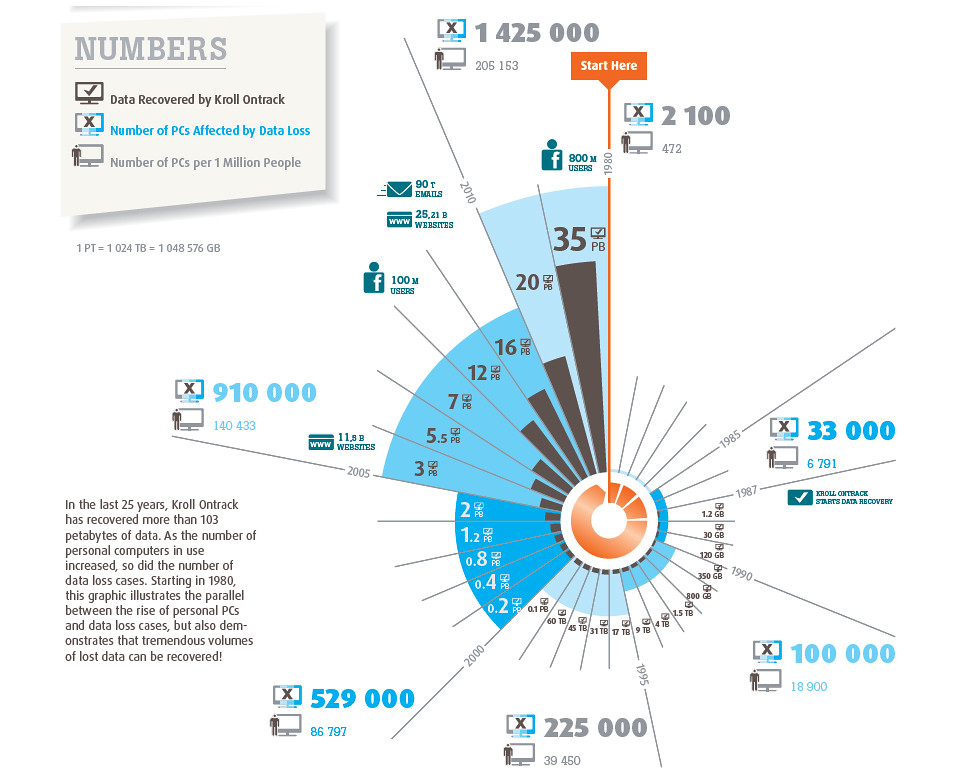
Kroll Ontrack has recovered more than 103 petabytes of data over the past 25 years.

THE DIGITAL ERA: How our life has changed into a digital one; and the creation, loss and recovery of data over time (Source: Kroll Ontrack).

THE DIGITAL ERA: How our life has changed into a digital one; and the creation, loss and recovery of data over time (Source: Kroll Ontrack).


Kroll Ontrack
has released new statistics regarding how the creation of storage technologies and digital information has impacted data loss and data recovery technology since the advent of the personal computer in the 1980’s.

“In the past 25 years, the worst cases Kroll Ontrack has seen have coincided with natural disasters, which included burned, water logged and physically damaged drives,” said Todd Johnson, vice president of operations, Kroll Ontrack.Since the first Kroll Ontrack data recovery lab opened in 1987, more than 103 petabytes (PB) of data has been recovered.

How much is 103 PB of data? That’s equivalent to 25 million USB flash drives, each with 4 GB capacity.

Only 1.2 GB of data was recovered in 1987, whereas the amount of data recovered by Kroll Ontrack in 2011 has skyrocketed to nearly 35 million GB (35 PB).

The number of computers impacted by data loss was estimated to have reached nearly 1.4 million – compared to only 33,000 in 1987.

According to an analysis by Kroll Ontrack, the number of data loss cases over the past 25 years grew in parallel with the total number of personal computers in the world.

“One of the company’s most successful endeavors was the recovery of more than 99 percent of mission-critical data from a melted, crashed and burned drive from the 2003 Space Shuttle Columbia,” revealed Johnson.The analysis also revealed that on average, one in one thousand computers lost data stored on it.

In the 1980’s, at the onset of the so-called PC era, the estimated number of personal computers in use was nearly 7,000 devices per one million people and approximately 33,000 of them suffered data loss.

By the mid 1990’s, the number of computers in use was nearly 40,000 per one million people and data was lost from approximately 225,000 computers.

In 2011, these figures reached more than 200,000 computers and 1.4 million cases of data loss, respectively.

“You cannot go through day-to-day life without interfacing with some form of digital data,” said CK Lee, country manager, Kroll Ontrack Singapore. “As technology advances to include virtualization, cloud, and social media, individuals, businesses and of course data recovery specialists have to evolve to address these storage mediums and the new challenges they present.”According to the latest IDC Digital Universe study, the amount of data more than doubles each year, and in 2012, it will exceed 1.8 zettabytes.

This is the equivalent of 200 billion two-hour long HD movies that one person would have to watch continuously for 47 million years.

As data creation increases, so does data loss.

According to a report by market research firm Gartner, every year at least 25 percent of computer users worldwide experience data loss.

Kroll Ontrack statistics indicate that 29 percent of data is lost as a result of hardware failure and 27 percent is due to human error.

Other causes include software errors (7 percent), computer viruses (7 percent) and natural disasters such as floods or fires (3 percent).

Below is a timeline infographic by Kroll Ontrack charting a brief history of the digital era.

(more…)

How Singapore IT practitioners perceive mobility risks

Thursday, March 1st, 2012

Singapore was one of 12 countries surveyed in a new “Global Study on Mobility Risks” conducted by Ponemon Institute. Out of the overall 4,640 IT and IT security practitioners surveyed, 259 respondents were from Singapore.

Perception of mobile phone use as a threat and presence of security controls to mitigate the risks.

Perception of mobile phone use as a threat and presence of security controls to mitigate the risks.

The study was sponsored by content security provider Websense Inc, and is designed to help IT security professionals plan for an increasingly mobile workforce.

“We asked thousands of IT security professionals and found mobile devices were overwhelmingly important to business objectives,” said Dr Larry Ponemon, chairman and founder of the Ponemon Institute.Corporate mobile devices and the bring-your-own-device (BYOD) phenomenon are rapidly circumventing enterprise security and policies.

In Singapore, 45 percent of respondents say that their organizations experienced a data breach due to insecure mobile devices, and 22 percent are unsure.

“However, mobile devices put organizations at risk — risks that they do not have the necessary security controls and enforceable policies to address. It’s also clear that employees are deliberately disabling security controls, which is a serious concern,” Dr Ponemon addedThis is slightly less than the overall proportion of 51 percent for all 12 countries.

Fifty-five percent say that their employees circumvent or disengage security features such as passwords and key locks – versus the overall 59 percent.

Below is the Executive Summary for the survey of IT & IT Security Practitioners in Singapore, which was extracted from the “Global Study on Mobility Risks”.

(more…)

BYOD causing security breaches

Thursday, March 1st, 2012

51 percent of organizations lose data through mobile devices, while 59 percent of employees dodge security controls, according to a new  “Global Study on Mobility Risks” unveiled at the RSA Conference in San Francisco, USA.

The “Global Study on Mobility Risks” by Ponemon Institute.

The “Global Study on Mobility Risks” by Ponemon Institute.

Mobile devices help business, but security is needed to prevent costly data loss.

Corporate mobile devices and the bring-your-own-device (BYOD) phenomenon are rapidly circumventing enterprise security and policies. This survey defines mobile devices as laptops, USB drives, smartphones, and tablets.

“IT has spent years working on desktop security and trying to prevent data loss over web and email channels—but mobile devices are radically changing the game,” said Tom Clare, senior director of Product Marketing Management.Seventy-seven percent of more than 4,600 respondents in 12 countries (Australia, Brazil, Canada, France, Germany, Hong Kong, India, Italy, Mexico, Singapore, United Kingdom, and the United States) surveyed agree that the use of mobile devices in the workplace is important to achieving business objectives.

But 76 percent also believe that these devices put their organizations at risk—and only 39 percent have the necessary security controls to address the risk.

The study was conducted by the Ponemon Institute and sponsored by content security provider Websense Inc, and is designed to help IT security professionals plan for an increasingly mobile workforce.

“Tablets and iOS devices are replacing corporate laptops as employees bring-their-own-devices to work and access corporate information. These devices open the door to unprecedented loss of sensitive data. IT needs to be concerned about the data that mobile devices access and not the device itself,” Clare added.The research shows that organizations often don’t know how and what data is leaving their networks through non-secure mobile devices.

Traditional static security solutions such as antivirus (AV), firewalls, and passwords are not effective at stopping advanced malware and data theft threats from malicious or negligent insiders.

To safely permit corporate use of mobile devices, Websense has released its new Websense TRITON Mobile Security solution.

Sixty-five percent of respondents are most concerned with employees taking photos or videos in the workplace—probably due to fears about the theft or exposure of confidential information.

Other unacceptable uses include downloading and using internet apps (44 percent) and using personal email accounts (43 percent).

Twitter reaches 500 million users

Thursday, February 23rd, 2012

Twitter now has more than 500 million users, according to twopcharts.com, although only 100 million are active accounts.

Websense illustrates “some of the not-so-high Twitter highlights of the last 5 years”.

Websense illustrates “some of the not-so-high Twitter highlights of the last 5 years”.

Started in 2006, Twitter had hit 300 million users back in May 2011.

Commenting on the situation, Mr. Carl Leonard, Senior Manager, Websense Security Labs said: “… what’s in a number? Twitter is free to use, easier to abuse and is constantly targeted by malware authors and spammers. It’s nothing new; not all Twitter users are who they claim to be. Let’s see this more than just a numbers game and focus on keeping users safe in real-time so they are not just another statistic.”Twitter estimated that only ten percent of its active users have sent more than 100 tweets, while only 20 percent of users have sent more than ten tweets.

Facebook hit 500 million ACTIVE users back in July last year.

Launched in 2004, Facebook now has more than 845 million monthly active users, according to its statistics.

The number of DAILY active Facebook users is roughly half that number, at 483 million.

The popularity of Twitter has made it a fertile hunting ground for abuse by spammers and bot networks.

Kelihos spam engine lives on

Wednesday, February 22nd, 2012

The Websense Security Labs Spam Trap system has detected a variant of Kelihos that is apparently still active.

Google Maps showing geographically how widespread the Kelihos command and control and peers infrastructure is, and therefore how well protected the botnet is.

Google Maps showing geographically how widespread the Kelihos command and control and peers infrastructure is, and therefore how well protected the botnet is.

“Kelihos is yet another example of how botnets shut down and reappear. Malware authors have a motive to get them up and running again. Websense Labs detected this new variant of Kelihos as we are constantly monitoring web and email exploits. More importantly, we are able to join the dots between these different attack vectors and protect against cybercriminals achieving their ultimate goal – stealing data,” said Carl Leonard, Senior Security Research Manager (EMEA), Websense Security Labs.Over the last half a year, the spam engine Kelihos has attracted the attention of many people, including security company researchers and analysts.

Microsoft had partnered with Kyrus Tech Inc. and Kaspersky Lab to take down the Kelihos botnet in September 2011.

However, Microsoft has recently confirmed, on its official blog, a new generation of Kelihos variants derived from the original Kelihos botnet.

Websense Security Labs has written up a detailed account of their investigations into this resilient nuisance.

CA Technologies earns Overall Positive Vendor Rating from Gartner

Tuesday, February 14th, 2012

CA Technologies has also earned a “positive” rating in the following categories: Identity and Access Management; Service Management; Portfolio Management; and Service Assurance; and Capacity Management.

For the Mainframe Modernization category, it earned a “strong positive.”

Gartner rates CA Technologies with an overall Positive rating in the latest Vendor Rating report.

Gartner rates CA Technologies with an overall Positive rating in the latest Vendor Rating report.

According to Gartner, a positive rating means that “potential customers should consider this provider a viable choice for strategic or tactical investments, while planning for known limitations.”

“With a deep commitment to focusing on high-growth markets in areas such as automation, cloud computing security and software as a service (SaaS), we believe CA Technologies has laid out a strong roadmap for the future,” said Peter Griffiths, executive vice president, Enterprise Solutions Technology Group, CA Technologies.A “Strong Positive” is the highest possible rating given.

The Mainframe Modernization category includes new products geared to simplify mainframe management, such as CA Mainframe Chorus and CA Mainframe Software Manager.

Gartner is a leading provider of research and analysis on the global information technology industry.

Its Vendor Ratings assess all the different aspects of a technology provider, such as its strategy, organization, products, technology, marketing, financials and support.

These ratings are periodically revised to reflect changes in assessment when a significant internal or external event directly affects the provider.

Here is the Vendor Rating report.

CA Technologies leads in User Authentication

Thursday, February 9th, 2012

Gartner has positioned CA Technologies in the Leaders Quadrant of the Magic Quadrant for User Authentication.

CA Technologies has a range of User Authentication security solutions.

CA Technologies has a range of User Authentication security solutions.

Gartner estimates the overall growth in the market by customers to be approximately 30 percent year-over-year.

“By 2017, more than 50 percent of enterprises will choose cloud-based services as the delivery option for new or refreshed user authentication implementations, up from less than 10 percent today,” writes Ant Allan, Gartner Research Vice President.Because of the shift toward lower-cost authentication solutions, the overall growth by revenue is estimated to be approximately only 20 percent.

Considering Gartner’s user authentication market growth estimate, and the forecast that half of the implementations will be cloud services, CA Technologies is confident it is in a solid position for success in this sector.

“With more than 14,000 organizations leveraging our authentication solutions and more than 85 million identities protected by our cloud-based authentication services we should be on the short-list for anyone considering a cloud authentication solution,” said Vic Mankotia, Vice President of Security, Asia Pacific, CA Technologies.

Get a complimentary copy of the report here.

CA Technologies was also positioned by Gartner in the Leaders Quadrant of two Gartner reports: Magic Quadrant for Identity and Access Governance (IAG), and Magic Quadrant for User Administration/Provisioning.

eBook: Digital PR Techniques to Use in this Digital Age

Sunday, February 5th, 2012

A friend of mine sent me a hardcopy of this book about the importance of digital PR and digital PR techniques that work well.

"The Changing Face of Communications: 12 digital techniques for modern PR" - released by Lewis PR.

"The Changing Face of Communications: 12 digital techniques for modern PR" - released by Lewis PR.

It was recently released by her PR agency (Lewis PR) to delve into what is really key to marketing and PR professionalism, as well as companies in general who are looking to keep themselves updated in this digital age.

eBook on modern digital PR techniques for the digital age.In this digital age, we see social media evolve by the day and emerge in communications more and more.

So I do agree with my friend, Gina Daryani, how important it is to keep abreast with the latest techniques in this fast-paced and rapidly-changing age.

In order to address “The Changing Face of Communications”, this book propounds “12 digital techniques for modern PR”.

I have listed below the 12 techniques – each delved with in its own How-to chapter in the book.

  1. How to communicate in a real-time world
  2. How to incorporate SEO into PR
  3. How to evaluate a social media campaign
  4. How to improve your corporate videos
  5. How to get started in word-of-mouth marketing
  6. How to make your corporate blog take off
  7. How to use social media to enhance events
  8. How to create sticky content
  9. How to handle a social media crisis
  10. How to optimize your web presence for conversions
  11. How to make the case for social media
  12. How to work with online influencers

You may also download the free e-book from this link here.

I’m just beginning to read the book, but below is an excerpt to get you started.

(more…)