Archive for the ‘Infographic’ Category
Thursday, February 26th, 2015
Yesterday CA Technologies released the results of its study on security in the application economy in Asia Pacific & Japan. Here are the results from the respondents in Singapore.

Excerpt of a graphical representation of the survey results for Singapore. To download/view the full enlarged infographic, click on the image above.
The study, sponsored by CA Technologies shows how mobility, APIs and an eye toward growing the business have brought a balanced view of control and enablement to security.
“It is paramount for Singapore organizations to stay ahead of the fast-changing IT threat landscape, especially in a geographic location that serves as a strategic regional and global hub for commerce,” said Chua I-Pin, vice president, Asia South, CA Technologies.
Singapore respondents were nearly equally split when asked if security was mostly about control or enabling the business.
49 percent of respondents said security was mostly about control, while 51 percent indicated that it was about both control and enablement.
Key Singapore findings from the study show:
1. Protection as top priorities
Protecting identities (48 percent) and protecting against data breaches (46 percent) were the top security priorities among Singapore respondents.
This was followed closely by improving/supporting compliance and audit (45 percent) and improving the mobile customer experience (39 percent).
(more…)
Tags:API, APJ, CA, CA Technologies, enterprise IT, infographics, mobility, security, Singapore, survey, Vanson Bourne
Posted in Announce, App, Business IT, CA Technologies, Enterprise IT, Events, Figures, Infographic, Mobile, Press Release, Security, Study | No Comments »
Wednesday, February 25th, 2015
A study from CA Technologies reveals the application economy demands a new approach to security in Asia Pacific & Japan.

Excerpt of a graphical representation of the survey results for APJ. To download/view the full enlarged infographic, click on the image above.
Mobility, APIs and Business Enablement are sparking new attitudes towards security and are driving an increase in investment in these areas.
“As more organisations understand the impact of the application economy in the increasingly connected Asia Pacific & Japan business landscape, security is moving from being a back-room afterthought to being a core business function. In the world of ever-increasing connected devices, organisations will leverage security to deliver better customer experience and contribute to positive business outcomes,” said Kenneth Arredondo, president & general manager, Asia Pacific & Japan, CA Technologies.
Protection is still the main driver for security, but a new CA Technologies study reveals that Asia Pacific & Japan (APJ) organisations are approaching security from new perspectives, recognising its potential to deliver frictionless and positive customer experience and contribute to business growth in the increasingly competitive application economy.
The study is titled “8 Steps to Modernize Security for the Application Economy” and is sponsored by CA Technologies.
The study shows how mobility, APIs and business growth have brought a balanced view of control and enablement to security, leading to an increase in investment by APJ organisations.
Key findings from the study show four key trends influencing the perception and implementation of security in APJ enterprises:
(more…)
Tags:API, APJ, CA, CA Technologies, enterprise IT, infographics, mobility, security, survey, Vanson Bourne
Posted in Brief, Business IT, CA Technologies, Enterprise IT, Events, Figures, Infographic, infographics, Mobile, Press Release, Reference, Security, Study | No Comments »
Tuesday, September 16th, 2014
An online poll finds that 3 in 4 Internet users in Singapore are concerned about privacy on Social Networks. However, almost 66 percent of respondents in Singapore are not protected on their mobile devices and personal computers.

The recent online poll was conducted by Trend Micro Incorporated – a global developer of security software – between August to September 2014 surveying 744 respondents in Singapore.
Internet users in Singapore are concerned about sharing private information on social networking sites (76%), and as many as 69 percent of respondents deleted or hid timeline posts they had shared previously.
“电脑防卫软件出版商 Trend Micro 的网上调查显示,新加坡的网上用户注重社交网络的私隐,但大多数人的电脑与手机却未安装安全软件。” – 科技点心(微薄)
Security solutions are therefore more necessary than ever, as verified by the results of the poll revealing that risky behavior by Internet users was generating new attack opportunities for cyber criminals.

“Consumers today are very reliant on their devices, with an average individual owning around five digital devices each. Yet, they often forget that having more devices also increases their exposure to cyberattacks,” said Terrence Tang, Senior Director of Consumer Business, Asia Pacific, Trend Micro.
Survey findings included:
(more…)
Tags:infographics, Maximum Security, security, Singapore, Trend Micro
Posted in Announce, Figures, Infographic, infographics, Reference, Security, Study, Trend Micro | 1 Comment »
Wednesday, July 23rd, 2014
Are your devices infected? “Operation Emmental” is a new criminal operation which targets banks that use session tokens such as Short Message Service (“SMS”) for authentication purposes – to steal customers’ online banking credentials to gain full access and control of their bank accounts.

A comparison between the two-factor authentication process in uninfected and infected computers with Operation Emmental.
Like Swiss Emmental cheese, the ways in which your online banking accounts are protected might be full of holes, or rather loopholes.
Commenting on today’s rampant mobile cybercrimes, Paul Oliveria, Technical Communications Manager of Trend Labs, Trend Micro shared: “Monetary benefits remain the biggest motivation for cybercriminals. Based on Trend Micro TrendLabs 1Q 2014 Security Roundup report, the number of online banking malware detections in the first quarter reached roughly 116,000 showing a steady increase from the same quarter in 2013.”
Cloud security experts Trend Micro warns of “undetectable” malware infection that targets mobile banking users.
Currently prevalent in Austria, Sweden and Switzerland, this cybercrime has reached Japan, leaving the Asia Pacific region at greater risk of a similar attack.
Mobile devices are also increasingly being included in cross-platform threats.
With mobile devices no longer being just phones and serve as computer substitutes in their own right, users are often connecting their mobile devices to their home/work systems to sync their files and documents.
This link between the devices is what threats use to jump across.
(more…)
Tags:banking, cloud, Emmental, mobile, security, Trend Micro
Posted in Announce, App, Browser, Cloud, Enterprise IT, Infographic, infographics, Mobile, Phones, Reference, Security, Shopping, Software, Study, Tablets, Tips, Trend Micro | No Comments »
Tuesday, July 15th, 2014
Twitter recorded 672 million Tweets for the 32-day, 64-match World Cup, with Neymar, Messi, Suarez, Ronaldo, Robben and Oscar the most mentioned players around the world.

Most mentioned players on Twitter around the world.
Fans shared the most during the Brazil vs Germany semi-final match.
Here are the top five most-tweeted matches from the #WorldCup:
- Brazil (@CBF_Futebol) vs. Germany (@DFB_Team) on July 8: 35.6 million Tweets.
- Germany (@DFB_Team) vs. Argentina (@Argentina) #WorldCupFinal on July 13: 32.1 million Tweets.
- Brazil (@CBF_Futebol) vs. Chile (@ANFPChile) on June 28: 16.4 million Tweets.
- Netherlands (@KNVB) vs. Argentina (@Argentina) on July 9: 14.2 million Tweets.
- Brazil (@CBF_Futebol) vs. Colombia (@FCFSeleccionCol) on July 4: 12.4 million Tweets.

Top mentioned players on Twitter in APAC.
Three of the top five most-tweeted moments occurred during Brazil’s devastating 7-1 semi-final loss to Germany on July 8, while the other top moments came in yesterday’s final match.
(more…)
Tags:APAC, Arjen Robben, Brazil, Christiano Ronaldo, David Luiz, FIFA, FIFA14, James Rodriguez, Lionel Messi, Luis Suarez, Neymar, Oscar, Pepe, Singapore, Twitter, World Cup
Posted in Figures, Infographic, infographics, Internet, Lists, Reference, Sports, Tickers, Twitter | No Comments »
Saturday, May 24th, 2014
Was having lunch last week with John Ruthven, Eugene Ho of SAP, Bob Aubrey of Mazars and a few other journos from the media – when Bob mentioned a study that Mazars did in 2013 about Millennials.

If you’re a “Millennial”, how often do you use social media? Click on image to view enlarged version.
The study was conducted in 2013 and approached 6,900 Millennial employees in 64 countries worldwide, out of which 3,010 responded – that’s a remarkably high return rate.

Bob Aubrey, Partner & Practice Leader, People Development Consulting, Mazars. With more than 20 years’ experience in leadership and people development consulting, Dr Aubrey is also an entrepreneur, writer and professor.
The “Millennials” or, otherwise known as Gen Y (Generation Y) are defined in this study as young people born between the beginning of the 1980s and the mid-90s.
Since the Gen Y will account for a huge chunk of the world’s population and workforce in the near future, the demography is relevant to global companies such as SAP that provides business IT solutions to large enterprises and organisations employing these Millennials.
Currently, Millennials make up more than half of our workforce. This is expected to increase to 75% in 2025.
It would be interesting to watch how these statistics change over time to observe the underlying trend, although the result would not be surprising, given the increasing popularity of social media amongst the increasingly IT-savvy working population.
Here are some additional statistics surrounding Millennials.
(more…)
Tags:enterprise IT, factoid, Mazars, SAP, social media, study
Posted in Brief, Enterprise IT, Events, Figures, Infographic, infographics, Reference, SAP, Study | No Comments »
Sunday, May 18th, 2014
“A Day in the Life of a Mining Engineer” in Australia. See how the Internet of Things helps him manage work from his Perth office and travel to the company’s mining site 400km away.

Click on the image to view/download the entire infographic.
This is the final of three infographics that IDC has released on the impact of The Internet Of Things on all aspects of our lives.
The infographics illustrate how being connected would mean better productivity, being connected at all times to the larger ecosystem and how this would change things for all users.
(more…)
Tags:IDC, infographics, Internet of Things, IoT, mining, travel
Posted in Infographic, infographics, Internet, Reference | No Comments »
Saturday, May 17th, 2014
“A Day in the Life of a Chief Operating Officer” in Shenzhen, China.
See how the Internet of Things will help him better manage his electronics manufacturing company, monitor his personal health and remote check in on his home surveillance system while having lunch with his wife at the restaurant.

Click on the image to view/download the entire infographic.
This is the second of three infographics that IDC has released on the impact of The Internet Of Things on all aspects of everybody’s lives.
The infographics illustrate how being connected would mean better productivity, being connected at all times to the larger ecosystem and how this would change things for all users.
(more…)
Tags:health, IDC, infographics, Internet of Things, IoT, manufacturing, security
Posted in Infographic, infographics, Internet, Reference | No Comments »
Friday, May 16th, 2014
“A Day in the Life of a Doctor” in Singapore, when the Internet of Things arrives.

Click on the image to view/download the entire infographic.
IDC has released three infographics on the topic of The Internet Of Things and how being connected would mean better productivity, being connected at all times to the larger ecosystem and how this would change things for all users.
(more…)
Tags:doctors, IDC, infographics, Internet of Things, IoT
Posted in Infographic, infographics, Internet, Reference | No Comments »
Sunday, May 11th, 2014
These indoor farms grow vegetables sustainably and locally in areas where traditional field farming is not possible. The lighting system uses 85% less energy than traditional systems.
Update (15 November, 2021):
Seven years on, Signify (formerly Philips Lighting) is launching its first global virtual horticulture COE for Singapore and Asia.
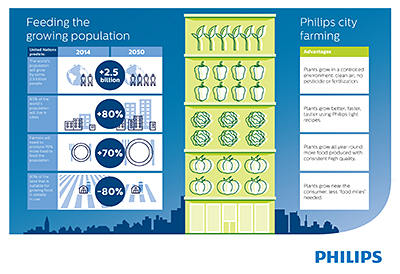
Feeding the growing population with Philips city farming.
Royal Philips has partnered with Green Sense Farms (GSF), a Chicago-area commercial grower, to develop one of the largest indoor commercial farms using LED grow lights tailored to their specific crops.

“By growing our crops vertically, we are able to pack more plants per acre than we would have in a field farm, which results in more harvests per year. We produce little waste, no agricultural runoff and minimal greenhouse gasses because the food is grown where it is consumed,” said Robert Colangelo.
This innovative farming model allows them to harvest 20-25 times a year by using ‘light recipes’ optimised for their produce, using 85 percent less energy.
The result will be an increase in crop yields and reduced operating costs, while providing consumers with locally grown, fresh vegetables throughout the year.
GSF is located in a small town called Portage, which is very close to Chicago.
GSF has invested millions of dollars to renovate and equip a million cubic foot indoor growing area consisting of fourteen 25 foot tall growing towers in two climate-controlled grow rooms.
These rooms use Philips energy-efficient LED solutions tailored to their specific crops.
This method also eliminates the need for harmful pesticides, fertilisers or preservatives, resulting in produce that is organically grown and virtually chemical free.
(more…)
Tags:Chicago, environment, farming, green, Green Sense Farms, LED, Philips, technology
Posted in Announce, Infographic, infographics, Philips, Study, Technology | No Comments »