Posts Tagged ‘broadband’
Thursday, August 30th, 2012
SingTel will be at COMEX 2012 at Suntec Singapore at Level 3 Rooms 301-306, 11am to 9pm.

Click to view or download SingTel promotions during COMEX 2012.
SingTel will also start their COMEX 2012 days earlier at 11am instead of noon. Check out their smartphone, tablets and broadband deals here, as well as their bundled packages.
Below are some highlights to check out.
(more…)
Tags:broadband, COMEX, COMEX 2012, COMEX 2012 accessories, COMEX 2012 computers, COMEX 2012 smartphones and tablets, game consoles, IT exhibition, laptops, MacBook, notebooks, promotions, Singapore, SingTel, Smart TV, smartphones, Suntec, tablets, telco
Posted in Brochures, Events, Exhibition, Gadgets, Games, Notebooks, Phones, Prices, Promotions, SingTel, Specifications, Tablets, Ultrabooks | 1 Comment »
Thursday, August 30th, 2012
M1 will be at COMEX 2012 at Suntec Singapore at Level 3 Rooms 307-314, 11am to 9pm.

Click to view or download M1 promotions during COMEX 2012.
M1 will start their COMEX 2012 days earlier at 11am instead of noon. Check out their smartphone, tablets and broadband deals here, as well as their bundled packages.
Tags:broadband, COMEX, COMEX 2012, COMEX 2012 accessories, COMEX 2012 computers, COMEX 2012 smartphones and tablets, IT exhibition, M1, promotions, Singapore, smartphones, Suntec, tablets, telco
Posted in Accessories, Brochures, Events, Exhibition, Gadgets, Galaxy, Notebooks, Phones, Prices, Promotions, Specifications, Tablets | 1 Comment »
Saturday, August 11th, 2012
Utilising unused TV frequencies to provide wireless broadband connectivity increases the range and and penetration of coverage through foliage and reflective water surfaces that traditional Wi-Fi simply cannot penetrate.

Squeezing more more channels from the electromagnetic spectrum.
Currently, the radio spectrum in the TV broadcast bands have been reserved for use by licensed broadcasters and are out-of-bounds for wireless broadband networks.
“Broadband connectivity is the ‘oxygen’ to today’s digital economy, and is fundamental to the wide adoption of cloud computing services that are already part of our daily lives, whether at work, home or play,” observed Jessica Tan, General Manager, Enterprise & Partner Group, Microsoft Asia Pacific.
However, much of these reserved radio spectrum remain unused and are called TV White Spaces (TVWS).
For instance, Singapore, Malaysia and Indonesia shares out the TV broadcast bands in the region and there are certain bands allocated to Malaysia and Indonesia that Singapore cannot use for TV broadcast.
If these TV White Spaces can be harnessed effectively for wireless broadband connectivity without interfering with the quality of TV broadcast, it will translate to better coverage, lower power consumption and reduced network costs.
“TVWS radio technology will create a new generation of wireless connectivity by unlocking these large, unused chunks of spectrum that will enable more ubiquitous and affordable wireless broadband for all,” said Tan.
The physical characteristics of the 700 MHz band (as compared to the higher-frequency 2.4 GHz and 5 GHz bands used by traditional Wi-Fi), for example, means that it can reach further, penetrate thick foliage, and transmit across reflective water surfaces with less interference.
In terms of bandwidth, however, both TVWS and Wi-Fi are capable of roughly 2Mbps per MHz. It is the penetrative and low-power attributes of the former that makes it an attractive supplement to the latter.
The spectrum as a precious commodity
Globally, explosive growth of wireless data traffic is putting a severe strain on today’s mobile and Wi-Fi network infrastructure, signalling the need for more efficient management of the spectrum, through policy and technology innovations.
The exploitation of TVWS turns unused TV broadcast frequency bands into premium wireless broadband delivery channels.
Tags:broadband, communications, Microsoft, mobile, radio, spectrum, StarHub, TV White Spaces, White Spaces, Wi-Fi, wireless
Posted in Figures, Internet, Microsoft, Mobile, Network, Reference, StarHub, Technology | 1 Comment »
Saturday, August 4th, 2012
SingTel celebrates Singapore’s 47th birthday with mobile, broadband, mio TV and multimedia content offers.

Check out SingTel’s National Day offers and promotions from 4 to 12 August.
Singapore Telecommunications Limited (SingTel) will offer 47 mio TV on-demand movies for just $1 each from 8 to 12 August. Titles include recently released Hollywood blockbusters, as well as Asian, Bollywood and Malay favourites.

Discounts to celebrate Singapore’s 47th birthday.
Customers who sign up for SingTel’s Flexi mobile plans from 4 to 12 August will enjoy $47 off all handset purchases.
They will also receive a discount of $4.70 off their monthly Flexi plan subscriptions.
The promotion is also available to existing customers who renew their subscriptions.
In addition, customers who subscribe to SingTel’s mio Home or exPlore Home broadband plans from 4 to 12 August can enjoy mio TV’s Combo pack at a special price of $19.90 per month, discounted from $29.90 per month.
The Combo pack includes mio Stadium football channels and ESPN STAR sports, as well as English entertainment and Jingxuan Chinese channels.
SingTel has supported the National Day Parade since 1995 as its Principal Telecoms Provider.
This year, SingTel is also providing the technology for the NDP online ticket balloting system and One Place multimedia portal.
With the new Barclays Premier League season starting on 18 August, the Combo pack is ideal for fans of the beautiful game.
In the spirit of the occasion, SingTel will offer a selection of Singapore’s most loved National Day songs for download and streaming through its award-winning AMPed 2.0 music service.
SingTel will also offer the Reuters SMS news alerts service for $4.70 per month, discounted from $7.50 per month.
Tags:Barclays Premier League, broadband, ESPN, Flexi, Mio TV, mobile, National Day, promotions, Reuters, Singapore, SingTel, subscription, telco
Posted in Announce, Holiday, Prices, Promotions, SingTel | No Comments »
Thursday, June 7th, 2012
StarHub will be at the PC Show 2012 at Suntec Singapore at Level 6, Hall 603.

Check out StarHub's PC Show 2012 promotions.
Here are the flyers for StarHub’s PC Show 2012 promotions for mobile and fibre broadband, smartphones and tablets, as well as cable TV.
Tags:broadband, cable, fibre, IT exhibition, laptops, mobile, notebooks, PC Show, PC Show 2012, promotions, Singapore, smartphones, StarHub, Suntec, tablets, TV
Posted in Brochures, Events, Exhibition, Gadgets, Internet, Notebooks, Phones, Prices, Promotions, Specifications, StarHub, Tablets | 1 Comment »
Monday, June 4th, 2012
SingTel officially launches Singapore’s first 4G service for smartphones and reins in data usage by reducing 12GB data limit.
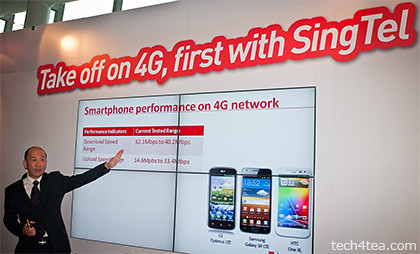
Mr Yuen Kuan Moon, SingTel’s CEO Consumer Singapore briefing on the launch of the 4G services for smartphones.
SingTel is also introducing new Flexi and iFlexi plans with reduced data bundles from 1 July 2012.
SingTel had launched its LTE BroadBand on Mobile (BBoM) service for laptops via USB dongle in
December last year.
From tomorrow (5 June 2012), customers who purchase a 4G-enabled handset with a SingTel Flexi and iFlexi plan will be able to enjoy the 4G service.
Three handsets will be available at launch: HTC One XL, LG Optimus LTE and Samsung Galaxy S2 LTE.
4G LTE network
SingTel’s 4G service will provide mobile Internet access that is up to five times faster than existing 3G-based smartphone services, with one-fifth of the network latency.
“We need to break away from the traditional one-size-fits-all approach, which is not sustainable in the long term. Today, 64 per cent of mobile data on our network is consumed by 10 per cent of our subscribers. This prevents the remaining 90 per cent from enjoying the full benefits of the network. With our tiered pricing model, subscribers will pay for what they use, and this ultimately allows us to keep prices for our plans the same over time despite rising network costs,” explained Yuen Kuan Moon, SingTel’s CEO Consumer Singapore.Users can enjoy theoretical download speeds of up to 75Mbps and typical download speeds between 3.4Mbps and 12Mbps.
SingTel will also introduce its Priority Pass traffic priority feature for the 4G service next year.
This will provide subscribers with priority for their data traffic when the network is loaded, thus ensuring smoother streaming and downloads.
Islandwide rollout of SingTel’s 4G network is expected to be completed in early 2013.
In areas where 4G has not yet been deployed, users will fallback to 3G connectivity with download speeds of up to 42Mbps.
Check the coverage diagrams at the end of this post to see when you will be enjoy LTE coverage.
Data bundle cutback
Data bundles for most of SingTel’s Flexi plans have been reduced drastically from 12GB to a range of 2GB to 12GB, although the number of bundled SMS has been increased.
“At the same time, heavy users will benefit from the significantly reduced excess usage rates. Data traffic on our mobile networks has been growing at 62 percent each year since 2010 due to the tremendous growth of smartphones, tablets and mobile content. By encouraging fair usage of the network, we will be able to deliver consistently high-quality services for our customers,” Yuen said.Charges for data usage beyond bundled allowances have been revised to $5.35 per gigabyte from 1 July to 31 December 2013, and subsequently to $10.70/GB from 1 January 2013.
Approximately 10 per cent of SingTel’s subscribers who are heavy SMS users will save from the new improved SMS bundles.
The plans will be available to all new and re-contracting customers from 1 July 2012, and will replace existing 3G Flexi and iFlexi plans.
So if you don’t want to relinquish the existing 12GB data bundle, you can let the existing contract run in perpetuity – but you’ll have to forego the handset subsidies that come with re-contracting.
Mr Yuen noted that based on current usage patterns, 90 per cent of subscribers should not incur higher charges, as their data consumption does not exceed the new bundles.
Read about StarHub’s response to SingTel’s launch below.
(more…)
Tags:4G, broadband, HTC, Internet, launch, LG, LTE, mobile, network, Samsung, Singapore, SingTel, smartphone, StarHub, Yuen Kuan Moon
Posted in Announce, Gadgets, Galaxy, HTC One, Internet, Launch, Optimus, Phones, Prices, SingTel, Specifications, StarHub, Tech news, Technology | 1 Comment »
Tuesday, December 20th, 2011
SingTel has just launched its Prestige 75 LTE mobile broadband service.
The price plan for the BroadBand on Mobile (BBoM) Prestige 75 LTE is shown here.
| SingTel Broadband on Mobile Prestige 75 LTE Price Plan |
| Price (including GST) |
$69.90/month |
| Data Bundle |
50GB 3G data (21Mbps) + 10GB LTE data |
| Excess Charges |
$0.512/MB, Capped at $94.16/month |
| Download Speed |
Theoretical: 75Mbps
Typical range: 3.4Mbps to 12Mbps |
| Comes with free LTE dongle and free Wireless@SG (3Mbps) |
For comparison, here are the price plans for its other BBoM packages.
| 3G Mobile broadband plan |
Theoretical speed |
Typical download speed range |
Price |
| Classic 3.6 |
3.6Mbps |
0.8Mbps to 2.1Mbps |
$29.90 |
| Priority 7.2 (with Priority Pass) |
7.2Mbps |
1.4Mbps to 3.7Mbps |
$40.00 |
| Premium 21 (with Priority Pass) |
21Mbps |
1.7Mbps to 4.8Mbps |
$59.90 |
Tags:4G, BBoM, broadband, dongle, Internet, LTE, mobile, SingTel
Posted in Events, Internet, Launch, Notebooks, Phones, Prices, SingTel, Specifications, Tablets, Tech news | 2 Comments »
Tuesday, December 20th, 2011
SingTel toady announced the commercial launch of the Mobile Prestige 75 (S$69.90 per mth), the first LTE service in Singapore for both consumer and business customers.

Eventually, coverage will grow to 80% of mobile data users by end 2012 and 95% by 2013.
Singapore Telecommunications Limited (SingTel) today announced the commercial launch of its 4G Long Term Evolution (LTE) BroadBand on Mobile (BBoM) service.
Fast speed
Bandwidth consumption profile
Yuen Kuan Moon, SingTel EVP of Digital Consumer said that SingTel does not offer any unlimited data plans, although the 50GB limit is more than enough for most consumers.
He revealed that 89% of SingTel’s subscriber base consume less than 10GB per mth, 10% consume 10 to 50 GB, while only 1% consume more than 50%.
This effectively means that 11% of subscribers consume 60% of data traffic.
The service offers theoretical download speeds of up to 75Mbps and typical download speeds between 3.4Mbps and 12Mbps.
It provides mobile Internet access that is more than three times faster than existing 3G-based services, with only one-fifth of the network latency.
SingTel 4G LTE will enable many bandwidth-intensive applications, such as cloud storage, music/video/HDTV streaming, video conferencing, online gaming, mobile data networking, rich voice etc.
SingTel’s BBoM Prestige 75 LTE will provide performances and services approaching that of fixed line networks. For instance, it will take only 2 min 14s to stream a 3.5 min-long snippet of video from YouTube.
Coverage evolution
At launch, the service provides outdoor coverage in the central financial district and other areas that experience high data usage.

At launch, SingTel BBoM Prestige 75 will cover the CBD and more than 100 sites.
This includes Shenton Way, Orchard, City Hall, Marina Bay, River Valley, Tanglin, Newton, Novena, Kallang, Rochor, Outram, Tanjong Pagar, Jurong West, Boon Lay, Bukit Panjang, Bedok and Changi.
In-building coverage is available in major shopping malls such as Ngee Ann City, Plaza Singapura, Ang Mo Kio Hub, Tampines Mall, West Mall, Parkway Parade and Jurong IMM. Office buildings such as Republic Plaza and Temasek Tower are also covered.
The service falls back to SingTel’s 3G-based Premium 21 service when users roam outside the LTE coverage area.

USB dongle
Mr Yuen said that SingTel is progressively expanding its network, which is expected to be able to provide LTE coverage for 80 per cent of mobile data users by the end of 2012.
By 2013, coverage will be extended to 95 per cent.
BBoM plans
Broadband on Mobile Prestige 75 will initially be available for USB dongle modems only.
Support for LTE-enabled smartphones and tablets will only be available when these mobile devices become more readily available in the market later on in 2012.
Existing 21Mbps 3G Broadband on Mobile Premium 21 customers can upgrade to LTE with a top-up of $10 per month.
The price plans for SingTel’s various mobile broadband plans can be found here.
Tags:4G, BBoM, broadband, dongle, Internet, LTE, mobile, SingTel
Posted in Events, Internet, Launch, Notebooks, Phones, Prices, SingTel, Specifications, Tablets, Tech news | 2 Comments »
Monday, October 24th, 2011
Taiwan has beaten Myanmar and US as the top source of attack traffic on the Internet, while Asian cities maintain their dominance of having the fastest connection speeds in the world, with HK at the pinnacle.
This is the 4th year for the quarterly report.
Akamai has released its Q2 State of the Internet report for 2011. It is a leading provider of cloud optimisation services.
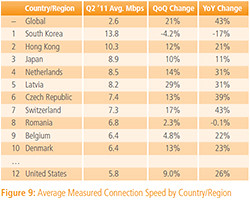
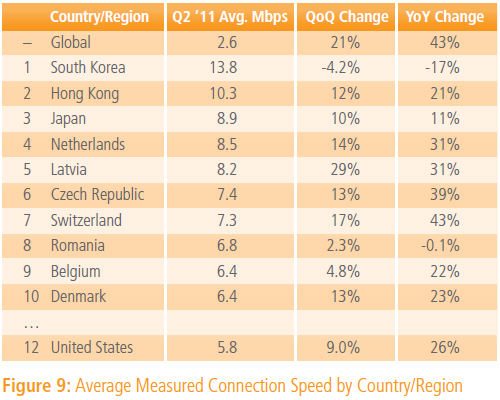
Average Connection Speed by Country/Region
Based on data gathered from the Akamai Internet Platform, which carries between 15-30 percent of the world’s Web traffic, the report provides insight into key global Internet statistics such as the world’s fastest and slowest regions for connection speed, the most frequent origins of attack traffic, and the highest-performing geographies for mobile connectivity, as well as resulting trends over time.
It uses its globally distributed network of servers to gather massive amounts of information on many metrics about the Internet, such as connection speeds, attack traffic, and network connectivity/availability/latency problems, as well as traffic patterns on leading Web sites.
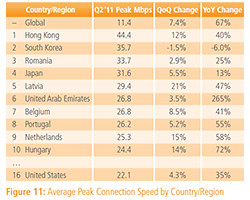
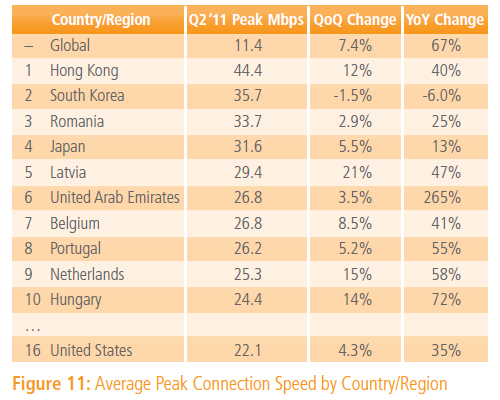
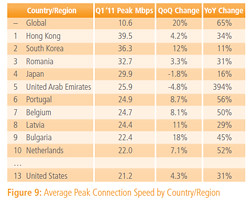
Average Peak Connection Speed by Country/Region
The Q2 report includes data gathered from across Akamai’s Intelligent Internet Platform during the second quarter of 2011 about attack traffic, broadband adoption, and mobile connectivity, as well as trends seen in this data over time.
In addition, this quarter’s report also includes insights into the state of IPv4 exhaustion, the impact of World IPv6 Day, the state of client-side SSL, and smartphone usage trends as observed by Akamai partner Ericsson.
The main highlights from the Q2 report paints the following picture:
Speed
- Global average connection speed increased 43 percent year over year to 2.6 Mbps. South Korea again had the highest average connection speed at 13.8 Mbps. Singapore was ranked 29th at 4.5 Mbps.
- Global average peak connection speed was 11.4 Mbps. Hong Kong has maintained its position as having the highest average peak connection speed at 44.4 Mbps. Singapore was 19th at 20.7 Mbps.
- Globally, high broadband (>5 Mbps) adoption grew to 27%. At 68%, the Netherlands was the highest, pushing S Korea to third position. Hong Kong came in second, while Singapore was 20th at 33% adoption.
- Gloobal broadband (>2 Mbps) adoption increased to 65%. Singapore was 48th at 67%.
- Global narrowband (<256 kbps) adoption at 2.9% continued its decline. Lebanon, with its 56% narrowband adoption is the top laggard.
- Cities in Asia again have the fastest connection speeds in the world. Out of the 100 fastest cities worldwide, 70 were from Asia, with Hong Kong, 59 cities in Japan and 10 cities in South Korea.
- Brno, Czech is the fastest city in Europe, at number 55 out of 100.
- 18 US cities made the top 100 list. 9th-placed San Jose’s 13.7 Mbps moved the US into the top 10 for the first time.
Security
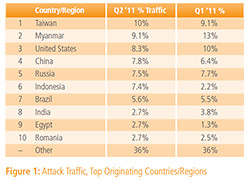
Sources of top attack traffic
Taiwan was the top source of attack traffic accounting for 10% of overall attack traffic. Myanmar and US together accounted for another 17%. Having made it debut as top attack traffic source in the last quarter, second-placed Myanmar has continued its attack activities showing its entrance into the ranks of top attack traffic sources was not a flash in the pan.
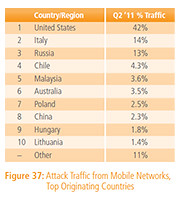
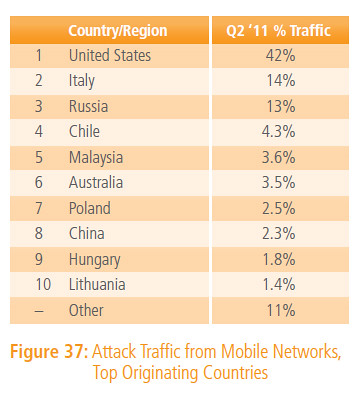
Attack from mobile networks
With respect to attack traffic originating from mobile network providers, the US vaulted to the top of the list, generating 42% of the observed traffic. Italy has gone down to second place, after its observed attack traffic from was halved compared to the previous quarter. Russia took third place. The top three countries were responsible for almost 70% of observed attacks, while the top 10 countries accounted for nearly 90% of the observed attacks.
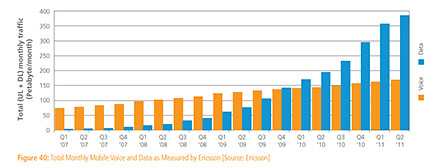
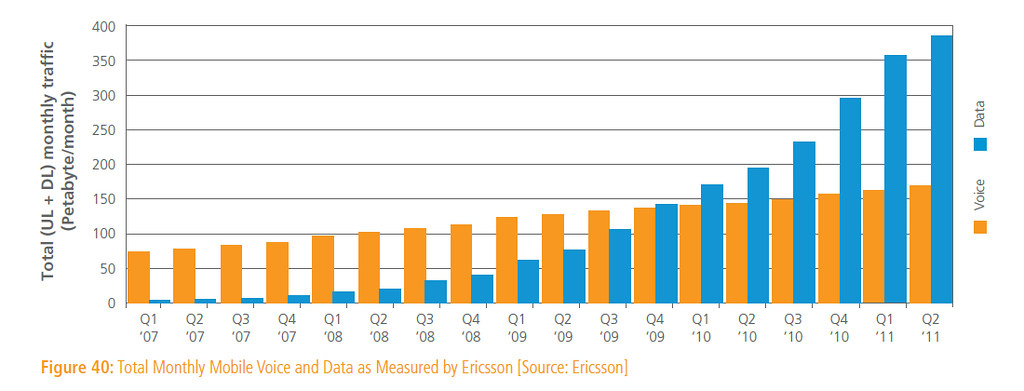
Exponential growth in mobile data traffic is outstripping linear growth of mobile voice traffic.
Previous SOTI reports from Akamai on tech4tea.com
1st Quarter, 2011 Report (Volume 4, Number 1)
4th Quarter, 2010 Report (Volume 3, Number 4)
Tags:Akamai, broadband, Internet, mobile, security, speed, statistics
Posted in Figures, Internet, Tech news | No Comments »
Sunday, July 31st, 2011
Asian cities again claim the fastest connection speeds in the world, with HK maintaining its lead in clocking the highest peak connection speed. Myanmar has pipped Russia to generate the most attack traffic.
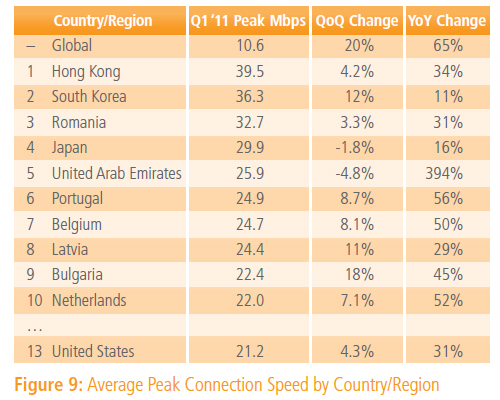
 Akamai has released its Q1 State of the Internet report for 2011. It is a leading provider of cloud optimisation services. Based on data gathered from the Akamai Internet Platform, which carries between 15-30 percent of the world’s Web traffic, the report provides insight into key global Internet statistics such as the world’s fastest and slowest regions for connection speed, the most frequent origins of attack traffic, and the highest-performing geographies for mobile connectivity, as well as resulting trends over time.
The main findings from the quarterly State Of The Internet (SOTI) report paints the following picture:
Speed
- Global average connection speed increased 23 percent year over year to 2.1 Mbps.
- Cities in Asia have the fastest connection speeds in the World. The 100 fastest cities worldwide is dominated by Asian countries, with 61 cities in Japan, five cities in South Korea, and Hong Kong. Lyse, Norway is the fastest city in Europe, at number 33 out of 100. 18 U.S. cities made the top 100 list, with Riverside in California ranking as the fastest U.S. city, at number 39 out of 100.
 South Korea has the highest level of “high broadband” (> 5 Mbps), with 60% of connections to Akamai at speeds above 5 Mbps.
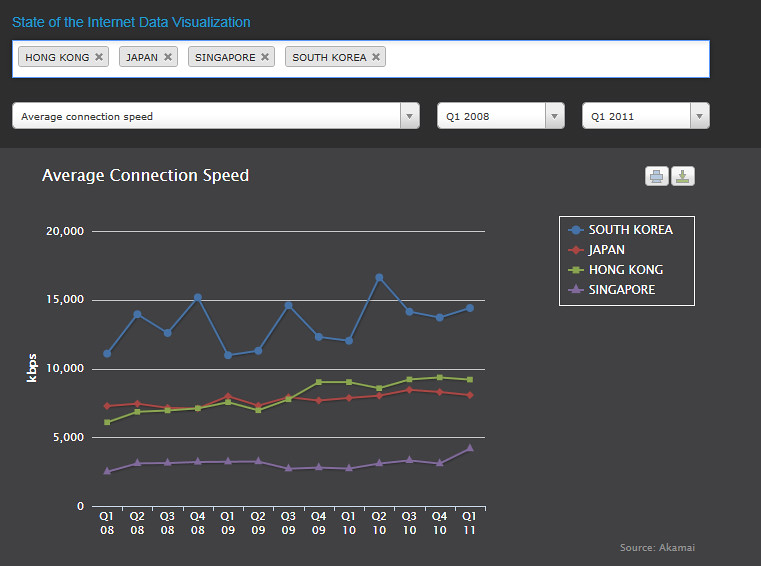
- South Korea has also achieved the highest average connection speed at 14.4 Mbps.
- Hong Kong has maintained its position as having the highest average peak connection speed.
- Other cities in Japan and South Korea continued to hold many of the top spots for highest average and average peak connection speeds by city.
Security
The latest findings reflected in the report show some significant changes in Q1 2011 related to sources of attack traffic. Most notably, Myanmar not only made its first appearance on the list, but also ranked #1 by generating 13 percent of attack traffic during this period.
Russia dropped from top into 4th place, accounting for 7.7 percent of global observed attack traffic, down from 10 percent in the previous quarter. Among other changes, the United States rose from 5th to 2nd, accounting for 10 percent of observed global attack traffic.
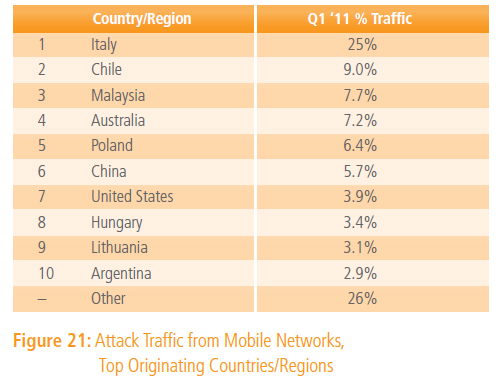
For attack traffic originating from mobile network providers, Italy remained in the top spot, responsible for 25 percent of observed attack traffic in the first quarter.
Mobile Consumption & Connectivity
In the first quarter of 2011, the average measured connection speed for known mobile providers worldwide ranged from a high of slightly more than 6 Mbps to a low of 163 kbps. A service provider from Poland delivered the highest average mobile connection speed in the first quarter 2011, bumping last quarter’s fastest provider from Greece to the number two spot.
 Consumption figures indicate that during Q1 2011, seven percent of the surveyed mobile providers consumed an average of 1 GB of content per month, while 73 percent consumed an average of 100 MB. The remaining 20 percent consumed less than 100 MB.
As a result of Akamai’s recently announced partnership with Ericsson, the report now includes data collected by the equipment provider. Overall mobile data traffic, as measured by Ericsson, experienced 130 percent yearly growth in the first quarter, and is now more than double the volume of voice traffic.
Akamai’s SOTI analysis
This is the fourth year that Akamai is publishing its quarterly analysis of Global Connectivity, Attack Traffic and Broadband Consumption.
More than 584 million unique IP addresses from 237 countries/regions connected to the Akamai Platform in Q1 2011. This represents 5.2 percent more IP addresses when compared with the fourth quarter of 2010, and an increase of 20 percent compared to the same quarter a year ago.
Consistent with last quarter’s report, the top ten countries/regions accounted for nearly 70 percent of the total IP addresses, indicating that the majority of the world’s unique IP addresses are concentrated within a relatively small number of geographies. This quarter saw Italy enter the top ten with its 11 percent quarter-over-quarter growth while Canada dropped out of the top ten.
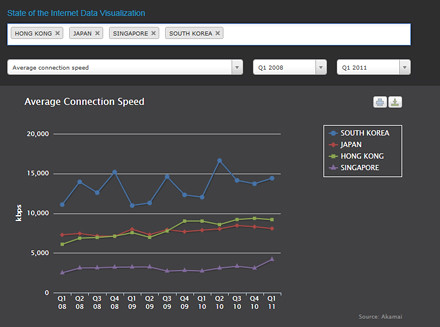
New data visualization tool show trends by geography in several measured categories.
Akamai has also released a new data visualization tool showcasing trends by geography in several measured categories. The tool allows users to generate and print/download graphs highlighting average connection speed, average peak connection speed, and high broadband/broadband/narrowband adoption rates. In addition, the online tool offers quick, easy and customized views of trend data since the report was first published at the beginning of 2008.
Tags:Akamai, broadband, Internet, mobile, security, speed, statistics
Posted in Figures, Internet, Tech news | 1 Comment »