Archive for the ‘Study’ Category

The State of the Internet 4Q 2011 report from Akamai

Monday, April 30th, 2012

China is now the top source of observed attack traffic. South Korea boasts both highest average connection speed and highest average peak connection speed.

Fourth Quarter, 2011 State of the Internet report released by Akamai Technologies.

Fourth Quarter, 2011 State of the Internet report released by Akamai Technologies.

China, at 13 percent, generated the most attack traffic observed by Akamai. The United States (10%) and Indonesia (7.6%) rounded out the top three.

The findings were in the Fourth Quarter, 2011 State of the Internet report released by Akamai Technologies.

Going into its fifth year, the report incorporates four-year’s worth of trending data, illustrating how Internet connectivity has improved over time.

Based on data gathered from the Akamai Intelligent Platform, the report provides insight into key global statistics such as Internet penetration, mobile traffic and data consumption, origins of attack traffic, IPv6 adoption and global and regional connection speeds.

In the fourth quarter of 2011, more than 628 million unique IP addresses from 236 countries and regions connected to the Akamai Intelligent Platform. This represents 2.1 percent more IP addresses than connected in the third quarter of 2011, and an increase of 13 percent compared to the same quarter a year ago.

The Fourth Quarter, 2011 State of the Internet report includes a new section that will appear annually going forward and that tracks trends since the report’s inception in 2008.

Speed

Cities in the Asia Pacific region enjoy the fastest connection speeds in the world. Out of the 100 fastest cities worldwide, 69 cities were from the region, with 61 in Japan, six in South Korea, as well as Australia and Hong Kong.

24 cities in North America ranked among the top 100, including two in Canada and 22 in the United States.

Seven cities in Europe – including three in Sweden, two in Switzerland and one each in Romania and Latvia – made up the balance.

Globally, high broadband (>5 Mbps) adoption maintained at 27%.

South Korea took the top spot in high broadband adoption, with 83% of the country’s connections to Akamai > 5 Mbps.

Netherlands was second with 67%. US was twelfth (44%) while Singapore languished at 21st (32%).

BlackBerry OS vs iOS vs Windows Phone vs Android

Monday, April 16th, 2012

Trend Micro has released the results of its study on the four main mobile operating systems in a report titled “Enterprise Readiness of Consumer Mobile Platforms”.

The security firm found the BlackBerry 7 OS the most secure mobile operating system, followed by iOS 5, Windows Phone 7.5, and Android 2.3.

Summary chart from “Enterprise Readiness of Consumer Mobile Platforms” White Paper by Trend Micro.

Summary chart from “Enterprise Readiness of Consumer Mobile Platforms” White Paper by Trend Micro.

Android 2.3 was used in the study because it was the dominant installed/supplied version of Google’s mobile OS at the time of the research.

Below is an excerpt from the White Paper summarising the findings about the four mobile platforms.

(more…)

US$1million for complete access to your computer?

Thursday, April 5th, 2012

Norton has unveiled the findings of its latest survey which provides insights into Singaporeans’ Internet dependence, the importance of their personal information and their level of understanding when it comes to Internet security.

Say it with numbers - from Norton's survey of Internet Security.

Say it with numbers – from Norton’s survey of Internet Security.

Last year, Norton did an interesting survey that revealed that phone owners in Singapore were willing to pay an average of S$148 to get their lost/stolen phones back, in order to alleviate the stress and inconvenience losing their mobile phones.

This year, Norton found that 76 percent of Internet users in Singapore would rather forgo US$1million than give strangers unlimited access to their computers.

The key findings are highlighted in the info-graphic above, while the details are at the end of this post.

Protection

So what does Symantec have to protect the multitude of PCs, Macs, smartphones and tablets in the modern household?

Norton will be offering Norton 360 Everywhere in the first half of 2012 (Pricing and systems requirements to be announced at launch).

Norton 360 Everywhere promises to be an easy-to-manage, all-in-one security solution that delivers a multi-platform solution for PCs, Macs, Android-based phones and tablets.

Users can customise their security to meet their specific needs, be it against online threats, data loss, and device loss or theft.

The details of the survey is excerpted below.

(more…)

Darth Vader’s voice on TomTom GPS makes babies happy

Sunday, April 1st, 2012

Following six months of research and rigorous tests, TomTom’s Navigation Laboratory (NavLab) has discovered that Darth Vader’s navigation voice increases children’s happiness in the car by over 68%.

More than 300 baby and toddler volunteers took parts in Project GAGA, the NavLab research project to find the perfect satnav voice for families with small children.

Of course this has been TomTom’s April Fools’ joke.

But jokes aside, I used the TomTom 750 GPS last year during my self-drive family holiday in Germany with two young kids in tow.

You won’t believe how much fun the kids had listening to the various voices providing turn-by-turn navigation instructions from the portable navigation device.

We tried out Bugs Bunny, Homer Simpsons and Ken with the Australian accent.

But it was Darth Vader and Yoda which battled it out for the top favourite spot. Eventually, we decided the dark lord had just that bit of an edge over the benevolent Jedi master.

To be honest, I had initially thought the celebrity voices feature was a useless gimmick.

But after we had so much fun, we really liked it. The whole family had such a laugh on those long drives imitating the accents and nuances of those voices.

We were like going “Turn around where possible … <heavy breathing> … I sense your lack of faith disturbing,” and “Take the left turn … <heavy breathing> … and face your destiny, you are coming over … <heavy breathing> … to the dark side”.

New Zealand-based Valerie Cross of TomTom told me during her visit to Singapore that the All Blacks did a recording too for TomTom – who had truckloads of fun improvising around the provided script.

I would love to hear that some time.

Nelson Mandela Digital Archive goes live online

Wednesday, March 28th, 2012

Google and the Nelson Mandela Centre of Memory (NMCM) have launched archive.nelsonmandela.org which is freely accessible to the public.

The archives include never-seen sequel manuscripts to Mandela’s “Long Walk to Freedom” autobiography.

We should never allow ourselves to forget the struggles for such basic rights as racial equality and take racial harmony for granted.

We should never allow ourselves to forget the struggles for such basic rights as racial equality and take racial harmony for granted.

When I was a youth, everybody knew who Nelson Mandela was and Apartheid was a must-study topic for the General Paper exam in school.

I wonder how many of the current generation remember or know about the tumultuous struggles in South Africa to fight for what many in the rest of the world take for granted – racial equality.

Even today in Singapore, you have people posting insensitive remarks about other races and nationalities over Twitter.

And in the US, the Trayvon Martin shooting is still brewing over.

In order to keep the memories of Nelson Mandela alive, Google gave a US$1.25m grant to Johannesburg-based NMCM last year.

The aim was to preserve and digitize thousands of archival documents, photographs and videos about Mr Mandela.

The new online multimedia archive includes Mr Mandela’s correspondence with  family, comrades and friends, diaries written during his 27 years of imprisonment, and notes he made while leading the negotiations that ended apartheid in South Africa.

Start by looking at his Early Life, and take a peek into his personal memories of the time he was incarcerated during the Prison Years.

Read the handwritten notes on his desk calendars, which show, for example, that he met President F.W. De Klerk for the first time on December 13, 1989 for two and a half hours in prison; the Warrants of Committal issued by the Supreme Court which sent him to prison; the earliest known photo of Nelson Mandela’s prison cell on Robben Island circa 1971; and a personal letter written from prison in 1963 to his daughters, Zeni and Zindzi, after their mother was arrested, complete with transcript.

What was Apartheid

Apartheid was the official policy of the National Party, which came to power in 1948 in South Africa. It was the practice of official racial segregation.

Under apartheid everyone in South Africa had to be classified according to a particular racial group.

This determined where someone could be born, where they could live, where they could go to school, where they could work, where they could be treated if they were sick and where they could be buried when they died.

Only white people could vote and they had the best opportunities and the most money spent on their facilities.

Apartheid made others live in poverty.

Black South Africans’ lives were strictly controlled.

Many thousands of people died in the struggle to end apartheid.

– www.nelsonmandela.org/content/page/faqs

How much data has been created, lost and recovered since the advent of the PC?

Tuesday, March 13th, 2012

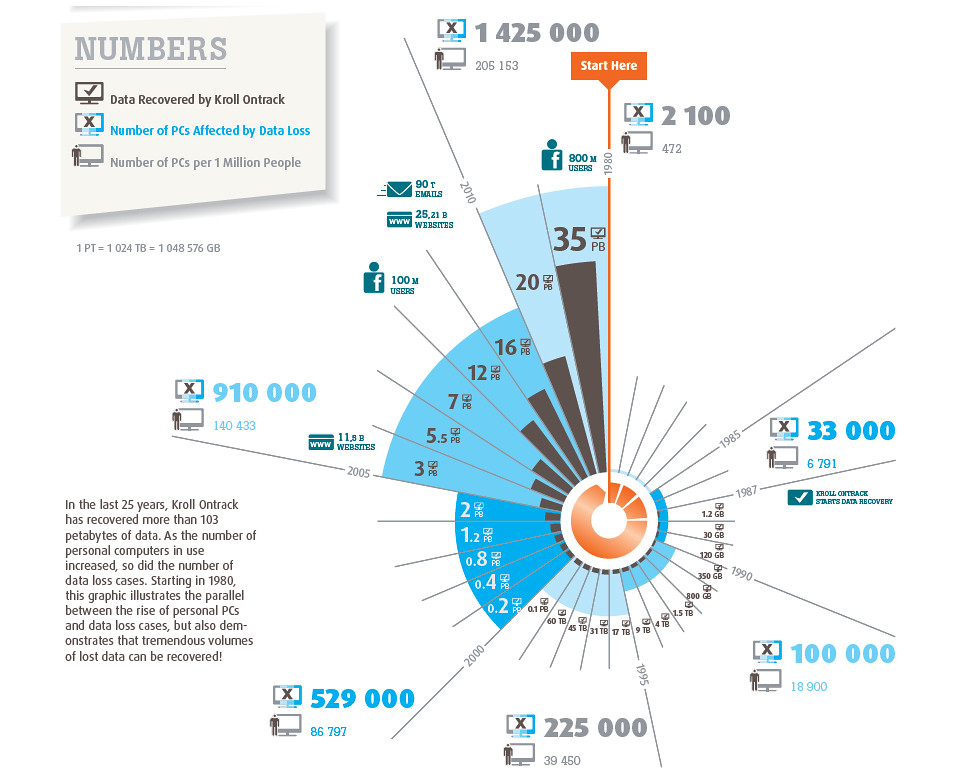
Kroll Ontrack has recovered more than 103 petabytes of data over the past 25 years.

THE DIGITAL ERA: How our life has changed into a digital one; and the creation, loss and recovery of data over time (Source: Kroll Ontrack).

THE DIGITAL ERA: How our life has changed into a digital one; and the creation, loss and recovery of data over time (Source: Kroll Ontrack).


Kroll Ontrack
has released new statistics regarding how the creation of storage technologies and digital information has impacted data loss and data recovery technology since the advent of the personal computer in the 1980’s.

“In the past 25 years, the worst cases Kroll Ontrack has seen have coincided with natural disasters, which included burned, water logged and physically damaged drives,” said Todd Johnson, vice president of operations, Kroll Ontrack.Since the first Kroll Ontrack data recovery lab opened in 1987, more than 103 petabytes (PB) of data has been recovered.

How much is 103 PB of data? That’s equivalent to 25 million USB flash drives, each with 4 GB capacity.

Only 1.2 GB of data was recovered in 1987, whereas the amount of data recovered by Kroll Ontrack in 2011 has skyrocketed to nearly 35 million GB (35 PB).

The number of computers impacted by data loss was estimated to have reached nearly 1.4 million – compared to only 33,000 in 1987.

According to an analysis by Kroll Ontrack, the number of data loss cases over the past 25 years grew in parallel with the total number of personal computers in the world.

“One of the company’s most successful endeavors was the recovery of more than 99 percent of mission-critical data from a melted, crashed and burned drive from the 2003 Space Shuttle Columbia,” revealed Johnson.The analysis also revealed that on average, one in one thousand computers lost data stored on it.

In the 1980’s, at the onset of the so-called PC era, the estimated number of personal computers in use was nearly 7,000 devices per one million people and approximately 33,000 of them suffered data loss.

By the mid 1990’s, the number of computers in use was nearly 40,000 per one million people and data was lost from approximately 225,000 computers.

In 2011, these figures reached more than 200,000 computers and 1.4 million cases of data loss, respectively.

“You cannot go through day-to-day life without interfacing with some form of digital data,” said CK Lee, country manager, Kroll Ontrack Singapore. “As technology advances to include virtualization, cloud, and social media, individuals, businesses and of course data recovery specialists have to evolve to address these storage mediums and the new challenges they present.”According to the latest IDC Digital Universe study, the amount of data more than doubles each year, and in 2012, it will exceed 1.8 zettabytes.

This is the equivalent of 200 billion two-hour long HD movies that one person would have to watch continuously for 47 million years.

As data creation increases, so does data loss.

According to a report by market research firm Gartner, every year at least 25 percent of computer users worldwide experience data loss.

Kroll Ontrack statistics indicate that 29 percent of data is lost as a result of hardware failure and 27 percent is due to human error.

Other causes include software errors (7 percent), computer viruses (7 percent) and natural disasters such as floods or fires (3 percent).

Below is a timeline infographic by Kroll Ontrack charting a brief history of the digital era.

(more…)

How Singapore IT practitioners perceive mobility risks

Thursday, March 1st, 2012

Singapore was one of 12 countries surveyed in a new “Global Study on Mobility Risks” conducted by Ponemon Institute. Out of the overall 4,640 IT and IT security practitioners surveyed, 259 respondents were from Singapore.

Perception of mobile phone use as a threat and presence of security controls to mitigate the risks.

Perception of mobile phone use as a threat and presence of security controls to mitigate the risks.

The study was sponsored by content security provider Websense Inc, and is designed to help IT security professionals plan for an increasingly mobile workforce.

“We asked thousands of IT security professionals and found mobile devices were overwhelmingly important to business objectives,” said Dr Larry Ponemon, chairman and founder of the Ponemon Institute.Corporate mobile devices and the bring-your-own-device (BYOD) phenomenon are rapidly circumventing enterprise security and policies.

In Singapore, 45 percent of respondents say that their organizations experienced a data breach due to insecure mobile devices, and 22 percent are unsure.

“However, mobile devices put organizations at risk — risks that they do not have the necessary security controls and enforceable policies to address. It’s also clear that employees are deliberately disabling security controls, which is a serious concern,” Dr Ponemon addedThis is slightly less than the overall proportion of 51 percent for all 12 countries.

Fifty-five percent say that their employees circumvent or disengage security features such as passwords and key locks – versus the overall 59 percent.

Below is the Executive Summary for the survey of IT & IT Security Practitioners in Singapore, which was extracted from the “Global Study on Mobility Risks”.

(more…)

BYOD causing security breaches

Thursday, March 1st, 2012

51 percent of organizations lose data through mobile devices, while 59 percent of employees dodge security controls, according to a new  “Global Study on Mobility Risks” unveiled at the RSA Conference in San Francisco, USA.

The “Global Study on Mobility Risks” by Ponemon Institute.

The “Global Study on Mobility Risks” by Ponemon Institute.

Mobile devices help business, but security is needed to prevent costly data loss.

Corporate mobile devices and the bring-your-own-device (BYOD) phenomenon are rapidly circumventing enterprise security and policies. This survey defines mobile devices as laptops, USB drives, smartphones, and tablets.

“IT has spent years working on desktop security and trying to prevent data loss over web and email channels—but mobile devices are radically changing the game,” said Tom Clare, senior director of Product Marketing Management.Seventy-seven percent of more than 4,600 respondents in 12 countries (Australia, Brazil, Canada, France, Germany, Hong Kong, India, Italy, Mexico, Singapore, United Kingdom, and the United States) surveyed agree that the use of mobile devices in the workplace is important to achieving business objectives.

But 76 percent also believe that these devices put their organizations at risk—and only 39 percent have the necessary security controls to address the risk.

The study was conducted by the Ponemon Institute and sponsored by content security provider Websense Inc, and is designed to help IT security professionals plan for an increasingly mobile workforce.

“Tablets and iOS devices are replacing corporate laptops as employees bring-their-own-devices to work and access corporate information. These devices open the door to unprecedented loss of sensitive data. IT needs to be concerned about the data that mobile devices access and not the device itself,” Clare added.The research shows that organizations often don’t know how and what data is leaving their networks through non-secure mobile devices.

Traditional static security solutions such as antivirus (AV), firewalls, and passwords are not effective at stopping advanced malware and data theft threats from malicious or negligent insiders.

To safely permit corporate use of mobile devices, Websense has released its new Websense TRITON Mobile Security solution.

Sixty-five percent of respondents are most concerned with employees taking photos or videos in the workplace—probably due to fears about the theft or exposure of confidential information.

Other unacceptable uses include downloading and using internet apps (44 percent) and using personal email accounts (43 percent).

Kelihos spam engine lives on

Wednesday, February 22nd, 2012

The Websense Security Labs Spam Trap system has detected a variant of Kelihos that is apparently still active.

Google Maps showing geographically how widespread the Kelihos command and control and peers infrastructure is, and therefore how well protected the botnet is.

Google Maps showing geographically how widespread the Kelihos command and control and peers infrastructure is, and therefore how well protected the botnet is.

“Kelihos is yet another example of how botnets shut down and reappear. Malware authors have a motive to get them up and running again. Websense Labs detected this new variant of Kelihos as we are constantly monitoring web and email exploits. More importantly, we are able to join the dots between these different attack vectors and protect against cybercriminals achieving their ultimate goal – stealing data,” said Carl Leonard, Senior Security Research Manager (EMEA), Websense Security Labs.Over the last half a year, the spam engine Kelihos has attracted the attention of many people, including security company researchers and analysts.

Microsoft had partnered with Kyrus Tech Inc. and Kaspersky Lab to take down the Kelihos botnet in September 2011.

However, Microsoft has recently confirmed, on its official blog, a new generation of Kelihos variants derived from the original Kelihos botnet.

Websense Security Labs has written up a detailed account of their investigations into this resilient nuisance.

CA Technologies earns Overall Positive Vendor Rating from Gartner

Tuesday, February 14th, 2012

CA Technologies has also earned a “positive” rating in the following categories: Identity and Access Management; Service Management; Portfolio Management; and Service Assurance; and Capacity Management.

For the Mainframe Modernization category, it earned a “strong positive.”

Gartner rates CA Technologies with an overall Positive rating in the latest Vendor Rating report.

Gartner rates CA Technologies with an overall Positive rating in the latest Vendor Rating report.

According to Gartner, a positive rating means that “potential customers should consider this provider a viable choice for strategic or tactical investments, while planning for known limitations.”

“With a deep commitment to focusing on high-growth markets in areas such as automation, cloud computing security and software as a service (SaaS), we believe CA Technologies has laid out a strong roadmap for the future,” said Peter Griffiths, executive vice president, Enterprise Solutions Technology Group, CA Technologies.A “Strong Positive” is the highest possible rating given.

The Mainframe Modernization category includes new products geared to simplify mainframe management, such as CA Mainframe Chorus and CA Mainframe Software Manager.

Gartner is a leading provider of research and analysis on the global information technology industry.

Its Vendor Ratings assess all the different aspects of a technology provider, such as its strategy, organization, products, technology, marketing, financials and support.

These ratings are periodically revised to reflect changes in assessment when a significant internal or external event directly affects the provider.

Here is the Vendor Rating report.