Archive for the ‘Study’ Category

CA Technologies leads in User Authentication

Thursday, February 9th, 2012

Gartner has positioned CA Technologies in the Leaders Quadrant of the Magic Quadrant for User Authentication.

CA Technologies has a range of User Authentication security solutions.

CA Technologies has a range of User Authentication security solutions.

Gartner estimates the overall growth in the market by customers to be approximately 30 percent year-over-year.

“By 2017, more than 50 percent of enterprises will choose cloud-based services as the delivery option for new or refreshed user authentication implementations, up from less than 10 percent today,” writes Ant Allan, Gartner Research Vice President.Because of the shift toward lower-cost authentication solutions, the overall growth by revenue is estimated to be approximately only 20 percent.

Considering Gartner’s user authentication market growth estimate, and the forecast that half of the implementations will be cloud services, CA Technologies is confident it is in a solid position for success in this sector.

“With more than 14,000 organizations leveraging our authentication solutions and more than 85 million identities protected by our cloud-based authentication services we should be on the short-list for anyone considering a cloud authentication solution,” said Vic Mankotia, Vice President of Security, Asia Pacific, CA Technologies.

Get a complimentary copy of the report here.

CA Technologies was also positioned by Gartner in the Leaders Quadrant of two Gartner reports: Magic Quadrant for Identity and Access Governance (IAG), and Magic Quadrant for User Administration/Provisioning.

eBook: Digital PR Techniques to Use in this Digital Age

Sunday, February 5th, 2012

A friend of mine sent me a hardcopy of this book about the importance of digital PR and digital PR techniques that work well.

"The Changing Face of Communications: 12 digital techniques for modern PR" - released by Lewis PR.

"The Changing Face of Communications: 12 digital techniques for modern PR" - released by Lewis PR.

It was recently released by her PR agency (Lewis PR) to delve into what is really key to marketing and PR professionalism, as well as companies in general who are looking to keep themselves updated in this digital age.

eBook on modern digital PR techniques for the digital age.In this digital age, we see social media evolve by the day and emerge in communications more and more.

So I do agree with my friend, Gina Daryani, how important it is to keep abreast with the latest techniques in this fast-paced and rapidly-changing age.

In order to address “The Changing Face of Communications”, this book propounds “12 digital techniques for modern PR”.

I have listed below the 12 techniques – each delved with in its own How-to chapter in the book.

  1. How to communicate in a real-time world
  2. How to incorporate SEO into PR
  3. How to evaluate a social media campaign
  4. How to improve your corporate videos
  5. How to get started in word-of-mouth marketing
  6. How to make your corporate blog take off
  7. How to use social media to enhance events
  8. How to create sticky content
  9. How to handle a social media crisis
  10. How to optimize your web presence for conversions
  11. How to make the case for social media
  12. How to work with online influencers

You may also download the free e-book from this link here.

I’m just beginning to read the book, but below is an excerpt to get you started.

(more…)

Love traffic jams – love Clementi and Bukit Timah

Monday, December 19th, 2011

TomTom study reveals the best and worst travel times on Singapore roads.

West and central parts of Singapore experience the largest traffic slowdowns during the morning peak hours.

West and central parts of Singapore experience the largest traffic slowdowns during the morning peak hours.

TomTom did a study on driving times between the City and different suburbs during the peak hours.

The time taken to drive from each suburb to Raffles Place during peak hour in the morning (8-9am) was compared with the time taken during silent hours (1-5am) – when traffic was not a constraint to vehicle speed.

Traffic slowdowns during the evening peak hours in Singapore.

Traffic slowdowns during the evening peak hours in Singapore.

Similarly, the time taken to drive from Raffles Place to each suburb during the peak hour in the evening (5-7pm) was compared with the time taken during silent hours.

The spread of traffic degradation seems broader in the morning peak hours compared to the evening peak hours.

The spread of traffic degradation seems broader in the morning peak hours compared to the evening peak hours.

Clementi and Bukit Timah were found to suffer the greatest slow downs during the two peak hours compared to unobstructed driving timings between these two suburbs and the City.

New Zealand based Valerie Cross of TomTom Asia Pacific told me during her visit to Singapore that IQ Routes takes into consideration the different travel times for each road during different times of the day. “That’s because the actual travel speeds of each road varies throughout the day, and IQ Routes takes that into account.”Bishan and Jurong West were another two suburbs that experiences severe slowdowns during the peak hours.

For the evening peak hour, the overall spread of degradation was much smaller than during the morning peak hour.

Tampines is an interesting exception in that is the least affected by the morning peak hour, yet it was most severely affected during the evening peak hour.

There doesn’t seem to be any obvious reason to that.

TomTom derived the traffic data from the logs of portable navigation devices (PND) of its users when the latter connected their GPS devices to the Internet for updates.

The traffic data were extracted without any tags that could be used to identify the PND users.

Historic traffic data along roads are used during route planning by TomTom PNDs.

Historic traffic data along roads are used during route planning by TomTom PNDs.

These historical traffic data is also used by TomTom to inject intelligence into the route planning algorithms of its PNDs, in the form of its IQ Routes feature.

Instead of planning routes based on jam-free traffic conditions and maximum road speed limits, IQ Routes take into consideration the historical and real travel timings of those roads considered for the routes for more accurate “fastest route” recommendations.

It’s as if the PND is a local choosing to drive further on a less congested road in order to avoid a 300m stretch that typically takes an hour due to peak hour traffic.

HD Traffic uses live data for route planning.

The next step beyond IQ Routes is live traffic information, which TomTom offers for 22 countries in the form of its HD Traffic feature.

Unfortunately, it is not available and for the moment, TomTom does not yet have any plans to introduce that to its Singapore users, because of the complexity of setting up its own live traffic sources and integration with other live traffic sources.

Ernst & Young finds security lagging behind business needs in survey

Thursday, November 17th, 2011

In its 14th annual Global Information Security Survey, Ernst & Young found that companies rushing to digitise their businesses with new technologies are increasingly leaving their ability to tackle new and complex security threats behind.

“Information security needs to be more visible in the board room with a clearly defined strategy that will support the business,” said Gerry Chng, IT Risk and Assurance Partner, Ernst & Young Advisory Pte. Ltd.The global survey involved 1,700 organisations in 52 countries and was conducted between June and August 2011.

Although companies are moving into the increasingly borderless world of cloud computing and social media, information security is still not a boardroom priority for most companies and is not a visible agenda for them.

“Security must be carefully planned and take into consideration the practicality of the controls that considers the IT operations. There needs to be buy-in from the business functions, and support needs to come from the top,” Chng added.Only 51% of the survey stated that they have a documented information security strategy. 12% of the respondents present information security topics at each board meeting and fewer than half (49%) of respondents believe that their information security function is meeting the needs of the organization.

With the consumerisation of enterprise IT, organisations have had to allow employees to use personal tablets to access corporate information.

“There are existing solutions in the market that support the secure access of information on personal smartphones and tablets. Organizations should evaluate whether these solutions meet their needs, rather than using traditional channels such as web interfaces and opening up email access via the web as an option.”It was therefore natural that more than half the survey respondents ranked this adoption the second-highest on the list of technology challenges.

Policy adjustments and awareness programs are the top two measures used to address risks posed by this new mobile technology.

The adoption of security techniques and software, however, is still low. For instance, encryption techniques are used by fewer than half (47%) of the global organisations.

The massive popularity and growth of social media has also threatened the IT risk landscape. Social media risks include the introduction of malicious software lurking within social networks, hacked accounts that are used to solicit information, and the release of confidential or negative company information or personal data.

“The traditional paradigm of security within a perimeter is no longer valid.”To address potential risks posed by social media, organizations seem to be adopting a hard-line response. A majority (53%) of the global organizations respond by blocking access to sites rather than embracing the change and adopting enterprise-wide measures.

“With the increased collaboration with upstream and downstream partners, data resides not just within the confines of the organization.”Despite all the hype about cloud computing, many organisations are still unclear of the implications of cloud computing. From the survey, 48% of the global respondents said that the implementation of cloud computing is a difficult challenge, and more than half of them (52%) have not implemented any controls to mitigate the risks associated with cloud adoption.

The most frequently taken measure is stronger oversight on the contract management process with cloud providers, but even this is done by only 22% of respondents.

“Confronted with diminishing borders, cloud services, and increasing support of personal tablets for information mobility, companies are asking themselves how to respond to new and emerging risks and whether their strategy needs to be revisited. The focus must move from short-term fixes to a more holistic approach integrated with long-range strategic corporate goals.”The good thing is that companies are aware of the widening gap between business needs and information security – and are willing to address the situation.

72% of the respondents in the survey see a rising level of risk due to increased external threats.

At the same time, more than half (59%) of them plan to increase their information security budgets in the coming 12 months, focusing on areas including business continuity capabilities (47%), data leakage and data loss prevention (28%), compliance monitoring (21%), and identity and access management (21%).

Gerry Chng observes that “there is generally a slow uptake of public cloud services for larger enterprises due to risk concerns. Such services may make sense for a small company as the utility model of the cloud means that these companies do not need to have the capital and operational expenses to maintain their own infrastructure and applications.”

“For larger organizations, the risks of compromising the integrity of sensitive data far outweighs the benefits they may reap from cloud computing. The concept of cloud computing is centered around easy access to data, without the need for knowledge on where the data is stored and how the cloud works,” Chng added

“This lack of specific details makes it difficult for organizations to assess the risks to their data residing in the cloud. In the absence of clear guidance, many organizations seem to be making ill-informed decisions, either moving to the cloud prematurely and without appropriately considering the associated risks, or avoiding it altogether,” concluded Chng.

Singaporeans are not the biggest complainers after all

Friday, November 11th, 2011

The Argentinians are the most likely to complain about brands online – according to TNS’s Digital Life study of consumer attitudes and behaviour online – with 12.5 per cent of those who responded to the survey doing so.

On the other hand, the Japanese were the most polite, with only 7 per cent of them writing to complain online.

In Singapore, more people like to praise than complain online – with 13 per cent likely to praise and only 11 percent inclined to complain.

This is consistent with the global averages.

The Spanish are the least likely to praise online, with just one in ten people saying they would do this.

The Thais, however, are most likely to praise online, with 22 per cent claiming to do so.

The Digital Life study also sheds vital light on why people do engage with brands online.

45 per cent of Singapore users motivated to post comments on companies do so for the simple desire to impart advice.

However, motivations of online commentators can be self-serving.

76 per cent of Singaporean consumers are driven to engage with brands online by a promotion or special offer.

The global average stands at 61 per cent.

Digital Life study by TNS uncovers Internet pollution by digital waste

Thursday, November 10th, 2011

You’ve heard of “environmental pollution” and “noise pollution”, as well as “toxic waste” and “hazardous waste”. Now it’s time to add “Internet pollution” and “digital waste” to your lexicon.

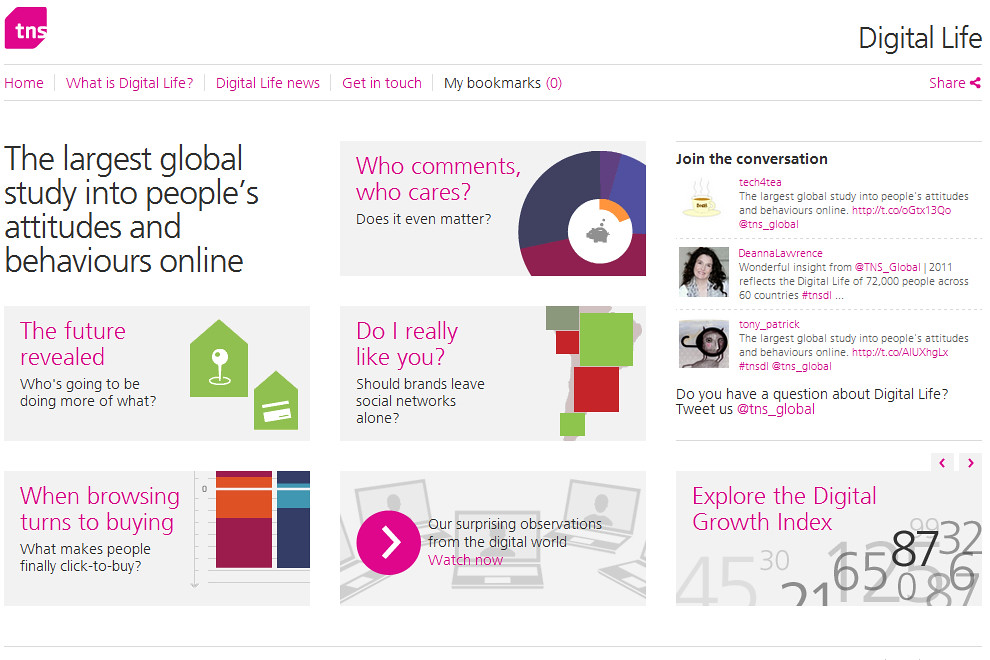
Digital Life 2011 study by TNS

Digital Life 2011 study by TNS

TNS today published their study of the modern digital lifestyle in today’s Internet age. The extensive survey was based on conversations with over 72,000 people in 60 countries. Digital Life’s size, scale and detail make it the most comprehensive view of consumer attitudes and behaviour online, on a global and local level.

“Digital waste is the accumulation of thousands of brands rushing online without thinking who they want to talk to – and why. Whilst many brand owners understand the value and relevance of the vast online world, many fail to understand the audience they are connecting with,” said Arnaud Frade, Regional Director Digital Strategy, TNS APAC.Inaugurated in 2010, today’s 2011 report is the second iteration of the annual study.

One of this year’s key findings is that businesses are generating much “digital waste” by way of electronic marketing material on the Internet that no one is interested in perusing.

For instance, even though brands are scrambling to inundate social networks such as Facebook and YouTube with their online presence, Digital Life showed that 43% of Singapore consumers actually don’t want to be bothered in social networks.

The global average for consumers who don’t want to engage with brands via social media is even higher at 57% for developed markets such as US (60%), UK (61%), Japan, Australia, Hong Kong and Taiwan.

“Control is firmly in the hands of consumers. The goal should therefore be to understand your target audience intimately, enabling your brand to connect openly and with integrity. This also means that selecting the right online approach and focusing on efficient messaging are critical to be relevant” Frade added.Brands that persist in spamming these consumers are not only wasting their marketing resources, but polluting the Internet instead. In the worst case, mis-targeted consumers may even resent the invasion of their social networks by the uninvited attention.

Businesses should therefore study these demographics and their details in order to tailor a marketing campaign that targets the right audience on the Internet.

The Digital Life study aims to provide these knowledge to brands looking for growth opportunities in the online world.

Digital Life applies TNS’s long-established expertise and deep consumer understanding to develop insights and address the key questions that inform marketing investment.

Some of these questions include:

  • How can I use digital channels to help grow my business?
  • Who can I reach through digital platforms?
  • How do I build my brand through engagement with new and existing consumers online?
  • How do I identify and cultivate brand advocates online?
  • How do I target potential customers online?

Digital Life also introduces the Digital Growth Index, a single number score defining the opportunity across product categories and countries for growth through digital channels, and showing the diversity of opportunities available in the online world.

An interactive data visualisation of the key findings can be found at www.tnsdigitallife.com.

About TNS

TNS Global Market ResearchTNS advises clients on specific growth strategies around new market entry, innovation, brand switching and stakeholder management, based on long-established expertise and market-leading solutions.



With a presence in over 80 countries, TNS has more conversations with the world’s consumers than anyone else and understands individual human behaviours and attitudes across every cultural, economic and political region of the world.

TNS is part of Kantar, one of the world’s largest insight, information and consultancy groups.