Archive for the ‘Figures’ Category

Apple’s Mac App Store hits 100 million downloads

Tuesday, December 13th, 2011

In less than one year, 100 million apps have been downloaded from the Mac App Store.

Apple's Mac App Store tops 100 million downloads.

Apple's Mac App Store tops 100 million downloads.

“With Autodesk products in both the App Store and Mac App Store, we can reach hundreds of millions of Apple users around the world,” said Amar Hanspal, senior vice president of Platform Solutions and Emerging Business at Autodesk. “With our free AutoCAD WS and the more powerful professional drafting tools of AutoCAD LT, we’re using the Mac App Store to deliver new products and reach a growing base of new Mac customers.”With thousands of free and paid apps, the Mac App Store brings the App Store experience to the Mac.

Users can buy apps using their  iTunes account, and download and install them in just one step.

Apple’s App Store now has more than 500,000 apps.

Overall, customers have downloaded more than 18 billion apps and continue to download more than 1 billion apps per month.

The Mac App Store offers thousands of apps in Education, Games, Graphics & Design, Lifestyle, Productivity, Utilities and other categories.

“The Mac App Store has unparalleled reach and has completely transformed our distribution and development cycle,” said Saulius Dailide of the Pixelmator Team. “Offering Pixelmator 2.0 exclusively on the Mac App Store allows us to streamline updates to our image editing software and stay ahead of the competition.”Users can browse new and noteworthy apps, find out what’s hot, see staff favourites, search categories and look up top charts for paid and free apps, as well as user ratings and reviews.

The Mac App Store is included with Mac OS X Lion and is available as a software update for any Mac running Mac OS X Snow Leopard.

Mac developers set the prices for their apps, keep 70 percent of the sales revenue, are not charged for free apps and do not have to pay hosting, marketing or credit card fees.

BlackBerry DevCon Asia: Day 1

Wednesday, December 7th, 2011

The conference kicked off with a general session to update developers on the latest developments around the BlackBerry platforms, followed by multi-tracked technical, practical and insight sessions that zero into the details.

BlackBerry DevCon Asia in Singapore Suntec from 7-8 December, 2011.

BlackBerry DevCon Asia in Singapore Suntec from 7-8 December, 2011.

The break-out sessions were helmed by specialists from Research In Motion (RIM) and its partners and delved into wide ranging topics from technical issues to commercial and monetizing approaches.

Gregory Wade, Regional Managing Director, East Asia, RIM

Gregory Wade, Regional Managing Director, East Asia, RIM

Delivering the keynote address was Gregory Wade, Regional Managing Director, East Asia, RIM.

He revealed there were more than 1,000 registrants for the DevCon Asia event in Singapore.

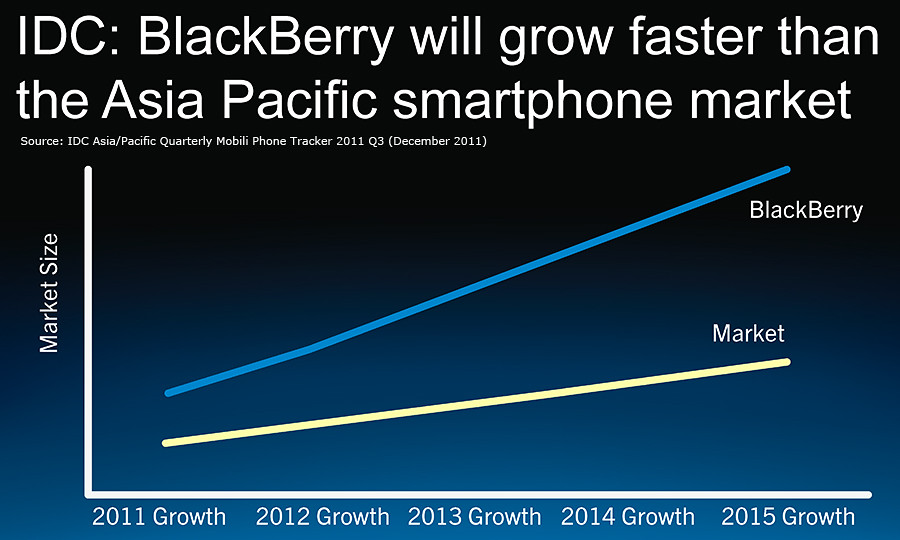
Wade quoted a GfK report that for the first half of 2011, BlackBerry was the number one smartphone in multiple countries in Asia, including Indonesia, Thailand and the Philippines.

He said that more than 3 million BlackBerry fans were engaged on social media channels in Asia.

Alec Saunders then updated developers of BlackBerry Jam – RIM’s initiative to provide a one-stop-shop for all BlackBerry developers to assess a wide array of developer resources.

Alec Saunders, VP, Developer Relations & Ecosystems Development, RIM

Alec Saunders, VP, Developer Relations & Ecosystems Development, RIM

Saunders is the VP, Developer Relations & Ecosystems Development at RIM.

The initiative was announced at the BlackBerry DevCon Americas in October. Since then, a BlackBerry Jam communities have sprung up all over the world linking experts, partners and developers for all to be more successful on the BlackBerry platform.

George Staikos then delved into the new BlackBerry platform – previously named BBX but now renamed to BB10. Staikos is the VP, Web Technologies at RIM.

BlackBerry Jam Communities around the world

BlackBerry Jam Communities around the world

He also described the two choices of runtime environments available for developers. The Native runtime environment was for “spectacular” performance whereas HTML5 will enable the dream of “write once deploy everywhere”.

RIM will return DevCon Asia to Thailand in the future.

RIM will return DevCon Asia to Thailand in the future.

Whilst the native environment will serve as the bridge between POSIX based systems and BlackBerry 10 and allow rapid porting of native applications, HTML5 is the mass application platform for the future.

The cross-platform, cross-device HTML5 can serve as the bridge between BlackBerry 6, BlackBerry 7 and BlackBerry 10 and is the obvious choice for modern application development.

BlackBerry is therefore fully committed to HTML5.

Leica Camera increases Asia sales by 56%

Friday, November 18th, 2011

Leica Camera sales from first half of this year (April 1 to September 30, 2011) increased by a double digit 56% compared to the corresponding period last year (April 1 to September 30, 2010).

Leica S2 Leica X1

Sales in Asia contributed to 23.7% of Leica’s global sales.

The Company’s success drivers were the Leica M9 rangefinder camera, the S2 professional system, as well as the Leica X1 compact camera.

“I am glad to witness the increase in demand for our cameras, sport optics and accessories in Asia,” said Sunil Kaul, Managing Director of Leica Camera Asia Pacific.Sunil Kaul, Managing Director of Leica Camera Asia Pacific

The Leica compact camera models V-Lux 20, V-Lux 2 and D-Lux 5 also made essential contributions to the positive overall development.

Leica M9-P Leica Silverline

Further success drivers are the Rangemaster and Televid product lines in the Leica Sport optics product group.

Ernst & Young finds security lagging behind business needs in survey

Thursday, November 17th, 2011

In its 14th annual Global Information Security Survey, Ernst & Young found that companies rushing to digitise their businesses with new technologies are increasingly leaving their ability to tackle new and complex security threats behind.

“Information security needs to be more visible in the board room with a clearly defined strategy that will support the business,” said Gerry Chng, IT Risk and Assurance Partner, Ernst & Young Advisory Pte. Ltd.The global survey involved 1,700 organisations in 52 countries and was conducted between June and August 2011.

Although companies are moving into the increasingly borderless world of cloud computing and social media, information security is still not a boardroom priority for most companies and is not a visible agenda for them.

“Security must be carefully planned and take into consideration the practicality of the controls that considers the IT operations. There needs to be buy-in from the business functions, and support needs to come from the top,” Chng added.Only 51% of the survey stated that they have a documented information security strategy. 12% of the respondents present information security topics at each board meeting and fewer than half (49%) of respondents believe that their information security function is meeting the needs of the organization.

With the consumerisation of enterprise IT, organisations have had to allow employees to use personal tablets to access corporate information.

“There are existing solutions in the market that support the secure access of information on personal smartphones and tablets. Organizations should evaluate whether these solutions meet their needs, rather than using traditional channels such as web interfaces and opening up email access via the web as an option.”It was therefore natural that more than half the survey respondents ranked this adoption the second-highest on the list of technology challenges.

Policy adjustments and awareness programs are the top two measures used to address risks posed by this new mobile technology.

The adoption of security techniques and software, however, is still low. For instance, encryption techniques are used by fewer than half (47%) of the global organisations.

The massive popularity and growth of social media has also threatened the IT risk landscape. Social media risks include the introduction of malicious software lurking within social networks, hacked accounts that are used to solicit information, and the release of confidential or negative company information or personal data.

“The traditional paradigm of security within a perimeter is no longer valid.”To address potential risks posed by social media, organizations seem to be adopting a hard-line response. A majority (53%) of the global organizations respond by blocking access to sites rather than embracing the change and adopting enterprise-wide measures.

“With the increased collaboration with upstream and downstream partners, data resides not just within the confines of the organization.”Despite all the hype about cloud computing, many organisations are still unclear of the implications of cloud computing. From the survey, 48% of the global respondents said that the implementation of cloud computing is a difficult challenge, and more than half of them (52%) have not implemented any controls to mitigate the risks associated with cloud adoption.

The most frequently taken measure is stronger oversight on the contract management process with cloud providers, but even this is done by only 22% of respondents.

“Confronted with diminishing borders, cloud services, and increasing support of personal tablets for information mobility, companies are asking themselves how to respond to new and emerging risks and whether their strategy needs to be revisited. The focus must move from short-term fixes to a more holistic approach integrated with long-range strategic corporate goals.”The good thing is that companies are aware of the widening gap between business needs and information security – and are willing to address the situation.

72% of the respondents in the survey see a rising level of risk due to increased external threats.

At the same time, more than half (59%) of them plan to increase their information security budgets in the coming 12 months, focusing on areas including business continuity capabilities (47%), data leakage and data loss prevention (28%), compliance monitoring (21%), and identity and access management (21%).

Gerry Chng observes that “there is generally a slow uptake of public cloud services for larger enterprises due to risk concerns. Such services may make sense for a small company as the utility model of the cloud means that these companies do not need to have the capital and operational expenses to maintain their own infrastructure and applications.”

“For larger organizations, the risks of compromising the integrity of sensitive data far outweighs the benefits they may reap from cloud computing. The concept of cloud computing is centered around easy access to data, without the need for knowledge on where the data is stored and how the cloud works,” Chng added

“This lack of specific details makes it difficult for organizations to assess the risks to their data residing in the cloud. In the absence of clear guidance, many organizations seem to be making ill-informed decisions, either moving to the cloud prematurely and without appropriately considering the associated risks, or avoiding it altogether,” concluded Chng.


Singaporeans are not the biggest complainers after all

Friday, November 11th, 2011

The Argentinians are the most likely to complain about brands online – according to TNS’s Digital Life study of consumer attitudes and behaviour online – with 12.5 per cent of those who responded to the survey doing so.

On the other hand, the Japanese were the most polite, with only 7 per cent of them writing to complain online.

In Singapore, more people like to praise than complain online – with 13 per cent likely to praise and only 11 percent inclined to complain.

This is consistent with the global averages.

The Spanish are the least likely to praise online, with just one in ten people saying they would do this.

The Thais, however, are most likely to praise online, with 22 per cent claiming to do so.

The Digital Life study also sheds vital light on why people do engage with brands online.

45 per cent of Singapore users motivated to post comments on companies do so for the simple desire to impart advice.

However, motivations of online commentators can be self-serving.

76 per cent of Singaporean consumers are driven to engage with brands online by a promotion or special offer.

The global average stands at 61 per cent.

Digital Life study by TNS uncovers Internet pollution by digital waste

Thursday, November 10th, 2011

You’ve heard of “environmental pollution” and “noise pollution”, as well as “toxic waste” and “hazardous waste”. Now it’s time to add “Internet pollution” and “digital waste” to your lexicon.

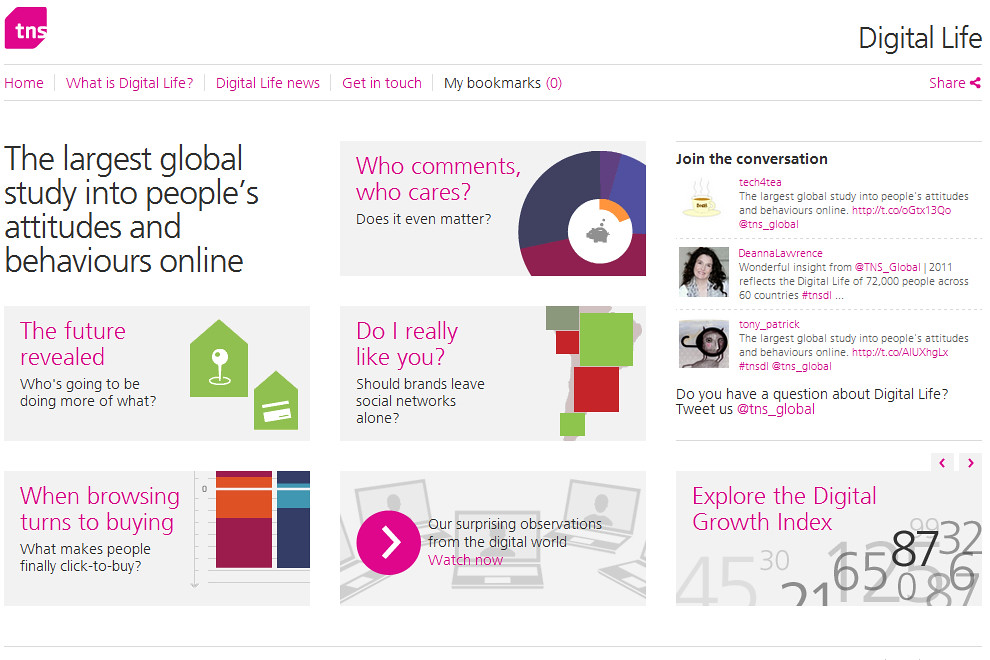
Digital Life 2011 study by TNS

Digital Life 2011 study by TNS

TNS today published their study of the modern digital lifestyle in today’s Internet age. The extensive survey was based on conversations with over 72,000 people in 60 countries. Digital Life’s size, scale and detail make it the most comprehensive view of consumer attitudes and behaviour online, on a global and local level.

“Digital waste is the accumulation of thousands of brands rushing online without thinking who they want to talk to – and why. Whilst many brand owners understand the value and relevance of the vast online world, many fail to understand the audience they are connecting with,” said Arnaud Frade, Regional Director Digital Strategy, TNS APAC.Inaugurated in 2010, today’s 2011 report is the second iteration of the annual study.

One of this year’s key findings is that businesses are generating much “digital waste” by way of electronic marketing material on the Internet that no one is interested in perusing.

For instance, even though brands are scrambling to inundate social networks such as Facebook and YouTube with their online presence, Digital Life showed that 43% of Singapore consumers actually don’t want to be bothered in social networks.

The global average for consumers who don’t want to engage with brands via social media is even higher at 57% for developed markets such as US (60%), UK (61%), Japan, Australia, Hong Kong and Taiwan.

“Control is firmly in the hands of consumers. The goal should therefore be to understand your target audience intimately, enabling your brand to connect openly and with integrity. This also means that selecting the right online approach and focusing on efficient messaging are critical to be relevant” Frade added.Brands that persist in spamming these consumers are not only wasting their marketing resources, but polluting the Internet instead. In the worst case, mis-targeted consumers may even resent the invasion of their social networks by the uninvited attention.

Businesses should therefore study these demographics and their details in order to tailor a marketing campaign that targets the right audience on the Internet.

The Digital Life study aims to provide these knowledge to brands looking for growth opportunities in the online world.

Digital Life applies TNS’s long-established expertise and deep consumer understanding to develop insights and address the key questions that inform marketing investment.

Some of these questions include:

  • How can I use digital channels to help grow my business?
  • Who can I reach through digital platforms?
  • How do I build my brand through engagement with new and existing consumers online?
  • How do I identify and cultivate brand advocates online?
  • How do I target potential customers online?

Digital Life also introduces the Digital Growth Index, a single number score defining the opportunity across product categories and countries for growth through digital channels, and showing the diversity of opportunities available in the online world.

An interactive data visualisation of the key findings can be found at www.tnsdigitallife.com.

About TNS

TNS Global Market ResearchTNS advises clients on specific growth strategies around new market entry, innovation, brand switching and stakeholder management, based on long-established expertise and market-leading solutions.
With a presence in over 80 countries, TNS has more conversations with the world’s consumers than anyone else and understands individual human behaviours and attitudes across every cultural, economic and political region of the world.

TNS is part of Kantar, one of the world’s largest insight, information and consultancy groups.

The State of the Internet 2Q 2011 report from Akamai

Monday, October 24th, 2011

Taiwan has beaten Myanmar and US as the top source of attack traffic on the Internet, while Asian cities maintain their dominance of having the fastest connection speeds in the world, with HK at the pinnacle.

Akamai State of the Internet report Q2 2011

This is the 4th year for the quarterly report.

Akamai has released its Q2 State of the Internet report for 2011. It is a leading provider of cloud optimisation services.

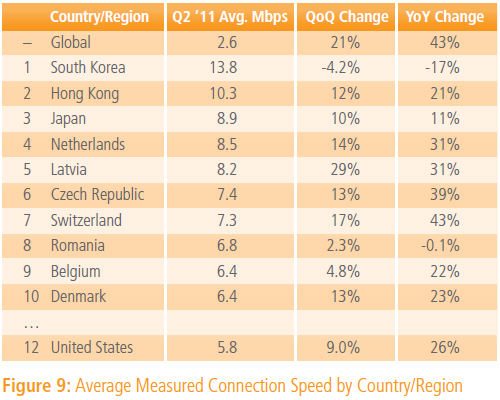
Average Connection Speed by Country/Region

Average Connection Speed by Country/Region

Based on data gathered from the Akamai Internet Platform, which carries between 15-30 percent of the world’s Web traffic, the report provides insight into key global Internet statistics such as the world’s fastest and slowest regions for connection speed, the most frequent origins of attack traffic, and the highest-performing geographies for mobile connectivity, as well as resulting trends over time.

It uses its globally distributed network of servers to gather massive amounts of information on many metrics about the Internet, such as connection speeds, attack traffic, and network connectivity/availability/latency problems, as well as traffic patterns on leading Web sites.

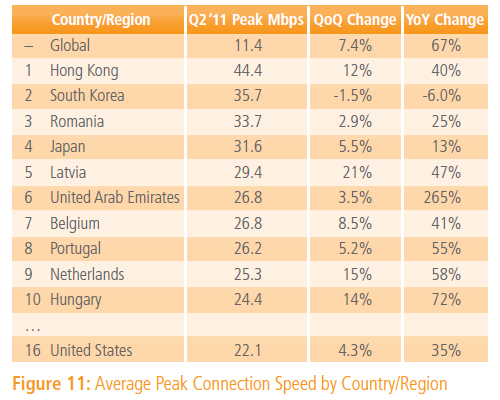
Average Peak Connection Speed by Country/Region

Average Peak Connection Speed by Country/Region

The Q2 report includes data gathered from across Akamai’s Intelligent Internet Platform during the second quarter of 2011 about attack traffic, broadband adoption, and mobile connectivity, as well as trends seen in this data over time.

In addition, this quarter’s report also includes insights into the state of IPv4 exhaustion, the impact of World IPv6 Day, the state of client-side SSL, and smartphone usage trends as observed by Akamai partner Ericsson.

The main highlights from the Q2 report paints the following picture:

Speed

  • Global average connection speed increased 43 percent year over year to 2.6 Mbps. South Korea again had the highest average connection speed at 13.8 Mbps. Singapore was ranked 29th at 4.5 Mbps.
  • Global average peak connection speed was 11.4 Mbps. Hong Kong has maintained its position as having the highest average peak connection speed at 44.4 Mbps. Singapore was 19th at 20.7 Mbps.
  • Globally, high broadband (>5 Mbps) adoption grew to 27%. At 68%, the Netherlands was the highest, pushing S Korea to third position. Hong Kong came in second, while Singapore was 20th at 33% adoption.
  • Gloobal broadband (>2 Mbps) adoption increased to 65%. Singapore was 48th at 67%.
  • Global narrowband (<256 kbps) adoption at 2.9% continued its decline. Lebanon, with its 56% narrowband adoption is the top laggard.
  • Cities in Asia again have the fastest connection speeds in the world. Out of the 100 fastest cities worldwide, 70 were from Asia, with Hong Kong, 59 cities in Japan and 10 cities in South Korea.
  • Brno, Czech is the fastest city in Europe, at number 55 out of 100.
  • 18 US cities made the top 100 list. 9th-placed San Jose’s 13.7 Mbps moved the US into the top 10 for the first time.

Security

Sources of top attack traffic

Sources of top attack traffic

Taiwan was the top source of attack traffic accounting for 10% of overall attack traffic. Myanmar and US together accounted for another 17%. Having made it debut as top attack traffic source in the last quarter, second-placed Myanmar has continued its attack activities showing its entrance into the ranks of top attack traffic sources was not a flash in the pan.

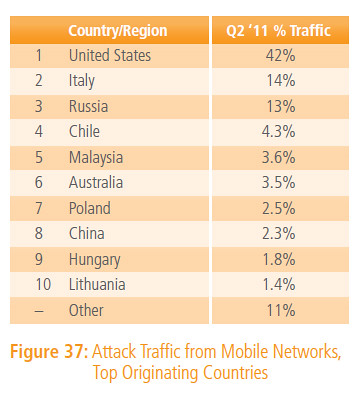
Attack traffic from mobile networks

Attack from mobile networks

With respect to attack traffic originating from mobile network providers, the US vaulted to the top of the list, generating 42% of the observed traffic. Italy has gone down to second place, after its observed attack traffic from was halved compared to the previous quarter. Russia took third place. The top three countries were responsible for almost 70% of observed attacks, while the top 10 countries accounted for nearly 90% of the observed attacks.

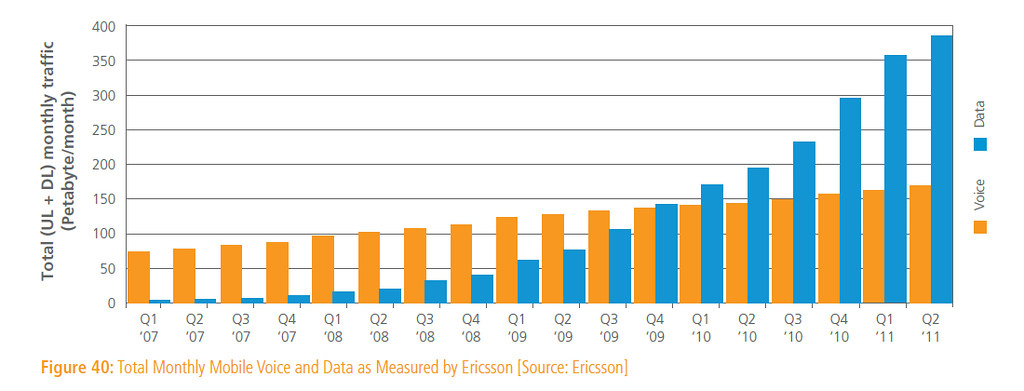
Exponential growth in mobile data traffic is outstripping linear growth of mobile voice traffic.

Exponential growth in mobile data traffic is outstripping linear growth of mobile voice traffic.

Previous SOTI reports from Akamai on tech4tea.com

1st Quarter, 2011 Report (Volume 4, Number 1)
4th Quarter, 2010 Report (Volume 3, Number 4)

Quick summary of IT company results

Wednesday, October 19th, 2011

It’s been a busy few days of earnings results from IT bigwigs. Here’s a quick sum-up of the state of the IT industry:

Brisk days of results from Apple, Google, Yahoo, Microsoft, RIM BlackBerry, Amazon, and IBMYahoo! did well with profits beating estimates – could it be because expectations were low?


Conversely, Apple didn’t do so good, missing analysts’ predictions for the first time in at least six years – but that’s probably because expectations were so high!

Google’s doing real well with sales and profit beating estimates – from search advertising growth as usual.

Microsoft is patting itself on its back – for not having bought Yahoo! back in 2008. And taking a swipe at Google’s Android – Steve Balmer says you need to be a computer scientist to use an Android smart phone, unlike Windows Phone 7.

RIM’s still trying to find its way forward by taking a step backward – trying to bridge new QNX with “old” BlackBerry OS 7 – hope that works out.

Amazon is being sued for screwing up the career of an actress by revealing her real age against her will in IMDb.

On the corporate IT front, industry bell weather IBM missed analysts’ estimates on slowing revenue growth at its software, hardware and services businesses.

Singapore Internet users embrace social networking

Saturday, October 1st, 2011

Studies by Experian’s global analysis shows Singapore loving both Facebook and Google+.

Websites Visits share in August 2011 Visits share in August 2010 % Annual Growth
Facebook 38.22% 37.83% 1.03%
YouTube 23.37% 20.13% 16.10%
Twitter 5.74% 4.38% 31.05%
Hardware Zone 3.27% 3.88% -15.72%
Tumblr 1.42% 0.63% 125.40%
Google+ 1.20% NA NA
Meebo 1.07% NA NA
Yahoo! Answers 0.92% 0.92% 0%
Tagged 0.50% 0.56% -10.71%
VR-Zone 0.50% 0.77% -35.06%

At the beginning of September 2011, Experian Hitwise had found that, In the Asia Pacific region, Google+ was the most popular in Singapore, followed by India, Australia, New Zealand and Hong Kong.

Singapore was also the only country in which Google+ had enjoyed a continued rate of adoption – other countries had seen its popularity decline after a peak in mid-July, following its initial beta-launch in end June.

A further study released last week by Experian revealed that Singapore users spent the longest average amount of time per session on Facebook in the world, in the month of August 2011. The average of 38 min 46 sec per session was longer than what users spent on Facebook per session in other parts of the world.

In the meantime, other social networking and sharing sites such as YouTube and Twitter have also grown their market shares amongst users in Singapore.

Singapore loves Facebook most in the world

Friday, September 30th, 2011

An international analysis on the use of social networks by Experian shows that Singapore users spend the longest time on Facebook in August 2011, with an average of 38 minutes and 46 seconds spent per session.

Country Average time spent per session on Facebook in Aug 2011
Singapore 38 min 46 sec
New Zealand 30 min 31 sec
Australia 26 min 27 sec
UK 25 min 33 sec
France 21 min 53 sec
US 20 min 46 sec
India 20 min 21 sec
Brazil 18 min 19 sec

This is longer than the average time spent per session in countries such as UK, US and Australia.

Experian further reveals that Facebook has managed to sustain its popularity with Singapore Internet users despite the emergence of Google+ this year. The social networking site managed to increase share of visits by 0.39% between August 2010 and August 2011.

Singapore Internet users also showed more interest in YouTube, evidenced by a 3.24% increase in share of visits between August 2010 and August 2011.