Over time, as we get new computers and leave the old still-functional computer as a second or third machine, and we still utilise the different machines, the files we create and work on can get distributed amidst the hard disk drives of the various computers.
A shared network hard drive can bring order back to an increasingly chaotic situation.
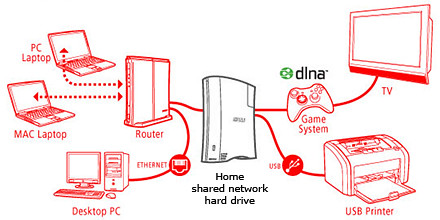
A network attached external hard drive can share files and media (illustration modified from www.buffalotech.com)
The above scenario was what happened to some of my friends and me. Computers and laptops today can last for a long time (if you look after them well) and most often then not, they’re still perfectly functionable when we get a new machine so it seems quite a waste to get rid of the old machine, especially since it can serve as a back up.
And if a member of the family is on the new laptop, others can use the spare computer. So over time, working files, photos, music and video can get distributed over a few computers. At first, it’s easy to remember and keep track of which file is in which computer and do the occasional transfer using an USB thumbdrive.
But over time, as the number of files grow, things can get out of hand – the convenience of being able to work on a few computers turns into a bane.
Now that cloud computing is catching on and we can save files and media on the Internet, this mess can be ameliorated. But those personal and confidential files and humongous video files are still best kept in local storage.
The NAS solution

Schematic of an NAS solution
So over the weekend, I helped my friend rig a similar solution that I use at home – set up a simple external hard drive that can be shared and accessed by a few different computers at home over a local Wi-Fi network.
Those files that are stored on the network attached storage (NAS) drive can then remain accessible no matter which computer you’re working on. It can be used to back up the computers connected.
Some NAS drives allow you to stream media to TVs, media players and game consoles connected to the home network.
In fact, some even enable access to be opened out to the Internet, so that when you’re outstation – in the office, on the road, or overseas – you can still securely access the files stored in the hard drive. This can be done via a browser on a laptop connected to the Internet, or via an app on a smartphone or tablet.
It’s like setting up your personal cloud storage. There are many consumer NAS drives in the market from makers such as Seagate, Western Digital and Buffalo.
They’re all designed to be easily set up by the layman who does not have a PhD in computer science. These NAS drives are connected directly to the router rather than a specific computer acting as a file server.
Any computer connected to the network via the router can access the NAS drive at any time.
Because these NAS drives are more intelligent than the regular dumb external hard drive, they do cost a slight premium over the latter. The NAS drives can manage network access by computers on the network and implement security, access and rights control as well.

Seagate GoFlex Home comes in capacities of 1TB, 2TB and 3TB
Since I’m familiar with the Seagate GoFlex Home, that was what I recommended my friend, who brought home a 3 TB version from the recent COMEX 2011 for S$299.
Tomorrow we’ll see how he managed to tame his growing diaspora of media and files.



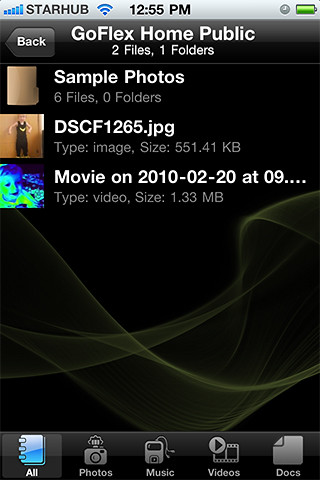
 With 500GB and Wi-Fi access over 802.11 b/g/n and a rechargeable battery, this latest member of the GoFlex family connects wirelessly to devices via the use of the free GoFlex Media app—available now on iTunes, the Apple App Store and Android Market—or a web browser.
 Available for Apple iOS devices such as iPad, iPhone and iPod touch and any Android devices; the GoFlex Media app provides a seamless way to connect the mobile wireless storage to your mobile devices. Those that currently use an Android smartphone or tablet can access content on a GoFlex Satellite device through its web browser.
 The easy-to-use Media Sync software, also included free with purchase, makes grabbing media from a Windows PC or Mac OS X computer a breeze. Wherever the files are stored, whether that is a file structure of your own creation or in an iTunes library, the Media Sync software will load all of your desired music, videos, photos and documents on to the GoFlex Satellite drive.
 For rapid loading of media content, the wireless mobile storage comes equipped with the superfast USB 3.0 cable to get files from the computer to the GoFlex Satellite drive. The USB 3.0 cable will also continue to work with USB 2.0 ports and is easily removed for portability. In addition to the USB 3.0 cable, the GoFlex Satellite drive comes complete with a car charger and a compact wall charger.



 The free app is now available for download from the iTunes Store and Android Market. The application can be found by searching for “Seagate” or “GoFlex” in either storefront using the computer or the app store on a iPad, iPhone, iPod touch or Android compatible mobile device.