Posts Tagged ‘TomTom’

Travel: When technology fails you

Monday, November 28th, 2011

That’s when old school topo skills come in useful.

View from Base HQ of Mount Kinabalu. Taken with Dramatic Tone Art Effect on the Olympus PEN E-P3.

View from Base HQ of Mount Kinabalu. Taken with Dramatic Tone Art Effect on the Olympus PEN E-P3.

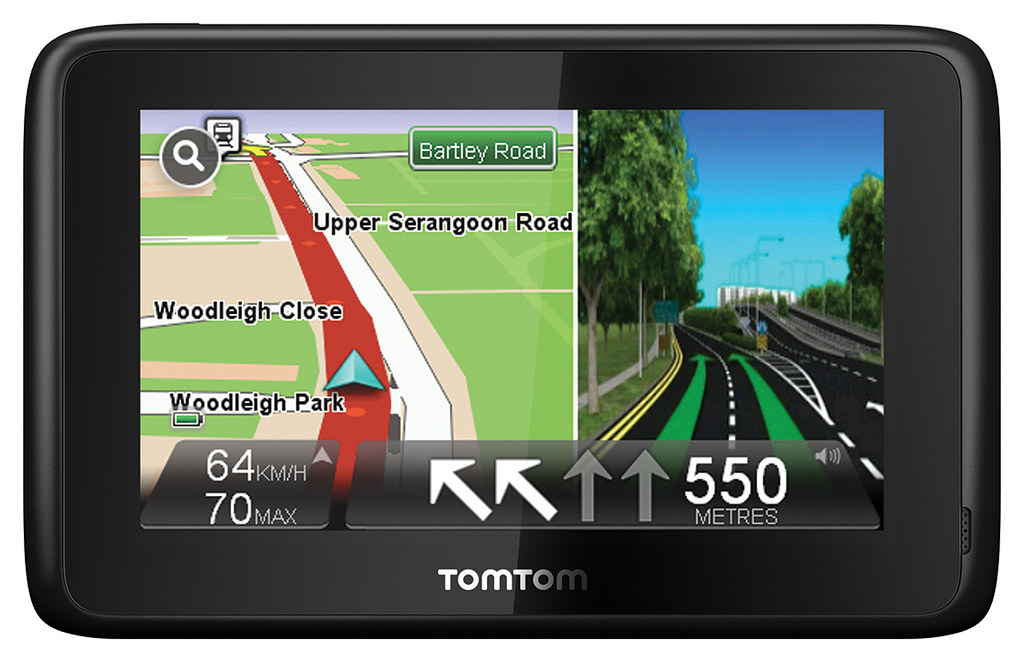
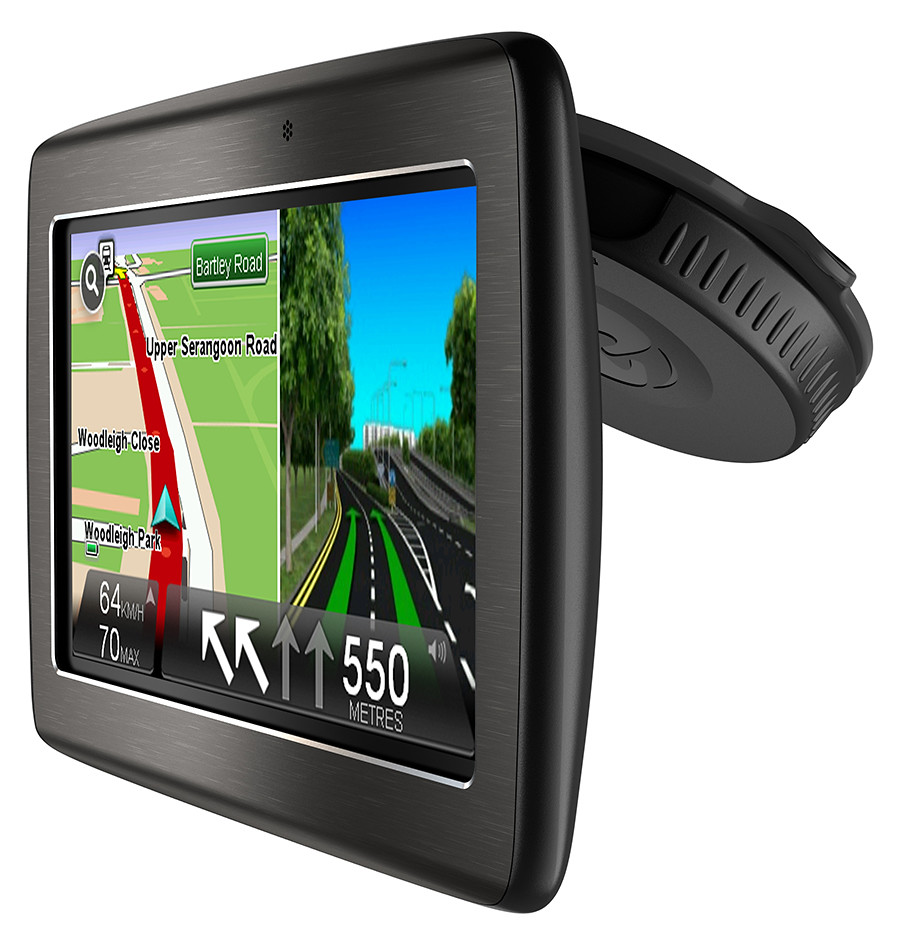
In the interest of packing light and reducing the gadget count, I’d decided to leave behind the TomTom VIA 280 dedicated GPS portable navigation device (PND) at home.

Mt Kinabalu, shrouded in clouds

Mt Kinabalu, shrouded in clouds

We were also undecided whether to rent a car to self-drive from Kota Kinabalu to Mount Kinabalu or to take a local tour.

Furthermore,  I’d just installed the equivalent turn-by-turn navigation app from TomTom on an  iPhone 3GS and found it to work as well as the PND while driving around Singapore.

When we arrived at 8pm last night, we found the rental rates at the airport to be reasonable and decided to go for the self-drive option.

Imagine our dismay when we found the iPhone 3GS could not get a GPS fix.

The other iPhone 3G that we had did not have any problems getting a fix so we realized the problem lay with the GPS unit within the iPhone 3GS.

Fresh Bougainvillea enroute to Mount Kinabalu

Fresh Bougainvillea enroute to Mount Kinabalu

Fortunately, the 15-minute journey from the airport to the hotel was short and simple, and we managed it through good old verbal instructions from the rental guy and maps from the brochure.
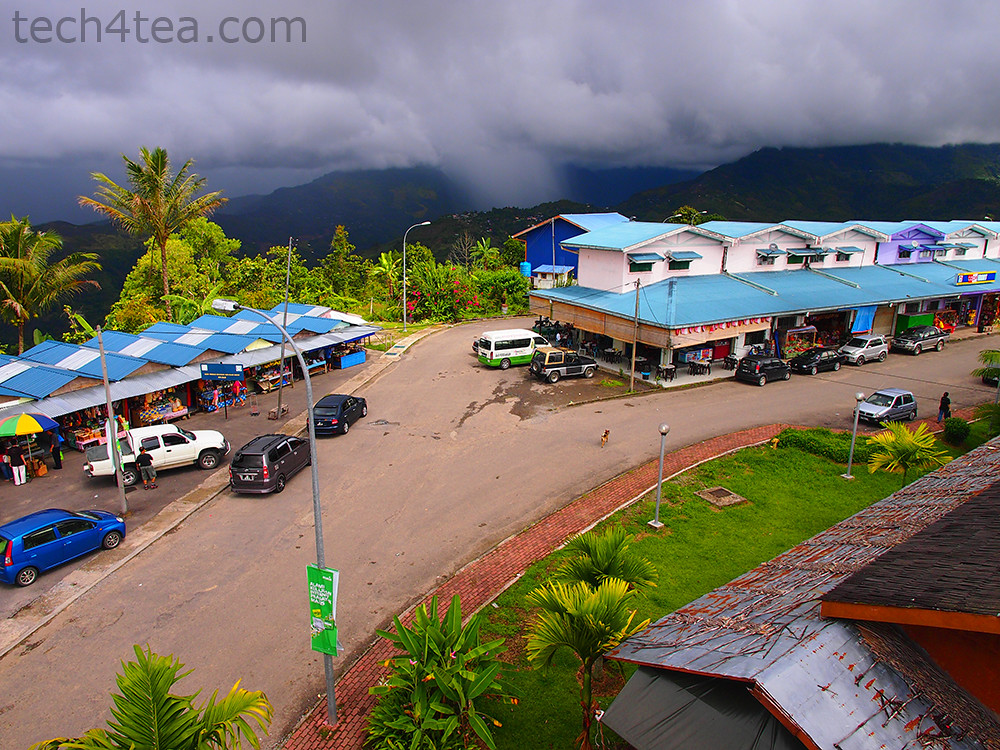
Pekan Nabalu enroute to Mt Kinabalu. Taken using Pop Art effect on Olympus PEN E-P3.

Pekan Nabalu enroute to Mt Kinabalu. Taken using Pop Art effect on Olympus PEN E-P3.

By the time we reached “Le Meridin” hotel (the neon light for the second “e” in Meridien must have burnt out), the iPhone 3GS still couldn’t get a fix.

The next morning, it was the same story, the 3GS couldn’t get a fix even though the 3G could.

Who would have thought a relatively simple and basic module like the GPS would fail on a month-old iPhone (Yes – I know – it’s two generations behind the iPhone 4S).

Stores at Pekan Nabalu. Olympus PEN E-P3 with Pop Art effect.

Stores at Pekan Nabalu. Olympus PEN E-P3 with Pop Art effect.

And the iPhone 3G (Yes – that’s THREE generations behind the iPhone 4S – and proud of that) didn’t have that app installed, and I wasn’t prepared to chalk up huge data roaming fees using the Google Maps app on the 3G.

So it was back to paper maps, driving instructions from the concierge, and old school topographical skills.

We’d driven around the complicated and tiny country roads of the Loire Valley in France on nothing more than paper maps, and surely the single highway route to Mt Kinabalu would be a piece of cake.

Prior to starting off, I ran the route through the Google Maps app on my iPhone 3G to download map data into the app’s cache using the hotel’s free WiFi. That should serve as reference later on during the drive.

Wild squirrel on the alert, at the foothills of Mt Kinabalu.

Wild squirrel on the alert, at the foothills of Mt Kinabalu.

We made the 2-hour drive to Mt Kinabalu smoothly. There was only one wrong turn prior to reaching the highway and a quick check on the Google Maps app on the iPhone 3G guided us back to the highway and we were on our way.

As in a marathon, most amateurs complete in more than 4 hours, although most choose to do the climb over 2 days, planning the arrival at the peak at sunrise.

As in a marathon, most amateurs complete in more than 4 hours, although most choose to do the climb over 2 days, planning the arrival at the peak at sunrise.

After a lunch stop at Pekan Nabalu, we reached the base HQ of Mt Kinabalu. Only at this highest mountain in Malaysia and South East Asia did the iPhone 3GS finally pick up a GPS signal, and it promptly told us we were some 300km away in Bandar Seri Begawan, the capital of Brunei.

After a long while it finally placed us at Mt Kinabalu. All along the way back to Kota Kinabalu, the GPS of the iPhone 3GS kept flip-flopping between our true location and Bandar Seri Begawan, forcing the GPS app to recalculate routes.

Half-way home, the 3GS decided it had had enough. It finally ran out of battery – from the constant search for a GPS signal, as well as its exertions to recalculate routes.

By which time, we’d all but given up on depending on the iPhone. I sure hope TomTom comes up with a GPS app on the Android.

SITEX 2011 field visit

Saturday, November 26th, 2011

Beating the crowds to Singapore EXPO

SITEX 2011 @ Singapore EXPO from 24 - 27 November

SITEX 2011 @ Singapore EXPO from 24 - 27 November

Barely back from one week in KL, I trundled down to Singapore EXPO to get that replacement printer.

First off, I nearly drove to Suntec City, before remembering that SITEX was the only one of the four annual IT expositions held in Singapore EXPO.

SITEX 2011 @ Singapore EXPO from 24 - 27 November
On the way there, the radio was warning of traffic build-up at Simei. Fortunately, the TomTom VIA 280 GPS recommended a route that brought me to the car parks behind the Singapore EXPO, where there was no jam and plenty of lots.

I’d always parked in the car parks at the front of Singapore EXPO and never realized there was this big car park on the other side.

At any rate, I got what I needed and got out before it became really crowded.

Maiden run: TomTom VIA 280

Sunday, November 20th, 2011

I tried out the TomTom VIA 280 for the first time during my drive from Singapore to Kuala Lumpur (KL) today after receiving the review unit yesterday. Here are the initial impressions.

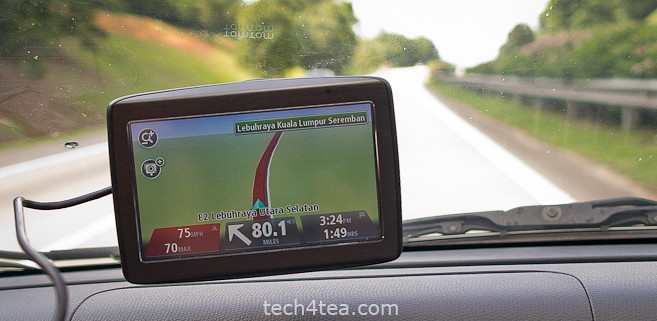
TomTom VIA 280 on its maiden run on the Malaysian North-South expressway.

TomTom VIA 280 on its maiden run on the Malaysian North-South expressway.

Set up was straightforward. Plug the main unit to the cigarette plug using the USB cable, attach the main unit to the windscreen and you’re set to go.

Once you start the engine, the TomTom VIA 280 switches on. Switching off the engine, switches off the VIA 280 automatically.

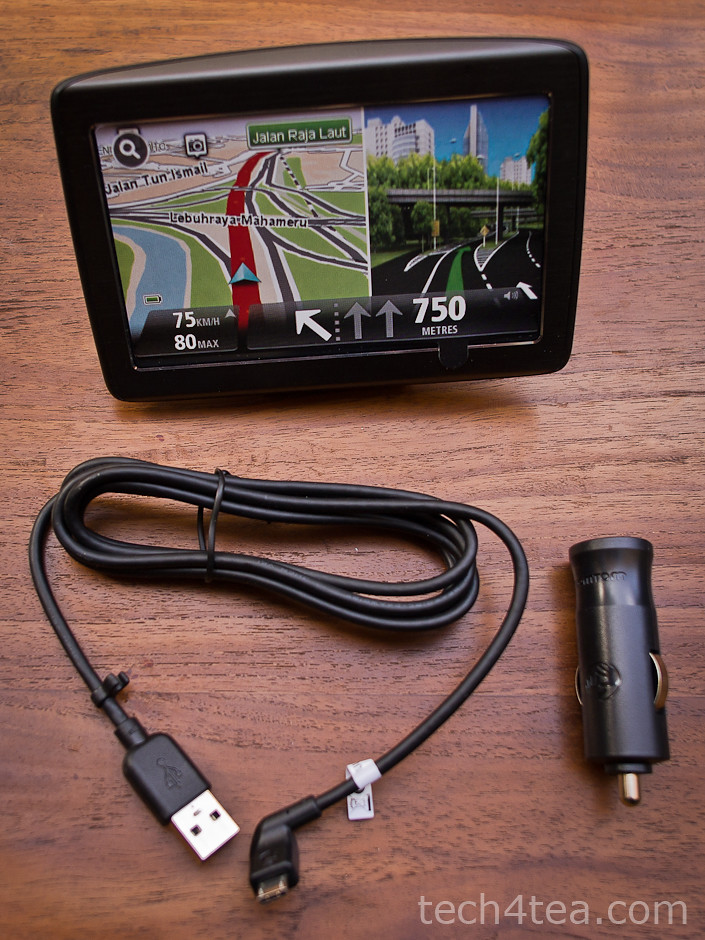
Only three components in the box: the main unit, the USB cable and the cigartette plug.

Only three components in the box: the main unit, the USB cable and the cigarette plug.

The user-interface was real easy. The route chosen was optimal. Changes to the route was simple. What impressed me most was how fast the recalculation took place.

I started off using the VIA 280 for a short journey running an errand round the neighbourhood. Just press “Navigate to” icon on the main menu, select “POI” (Point of interest), followed by “POI near you”, and then browse the various categories.

It was easy enough to find the neighbourhood shopping centre and set it as the destination. The map display was clear and the estimated distance to the next turning was accurate.

For the KL trip, I first set it as a “Favourite”. Next I set the route for it under “Plan route”. The recommended route was through the Causeway. But I preferred the Tuas Second Link.

By choosing the “Change route” option, you could ask for alternative routes, to travel via the Second Link or to avoid using the Causeway – which I did.

As I approached the second link, I realised that for the first time in my life, I’d forgotten to top up. The fuel gauge read just more than half-tank.

The Singapore government requires Singaporean drivers driving to Malaysia to have their petrol tanks at least ¾ tank full, otherwise if you’re caught in a spot-check, you’re fined S$500.

First impressions:

For a maiden run, the VIA 280 made a very positive impression.

The VIA 280 strikes me as a no-frills PND which is more than competent to handle all the functionalities one would expect for helping the driver navigate from point A to point B.

Now where’s the nearest petrol station?

Tapping anywhere on the map on the screen activated the main menu.

The following menu options: “Change route” > “Travel via…” > “Point of Interest” > “POI near you” > “Petrol station” revealed a list of petrol stations nearby, according to distance. 15 minutes later, we were back on track to hit the customs.

The drive on the North-South expressway was uneventful. En route, I deliberately deviated from the recommended route to see how the VIA 280 reacted. Both times, it came up with a new route in less than 3 seconds – impressive.

After the four-hour drive, we finally reached our destination 2 minutes before the time of arrival initially estimated by the VIA 280 at the beginning of the journey.

Mr Postman delivers: TomTom VIA 280

Saturday, November 19th, 2011

The courier dropped off the TomTom VIA 280 GPS portable navigation device (PND) for review. The VIA range is the new family of PNDs that TomTom just introduced to Singapore this week.

TomTom VIA 280 (Click to see the other accessories), the screen display here is a sticker.

TomTom VIA 280, the screen display here is a sticker.

TomTom has been selling the XL 250, XXL 550 and GO 750 PNDs in Singapore.This week, it introduced the GO 2050 and GI 2050 World, as well as the VIA 220, VIA 260 and VIA 280.

Only three components in the box: the main unit, the USB cable and the cigartette plug.

Only three components in the box: the main unit, the USB cable and the cigartette plug.

Compared to the GO family of PNDs, the VIA range represents the lower end, no-frills selection of PNDs.

I’d tried the GO 750 before and was impressed by it, but I was curious whether the VIA would cut it. Over the next week, I’ll be driving to Kuala Lumpur and back with the VIA 280 – and then I’ll let you know whether the VIA 280 is any good.

For now, a look at the new box of VIA 280 shows three parts: the main unit itself, the plug for the car’s cigarette lighter, and the USB cable which connects the main unit to the plug.

The same USB cable is also used to connect the main unit to the computer for software and map updates.

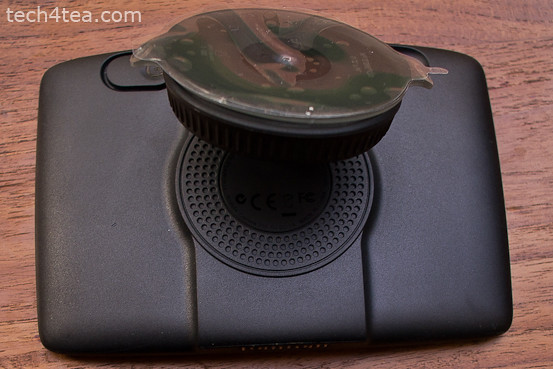
The integrated mount behind the TomTom VIA 280 comprises an adjustable suction disc.

The integrated mount behind the TomTom VIA 280 comprises an adjustable suction disc.

Behind the main unit is the integrated mount, with a suction disc. After connecting the cable, bend the suction disc outwards, press it against the windscreen and turn the knob around the disc to tighten the grip of the disc on the windscreen.

Then adjust the angle until the screen of the main unit is at the right viewing angle from the driver’s seat.

Press the power button behind the main unit and it’s ready to operate.

Tomorrow, I’ll be driving up to KL in the morning. We’ll see how it fares then.

5 New GPS PNDs: TomTom GO and Via series

Thursday, November 17th, 2011

Five new GPS PNDs from TomTom have arrived in Singapore – three from the Via range and two from the GO series. They will be available during SITEX 2011 from S$199 to S$479.

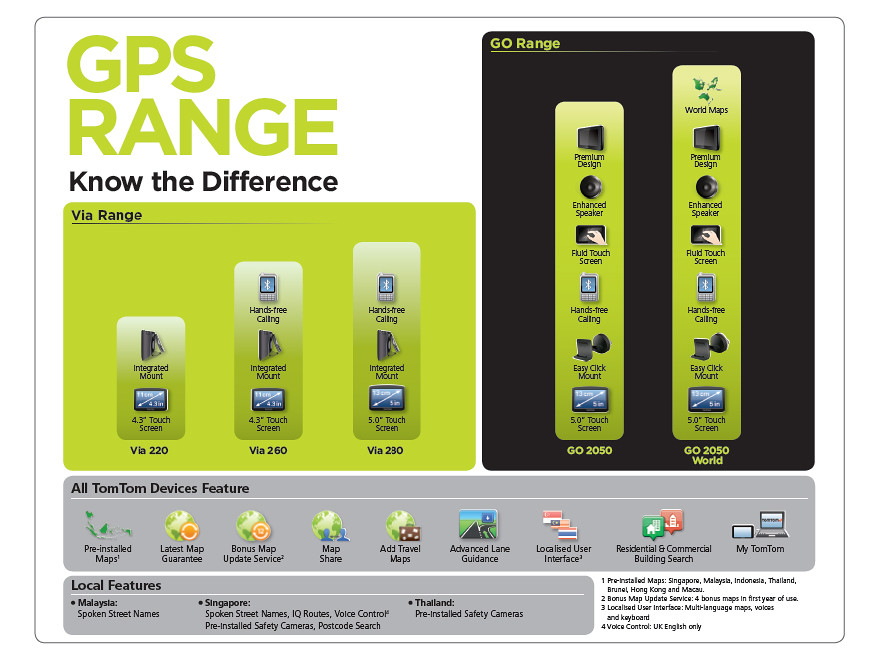
Comparison of the feature sets for the five TomTom GO and Via PNDs.

Comparison of the feature sets for the five TomTom GO and Via PNDs.

TomTom’s PNDs (Portable Navigation Devices) uses the unique IQ Routes technology that allows everyone to drive like a local.

Pricing & Availability: 

The new TomTom PNDs will be available at SITEX 2011 (24-27 November) at the following recommended retail prices.

TomTom Via 220 S$199
TomTom Via 260 S$239
TomTom Via 280 S$279
TomTom GO 2050 S$399
TomTom GO 2050 World S$479

The technology uses real road speed information contributed by TomTom drivers to consider all possible routes for selecting the fastest path – rather than rely on static maximum road speeds.

This often results in a different and faster route, saving significant travel time as well as money and fuel.

The PNDs comes with maps of Singapore, Malaysia, Thailand, Indonesia, Brunei, Hong Kong and Macau.

With road networks changing an average of 15% per year, TomTom allows users to download the latest map free-of-change within 90 days of first use. Users also get four bonus maps free in the first year of use.

TomTom GO 2050 and 2050 World

TomTom GO 2050 (S$399) and TomTom GO 2050 World (S$479)

TomTom GO 2050 (S$399) and TomTom GO 2050 World (S$479)

Both feature a large 5” Fluid Touch screen that allows users to pinch to zoom in and out of maps, or to scroll through menus with the tip of a finger. The Easy Click magnetic mount makes docking and undocking easier than ever – even with just one hand.

For S$80 more, the GO 2050 World comes with a world map which allows seamless navigation across 66 countries. The map covers includes coverage of South-East Asia, Europe, North America, Australia, New Zealand and major towns and cities in Africa.

TomTom Via 220 (S$199), 260 (S$239) and 280 (S$279)

TomTom Via 220 (S$199), 260 (S$239) and 280 (S$279)

TomTom Via 220, 260 and 280

The TomTom Via range ships with pre-installed Safety Cameras, IQ Routes, and Voice Control (Via 260 and 280).

Launching in Singapore for the first time, the software features Bluetooth hands free calling and an easy to use interface.

The TomTom Via 220 and 260 feature a 4.3” touch screen while the Via 280 sports a 5” touch screen.

TomTom App optimised for iPad

Sunday, October 30th, 2011

TomTom App for iPhone 1.9 is now available and optimised for iPad, offering higher resolution and improved user interface for the iPad at no extra cost. The app for South East Asia is available now at US$69.99 but existing app customers download for free.

TomTom App for iPhone/iPad Version 1.9

TomTom App for iPhone/iPad Version 1.9

First announced and show-cased during IFA 2011 in Berlin last month, Existing TomTom App customers can download the new version to their iPads for free.

The user interface has been enhanced to fit the larger screen of the iPad while the resolution has been increased for a sharper display. The new release is also compatible with Apple’s new iOS5.

TomTom, Europe's largest maker of portable navigation devicesThe TomTom App for iPhone/iPad 1.9 comes with a new map release, which includes updated roads, more accurate information about fixed speed camera locations and points of interest.

The new release makes use of the extra iPad screen space by showing both driving view and advanced lane guidance at the same time. Drivers can also switch to driving view with one touch from anywhere within the app, and can access guidance options in a tap.

TomTom maps extends coverage to 35 million km

Thursday, October 6th, 2011

TomTom has added some 400,000 kilometres of coverage globally to its maps. This extends its navigable map database to 35.2 million kilometres of roads in 104 countries with 3.4 billion people worldwide.

TomTom, Europe's largest maker of portable navigation devicesTomTom has enhanced its road network database and improved key features throughout Europe.

In Western Europe, 74,000 km of roads were added or realigned, including routes that are being built to accommodate the London 2012 Summer Olympics. A new low emission zone feature was added throughout “With the latest map release we are adding significant coverage in emerging countries like Brazil, Russia and India, … to a truly global offering” said Maarten van Gool, Managing Director of TomTom Licensing.Western Europe to support environmental driving. In Eastern Europe, over 36,000 km of roads were updated in key markets in Russia, Poland and Turkey.

In the Americas, TomTom expanded coverage in growth markets like Brazil where over 100,000 km of roads were realigned – for increased accuracy – and 600,000 Points of Interest were added, ensuring users can easily find businesses, places and people.

Users now benefit from features including specialized lane information and back road designation, which will lead to safer navigation. Having an up-to-date postal information available in the US and Canada is especially important for Enterprise and Business customers.

This latest release resulted in an Address Point uplift totaling more than 1.5 million throughout Asia Pacific, enabling more accurate routing and geocoding in this important region.

3D Landmarks, Landmark Icons, 2D City Maps and Junction Views were also updated, resulting in better visualization with a more realistic map display.

TomTom launches redesigned maps

Wednesday, September 21st, 2011

TomTom launches today the new version of all its online maps, after having redesigned them for easier use. The new maps are more detailed than before, with enhanced colouring and shading, as well as clearer labeling of cities, districts and roads.

New online maps from TomTom.

New online maps from TomTom.

The new TomTom online maps offer a number of improvements:

  • Location names are now clearer to view.
  • Country names are depicted in the local language.
  • The format of names and numbers around roads and cities has been optimised and localised.
  • The map now features extra details such as bridges, tunnels and even ferry names.

Map readability has also been improved with the introduction of 2.5D rendering, allowing the user to recognise the environment easily. The colours have been chosen to make the routing as clear and easy to understand as possible.

Check the maps out at www.routes.tomtom.com.

TomTom launches four in-car navigation systems

Friday, September 16th, 2011

TomTom has announced the launch of in-car navigation systems with Renault, Fiat and Mazda at the IAA Frankfurt Motor Show (15-25 September 2011).

Apart from the usual navigation features, the Renault system also monitors battery level of the electric car and ensures that the car has enough juice to make it to a charging station.

The new Renault Fluence Z.E. electric car.

The new Renault Fluence Z.E. electric car.

Ever wondered who makes those in-car navigation systems that come with the cars on their dashboards? TomTom has launched four such in-car navigation systems based on their LIVE platform for the Renault  Fluence Z.E., Fiat Panda, Mazda3 facelift and the Mazda CX-5.

TomTom LIVE in-car navigation system for Mazda CX-5 and Mazda3 facelift.

TomTom LIVE in-car navigation system for Mazda CX-5 and Mazda3 facelift.


All four systems feature the regular slew of navigation features in typical in-car navigation systems. These include HD Traffic which combines real time traffic with dynamic routing, speed camera information on both fixed and mobile cameras enroute, live weather updates and local search, and updateability of both map data and system software.

TomTom’s navigation solution for the new compact crossover SUV Mazda CX-5 and the Mazda3 facelift is already available as an option for the recently launched compact van Mazda5. The Blue&Me TomTom LIVE is being featured on a Fiat A-segment car for the first time.

The range of the electric car is displayed against the location of charging stations.

The range of the electric car is displayed against the location of charging stations.


In addition to the usual navigation features, the Carminat TomTom Z.E. LIVE for Renault’s electric car receives information from the car’s battery on its current state of charge, and uses it to determine the remaining range of the vehicle. This information is displayed on the navigation screen, showing the current route against the available range and the routes to the charge stations.

No more worries about battery running out.This will help alleviate the “range anxiety” experienced by drivers of electric cars, helping them effectively manage charging into their daily itineraries. At the end of 2011, there will be more than 5000 charging stations in Europe.



All these systems will come standard fitted on the cars in selected European countries.

TomTom navigation app for iPhone optimised for iPad

Tuesday, September 13th, 2011

The new iPad App was showcased at the TomTom exhibition stand during IFA 2011 in Berlin and will be available in Q4 2011.

“… we have optimised our TomTom App for the iPad. Now customers have one App for all iOS devices.” said Corinne Vigreux, Managing Director at TomTom.Customers who already have the iPhone version of the navigation app will be able to download the new version to their iPads for free.

This latest version will feature enhanced screen resolution, sharpened graphics and more intuitive controls specifically developed for the iPad.