Archive for the ‘Tech news’ Category

Leica Camera increases Asia sales by 56%

Friday, November 18th, 2011

Leica Camera sales from first half of this year (April 1 to September 30, 2011) increased by a double digit 56% compared to the corresponding period last year (April 1 to September 30, 2010).

Leica S2 Leica X1

Sales in Asia contributed to 23.7% of Leica’s global sales.

The Company’s success drivers were the Leica M9 rangefinder camera, the S2 professional system, as well as the Leica X1 compact camera.

“I am glad to witness the increase in demand for our cameras, sport optics and accessories in Asia,” said Sunil Kaul, Managing Director of Leica Camera Asia Pacific.Sunil Kaul, Managing Director of Leica Camera Asia Pacific

The Leica compact camera models V-Lux 20, V-Lux 2 and D-Lux 5 also made essential contributions to the positive overall development.

Leica M9-P Leica Silverline

Further success drivers are the Rangemaster and Televid product lines in the Leica Sport optics product group.

Ernst & Young finds security lagging behind business needs in survey

Thursday, November 17th, 2011

In its 14th annual Global Information Security Survey, Ernst & Young found that companies rushing to digitise their businesses with new technologies are increasingly leaving their ability to tackle new and complex security threats behind.

“Information security needs to be more visible in the board room with a clearly defined strategy that will support the business,” said Gerry Chng, IT Risk and Assurance Partner, Ernst & Young Advisory Pte. Ltd.The global survey involved 1,700 organisations in 52 countries and was conducted between June and August 2011.

Although companies are moving into the increasingly borderless world of cloud computing and social media, information security is still not a boardroom priority for most companies and is not a visible agenda for them.

“Security must be carefully planned and take into consideration the practicality of the controls that considers the IT operations. There needs to be buy-in from the business functions, and support needs to come from the top,” Chng added.Only 51% of the survey stated that they have a documented information security strategy. 12% of the respondents present information security topics at each board meeting and fewer than half (49%) of respondents believe that their information security function is meeting the needs of the organization.

With the consumerisation of enterprise IT, organisations have had to allow employees to use personal tablets to access corporate information.

“There are existing solutions in the market that support the secure access of information on personal smartphones and tablets. Organizations should evaluate whether these solutions meet their needs, rather than using traditional channels such as web interfaces and opening up email access via the web as an option.”It was therefore natural that more than half the survey respondents ranked this adoption the second-highest on the list of technology challenges.

Policy adjustments and awareness programs are the top two measures used to address risks posed by this new mobile technology.

The adoption of security techniques and software, however, is still low. For instance, encryption techniques are used by fewer than half (47%) of the global organisations.

The massive popularity and growth of social media has also threatened the IT risk landscape. Social media risks include the introduction of malicious software lurking within social networks, hacked accounts that are used to solicit information, and the release of confidential or negative company information or personal data.

“The traditional paradigm of security within a perimeter is no longer valid.”To address potential risks posed by social media, organizations seem to be adopting a hard-line response. A majority (53%) of the global organizations respond by blocking access to sites rather than embracing the change and adopting enterprise-wide measures.

“With the increased collaboration with upstream and downstream partners, data resides not just within the confines of the organization.”Despite all the hype about cloud computing, many organisations are still unclear of the implications of cloud computing. From the survey, 48% of the global respondents said that the implementation of cloud computing is a difficult challenge, and more than half of them (52%) have not implemented any controls to mitigate the risks associated with cloud adoption.

The most frequently taken measure is stronger oversight on the contract management process with cloud providers, but even this is done by only 22% of respondents.

“Confronted with diminishing borders, cloud services, and increasing support of personal tablets for information mobility, companies are asking themselves how to respond to new and emerging risks and whether their strategy needs to be revisited. The focus must move from short-term fixes to a more holistic approach integrated with long-range strategic corporate goals.”The good thing is that companies are aware of the widening gap between business needs and information security – and are willing to address the situation.

72% of the respondents in the survey see a rising level of risk due to increased external threats.

At the same time, more than half (59%) of them plan to increase their information security budgets in the coming 12 months, focusing on areas including business continuity capabilities (47%), data leakage and data loss prevention (28%), compliance monitoring (21%), and identity and access management (21%).

Gerry Chng observes that “there is generally a slow uptake of public cloud services for larger enterprises due to risk concerns. Such services may make sense for a small company as the utility model of the cloud means that these companies do not need to have the capital and operational expenses to maintain their own infrastructure and applications.”

“For larger organizations, the risks of compromising the integrity of sensitive data far outweighs the benefits they may reap from cloud computing. The concept of cloud computing is centered around easy access to data, without the need for knowledge on where the data is stored and how the cloud works,” Chng added

“This lack of specific details makes it difficult for organizations to assess the risks to their data residing in the cloud. In the absence of clear guidance, many organizations seem to be making ill-informed decisions, either moving to the cloud prematurely and without appropriately considering the associated risks, or avoiding it altogether,” concluded Chng.


Facebook versus newsfeed porn

Wednesday, November 16th, 2011

Facebook has identified perpetrators of the recent flood of violent photos and hardcore porn in some users’ newsfeeds.

“We’ve built enforcement mechanisms to quickly shut down the malicious Pages and accounts that attempt to exploit it,” Facebook told Bloomberg.Facebook said that it is now working with its legal team to “ensure appropriate consequences follow.”

This was after porn images of extreme violence, and fake photographs of celebs including Justin Bieber in sexual situations inundated the profiles of some Facebook users.

Exploiting a browser vulnerability, users were tricked into pasting malware into their browsers, which resulted in sharing the offensive content.

Singaporeans are not the biggest complainers after all

Friday, November 11th, 2011

The Argentinians are the most likely to complain about brands online – according to TNS’s Digital Life study of consumer attitudes and behaviour online – with 12.5 per cent of those who responded to the survey doing so.

On the other hand, the Japanese were the most polite, with only 7 per cent of them writing to complain online.

In Singapore, more people like to praise than complain online – with 13 per cent likely to praise and only 11 percent inclined to complain.

This is consistent with the global averages.

The Spanish are the least likely to praise online, with just one in ten people saying they would do this.

The Thais, however, are most likely to praise online, with 22 per cent claiming to do so.

The Digital Life study also sheds vital light on why people do engage with brands online.

45 per cent of Singapore users motivated to post comments on companies do so for the simple desire to impart advice.

However, motivations of online commentators can be self-serving.

76 per cent of Singaporean consumers are driven to engage with brands online by a promotion or special offer.

The global average stands at 61 per cent.

Seagate GoFlex Satellite wins CES award

Thursday, November 10th, 2011

The GoFlex Satellite mobile wireless storage has been named an International CES Innovations 2012 Design and Engineering Awards Honouree.

Seagate is a worldwide leader in hard disk drives and storage solutions.Products entered in this prestigious program are judged by a panel of independent industrial designers, engineers and members of the media to honour outstanding design and engineering in cutting edge consumer electronics products across 32 product categories.

Started in 1976, the Innovations Design and Engineering Awards are sponsored by the Consumer Electronics Association (CEA),“A first for the industry, the GoFlex Satellite drive extends the limited capacity of mobile devices by wirelessly streaming media without the use of an external power source,” said Patrick Connolly, vice president and general manager of Seagate Branded Solutions. the producer of the International CES, the world’s largest consumer technology tradeshow.

The Seagate GoFlex Satellite external hard drive will be displayed at the Innovations Showcase in the Venetian Ballroom during the 2012 International CES, which runs January 10-13, 2012 in Las Vegas, Nevada.

The GoFlex Satellite was first announced in end-August. The 500GB version became available in Singapore in September at S$299.

Digital Life study by TNS uncovers Internet pollution by digital waste

Thursday, November 10th, 2011

You’ve heard of “environmental pollution” and “noise pollution”, as well as “toxic waste” and “hazardous waste”. Now it’s time to add “Internet pollution” and “digital waste” to your lexicon.

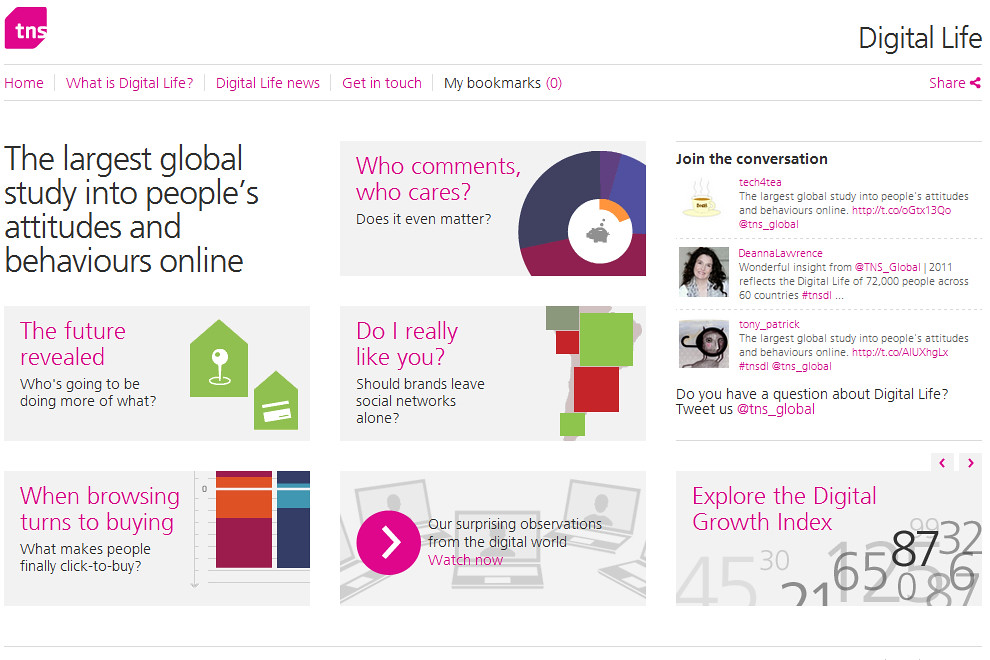
Digital Life 2011 study by TNS

Digital Life 2011 study by TNS

TNS today published their study of the modern digital lifestyle in today’s Internet age. The extensive survey was based on conversations with over 72,000 people in 60 countries. Digital Life’s size, scale and detail make it the most comprehensive view of consumer attitudes and behaviour online, on a global and local level.

“Digital waste is the accumulation of thousands of brands rushing online without thinking who they want to talk to – and why. Whilst many brand owners understand the value and relevance of the vast online world, many fail to understand the audience they are connecting with,” said Arnaud Frade, Regional Director Digital Strategy, TNS APAC.Inaugurated in 2010, today’s 2011 report is the second iteration of the annual study.

One of this year’s key findings is that businesses are generating much “digital waste” by way of electronic marketing material on the Internet that no one is interested in perusing.

For instance, even though brands are scrambling to inundate social networks such as Facebook and YouTube with their online presence, Digital Life showed that 43% of Singapore consumers actually don’t want to be bothered in social networks.

The global average for consumers who don’t want to engage with brands via social media is even higher at 57% for developed markets such as US (60%), UK (61%), Japan, Australia, Hong Kong and Taiwan.

“Control is firmly in the hands of consumers. The goal should therefore be to understand your target audience intimately, enabling your brand to connect openly and with integrity. This also means that selecting the right online approach and focusing on efficient messaging are critical to be relevant” Frade added.Brands that persist in spamming these consumers are not only wasting their marketing resources, but polluting the Internet instead. In the worst case, mis-targeted consumers may even resent the invasion of their social networks by the uninvited attention.

Businesses should therefore study these demographics and their details in order to tailor a marketing campaign that targets the right audience on the Internet.

The Digital Life study aims to provide these knowledge to brands looking for growth opportunities in the online world.

Digital Life applies TNS’s long-established expertise and deep consumer understanding to develop insights and address the key questions that inform marketing investment.

Some of these questions include:

  • How can I use digital channels to help grow my business?
  • Who can I reach through digital platforms?
  • How do I build my brand through engagement with new and existing consumers online?
  • How do I identify and cultivate brand advocates online?
  • How do I target potential customers online?

Digital Life also introduces the Digital Growth Index, a single number score defining the opportunity across product categories and countries for growth through digital channels, and showing the diversity of opportunities available in the online world.

An interactive data visualisation of the key findings can be found at www.tnsdigitallife.com.

About TNS

TNS Global Market ResearchTNS advises clients on specific growth strategies around new market entry, innovation, brand switching and stakeholder management, based on long-established expertise and market-leading solutions.

With a presence in over 80 countries, TNS has more conversations with the world’s consumers than anyone else and understands individual human behaviours and attitudes across every cultural, economic and political region of the world.

TNS is part of Kantar, one of the world’s largest insight, information and consultancy groups.

Akamai and TM Establish Strategic Partnership for NetStorage Deployment

Tuesday, November 8th, 2011

The partnership will see TM hosting Akamai NetStorage  – a secure managed service for the storage of large volume of data – via its Internet Protocol-based (IP-based) network to customers in South Asia.

Akamai is the leading global service provider for accelerating content and business processes online.Akamai Technologies is a leading cloud platform provider while Telekom Malaysia Berhad (TM) is a New Generation Network service provider in Malaysia.

TM’s IP network is delivered over its diverse international network infrastructure with worldwide Point of Presence (POPs) connectivity.

“The Akamai NetStorage will attract a high voume of Internet traffic to TM’s network, and definitely strengthen Malaysia’s position as a regional Internet hub,” said Rozaimy Abd Rahman, Executive Vice President of TM Global.Akamai NetStorage will be deployed in TM’s Data Center in Cyberjaya, Malaysia, which is targeted for completion by end of 2011. This will be Akamai’s only such storage facility in South Asia.

Historically, Internet users in Asia used to receive large amounts of content such as websites and videos from North America only.

The partnership with TM will allow Akamai to gain storage and co-location capacity in South Asia, and will serve to increase the transit bandwidth on the Akamai Intelligent Platform, Akamai’s cloud-based platform with global reach and local delivery capabilities.

Akamai Intelligent Platform delivers astronomical amounts of Web content on its infrastructure:

  • 1M mobile apps delivered day
  • Over 1 trillion Internet interactions daily
  • 85% of Internet users are a single network hop away
  • More than $200B in online commerce enabled annually
  • Scalable and 100% available

Akamai NetStorage service offers multiple terabytes of storage capacity on demand, automatic failover capability, content replication and connectivity to multiple Internet service providers. It also intelligently monitors network traffic and automatically avoids congestion and overloads for better overall user experience.

“With the collaboration, TM’s customers will be able to enjoy excellent internet connectivity and enhanced surfing experience as the source of content is stored locally here, which will result in seamless network performance,” Rozaimy added.TM has aggressively enhanced, improved and upgraded its IP service platform to further meet the ever demanding customers’ expectations. Earlier this year, the company has embarked into IPv6 capability to address the exhaustion of IPv4 in the region.

TM IP service is equipped with the latest security features such as black hole and clean pipe to secure its IP network against any unwanted threats.

VADS Berhad, a subsidiary of TM, provides global storage and serves as a major hub for data in the region.

As the largest Data Centre provider in the country, TM leverages on its 14 carrier-neutral data centres nationwide which are ISO 27001 certified and which fulfill all Tier 3 standards and Tier 4 ready.

Telekom Malaysia Berhad (TM), Malaysia’s broadband and integrated information and communications group.This is backed by its extensive nationwide and global high-speed IP network, and its existing vast customer base to offer high Service Level Assurance, superlative levels of availability, security with high redundancy for its clients.


It will enable companies to have an IT infrastructure without the complexity of procurement and capital investment.

Micro Focus announces new Test Server

Friday, November 4th, 2011

The new Test Server from Micro Focus offers a revolutionary approach and additional test capacity to IBM Mainframe Application Testing.

“We needed to find an innovative solution that would facilitate higher quality, scalable testing,” explained José Caetano Pereira, Senior IT Manager at BES. “By detecting errors earlier in the software development lifecycle, we will be able to deliver changes faster and deliver more robust software through to the User Acceptance Test phase and subsequent production.”Micro Focus, a leading provider of enterprise application modernization, testing and management solutions, has released Micro Focus Test Server – a unique technology that promises to accelerate testing processes while significantly reducing operating costs.

Customers such as the largest listed Portuguese bank, Banco Espirito Santo (BES), are implementing Micro Focus Test Server to enable them to improve software quality by increasing available mainframe test capacity on a Windows platform.

Micro Focus Test Server is an IBM z/OS compatible environment where application execution behaves just as it would on the target production mainframe. This makes it possible to perform a broad range of preproduction testing on readily available hardware. Testing capacity can now be easily increased to meet business-critical timeframes without incurring prohibitive costs.

Micro Focus Test Server is the first and only IBM mainframe-compatible solution for system, user acceptance and integration testing.

Micro Focus Test Server features:

  • Support for a wide range of mainframe COBOL and Assembler applications and data including batch with JCL, online CICS or IMS TM, DB2, IMS DB and VSAM files.
  • A black box test execution environment for composite applications where .NET and Java programmes invoke mainframe COBOL resources.
  • Close integration back to the mainframe with seamless and secure access to mainframe source code libraries, applications and data, enabling organizations to integrate testing with resources that continue to reside on the mainframe.
  • A proven test server engine that provides a high performance, robust execution environment for multi-region, multi-user testing.

Google withdraws Gmail app from Apple iOS devices

Thursday, November 3rd, 2011

Having just launched the new e-mail app earlier in the day, Google has withdrawn it new Gmail app from iPhone, iPad and iPod Touch devices after users started getting error messages.

“Unfortunately, it contained a bug which broke notifications and caused users to see an error message when first opening the app,” the company said in a blog. “We’ve removed the app while we correct the problem.”The newly-launched app is the first Gmail app for Apple’s iOS devices.

Google is now fixing the software bug and will release a new version. In the meantime, users who have already installed the app can continue using it, despite the bug.

Read the breaking story on Bloomberg.

Apple acknowledges iOS 5 impact on battery life

Thursday, November 3rd, 2011

Apple has finally broke its silence on the matter. A spokeswoman for Apple, Natalie Harrison, acknowledges that a “small” number of customers have reported “lower-than-expected battery life on iOS 5 devices.

"The power-efficient A5 chip and iOS 5 deliver outstanding battery life," says Apple's website.

"The power-efficient A5 chip and iOS 5 deliver outstanding battery life," says Apple's website.

It’s interesting that she mentioned iOS5 devices, instead of specifically iPhone 4S, when referring to the customer complaints.

So the problem is not confined to just the newly launched and hugely popular iPhone 4S. It’s just that the 4S has been hogging the headlines.

She tells Bloomberg that “We have found a few bugs that are affecting battery life and we will release a software update to address those in a few weeks.”