Archive for the ‘Tech news’ Category

Facebook to buy Instagram photo app for US$1 billion

Tuesday, April 10th, 2012

US$100 billion Facebook Inc has agreed to fork out US$1 billion in cash and stock to acquire the photo-sharing application for smartphones. The deal is expected to be completed this quarter.

Is Instagram worth one-hundredth of Facebook?

Is Instagram worth one-hundredth of Facebook?

Facebook is probably looking at attracting the users of mobile devices through its acquisition of Instagram – its biggest acquisition yet.

“Instagram, owned by San Francisco-based Burbn Inc, was valued at $500 million after raising about $60 million last week from investors,” Bloomberg was told.The idea is to attract the advertisers interested in reaching the mobile users.

Instagram started out as the top free photo-sharing app on Apple’s App Store with more than 30 million users.

Only last week, the company introduced the app for Android devices as well.

Instagram has only 13 employees so the offer works out to some US$76 million per employee, according to the Los Angeles Times.

“We need to be mindful about keeping and building on Instagram’s strengths and features rather than just trying to integrate everything into Facebook. That’s why we’re committed to building and growing Instagram independently,” – Zuckerberg wrote on his Facebook fanpage.Instagram was launched in October 2010 by Kevin Systrom and Mike Krieger with a seed funding of about US$500,000.

It subsequently raised US$7 million in 2011, when it had 1.75 million users, according to Bloomberg.

California-based Facebook is the biggest social-networking service today and intends to raise US$5 billion in its initial public offering (IPO) – which is to date the biggest IPO for an Internet company, valuing it at US$100 billion.

Facebook’s CEO, Mark Zuckerberg, said it plans to let Instagram retain its independence, in an effort to reassure Instagram users and potential advertisers.

RIM becomes Premier Sponsor for Echelon 2012

Friday, April 6th, 2012

Research In Motion (RIM) will be giving BlackBerry PlayBook tablets and BlackBerry smartphones as prizes for the startup winning team and participants.

Echelon 2012 in SingaporeWinners will also receive free membership into the BlackBerry Alliance Program, which includes technical and marketing benefits.

Sponsors for the startup entrepreneur's competition.

Echelon 2012 is a two-day, double-track event on 11 and 12 June 2012 at NUS with over 1,100 delegates, and a demo pit of up to 50 regional startups per day and various workshops.

It is organised by e27, a media organisation focused on the Asian technology startup community.

Representatives from RIM will also be speaking and judging at some of the Echelon
2012’s upcoming Satellites – shortlisting sessions for selecting the finalists for the actual event.

Other sponsors for the event includes Global Brain venture capital, Amazon Web Services, and Lenovo.

Nokia ventures into China with Lumia smartphones

Thursday, March 29th, 2012

China Telecom and Nokia have launched the first CDMA Windows phones in China. The Nokia 800C will be available for purchase in April at 3599 RMB (S$718) without contract; while the more affordable Nokia 600C will be available sometime in Q2 2012.

Stephen Elop, CEO of Nokia; and Wang Xiaochu, Chairman of China Telecom at the launch.

Stephen Elop, CEO of Nokia; and Wang Xiaochu, Chairman of China Telecom at the launch.

The Nokia 800C will be Nokia’s first Lumia phone for China – the world’s largest smartphone market. It is the CDMA variant of the Windows Phone-based Lumia 800.

China will see sales of up to 140 million smartphones this year. This is an increase of more than 80%, propelling China past the U.S. as the world’s largest smartphone market, according to researcher Gartner Inc. The Nokia 610C (CDMA variant of Lumia 610, price to be announced) will target more youthful audience and will provide a perfect introduction to Windows Phone with access to the same core signature experiences as the rest of the Lumia range

China Telecom is offering the Nokia 800C in black and cyan.

Nokia is also working on phones for networks operated by China Unicom Hong Kong Ltd. and
China Mobile Ltd, reported Bloomberg.

The smartphone features a 3.7″ AMOLED ClearBlack curved touchscreen display.

With a 1.4 GHz processor, hardware acceleration and a separate graphics processor, it also features an instant-share 8 Mpx camera with Carl Zeiss optics, HD video playback, 16GB of internal user memory and SkyDrive storage for accessing pictures and files from anywhere.

Android enjoys more than half the market share of smartphone platforms in the 4th quarter, while the iPhone accounts for nearly 25 percent, with Windows Phones (from all manufacturers) capturing 1.9 percent. – according to Gartner.Exclusive applications and services for a uniquely local experience

China Telecom and Nokia are targeting young people by integrating music, games, videos, and integrated reading apps right onto the Nokia 800C home screen.

To reach this target market, the Nokia 800C will be featured prominently in Tianyi FlyYoung shops, a distribution arm and new, youth-centered sub-brand of China Telecom.

People purchasing Nokia Lumia  smartphones in China will have access to applications such as magazines from Trends and special offers for free downloads of popular gaming titles such as Fruit Ninja and PVZ.

Trends, a provider of highly interactive fashion magazine applications, will launch Cosmopolitan first for Nokia Lumia smartphones and provide people using a Nokia Lumia phone with free access to For Him Magazine (FHM), Harper’s Bazaar and Esquire magazines in Marketplace, opening today.

Top 3 phone makers in China in the 4th quarter (Gartner)
Samsung 24.3%
Nokia 19.6%
Apple 7.5%

As an added incentive for  people using a Nokia Lumia smartphone in China, Nokia will soon offer 100,000 free downloads of the hit gaming titles Fruit Ninja and PVZ through the Nokia Collection in Marketplace.

Nokia and Microsoft also announced the Be Top program, which is designed to encourage and support developers in creating great new applications on Windows Phone specifically for people in China.

Nokia will offer Lumia users access to all major Internet services in China including Sina, SOHU, Tencent and Renren as well as a choice of nearly 20,000 apps available for download through Marketplace.

The Nokia 800C comes with the Nokia apps that are available only on Lumia smartphones:

The Nokia 800C is the CDMA variant of the Nokia Lumia 800.

The Nokia 800C is the CDMA variant of the Nokia Lumia 800.

Nokia Maps

Quick-access, three-dimensional maps in China and over 190 countries worldwide, as well as the ability to discover the top places nearby with local content support from Fantong, Jiepang, Ctrip, Qunar and Soufun.

People can easily click on the places to see photos, recommendations and information, and quickly dial restaurants to make a reservation.

Nokia Drive

Delivers a full-fledged personal navigation device with free, voice-guided, turn-by-turn navigation for over 100 countries including China.

It has a dedicated in-car user-interface, free offline navigation and speed notifications.

Nokia Music

Offers a single hub experience for discovering the latest music, including unlimited free music for 12 months for consumers in mainland China.

It also includes MixRadio, a free, global, mobile music-streaming application that delivers hundreds of channels of locally-relevant music, including the ability to listen to music offline and build personalized mixes for listening to favourite music from any location.


Nelson Mandela Digital Archive goes live online

Wednesday, March 28th, 2012

Google and the Nelson Mandela Centre of Memory (NMCM) have launched archive.nelsonmandela.org which is freely accessible to the public.

The archives include never-seen sequel manuscripts to Mandela’s “Long Walk to Freedom” autobiography.

We should never allow ourselves to forget the struggles for such basic rights as racial equality and take racial harmony for granted.

We should never allow ourselves to forget the struggles for such basic rights as racial equality and take racial harmony for granted.

When I was a youth, everybody knew who Nelson Mandela was and Apartheid was a must-study topic for the General Paper exam in school.

I wonder how many of the current generation remember or know about the tumultuous struggles in South Africa to fight for what many in the rest of the world take for granted – racial equality.

Even today in Singapore, you have people posting insensitive remarks about other races and nationalities over Twitter.

And in the US, the Trayvon Martin shooting is still brewing over.

In order to keep the memories of Nelson Mandela alive, Google gave a US$1.25m grant to Johannesburg-based NMCM last year.

The aim was to preserve and digitize thousands of archival documents, photographs and videos about Mr Mandela.

The new online multimedia archive includes Mr Mandela’s correspondence with  family, comrades and friends, diaries written during his 27 years of imprisonment, and notes he made while leading the negotiations that ended apartheid in South Africa.

Start by looking at his Early Life, and take a peek into his personal memories of the time he was incarcerated during the Prison Years.

Read the handwritten notes on his desk calendars, which show, for example, that he met President F.W. De Klerk for the first time on December 13, 1989 for two and a half hours in prison; the Warrants of Committal issued by the Supreme Court which sent him to prison; the earliest known photo of Nelson Mandela’s prison cell on Robben Island circa 1971; and a personal letter written from prison in 1963 to his daughters, Zeni and Zindzi, after their mother was arrested, complete with transcript.

What was Apartheid

Apartheid was the official policy of the National Party, which came to power in 1948 in South Africa. It was the practice of official racial segregation.

Under apartheid everyone in South Africa had to be classified according to a particular racial group.

This determined where someone could be born, where they could live, where they could go to school, where they could work, where they could be treated if they were sick and where they could be buried when they died.

Only white people could vote and they had the best opportunities and the most money spent on their facilities.

Apartheid made others live in poverty.

Black South Africans’ lives were strictly controlled.

Many thousands of people died in the struggle to end apartheid.

– www.nelsonmandela.org/content/page/faqs

Seagate achieves 1 Terabit per square inch in hard drive storage

Tuesday, March 27th, 2012

That’s one trillion (1,000,000,000,000) bits in one square inch of the disk.

That’s more than double the number of stars in the Milky Way, which astronomers estimate to number between 200 and 400 billion.

Seagate has squeezed 1,000,000,000,000 bits into every square inch.

Seagate has squeezed 1,000,000,000,000 bits into every square inch.

Seagate has become the first hard drive maker to achieve the milestone storage density of 1 terabit per square inch.

“The growth of social media, search engines, cloud computing, rich media and other data-hungry applications continues to stoke demand for ever greater storagecapacity,” said Mark Re, senior vice president of Heads and Media Research and Development at Seagate.The technology demonstration promises to double the storage capacity of today’s hard drives upon its introduction later this decade.

Don’t be surprised to see 3.5-inch hard drives with an extraordinary capacity of up to 60 terabytes over the 10 years that follow.

Seagate reached the landmark data density with heat-assisted magnetic recording (HAMR), the next- generation recording technology.

The current hard drive technology, Perpendicular Magnetic Recording (PMR), is used to record the spectrum of digitized data – from music, photos, and video stored on home desktop and laptop PCs to business information housed in sprawling data centers – on the spinning platters inside every hard drive.

PMR technology was introduced in 2006 to replace longitudinal recording, a method in place since the advent of hard drives for computer storage in 1956, and is expected to reach its capacity limit near 1 terabit per square inch in the next few years.

“Hard disk drive innovations like HAMR will be a key enabler of the development of even more data-intense applications in the future, extending the ways businesses and consumers worldwide use, manage and store digital content,” added Mark.Hard drive manufacturers increase areal density and capacity by shrinking a platter’s data bits to pack more within each square inch of disk space.

They also tighten the data tracks, the concentric circles on the disk’s surface that anchor the bits.

The maximum capacity of today’s 3.5-inch hard drives is 3 terabytes (TB), at about 620 gigabits per square inch, while 2.5-inch drives top out at 750 gigabytes (GB), or roughly 500 gigabits per square inch.

The first generation of HAMR drives, at just over 1 terabit per square inch, will likely more than double these capacities – to 6TB for 3.5-inch drives and 2TB for 2.5-inch models.

The technology offers a scale of capacity growth never before possible, with a theoretical areal density limit ranging from 5 to 10 terabits per square inch – 30TB to 60TB for 3.5-inch drives and 10TB to 20TB for 2.5-inch drives.

Tata Communications first to circumnavigate the globe

Friday, March 23rd, 2012

Tata Communications has completed the world’s first wholly owned cable network ring around the world. The global fibre optic network seamlessly links markets across Asia, Middle East, the U.S. and Europe to meet rising demand for 24/7 commerce. (Update: Click here to view Infographic)

Launch of the TGN-Gulf Landing constitutes part of Tata Communications's global fibre optic network.

Launch of the TGN-Gulf Landing constitutes part of Tata Communications's global fibre optic network.

This is following the official launch of its Tata Global Network – Gulf (TGN-Gulf) and Eurasia (TGN-EA) cables.

The TGN-Gulf cable sub-sea cable system connects the Gulf to Mumbai, India and onward to the rest of the Tata Global Network (TNG).

“Our customers, whether a European auto-manufacturer, an Asian hotel group or a large U.S. financial services firm, need to compete in global markets and are demanding faster and more reliable worldwide connectivity,” says Vinod Kumar, Managing Director and CEO, Tata Communications. The TGN-EA cable connects Europe to India, through Egypt, bringing increased capacity, resilience and enhanced communications links to not only the Middle East, but to the rest of the world. It will initially offer speeds of up to 10Gbps.

Tata Communications is a global communications service provider that owns and operates the world’s largest subsea cable network.

TNG covers nearly 20% of the world’s Internet routes reaching over 240 countries and territories. These countries constitute 99.7 per cent of the world’s GDP.

The completion of the final link across Egypt enables Tata Communications to offer its customers unique access to a wholly-owned express route cable from Europe to India with improved latency, redundancy and scalability.

In conjunction with the company’s recently launched TGN-Gulf these routes will cater to the increasing demand for voice, video and data services in and out of the Gulf region.

“Companies and carriers in developed and emerging economies require the confidence and security delivered by a wholly-owned network such as Tata Communications’ TGN,” added Kumar.The round-the-world ring also offers city-to-city connections in contrast to more traditional networks which only link cable landing stations.

This approach is more cost-effective, flexible and provides a faster time to market delivery, as well as being easier to maintain and manage.

The 9,280 km TGN-EA system which links Europe and India, running across the Mediterranean and the Middle East, uses fibre-optic technology based on microscopic glass fibres as thin as a strand of human hair, and offers customers the lowest levels of latency with RTD around 92 msec with speeds from 2Mbit/s to 10Gbit/s available.

Britannica stops print edition and goes purely online

Wednesday, March 14th, 2012

After 244 years, the Encyclopaedia Britannica is going out of print. But it is not going extinct. It had already gone online for more than 10 years, but from now on, it will be 100% digital.

Digital milestones for Encyclopaedia Britannica. (All images and inforgraphics in this post are from Encyclopaedia Britannica)

Digital milestones for Encyclopaedia Britannica. (All images and inforgraphics in this post are from Encyclopaedia Britannica)

The Encyclopaedia Britannica has existed since 1768.

The Encyclopaedia Britannica boasts some very prestigious sources.

The Encyclopaedia Britannica boasts some very prestigious sources.

In my mind, its greatest competitor is the 11-year-old Wikipedia, which is written and edited by a community of many thousand contributors around the world – with nearly four million articles in English, and increasingly quoted as sources in researches and reports.

Britannica’s differentiation from Wikipedia will be in its credibility, derived from its sources, and careful verificaiton and editing in its rigorous vetting process.

The 32-volume printed version (which weighs nearly 60 kilograms and costs US$1,395) will be discontinued when current inventory runs out. That’s 4,000 sets out of the 12,000 print run of the 2010 edition.

The bulk of Encyclopaedia Britannica current revenue comes from selling curriculum products in school.

The bulk of Encyclopaedia Britannica current revenue comes from selling curriculum products in school.

Britannica enjoyed the briskest sales in 1990, selling some 120,000 sets in the US. Now, the print version generates less than one percent of the company’s revenue.

The bulk of Britannica’s revenue comes from selling curriculum products in school (85 percent), while another 15 percent are from subscriptions to its website.

There are some 500 thousand subscriptions paying US$70 each year to enjoy full access to Britannica’s articles, videos and original documents.

Another general-interest encyclopedia that is still being printed in the US is the World Book, which sells a 22-volume yearly edition.

How much data has been created, lost and recovered since the advent of the PC?

Tuesday, March 13th, 2012

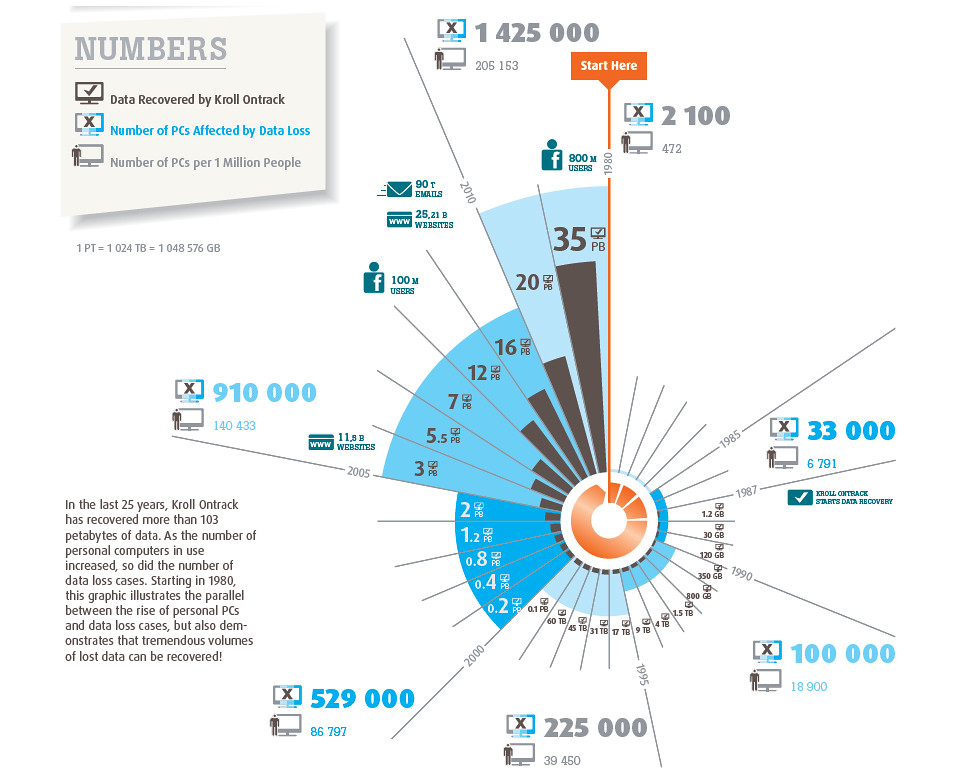
Kroll Ontrack has recovered more than 103 petabytes of data over the past 25 years.

THE DIGITAL ERA: How our life has changed into a digital one; and the creation, loss and recovery of data over time (Source: Kroll Ontrack).

THE DIGITAL ERA: How our life has changed into a digital one; and the creation, loss and recovery of data over time (Source: Kroll Ontrack).


Kroll Ontrack
has released new statistics regarding how the creation of storage technologies and digital information has impacted data loss and data recovery technology since the advent of the personal computer in the 1980’s.

“In the past 25 years, the worst cases Kroll Ontrack has seen have coincided with natural disasters, which included burned, water logged and physically damaged drives,” said Todd Johnson, vice president of operations, Kroll Ontrack.Since the first Kroll Ontrack data recovery lab opened in 1987, more than 103 petabytes (PB) of data has been recovered.

How much is 103 PB of data? That’s equivalent to 25 million USB flash drives, each with 4 GB capacity.

Only 1.2 GB of data was recovered in 1987, whereas the amount of data recovered by Kroll Ontrack in 2011 has skyrocketed to nearly 35 million GB (35 PB).

The number of computers impacted by data loss was estimated to have reached nearly 1.4 million – compared to only 33,000 in 1987.

According to an analysis by Kroll Ontrack, the number of data loss cases over the past 25 years grew in parallel with the total number of personal computers in the world.

“One of the company’s most successful endeavors was the recovery of more than 99 percent of mission-critical data from a melted, crashed and burned drive from the 2003 Space Shuttle Columbia,” revealed Johnson.The analysis also revealed that on average, one in one thousand computers lost data stored on it.

In the 1980’s, at the onset of the so-called PC era, the estimated number of personal computers in use was nearly 7,000 devices per one million people and approximately 33,000 of them suffered data loss.

By the mid 1990’s, the number of computers in use was nearly 40,000 per one million people and data was lost from approximately 225,000 computers.

In 2011, these figures reached more than 200,000 computers and 1.4 million cases of data loss, respectively.

“You cannot go through day-to-day life without interfacing with some form of digital data,” said CK Lee, country manager, Kroll Ontrack Singapore. “As technology advances to include virtualization, cloud, and social media, individuals, businesses and of course data recovery specialists have to evolve to address these storage mediums and the new challenges they present.”According to the latest IDC Digital Universe study, the amount of data more than doubles each year, and in 2012, it will exceed 1.8 zettabytes.

This is the equivalent of 200 billion two-hour long HD movies that one person would have to watch continuously for 47 million years.

As data creation increases, so does data loss.

According to a report by market research firm Gartner, every year at least 25 percent of computer users worldwide experience data loss.

Kroll Ontrack statistics indicate that 29 percent of data is lost as a result of hardware failure and 27 percent is due to human error.

Other causes include software errors (7 percent), computer viruses (7 percent) and natural disasters such as floods or fires (3 percent).

Below is a timeline infographic by Kroll Ontrack charting a brief history of the digital era.

(more…)

Norton Mobile Security protection for Samsung GALAXY smartphones

Monday, March 12th, 2012

Samsung Galaxy users worldwide will get a full-featured Norton Mobile Security free for 90 days. Usually, a one-year license costs S$19.90.

Complimentary 90-day subscription of Norton Mobile Security for Samsung GALAXY smartphones.

Complimentary 90-day subscription of Norton Mobile Security for Samsung GALAXY smartphones.

Norton Mobile Security, an application for Android OS, is available in multiple languages.

“With smartphone sales now outpacing PC sales, cybercriminals are devising new threats everyday to steal from mobile users. Consumers need to be protected more than ever,” said Janice Chaffin, group president, Consumer Business Unit, Symantec.Samsung Galaxy users will be able to download it from Samsung Apps.

Norton Mobile Security can be downloaded from the ‘Utility’ category in Samsung Apps or by entering ‘Norton Mobile Security’ into the search query at the Samsung Apps.

Norton Mobile Security supports all Samsung Galaxy Android smartphones, including Galaxy S2.

Norton Mobile Security combines anti-theft features with powerful anti-malware to protect user’s important data from loss, theft, viruses and other threats.

The following are the main features.

  • Remote Locate — Shows you the location of your smartphone so you can find if it’s lost or stolen.
  • Remote Lock — Lets you remotely lock your lost or stolen phone via the Internet or SMS to keep critical data safe and block unauthorized access.
  • Remote Wipe — Lets you remotely erase the data on your phone via SMS, blocking access to your private information. In addition, your phone is instantly locked if its SIM card is removed or replaced, so it can’t be used with another SIM card.
  • Anti-malware — Scans all files and application updates downloaded to your mobile phone and automatically detects and removes threats without slowing you down.
  • SD Card Scanning — Gives you the option of automatically scanning SD (Secure Digital) memory cards for threats when you plug them into mobile phone.
  • Automatic LiveUpdate — Automatically downloads and installs security updates keeping you a step ahead of cybercriminals.

How Singapore IT practitioners perceive mobility risks

Thursday, March 1st, 2012

Singapore was one of 12 countries surveyed in a new “Global Study on Mobility Risks” conducted by Ponemon Institute. Out of the overall 4,640 IT and IT security practitioners surveyed, 259 respondents were from Singapore.

Perception of mobile phone use as a threat and presence of security controls to mitigate the risks.

Perception of mobile phone use as a threat and presence of security controls to mitigate the risks.

The study was sponsored by content security provider Websense Inc, and is designed to help IT security professionals plan for an increasingly mobile workforce.

“We asked thousands of IT security professionals and found mobile devices were overwhelmingly important to business objectives,” said Dr Larry Ponemon, chairman and founder of the Ponemon Institute.Corporate mobile devices and the bring-your-own-device (BYOD) phenomenon are rapidly circumventing enterprise security and policies.

In Singapore, 45 percent of respondents say that their organizations experienced a data breach due to insecure mobile devices, and 22 percent are unsure.

“However, mobile devices put organizations at risk — risks that they do not have the necessary security controls and enforceable policies to address. It’s also clear that employees are deliberately disabling security controls, which is a serious concern,” Dr Ponemon addedThis is slightly less than the overall proportion of 51 percent for all 12 countries.

Fifty-five percent say that their employees circumvent or disengage security features such as passwords and key locks – versus the overall 59 percent.

Below is the Executive Summary for the survey of IT & IT Security Practitioners in Singapore, which was extracted from the “Global Study on Mobility Risks”.

(more…)