A friend of mine sent me a hardcopy of this book about the importance of digital PR and digital PR techniques that work well.
"The Changing Face of Communications: 12 digital techniques for modern PR" - released by Lewis PR.
It was recently released by her PR agency (Lewis PR) to delve into what is really key to marketing and PR professionalism, as well as companies in general who are looking to keep themselves updated in this digital age.
In this digital age, we see social media evolve by the day and emerge in communications more and more.
So I do agree with my friend, Gina Daryani, how important it is to keep abreast with the latest techniques in this fast-paced and rapidly-changing age.
In order to address “The Changing Face of Communications”, this book propounds “12 digital techniques for modern PR”.
I have listed below the 12 techniques – each delved with in its own How-to chapter in the book.
How to communicate in a real-time world
How to incorporate SEO into PR
How to evaluate a social media campaign
How to improve your corporate videos
How to get started in word-of-mouth marketing
How to make your corporate blog take off
How to use social media to enhance events
How to create sticky content
How to handle a social media crisis
How to optimize your web presence for conversions
How to make the case for social media
How to work with online influencers
You may also download the free e-book from this link here.
I’m just beginning to read the book, but below is an excerpt to get you started.
BlackBerry maker – Research In Motion (RIM) – has named Thorsten Heins as President and CEO of the company.
Mike Lazaridis remains Vice Chair of the Board while Jim Balsillie takes on a Director role at the company. This is effective immediately.
Outgoing Co-chairs and Co-CEOs Jim Basillie and Mike Lazaridis
Heins was also appointed to RIM’s Board. He joined RIM from Siemens Communications Group in December 2007 as Senior Vice President for Hardware Engineering and became Chief Operating Officer for Product and Sales in August 2011.
I believe Heins does not have time on his side, given BlackBerry’s rapid loss of market share to rival Android devices and Apple iOS products.
“We have a strong balance sheet with approximately $1.5 billion in cash at the end of the last quarter and negligible debt. We reported revenue of $5.2 billion in our last quarter, up 24% from the prior quarter, and a 35% year-to-year increase in the BlackBerry subscriber base, which is now over 75 million.” – Thorsten Heins, new President and CEO of RIM.RIM’s market share of smartphones in the US declined from a market leading 44% in 2009 to 10% in 2011, according to market researcher NPD Group.
BlackBerry has been growing outside of America but it is facing similar challenges from its competitors in those markets as well.
Coming from within RIM instead of outside, the natural question will be whether Heins will be doling out “more of the same” at RIM.
I’m not sure having been in RIM since 2007 is necessarily something that will be seen as positive for Heins.
Investors will be keen to know if he had his own ideas but could not act on them because he was not the CEO.
Heins will have a very short time to show how different he is from his predecessors, that he has his own vision and roadmap to bring RIM back to its previous success.
Thorsten Heins, new President and CEO at RIM
I’m hoping his “I don’t think that there is a drastic change needed” spiel during his first press conference as CEO is merely paying due respect to his predecessors.
The succession plan was submitted by the two Co-Chairs and co-CEOs, Mike Lazaridis and Jim Balsillie. RIM’s Board of Directors acted on their recommendations after conducting its own own due diligence.
Investors had forced RIM to consider a change in company leadership in 2011 and was stalled with the company’s promise to study the matter.
RIM promised a resolution in January 2012 and I’ve been wondering if they were going to make the move, after their closed-door meeting in mid December.
Mike Lazaridis, who co-founded RIM with Doug Fregin in 1984, has become Vice Chair of RIM’s Board and Chair of the Board’s new Innovation Committee.
As Vice Chair, he will work closely with Mr. Heins to offer strategic counsel, provide a smooth transition and continue to promote the BlackBerry brand worldwide.
Barbara Stymiest, who formerly served as a member of Royal Bank of Canada’s Group Executive and has been a member of RIM’s Board since 2007, has been named the independent Board Chair.
John Richardson, formerly Lead Director, will remain on the Board.
Prem Watsa, Chief Executive Officer of Fairfax Financial Holdings, also was named to the Board, expanding it to 11 members.
If you’re passionate about photography, why not submit your pictures to a stock photo agency? It might just make you enough money to pay for your next big lens.
iStockphoto workshop at the Canon Imaging Academy
Rather than let your photos collect dust in an old shoe box get lost and forgotten in the hard disk, try submitting them to a photo microstock agency.
The average contributor’s income may not be astounding, but it could be pocket money for that extra drink at the bar.
Canon Imaging Academy at Habour Front Place
I attended a workshop by Jumpei Matsuoka from iStockphoto last weekend at the Canon Imaging Academy (CIA) at Harbour Front Place.
CIA conducts photography courses, organises local outings and overseas trips, and provides free product training for photographers.
The 1-hour session was over-subscribed and the space had to be extended to accommodate almost forty photographers eager to find out how they could put their photos to work.
Jumpei Matsuoka, GM iStockphoto Japan
Matsuoka is the general manager for Japan and South Korea at iStockphoto.
He talked about how photography buffs can sign up as contributors on iStockphoto and make money from their passion for photography.
He also shared tips on what are the top selling images, the trends in the microstock industry, and how contributors can market themselves to potential customers.
iStockphoto is the world’s original source for user-generated, royalty-free stock images, media and design elements.
Its community of more than 7 million members enjoys access to a content collection approaching 10 million photographs, vector illustrations, flash, audio and video files on the site.
iStockphoto pays out US$1.9 million each week in royalty to its contributing artists.More than 50,000 files are approved each week from the site’s rapidly growing group of more than 125,000 contributing artists, with 5,500 submitting exclusively to iStockphoto.
Many iStockphoto artists earn a full-time living from iStockphoto, and many formerly traditional stock artists see micropayment stock imagery as an additional revenue channel.
I had a chat with Matsuoka after the session. The amicable fellow photographer conveyed a strong passion for photography and emphasised that a contributor should first and foremost possess this passion for photography.
With that as the backdrop, whatever income the contributor earns from submitting photos to a photo stock agency becomes an added bonus for the passion. On top of that, the contributor actually enjoys the work.
My own feel from speaking with Matsuoka is that if you’re thinking of becoming a contributing photographer, don’t quit your day job just yet.
The top six categories that bring in the most money:
Business
Lifestyle
Sports
Nature & Wildlife
Ideas
Travel
Start off small by submitting your shots to get a feel of the kind of income you can expect from the endeavour, and whether you have the eye to take photos that the agency will likely approve.
Photographers should know that the emphasis of stock photo agencies is to get photos that their paying subscribers can use – be it for business brochures or other publications.
It’s not so much the usual photo competition where there’s more emphasis on the artistic aspect of photography.
You would have heard wonderful success stories of a handful of contributors who earn big bucks from going full-time as stock photographers. But for the rest of us mere mortals, do test the waters first.
I have included some soundbites from Matsuoka about his perspectives on different aspects of stock photography. Check them out.
So dust out your old photos dig out those photos scattered all over your hard disks, and start shooting, you may just discover your ideal full-time job!
Apple co-founder Ronald Wayne could have been US$36 billion richer had he held on to his 10% in Apple in 1976.
In an Oct. 7 interview with Bloomberg, Wayne, 77, called Wozniak and Jobs “intellectual giants,” but “also felt it was going to be something of a roller coaster,” adding, “If I’d stayed with them, I was going to wind up the richest man in the cemetery.” Instead, he relinquished his stake 11 days after signing.
The $2,300 that he received in 1976 for the 10% stake would have become more than $36 billion today.
Warren Buffet would have hung on.
On hindsight, Wayne doesn’t seem to have any regrets.
He tells Bloomberg, “If I’d stayed with them, I was going to wind up the richest man in the cemetery.”
Read about Ronald Wayne and Apple’s founding in this Bloomberg story.
For its launch of the Lumia 800 and Lumia 710, Nokia has made it clear that it is not just launching these two handsets.
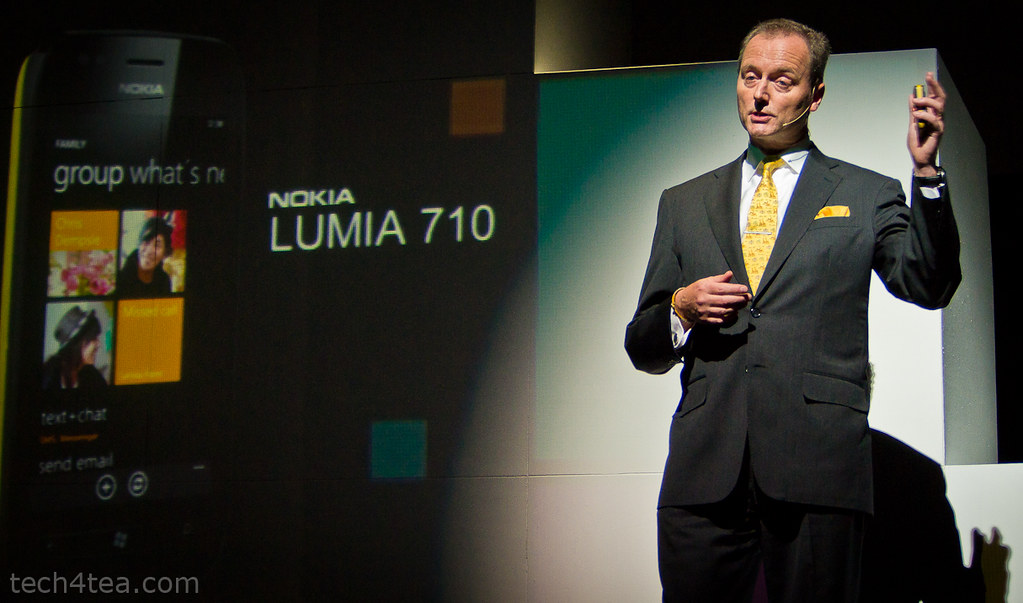
Niklas Savander, Executive Vice President, Markets, Nokia Corporation flew in from Finland to expound the virtues of the Lumia product line in Singapore.
Instead, it is launching a holistic mobile experience for the smartphone user – from the hardware performance to the software user interface, right down to the ecosystem of applications for users and development tools and environment for developers.
Tracey Fellows, Area Vice President, Microsoft Asia Pacific
The launch event was a testimony to this holistic approach.
There were customized sessions to woo different segments of that ecosystem.
The first session of the day was a “fireside chat” where Nokia and Microsoft executives briefed developers how they are developing and building the ecosystem.
Nokia is working with global and local developers to create new, innovative and differentiated apps and content for all Nokia devices.
Emphasis has been placed on supporting local developers transition to develop for the Windows Phone platform.
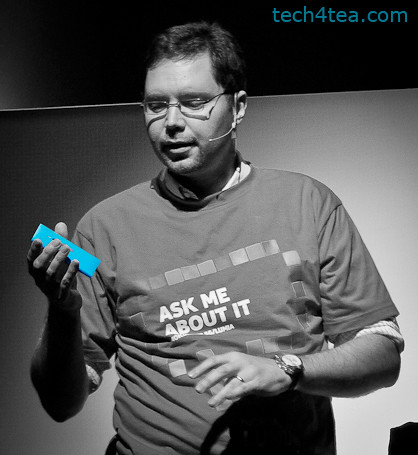
Ask Andrej Sonkin about how excited he is with the Lumia. He is the Head of Smart Devices for Nokia Southeast Asia Pacific.
It is also partnering with local institutions to actively develop applications.
This was followed by the keynote conference when the actual products were launched, and guests and media had a chance to hands-on the handsets and accessories.
Key executives from both Nokia and Microsoft were on hand for interviews to go into details with their plans for the Singapore market and their local focus, as well as the product specifications for the Nokia Lumia range of products.
The launch event was wrapped up with a bum-boat ride to Clark Quay for a party at Read Bridge.
I tried out the TomTom VIA 280 for the first time during my drive from Singapore to Kuala Lumpur (KL) today after receiving the review unit yesterday. Here are the initial impressions.
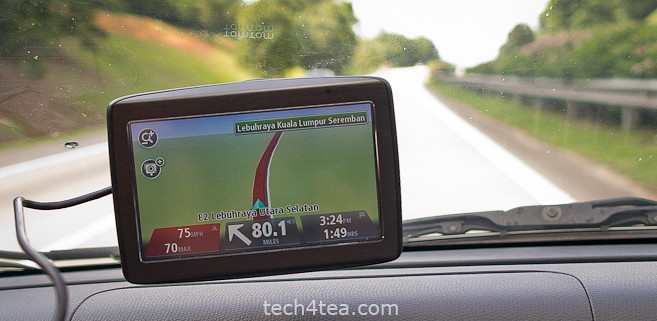
TomTom VIA 280 on its maiden run on the Malaysian North-South expressway.
Set up was straightforward. Plug the main unit to the cigarette plug using the USB cable, attach the main unit to the windscreen and you’re set to go.
Once you start the engine, the TomTom VIA 280 switches on. Switching off the engine, switches off the VIA 280 automatically.
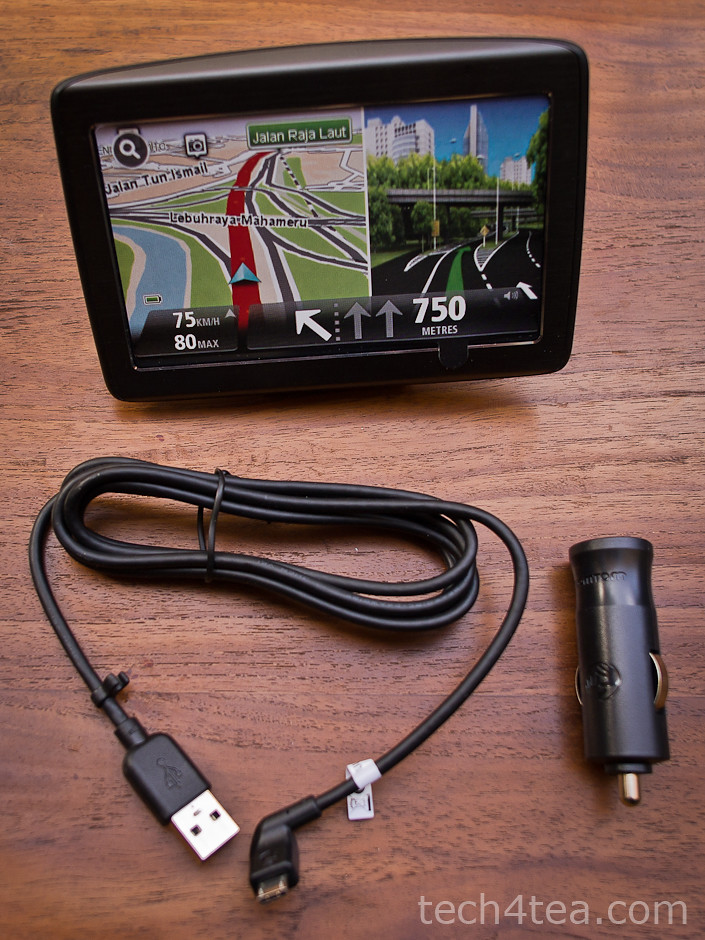
Only three components in the box: the main unit, the USB cable and the cigarette plug.
The user-interface was real easy. The route chosen was optimal. Changes to the route was simple. What impressed me most was how fast the recalculation took place.
I started off using the VIA 280 for a short journey running an errand round the neighbourhood. Just press “Navigate to” icon on the main menu, select “POI” (Point of interest), followed by “POI near you”, and then browse the various categories.
It was easy enough to find the neighbourhood shopping centre and set it as the destination. The map display was clear and the estimated distance to the next turning was accurate.
For the KL trip, I first set it as a “Favourite”. Next I set the route for it under “Plan route”. The recommended route was through the Causeway. But I preferred the Tuas Second Link.
By choosing the “Change route” option, you could ask for alternative routes, to travel via the Second Link or to avoid using the Causeway – which I did.
As I approached the second link, I realised that for the first time in my life, I’d forgotten to top up. The fuel gauge read just more than half-tank.
The Singapore government requires Singaporean drivers driving to Malaysia to have their petrol tanks at least ¾ tank full, otherwise if you’re caught in a spot-check, you’re fined S$500.
First impressions:
For a maiden run, the VIA 280 made a very positive impression.
The VIA 280 strikes me as a no-frills PND which is more than competent to handle all the functionalities one would expect for helping the driver navigate from point A to point B.
Now where’s the nearest petrol station?
Tapping anywhere on the map on the screen activated the main menu.
The following menu options: “Change route” > “Travel via…” > “Point of Interest” > “POI near you” > “Petrol station” revealed a list of petrol stations nearby, according to distance. 15 minutes later, we were back on track to hit the customs.
The drive on the North-South expressway was uneventful. En route, I deliberately deviated from the recommended route to see how the VIA 280 reacted. Both times, it came up with a new route in less than 3 seconds – impressive.
After the four-hour drive, we finally reached our destination 2 minutes before the time of arrival initially estimated by the VIA 280 at the beginning of the journey.
The courier dropped off the TomTom VIA 280 GPS portable navigation device (PND) for review. The VIA range is the new family of PNDs that TomTom just introduced to Singapore this week.
TomTom VIA 280, the screen display here is a sticker.
TomTom has been selling the XL 250, XXL 550 and GO 750 PNDs in Singapore.This week, it introduced the GO 2050 and GI 2050 World, as well as the VIA 220, VIA 260 and VIA 280.
Only three components in the box: the main unit, the USB cable and the cigartette plug.
Compared to the GO family of PNDs, the VIA range represents the lower end, no-frills selection of PNDs.
I’d tried the GO 750 before and was impressed by it, but I was curious whether the VIA would cut it. Over the next week, I’ll be driving to Kuala Lumpur and back with the VIA 280 – and then I’ll let you know whether the VIA 280 is any good.
For now, a look at the new box of VIA 280 shows three parts: the main unit itself, the plug for the car’s cigarette lighter, and the USB cable which connects the main unit to the plug.
The same USB cable is also used to connect the main unit to the computer for software and map updates.
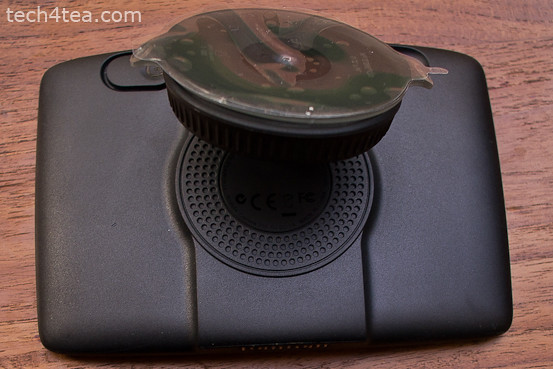
The integrated mount behind the TomTom VIA 280 comprises an adjustable suction disc.
Behind the main unit is the integrated mount, with a suction disc. After connecting the cable, bend the suction disc outwards, press it against the windscreen and turn the knob around the disc to tighten the grip of the disc on the windscreen.
Then adjust the angle until the screen of the main unit is at the right viewing angle from the driver’s seat.
Press the power button behind the main unit and it’s ready to operate.
It’s been a busy few days of earnings results from IT bigwigs. Here’s a quick sum-up of the state of the IT industry:
Yahoo! did well with profits beating estimates – could it be because expectations were low?
Conversely, Apple didn’t do so good, missing analysts’ predictions for the first time in at least six years – but that’s probably because expectations were so high!
Google’s doing real well with sales and profit beating estimates – from search advertising growth as usual.
Microsoft is patting itself on its back – for not having bought Yahoo! back in 2008. And taking a swipe at Google’s Android – Steve Balmer says you need to be a computer scientist to use an Android smart phone, unlike Windows Phone 7.
RIM’s still trying to find its way forward by taking a step backward – trying to bridge new QNX with “old” BlackBerry OS 7 – hope that works out.
Amazon is being sued for screwing up the career of an actress by revealing her real age against her will in IMDb.
On the corporate IT front, industry bell weather IBM missed analysts’ estimates on slowing revenue growth at its software, hardware and services businesses.
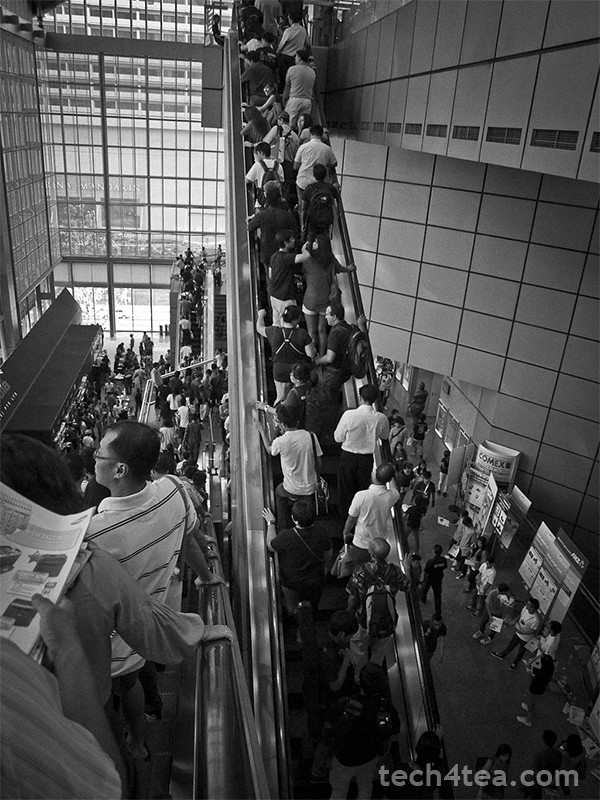
Once a quarter, half of Singapore converges on Suntec City or Singapore Expo to “shop till you drop”. I visited COMEX 2011 on its second of four days to take advantage of promotional prices and to stock up on IT gadgets and peripherals.
Visiting COMEX 2011 on Friday afternoon, the hope was to go in after the initial opening day rush crowd had petered out and before the working folks – who knock off work for the week at five – set in.
View from Level 6 of COMEX 2011. Combined panorama from 3 photos.
I like to think the ploy worked, though the marketplace was still plenty crowded.
I managed to park the car at Basement 2 of Suntec City itself and dived into the crowd on Level 6 at around half-past-three – shopping list in hand. I’d listed down beforehand the booth numbers of the vendors selling the stuff I wanted and studied the floor plans to work out an optimal route through the madhouse.
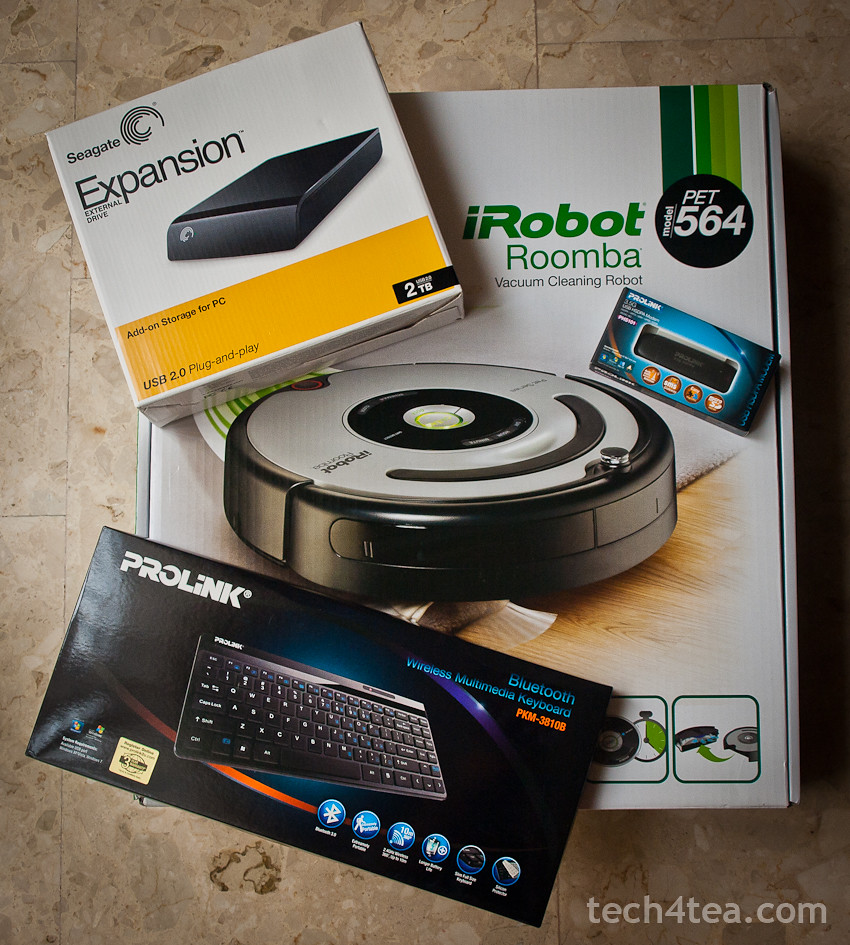
First stop was the Prolink booth where I bought the Prolink PKM-3810B bluetooth keyboard for my BlackBerry PlayBook. The guys at the booth wasn’t sure if it would be compatible with the PlayBook’s OS since it was built for Windows and they’d tested earlier that the keyboard did not play with Android. (Update: I’ve since tested the keyboard with an Android Tab and both worked together without a hitch!)
So I fished out the tablet and tested the display keyboard set. Amazingly both got connected without a hitch, so I became S$48 dollars poorer. And thanks to a cut-out coupon from the Straits Times, I saved S$8 from the original COMEX price of S$56.
My little haul from COMEX 2011
Since I was at Prolink, I bought a 3.5G USB HSDPA Modem for S$69. I was going to renew my home broadband subscription with SingTel. They’d offered a “free” modem for the mobile 1.5 Mbps on condition that I pay S$4 extra per month (if you use your own modem, you get the 1.5 Mbps and data SIM card for free).
Since that worked out to S$96 over the course of two years for the “free” modem, I figured I might as well purchase my own modem for less. Not a lot of savings, but I didn’t like the idea of being suckered into swallowing SingTel’s “free” modem offer.
Next stop was for an external 3.5” hard disk drive. The sweet spot for such storage disks is at 2 TB, and the cheapest 2 TB disk advertised was the Buffalo Drivestation.
“It’s sold out but we have other models that you may want to consider” – sounds all too familiar?
But it’s no darn good if it’s sold out – the “it’s sold out but we have other models that you may want to consider” sounded all too familiar.
So I headed for Seagate and got myself a 2 TB expansion external 3.5” hard disk for S$120. Basic USB 2.0 with no frills.
Last stop was for a robotic maid. The golden retriever at home was driving us nuts with its beautiful golden fur – strewn all over the floor – and the cleaners only come in once a week.
So I checked out the two booths at COMEX selling robotic vacuum cleaners – iClebo and iRobot. I ended up carting home the latter after parting with S$898 for the Pet series iRobot.
“If looks could kill, we’d both have been dead a million times through”.
On the way out of the lift lobby at the B2 carpark, I got waylaid by this guy who saw me lugging the iRobot box and wanted to know where I’d bought it from – while keeping the people in the lift waiting for him.
If looks could kill, we’d both have been dead a million times through.
Upon arrival at Frankfurt, we’d picked up the rental car and driven the 64km from the airport to Weinheim in slightly less than an hour. Thanks to the GPS, finding the hotel was a breeze.
This is the first time I’m using a TomTom GPS and so far so good. The GO 750 is easy to use and the turn by turn navigation for the dedicated GPS device is clear and timely.
NH Hotel Weinheim, a good base to explore Mannheim, Schwetzingen, Heidelberg and the surrounding region. Photo from www.nh-hotels.com
I remember the first time I’d used a GPS years ago, the voice instructions came so late I frequently missed turnings.
What does one look for in a navigational GPS device? Here are some things I look out for from my own experience.
Good database so that the hotel or sight you’re looking for is in the map data. Good road database also helps in planning a good route from start point to destination. I had this GPS in the past that repeatedly tried to direct me to enter an expressway by driving into a one-way EXIT from the expressway. I had to take things into my own hads and figure out how to get onto that expressway in France.
Good user interface so you can find that hotel or sight and select it for navigation. The “point of interest” (POI) is only useful only if you can dig it out from the map data. I’ve used devices in the past where I tore my hair out just to locate a specific hotel to get to but can’t find it – only to discover later that it was in the database after all. I couldn’t find it because I didn’t have the exact address down to the door number. Then again, in Japan you can just key in the phone number of that establishment, and the GPS gives you the location and route to that specific hotel or sight.
Intelligent route planning to give you the shortest or fastest or least congested (based on live traffic data) route, with quick adjustment of the route should you make a wrong turn. Again the GPS that came with the rental car in Japan was exemplary, it was dead accurate on estimating time of arrival – after taking into account the traffic congestions along the way.
Nice spacious rooms with plenty of power outlets. www.nh-hotels.com
Pre-planning
While still on the flight, I keyed in the six hotels that we are going to stay in for this vacation and saved them as my personal “Favourites”. It was a breeze on the GO 750. By simply keying in the postal code, the menu gave a list of streets to choose from. You can then type in the house number if you had it.
TomTom GO 750 dedicated turn-by-turn navigational GPS
It helped that I had consolidated all the full addresses of the hotels in a summary sheet, so that I didn’t have to rifle through reams of booking vouchers to find the addresses of the hotels.
By the way, in that summary, I find it useful to include other pertinent information like prices, phone numbers, check-in dates and time.
Having stored the hotel as a POI, I could set it as the destination the moment I got into the car and drive off. Rather than start fiddling with the GPS in the confines of the car park.

 In this digital age, we see social media evolve by the day and emerge in communications more and more.



 Yahoo! did well with profits beating estimates – could it be because expectations were low?







Management shakeup at RIM
Tuesday, January 24th, 2012BlackBerry maker – Research In Motion (RIM) – has named Thorsten Heins as President and CEO of the company.
Mike Lazaridis remains Vice Chair of the Board while Jim Balsillie takes on a Director role at the company. This is effective immediately.
Outgoing Co-chairs and Co-CEOs Jim Basillie and Mike Lazaridis
Heins was also appointed to RIM’s Board. He joined RIM from Siemens Communications Group in December 2007 as Senior Vice President for Hardware Engineering and became Chief Operating Officer for Product and Sales in August 2011.
I believe Heins does not have time on his side, given BlackBerry’s rapid loss of market share to rival Android devices and Apple iOS products.
“We have a strong balance sheet with approximately $1.5 billion in cash at the end of the last quarter and negligible debt. We reported revenue of $5.2 billion in our last quarter, up 24% from the prior quarter, and a 35% year-to-year increase in the BlackBerry subscriber base, which is now over 75 million.” – Thorsten Heins, new President and CEO of RIM.RIM’s market share of smartphones in the US declined from a market leading 44% in 2009 to 10% in 2011, according to market researcher NPD Group.
BlackBerry has been growing outside of America but it is facing similar challenges from its competitors in those markets as well.
Coming from within RIM instead of outside, the natural question will be whether Heins will be doling out “more of the same” at RIM.
I’m not sure having been in RIM since 2007 is necessarily something that will be seen as positive for Heins.
Investors will be keen to know if he had his own ideas but could not act on them because he was not the CEO.
Heins will have a very short time to show how different he is from his predecessors, that he has his own vision and roadmap to bring RIM back to its previous success.
Thorsten Heins, new President and CEO at RIM
I’m hoping his “I don’t think that there is a drastic change needed” spiel during his first press conference as CEO is merely paying due respect to his predecessors.
The succession plan was submitted by the two Co-Chairs and co-CEOs, Mike Lazaridis and Jim Balsillie. RIM’s Board of Directors acted on their recommendations after conducting its own own due diligence.
Investors had forced RIM to consider a change in company leadership in 2011 and was stalled with the company’s promise to study the matter.
RIM promised a resolution in January 2012 and I’ve been wondering if they were going to make the move, after their closed-door meeting in mid December.
Mike Lazaridis, who co-founded RIM with Doug Fregin in 1984, has become Vice Chair of RIM’s Board and Chair of the Board’s new Innovation Committee.
As Vice Chair, he will work closely with Mr. Heins to offer strategic counsel, provide a smooth transition and continue to promote the BlackBerry brand worldwide.
Barbara Stymiest, who formerly served as a member of Royal Bank of Canada’s Group Executive and has been a member of RIM’s Board since 2007, has been named the independent Board Chair.
John Richardson, formerly Lead Director, will remain on the Board.
Prem Watsa, Chief Executive Officer of Fairfax Financial Holdings, also was named to the Board, expanding it to 11 members.
Tags:BlackBerry, Playbook, RIM, smartphone, tablets
Posted in Announce, BlackBerry, BlackBerry 10, BlackBerry OS, BlackBerry Tablet OS, Commentary, Enterprise IT, Gadgets, Opinion, Phones, PlayBook, RIM, Tablets, Tech news | 1 Comment »