Archive for the ‘Opinion’ Category

Converting from Apple iPhone to Nokia Lumia 900

Saturday, August 18th, 2012

Having used the Apple iPhone for many years, I decided to switch over to the Nokia Lumia 900 smartphone to see what the new kid on the block has to offer.

The Nokia Lumia 900 Windows 7.5 smartphone, fresh out of the box.

The Nokia Lumia 900 Windows 7.5 smartphone, fresh out of the box.

I was given a Nokia Lumia 900 smartphone when it arrived in Singapore, so I’ve been using it for a while now, and I’m still with it.

First released in the US during CES 2012 in January this year, and then announced during MWC 2012 in February for markets outside the US, Nokia’s third Lumia smartphone has been available in Singapore since 26 May and retails for S$849.

I find the physical design of the Lumia 900 handsome and masculine. More importantly, the user interface is intuitive and smooth, while web-surfing and mail-checking performance is excellent. Social networking with the People Hub is also convenient and hassle-free.
To sum up, I ended up using my 7” tablet much less often than before.

What I like

Firstly, the design. I know the striking colour is the cyan, but I’m glad I had the black version. It’s a solid slab of masculinity.

If you need turn-by-turn navigation especially when travelling overseas, the Lumia 900 already pays for itself.

If you need turn-by-turn navigation especially when travelling overseas, the Lumia 900 already pays for itself.

At 11.5mm thick, the Lumia 900 is definitely not the most svelte model on the scene. If thin is your thing, go for the HTC One S instead.

I like the solid feel and heft when I hold the Lumia 900 in my palm.

The solid unibody and glass is really robust, despite the rough handling – like throwing the car keys and the Lumia in the same trousers pocket, and dropping it a coupla times – it’s got nary a scratch on body nor screen.

Display is bright and clear, even under strong sunlight.

The blacks are really black. Fonts are so clear that sometimes the red text appear receded below the other-coloured fonts (it’s an optical illusion).

Photos and video appear really vivid on the phone’s screen.

(more…)

Trend Micro CloudSec 2012 in Singapore

Wednesday, August 15th, 2012

This year’s theme is “Have a safe journey” and features thought leaders such as Jim Reavis from CSA and Tim Grance from NIST, in a full day’s programme bringing CXO attendees through security issues surrounding Cloud Computing.

CloudSec 2012 was held at Raffles City Convention Centre in Singapore on 15 August.

CloudSec 2012 was held at Raffles City Convention Centre in Singapore on 15 August.

I sat through a panel discussion over lunch that shed some light on the thoughts that Reavis, Grance and Nicholas Tan (VMware) had on cloud security.

Jim Reavis, Co-founder & Executive Director Cloud Security Alliance (CSA)

Jim Reavis, Co-founder & Executive Director Cloud Security Alliance (CSA)

One opinion that may come as a surprise to many people is Reaves’ belief that the choice of whether a company should adopt a private, public or hybrid cloud should not be driven by security alone, which is what most people would use as the immediate and main consideration, if not the sole determinant for their decision.

He felt that security could be a red herring in deciding between the different types of cloud implementation.

Instead, the decision should be based on compliance (regulations on cloud use and location of data centres), performance (whether on-premise servers are needed to reduce latency) and legacy support (transition from existing IT architecture).

Timothy Grance, Senior Computer Scientist, National Institute of Standards and Technology (NIST)

Timothy Grance, Senior Computer Scientist, National Institute of Standards and Technology (NIST)

Grance added that all the models are viable and the choice also involved the need for scale, which has to be balanced with the risk appetite of the organisation making the choice.

All the panelists were unanimous that, in reality, the considerations for security for cloud is no different from traditional systems, although the specific technology employed may be different.

Whether your systems are on a cloud or not, you would be facing threats, you still need to be vigilant, you still need to be rigorous about security, and you’d still need quality people to design and operate the system.

Last year’s CloudSec 2011 at The Sheraton Towers saw more than 300 participants examining the theme of “Have a vision not clouded by fear”.

This year, Trend Micro made the event bigger with more than 500 showing up at the Raffles City Convention Centre on 15 August.

(more…)

Event forecast: Canon launch on 23 July 2012

Sunday, July 22nd, 2012

Canon will be having a launch event tomorrow titled: “The Arrival of a New Milestone”. Many are speculating that Canon will finally be launching its first mirrorless interchangeable lens camera.

Update (23 July, 2012):

Okay, so I was both right and wrong. Canon has indeed launched its first mirrorless interchangeable lens camera – the EOS M. But it looks nowhere like the Hansa – it doesn’t even look retro.

1:1.4 scale model of the beautiful Hansa Canon.

1:1.4 scale model of the beautiful Hansa Canon.

But as a consolation, Canon did give each attendee a nice Hanso scale model (1:1.4).

To find out the details of the EOS M, check out the Livecast for the launch event here.

I’m purely speculating but I believe if Canon is launching an MIL camera, it will have a retro design inspired by the Hansa - Canon’s first commercial camera. Canon has been touting the camera as part of the camera’s 75th anniversary celebration.

I’m purely speculating but I believe if Canon is launching an MIL camera, it will have a retro design inspired by the Hansa – Canon’s first commercial camera. Canon has been touting the camera as part of the camera’s 75th anniversary celebration.

I received Canon’s invitation to tomorrow’s event some two weeks back.

It said simply, “Technological innovation has always formed the core of Canon’s pursuits. Come 23 July, Canon once again reaches a new milestone. On behalf of Canon Singapore, we cordially invite you to join us in this special occasion. ”

Stay tuned and check back tomorrow to find out.

Norton Mobile Survey 2012: Greater awareness of mobile security needed

Friday, July 13th, 2012

The ownership and use of mobile phones to access the internet and stay connected is fast catching up with the use of computers.

Yet, the awareness of mobile security remains wanting compared to the relative maturity in security awareness for general computer usage.

David Freer, Vice President, Consumer, Asia Pacific and Japan, Symantec

David Freer, Vice President, Consumer, Asia Pacific and Japan, Symantec. Photo taken on a mobile phone.

I was briefed on the results of the Norton Mobile Survey this morning at their offices at Suntec Singapore. A summary of the detailed numbers can be found at the end of this post. Here’s how the survey was conducted.

Ownership and use of mobile phones fast catching up with computers.

Mobile phone Computer
Ownership 91% 92%
Access Internet 88% 69%

This was the same survey which found that “76% of Internet users in Singapore would rather forgo US$1million than give strangers unlimited access to their computers”.

What stood out from the numbers was the disparity between the greater dependence and use of our mobile phones on one hand (see sideboxes), and on the other hand the lagging level of mobile security in their usage.

So we’re doing an awful lot of things on our mobile phones – pretty much the same sort of things we do on our computers – in terms of accessing the Internet and staying connected. (And snapping the cover photo for this article.)

Need for greater awareness of mobile security

Yet almost half of the mobile users in Singapore do not take the simple step of using passwords to protect their phones, even though 61% of Singaporeans acknowledge that mobile threats are real.

What do people actually do on their mobile phones?

Social networking 57%
Read the news 55%
Online messaging 39%
Mobile banking/payments 27%
Location-based tasks, including navigation 25%
Online shopping 19%

In addition, some 30% are not aware that they can remotely track their phone using GPS navigation software.

Is it because we’re still trapped in the age when mobile phones were less capable and we were less dependent on them – and therefore had little to lose if a mobile phone was lost or stolen.

You know, when we had feature phones, the most painful thing about losing the phone was the loss of the contacts on them, and the hassle of having to replace them.

Viruses and malware for feature phones were almost unheard of.

US$1million for complete access to your computer?

US$1million for complete access to your computer?

Now, your smartphone can store a substantial trove of precious PERSONAL photos and videos, work-related documents and apps that access your stockmarket transactions.

The survey found that for the one in three Singaporeans who have had their mobile phone stolen/lost, most of them (78%) mentioned that losing their contact information was the worst part of the experience, with 52% feeling their privacy had been invaded.

To resolve their lost/stolen phone situation, two in three Singaporeans had paid an average of S$424.

The survey found that three in five Singaporeans would rather pay a ransom S$273 to get your phone back.averaging S$273 in order to resolve their lost/stolen phone problem – assuming they were offered the chance.

This is almost double the S$148 “ransom” that half of those surveyed in LAST YEAR’s study were willing to pay.

Dark cloud arising

“Singapore is a very tech savvy nation that is hugely mobile and connected,” said David Freer, Vice President of Norton for Asia Pacific & Japan.

Personally, I believe the concern with lost contact information will diminish rapidly with the convenience of syncing contact and calendar information with cloud-based services, such as iCloud and Google.

These cloud services allow you to reinstate contact lists and calendars in a new smartphone in a matter of minutes.

On the other hand, the tight coupling between the smartphones with cloud services bring with it a much greater problem.

“With greater connectivity to the Internet through mobile devices, cybercriminals are increasingly targeting this platform.

With so much valuable and personal information residing on our mobile devices, mobile users need to have the right security measures in place – both a reliable mobile security solution and personal diligence to back up important information,” added Freer.

By serving as gateways to access huge repositories of information on the cloud, people who lose their mobile phones stand to lose much more than just what’s physically stored on the phone itself.

It’s akin to losing a wallet full of cash viz-a-viz losing a wallet full of cash and a couple of credit cards.

So, if you haven’t enabled remote locking or wiping, anyone losing their phone would also need to change the passwords of all the online services the phone and its apps has been authorised to access.

Emails accounts, Facebook/Twitter accounts, Dropbox are but a few that immediately pop into mind. How many of these can you recall off the top of your head, and in the heat and stress of having realised you’ve just lost your phone?

Norton Mobile Security

Norton Mobile Security for Android devices addresses some of today’s most common mobile issues, including device loss and data protection.

Norton Mobile Survey 2012Norton Mobile Security has anti-theft, anti-malware, locate and remote wipe features.

Norton Mobile Security Lite is available for free in English on the Google Play Store.

For users seeking additional protection, there is the option to upgrade to the full featured Norton Mobile Security for an annual subscription of S$19.90.

Versions for iOS and Windows Phone will be released later this year.

Below is a summary of the main findings of the Norton Mobile Survey 2012.

(more…)

Game-changing technology: wearable unified displays with scalable imagery

Sunday, July 8th, 2012

In a time when new technology and gadgets are launched everyday, and every one of their makers proclaim them to be game-changers, it is truly heartening to see products showcasing technology that has genuine potential to become a game changer in the near future.

Wearable video displays are an example. The Epson Moverio and Google Glass are examples of such gadgets.

Wearable unified displays can be used everywhere and for any purpose in the future, here an aircraft engineer has his hands free while referencing his technical manual through an Epson Moverio.

Wearable unified displays can be used everywhere and for any purpose in the future. Here an aircraft engineer can have his hands free (if he clips the controller to his overalls) while referencing his technical manual through an Epson Moverio.

In my humble opinion, there are two main constraints in consumer devices that represent frontiers in product developments for gadget makers.

Google Glass was showed off by co-founder Sergey Brin (not in this picture) at the Google I/O conference in June.

Google Glass was showed off by co-founder Sergey Brin (not in this picture) at the Google I/O conference in June.

These are display technology and device input.

What defines a smartphone and a tablet, laptop and a laptop, or even a television and even the cinema?

It is the size and form factor of the device.

Apart from the backend processor and performance, a large determinant of their category is simply their screen size.

If it’s a 3-5 inch device (with 3G connectivity), it’s a smartphone. 7-10 inch flat screen (with or without 3G), it’s a tablet (used to be netbook not too long ago).

Beyond that, you have the 13-17 inch notebook computer, and still beyond that – the desktops with even bigger screens.

Sony HMZ T1 Personal 3D Viewer

Sony HMZ T1 Personal 3D Viewer

Need we go into the numerous sizes for TVs, projectors and erm – cinemas?

A large determinant of device portability and usability – which often run counter to each other – is the size of the display.

Greater portability results in more squinting, whereas nice expansive viewing pleasure means bigger heavier screens.

A viewer/display device that allows the user to divorce display size from processing hardware will free the user from having to own multiple devices with different form factors.

Imagine the ability to make calls, read ebooks, play games, work on documents or edit images/video, watch the equivalent of large-screen movies on a single viewer/display.

Wanna look like an X-men? Try the Cyclops look.

Wanna look like an X-men? Try the Cyclops look.

No need to purchase separate bulky devices with their own different-sized displays.

You’d still need to have the little black-boxes containing the different processing hardware and device input.

But imagine sharing the same viewer/display amongst all these devices.

All of them “plug” into the same viewer/display.

There’s no more difference between a smartphone and a 3G-capable tablet computer.

Cameras and camcorders could also pair up wirelessly.

Although the device closest to bringing this to reality is the mounted-visor display/viewer, I’m sure there’ll be other physical means and ways to achieve this “unified display”.

Olympus has just announced its wearable display prototype - MEG4.0.

Olympus has just announced its wearable display prototype – MEG4.0.

Eventually, I can envisage (pun intended) displays embedded in contact lenses or even implanted into the cornea of the eyes.

In fact, patents have already been filed for such designs.

I haven’t seen any patents that bypass the eyes and inject vision signals directly into the brain though.

In a way, nature already unifies human vision through our eyes. We do not put on a different set of eyes to see different things.

The Olympus MEG 4.0 promises to connect to devices via Bluetooth.

The Olympus MEG 4.0 promises to connect to devices via Bluetooth.

Everything we see are through the same pair of eyes.

Why should we require a different screen to view the contents of different devices?

Now this single unified display may not be good news to device makers, although it surely should be the dream of consumers – even if we may not realise it yet.

Surely it’s better to be able to sell a single user multiple devices with different screen sizes if his/her needs forces him/her to do so.

Many users today own separate tablets and smartphones.

Sony HMZ T1 Personal 3D Viewer

Sony HMZ T1 Personal 3D Viewer

Apple, for instance, would rather sell you an iPhone AND an iPad, than only a single mobile device that “throws” its display into a single viewer with a “scalable” image size.

Google Glass with augmented reality.

Google Glass with augmented reality.

I’m sure it isn’t even news to the makers.

It’s a bit akin to traditional airlines offering budget flights.

Why introduce new budget services – even though it would benefit customers – that will change the game and threaten their erstwhile profitable business?

Fortunately, we have entrepreneurs who have broken the ranks to offer such choice to budget travellers.

A closer analogy would be the way netbooks had cannibalised the mainstream laptop market.

Sony HMZ T1 Personal 3D Viewer

Sony HMZ T1 Personal 3D Viewer

We have Asus to thank for “creating” the netbook niche to bring affordable and no-frills portable computing to the masses.

The Epson Moverio and Google Glass are not the first such device on the market, and in their current form are not mature enough for mass adoption by consumers yet – in terms of usability and feature-set, as well as content and consumer readiness.

But hopefully it precipitates more momentum to force makers to get on the bandwagon.

The other frontier

The other “physical constraint” to device form-factor is input interaction, a large part of which is text-input.

The size of screen again comes into the picture again if an on-screen keyboard is used.

And if a physical keyboard is used – be it a BlackBerry style keypad or a bigger portable keyboard – it translates into the overall form factor of the device.

Voice-input represents a means to free a device from a physical or on-screen keyboard, and even provide interactivity – through voice commands and voice search.

It’s also still early days and much development is needed before we can enjoy keyboardless devices

But as consumers and end-users, we can always dream on.

* Photos and illustrations used in this article belong to Epson, Google, Sony, and Olympus.

窥探一下未来的显示浏览器。如今已有一些头目。譬如:Epson Moverio BT-100, Google Glass, Sony HMZ T1 Personal 3D Viewer, Olympus MEG4.0。希望有朝一日,能够只凭一个显示机利用多种电子设备器材。

Event: Global starcount launch in Singapore at Pangaea, Marina Bay Sands

Friday, June 1st, 2012

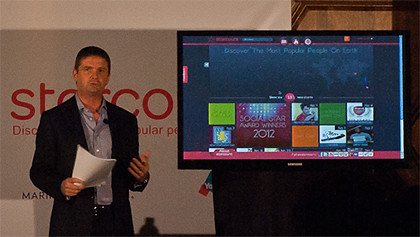
I attended the launch of the latest social aggregation website on the scene last night. It’s a website with leaderboards of the most prominent celebrities being followed in the social space.

Drew Thomson, Chief Executive Officer, All The Worlds Entertainment, bringing guests through the starcount website.

Drew Thomson, Chief Executive Officer, All The Worlds Entertainment, bringing guests through the starcount website.

Who is the most popular artiste in the world today?

No prizes for guessing that it’s Lady Gaga, who happened to be performing live in Singapore at that time – almost directly above the venue for the launch of starcount at Pangaea in Marina Bay Sands.

But which is the most popular football (as in soccer) club in the world?

There were equally riotous calls for Manchester United and Barcelona among the guests at the launch event.

Well, starcount says it’s Barcelona FC.

The starcount website is all about popularity.

It crawls the top 11 social networks on the Internet everyday to mine what 1.5million people are saying and sharing about celebrities or things (from sports clubs to musical instruments).

Based on the amount of buzz in the social space, each celeb is allocated a starcount score which is used in ranking them in all manners of leaderboards that users of the website can view.

Based and nurtured in Singapore, www.starcount.com looks set to tap and unlock the trove of opinions and sentiments swirling within the top 11 social networks on the Internet.

There are preset leaderboards in the usual categories (such as best films, most popular singers) for users to browse, or they can create their own charts (such as who serves the best macaroons in Tanzania).

(more…)

Happy Mother’s Day 2012

Sunday, May 13th, 2012

Here’s to all mothers. Happy Mother’s Day! And here’s a little bit of history that’s surely a testimony to Mothers and the womenfolk amidst us.

Happy Mother's Day!

Happy Mother's Day!

This photo of a rose was taken in a little German town called Weinsberg in the southern state of Baden-Württemberg.

Statue commemorating the bravery and loyalty of Weinsberg's womenfolk.

Statue commemorating the bravery and loyalty of Weinsberg's womenfolk.

Weinsberg means “wine” in German and this quaint and sleepy little town, which is noted for its wine, has only 11,800 inhabitants.

The family had detoured there to visit its castle ruins during our drive last year from Heilbronn to another scenic town called Schwäbisch Hall.

While we were having a picnic at Weinsberg, an ancient couple who lived in Weinsberg came over to chat with us.

They told us a very interesting and touching bit of history about the town and its castle, which is somewhat relevant today since it’s Mother’s Day.

Between our non-existent German and their English, this was what we understood, which we later corroborated on Wikipedia.

In 1140, the castle was besieged by Konrad III. Eventually, it had to surrender.

Apparently, the women of the castle were allowed to go free and to take whatever they could carry on their backs.

Guess what they carried?

Their men! In so doing, these gallant women saved the lives of their fathers, husbands, brothers and sons, since the king adhered to his word.

These women became known as treue Weiber (“loyal women”), and the castle (today’s ruin) is called Weibertreu due to this incident.

Facebook to buy Instagram photo app for US$1 billion

Tuesday, April 10th, 2012

US$100 billion Facebook Inc has agreed to fork out US$1 billion in cash and stock to acquire the photo-sharing application for smartphones. The deal is expected to be completed this quarter.

Is Instagram worth one-hundredth of Facebook?

Is Instagram worth one-hundredth of Facebook?

Facebook is probably looking at attracting the users of mobile devices through its acquisition of Instagram – its biggest acquisition yet.

“Instagram, owned by San Francisco-based Burbn Inc, was valued at $500 million after raising about $60 million last week from investors,” Bloomberg was told.The idea is to attract the advertisers interested in reaching the mobile users.

Instagram started out as the top free photo-sharing app on Apple’s App Store with more than 30 million users.

Only last week, the company introduced the app for Android devices as well.

Instagram has only 13 employees so the offer works out to some US$76 million per employee, according to the Los Angeles Times.

“We need to be mindful about keeping and building on Instagram’s strengths and features rather than just trying to integrate everything into Facebook. That’s why we’re committed to building and growing Instagram independently,” – Zuckerberg wrote on his Facebook fanpage.Instagram was launched in October 2010 by Kevin Systrom and Mike Krieger with a seed funding of about US$500,000.

It subsequently raised US$7 million in 2011, when it had 1.75 million users, according to Bloomberg.

California-based Facebook is the biggest social-networking service today and intends to raise US$5 billion in its initial public offering (IPO) – which is to date the biggest IPO for an Internet company, valuing it at US$100 billion.

Facebook’s CEO, Mark Zuckerberg, said it plans to let Instagram retain its independence, in an effort to reassure Instagram users and potential advertisers.

I tried out Zinio on the BlackBerry PlayBook

Sunday, March 25th, 2012

The free Zinio app was released on BlackBerry App World on Tuesday, 20 March. I’ve tried it out for the past few days to read the two free magazines that came with the “magazine stand” app.

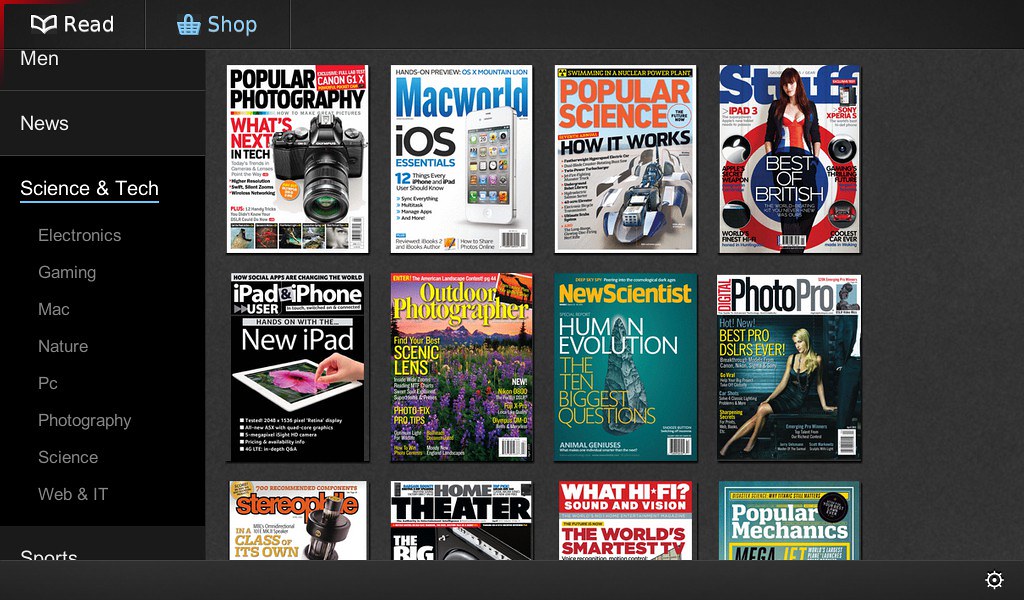
Zinio stocks over 5,000 titles in more than 30 languages.

Zinio stocks over 5,000 titles in more than 30 languages.

Installation was easy and fuss-free. Fire up App World on the PlayBook, search for Zinio, click the Download button.

The 1.8 MB app is downloaded and installed in a jiffy (depending on your bandwidth) and you’re set to go.

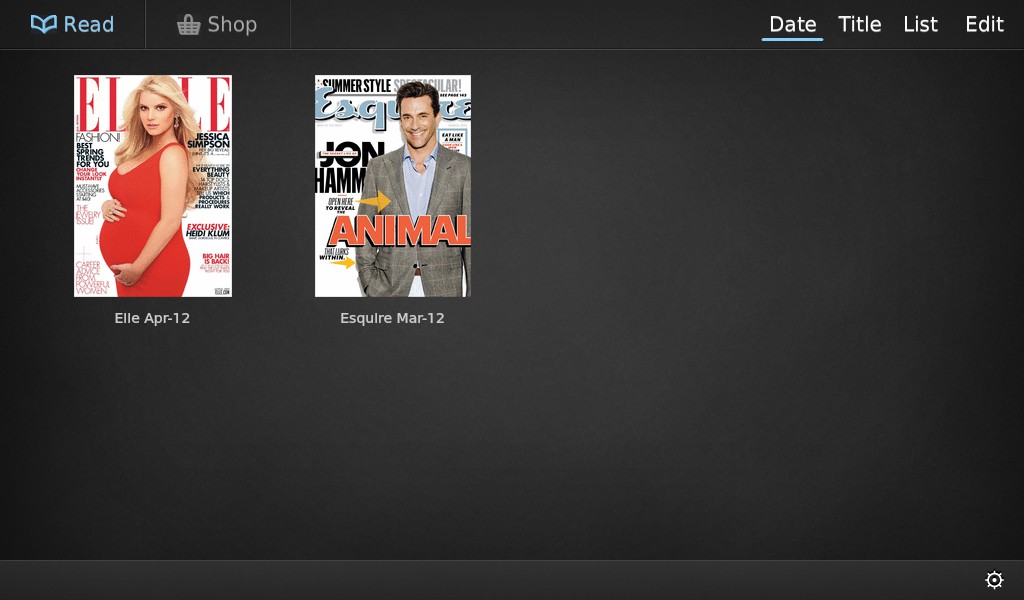
Zinio starts you off with two free magazines when you first install the app.

Zinio starts you off with two free magazines when you first install the app.

Starting up Zinio, you’re prompted to sign in if you have an existing account with Zinio (which is also available through a browser and via apps for iOS and Android tablets), or sign up for a new account.

All you need to sign up is an email and a password. Once logged in, you remain logged in on the PlayBook until you log out.

Once in, you get to the library with two free magazines for installing the app. At this point, you get the March 12 issue of Esquire and April 12 issue of Elle.

Click on the thumbnail to download the magazine. Once downloaded, you can read the magazine even when offline.

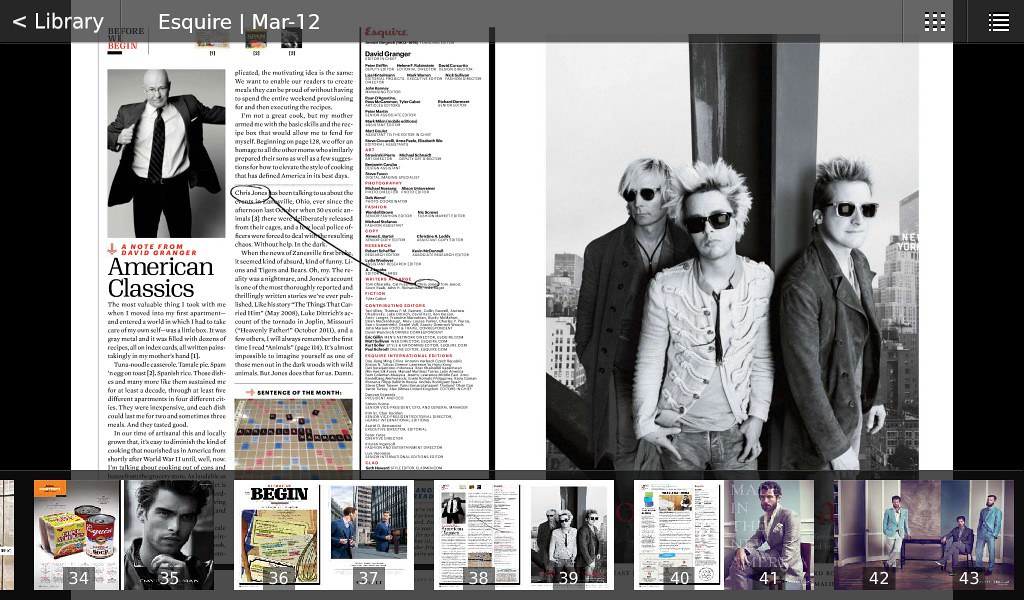
View two pages at a time in landscape mode, with navigation interface when you tap on the screen.

View two pages at a time in landscape mode, with navigation interface when you tap on the screen.

The user interface is simple and intuitive. In portrait mode, you view one page at a time. In landscape mode, you view two pages on the screen.

Pinch to zoom out and spread the fingers to zoom in.

View one page at a time when in portrait mode.

View one page at a time when in portrait mode. Shown with navigation thumbnails below and options above.

Double-tap to zoom-in quickly and single tap to display options, such as a row of scrollable thumbnail pages at the bottom for quick navigation.

Navigation was easy and smooth and the app has been stable in the few days that I’ve played with it.

Want more magazines? Hit the online shop. The categories are listed to the left, and the magazine covers in the category listed to the right.

Selecting a magazine will bring you to the details page where you can choose to purchase either a single issue or subscribe for a number of issues.

After that, it’s the typical payment transactions, with entry and verification of credit card details.

Zinio has more than 5,000 titles (magazines and newspapers) in more than 30 languages from around the world.

Publications purchased or subscribed to can be perused on any compatible device as long as the user is logged in with the account used to make the purchase, and a version of the magazine compatible for the OS is available on Zinio.

Remembering the earthquake-tsunami-nuclear disasters in Japan

Monday, March 12th, 2012

It’s hard to imagine one year has passed since the triple disasters struck in north eastern Japan on 11 March 2011.

I can still remember vividly the terrifying footage of the earthquakes that started it all; the gruesome images of the tsunami rolling in and cars in its path being swept aside; and the subsequent alarm arising from the melt-down at the nuclear plant in Fukushima.

Amidst news updates of the repeatedly futile attempts to bring the melt-down under control and to stem the release of radioactive materials into the atmosphere, the greatest consolation was the quick and generous response of other countries to offer aid for the disaster victims – as well as the steadfast and stoic resilience shown by the victims themselves.

Photo tribute to the victims of the disasters and the volunteers.

Photo tribute to the victims of the disasters and the volunteers.

Although saddened by the tragedy like many others, I put together a compilation – at that time – of some photos that I’d taken over the years in Japan.

“Photos that bring to mind some pleasant memories of a beautiful country with a wonderful culture, and most importantly the hospitable and kind people that I’ve had the privilege of encountering in Japan.

In the mass of depressing scenes depicting the horrors of the disasters, hopefully these photos will help remind us of the beautiful Japan.” March 27, 2011.

I’d hoped that the images would slightly ameliorate the depression caused by the horrors of the disasters.

It seems apt that one year after that fateful night, we should take pause from our hectic lives to remember the victims of the triple disaster, who had perished or who are still suffering from the aftermath.

May the passage of time heal the terrible wounds and losses that nature has so terribly dealt them.

Below is the photo remembrance that I compiled last year – my own little contribution – terribly insignificant compared to those who had risked life and limb physically helping out at the scene of the disasters.

May we also remember these selfless workers and volunteers who truly displayed the greatness of the human spirit.

(more…)