Posts Tagged ‘storage’

Delete does not mean deleted

Tuesday, November 1st, 2011

More than 300GB of potentially sensitive data was discovered on five second hand storage devices that were advertised as having been wiped of previously stored information.

“Our findings underline that data erasure is critical before any hardware devices are disposed of – personal computers, servers, hard disk drives, USBs and even MP3 players,” said CK Lee, country manager, Kroll Ontrack Singapore.Kroll Ontrack – a leading provider of data recovery and information management products and services, is warning companies to be extra vigilant when disposing of computer equipment in light of recent tests carried out in its labs

It recently conducted a little experiment in Singapore. Specialists from the company purchased five storage devices from a popular international online auction site to see if there was any sensitive data that could be recovered from the supposedly “wiped” devices.

The specialists found more than 300GB of data including personal and corporate proprietary information including Microsoft Office documents, applications, databases, e-mails and photos.

“Simply pressing the ‘delete’ button or using other basic overwriting techniques only removes the pathways to the data and not the data itself and it is essential to remember this when preparing equipment for sale or disposal,” Lee added.The five devices were from different parts of Singapore and included two hard disk drives from a server in RAID configuration, a server, a desktop HDD (Hard Disk Drive) and a laptop HDD.

Recoverable data poses risk of security breaches if it falls into the wrong hands. It is crucial for individuals and businesses to ensure that data is destroyed before disposal. Without the correct data erasure procedures, proprietary information becomes vulnerable.

Kroll Ontrack provides several options for data erasure such as Ontrack Eraser Software and Ontrack Eraser Degausser. Both solutions set out to destroy data in a fast, secure and user-friendly way.

Setting up a home shared network hard drive

Sunday, September 25th, 2011

Over time, as we get new computers and leave the old still-functional computer as a second or third machine, and we still utilise the different machines, the files we create and work on can get distributed amidst the hard disk drives of the various computers.

A shared network hard drive can bring order back to an increasingly chaotic situation.

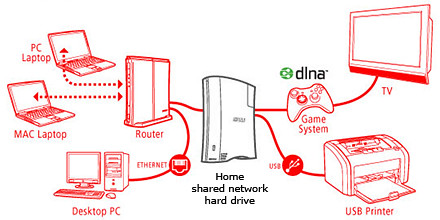
A network attached external hard drive can share files and media amongst computers and media players in the home

A network attached external hard drive can share files and media (illustration modified from www.buffalotech.com)

The above scenario was what happened to some of my friends and me. Computers and laptops today can last for a long time (if you look after them well) and most often then not, they’re still perfectly functionable when we get a new machine so it seems quite a waste to get rid of the old machine, especially since it can serve as a back up.

And if a member of the family is on the new laptop, others can use the spare computer. So over time, working files, photos, music and video can get distributed over a few computers. At first, it’s easy to remember and keep track of which file is in which computer and do the occasional transfer using an USB thumbdrive.

But over time, as the number of files grow, things can get out of hand – the convenience of being able to work on a few computers turns into a bane.

Now that cloud computing is catching on and we can save files and media on the Internet, this mess can be ameliorated. But those personal and confidential files and humongous video files are still best kept in local storage.

The NAS solution

Schematic of an NAS solution

Schematic of an NAS solution

So over the weekend, I helped my friend rig a similar solution that I use at home – set up a simple external hard drive that can be shared and accessed by a few different computers at home over a local Wi-Fi network.

Those files that are stored on the network attached storage (NAS) drive can then remain accessible no matter which computer you’re working on. It can be used to back up the computers connected.

Some NAS drives allow you to stream media to TVs, media players and game consoles connected to the home network.

In fact, some even enable access to be opened out to the Internet, so that when you’re outstation – in the office, on the road, or overseas – you can still securely access the files stored in the hard drive. This can be done via a browser on a laptop connected to the Internet, or via an app on a smartphone or tablet.

It’s like setting up your personal cloud storage. There are many consumer NAS drives in the market from makers such as Seagate, Western Digital and Buffalo.

They’re all designed to be easily set up by the layman who does not have a PhD in computer science. These NAS drives are connected directly to the router rather than a specific computer acting as a file server.

Any computer connected to the network via the router can access the NAS drive at any time.

Because these NAS drives are more intelligent than the regular dumb external hard drive, they do cost a slight premium over the latter. The NAS drives can manage network access by computers on the network and implement security, access and rights control as well.

Seagate GoFlex Home comes in capacities of 1TB, 2TB and 3TB

Seagate GoFlex Home comes in capacities of 1TB, 2TB and 3TB

Since I’m familiar with the Seagate GoFlex Home, that was what I recommended my friend, who brought home a 3 TB version from the recent COMEX 2011 for S$299.

Tomorrow we’ll see how he managed to tame his growing diaspora of media and files.

CA ARCserve r16 unifies data protection for enterprise IT

Thursday, September 8th, 2011

CA Technologies today announced CA ARCserve r16, a comprehensive hybrid data protection solution that enables customers and service providers to rigorously safeguard the availability of critical data, applications and services across their increasingly diverse mix of virtual, conventional, and cloud resources.

CA Technologies is an IT management software and solutions company.The comprehensive solution and simplified licensing enable customers to reduce costs and better mitigate risk.

The CA ARCserve r16 unifies data protection across virtual, conventional and cloud resources to ease management of diverse IT Infrastructures.

CA ARCserve r16 delivers this high-value capability with:

  • A modular architecture that unifies diverse data management functions and facilitates integration with third-party management tools and services
  • A simplified single license based on total amount of data being protected
  • Standby replication of virtual machine images
  • A new cloud connection layer that eases management of access to multiple public and private cloud storage resources

It unifies data management functions through a scalable, modular architecture that also facilitates integration with third-party software such as remote monitoring tools, “Today’s IT organizations are spending inordinate time and money to protect critical services—often relying on a mix of ‘point’ backup solutions for conventional servers, virtual infrastructure and cloud resources that leave them exposed to the risk of a highly damaging outage,” James Forbes-May, Vice President of Data Management, APAC at CA Technologies.management platforms, and solutions from service providers, like Amazon Web Services, Microsoft, N-able and LabTech.

CA ARCserve r16 further simplifies management of heterogeneous IT environments by allowing customers to purchase multiple data protection functionalities with a single license based on the total amount of data they need to protect.

This licensing model also makes it easy for service providers to price and package complete data protection and management solutions to their customers. CA ARCserve r16 is also available through traditional licensing models.

Comprehensive Protection for Virtualized Infrastructure

A new offering, CA ARCserve r16 Central Host-Based VM Backup, empowers organizations to protect their virtual infrastructure with image-based host-level protection for VMware vSphere, “Downtime is not an option in today’s highly competitive world, where businesses must be more agile than ever despite finite resources,” said Eric Rockwell, president of centrexIT, a San Diego-based provider of technology management services. “We’re migrating our customers from Symantec to CA ARCserve for a variety of reasons—including its overhead-slashing infinite incrementals functionality, its ready-to-go virtualization support, its reliability and its unbeatable replication capabilities.”as well as full system replication and high availability supporting Microsoft Hyper-V, VMware vSphere and Citrix XenServer.

By providing both full bare-metal recovery and full system failover of complete VMs, it enables organizations to meet their increasingly stringent restore SLAs. Recovery of individual applications and granular recovery of targeted files and folders can be accomplished within minutes.

With the new CA ARCserve r16 Central Virtual Standby, customers can schedule the automatic conversion of image-based recovery points to VMware Virtual Disk or Microsoft Virtual Hard Disk formats. By making these backup images available as standby virtual machines, customers can further speed the recovery of data and services.

Powerful Support for the Cloud

CA ARCserve r16 introduces a common cloud connection layer across all data protection components— including traditional file backup, disk imaging, replication and high availability. “The banks that rely on our data protection services are subject to strict regulatory scrutiny,” said Terry Oehring, founder and CEO of Solis Security, an MSP specializing in providing information security for financial institutions. “By leveraging CA ARCserve, we can reliably and cost-effectively enable our customers to meet this key challenge by accurately targeting the data that they need to protect and securely replicating it offsite in the cloud.”This provides integrated access to hybrid cloud storage, enabling customers to more readily take advantage of public and private cloud services such as Amazon Web Services, Microsoft Windows Azure and Eucalyptus, for purposes such as remote, off-site data protection, archiving and failover.

CA ARCserve r16 also allows customers to use Amazon Elastic Compute Cloud (EC2) as their disaster recovery infrastructure helping to ensuring they can be up and running quickly in the event of a problem with their on-premises infrastructure. This cold standby technology can eliminate the significant costs associated with the purchase of redundant hardware and cloud computing charges as part of a business continuity plan.

CA ARCserve r16 also enables service providers and their customers to protect systems and data both locally (for fast, simple end-user or administrator recovery), and in the cloud (to protect critical data files offsite for disaster recovery).

Additional Enhancements across Entire Solution Set

“Since implementing CA ARCserve as the primary disaster recovery solution to help ensure the availability of key business systems in our highly virtualized environment, we’ve reduced our recovery time from more than three days to less than four hours,” said Prashanth Thirumlai, IT infrastructure manager at The Haskell Company, a $500 million integrated design-build firm based in Jacksonville, Florida. All major components of CA ARCserve r16—including ARCserve Backup, ARCserve D2D and ARCserve Replication and High Availability—have been updated with significant enhancements, including new AES encryption to secure data in transfer and at rest, as well as tighter integration between traditional and image-based backup.

In addition, CA ARCserve continues to offer integrated backup to disk, tape or cloud, storage resource management, infrastructure visualization and data deduplication.
Company byte: Seagate Technology

Thursday, July 14th, 2011

NASDAQ-listed Seagate Technology (STX) is one of the world’s largest manufacturers of hard disk drives. It is currently incorporated in Dublin, Ireland but its principal executive offices are located in Scotts Valley, California in the United States.

Seagate is a worldwide leader in hard disk drives and storage solutions.Seagate was originally incorporated in 1978 as Shugart Technology. It is a worldwide leader in the design, manufacturing and marketing of hard disk drives and storage solutions.

In fiscal 2011, the company had a revenue of $11 billion, net income of $0.5 billion and shipped 199 million units (approximate data from Seagate’s website).

Follow articles related to Seagate on tech4tea.com.

Company byte: Kroll Ontrack

Wednesday, July 13th, 2011

Kroll Ontrack provides technology-driven services and software to help legal, corporate and government entities as well as consumers manage, recover, search, analyze, produce and present data efficiently and cost-effectively.

“Kroll Ontrack has become a leading provider of legal technologies, with operations in North America, Europe, and Asia Pacific. It has patented technologies and capabilities in recovering seemingly deleted files, including internet-based information cleared from the cache.” – WikipediaIn addition to its suite of software, Kroll Ontrack provides data recovery, data destruction, paper and electronic discovery, document review, computer forensics and ESI consulting.

Kroll Ontrack is the technology services division of Kroll Inc., the global risk consulting company. Kroll is a subsidiary of Altegrity, an industry-leading provider of information solutions.

Companies or individuals can contact Kroll Ontrack for free consultation on the best way to erase data from all types of media. Those in Singapore can call (+65) 6296 5131 or visit their website here. Kroll Ontrack provides several options for data erasure such as Ontrack Eraser Software and Ontrack Eraser Degausser. Both solutions set out to data in a fast, secure and user-friendly way.