Posts Tagged ‘Microsoft’

Windows 8 previews by Microsoft

Friday, June 3rd, 2011

Windows President in Microsoft, Steven Sinofsky, previewed the next version of the Windows operating system that will likely premier in March 2012.

The radically revamped OS works on tablets with touch screens; runs on desktop and laptop computers with touchscreen, mouse or keyboards; runs existing Windows software and runs on both Intel and ARM chips.

Windows 8 is set to challenge the dominance of Apple’s iPad iOS and Google’s Android.

Sinofsky gave a preview of Windows 8 on a 10.6-inch touch-screen tablet during the AllThingsD’s D9 Conference in Rancho Palos Verdes, California.

A 30-minute demonstration was subsequently given at the Computex 2011 in Taiwan by Mike Angiulo, Microsoft corporate vice president.

In appearance, it resembles Windows Phone 7 – Microsoft’s operating system for smartphones – using “tiles” instead of icons to represent applications. The tiles on the computer’s start screen can be automatically updated to display the latest information from applications. For instance, a stock ticker app could display stock quotes right on the tile without requiring users to open the app.

Windows 8 will be the first full version of Windows capable of operating on ARM chips which has been the sole supplier of tablet CPUs since Apple launched its iPad in 2010.

Citing Jefferies Group, Bloomberg reports that the number of tablets sold globally will almost quadruple this year to 70 million units from 18 million in 2010. This will more than double to 158 million in 2012. Apple, which will control some 64 percent of the 2011 tablet market, will see its market share fall to 41 percent in 2012.

Computex Taipei 2011 draws tablet watchers and stake holders

Monday, May 30th, 2011

The 5-day annual trade show in Taipei will see more tablet models based on Google’s Android and a preview of Microsoft’s next Windows platform for tablets – one year after Apple’s game changing iPads grab the lion’s share of the tablet market.

COMPUTEX Taipei, or Taipei International Information Technology Show (台北國際電腦展), will be held from May 31 to June 4, 2011 in Taipei. Taiwan based Acer and Asustek had first showed off their low-cost but trend-setting netbooks at the Computex in 2007 and 2008.

Investors and analysts will be watching to see if new Android based tablets can challenge Apple’s iPad. Non-iPad tablet competitors are expected to halve Apple’s 100 percent dominance of the tablet market to 50 percent next year, iSuppli predicted on April 21. The iPad had cordoned off the entire tablet market when it was first launched in June last year because of the absence of competitors.

Computex Taipei 2011 from May 31 to June 4, 2011

Computex Taipei 2011 from May 31 to June 4, 2011.

Both Google and Microsoft will send executives to the event to brief the media on their plans. Intel, the world’s largest chipmaker, and ARM, whose chip designs are licensed by Qualcomm and Nvidia to power tablets, will also be vying for tablet manufacturers to select their chips.

Global shipments of tablets will increase almost twelve times to 215 million units in 2015 from 17 million last year, Toni Sacconaghi, a New York-based analyst at Sanford C. Bernstein & Co., wrote in a May 26 report.

Computer sales growth will be reduced by 2 percent annually between 2010 and 2015, Sacconaghi wrote, because fifteen percent of all tablets will cannibalize the sale of consumer PCs.

Bloomberg reports that Microsoft will “preview its operating system designed for tablets this week, using hardware with ARM-based chips”. The current Windows 7 operating system from Microsoft is not compatible with the ARM chips used in tablets from manufacturers such as Samsung and Motorola.

IBM overtakes Microsoft in market capitalisation

Tuesday, May 24th, 2011

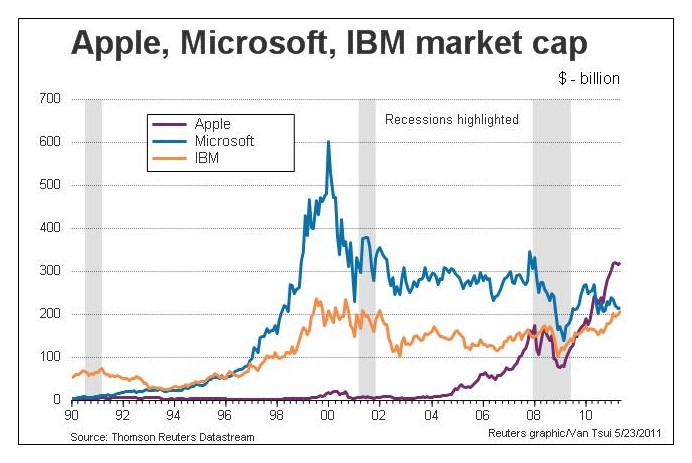
For the first time in 15 years, since 1996, IBM has overtaken Microsoft in market value. It is now the second largest US tech company behind Apple, while Microsoft has dropped to third.

Only a year after Apple had surged past Microsoft in market value, IBM has also powered past Microsoft.

Market capitalisation of Apple, IBM and Microsoft over the past 20 years

Market capitalisation of Apple, IBM and Microsoft over the past 20 years

IBM had been the dominant company in the computer industry for decades until it selected Microsoft to supply the operating system for its personal computers in the eary 80s. Bill Gates managed to turn that opportunity into a dominance of the operating systems market.

Rank Company Market cap 

(billion)

1 Exxon Mobil $397.4
2 Apple $309.2
3 General Electric $205.6
4 IBM $203.8
5 Microsoft $203.7

At its zenith just before the turn of the millennium, Microsoft’s market capitalisation was three times that of IBM’s. It was also the biggest US company then. Now it is the third biggest technology company and fifth biggest US company.

Microsoft is facing challenges in many of its business sectors. Its dominance of the operating systems market, is being challenged by the advent of tablets and Google’s newly introduced Chrome OS, while it has lost its market share in the smartphone market to RIM’s BlackBerry devices, Apple’s iPhones and recently Android based phones.

Microsoft’s decline since 2000 coincides with the burst of the Internet technology bubble and the tenure of Bill Gates’ successor Steve Ballmer as the CEO.

IBM, on the other hand, has reinvented itself from being a predominantly hardware manufacturer into a specialist in enterprise software, servers and consulting. It has even offloaded its PC business to Lenovo in 2002.

Bill Rigby of Reuters observes that “an investor putting $100,000 into both stocks 10 years ago would now have about $143,000 in IBM stock and about $69,000 in Microsoft stock.”

Google to unveil Chromebooks

Tuesday, May 10th, 2011

Google will reveal its first Chrome-based notebooks from Acer and Samsung at the Google I/O conference in San Francisco. They will be available for order online from June 15.

The Samsung Chromebook will cost $429 for the Wi-Fi only version and $499 for the 3G version, while Acer’s Wi-Fi only Chromebook will cost $349.

It’ll be interesting whether consumers will bite, considering that you can buy a decent Netbook or an iPad the $499 price-tag for the 3G Samsung Chromebook.

Acer Chromebook, available from June 15, 2011

Acer Chromebook

Chromebooks will be available online June 15 in the U.S., U.K., France, Germany, Netherlands, Italy and Spain. More countries will follow in the coming months. In the U.S., Chromebooks will be available from Amazon and Best Buy and internationally from leading retailers.

Equipped with dual-core processors from Intel, the Chromebooks boast all-day battery life, and instant-on ability and built-in Net connectivity. Chromebooks will get updates and patches automatically every few weeks, like its browser cousin Chrome.

A special pricing is available for schools – Google will charge $20 a month for each Chromebook. The price will include hardware, administrative support, hardware upgrades, and warranty.

With this long awaited foray, Chromebooks will be taking on the tablet market dominated by Apple’s iPads, and the PC market dominated by both Microsoft and Apple.

Samsung Chromebook, available from June 15, 2011

Samsung Chromebook

The Chromebooks will run a new new bare-bones operating system that is basically a web browser that allows users to access applications like email, wordprocessors and spreadsheets directly on the web, instead of installing software such as Outlook or Office directly on the computer’s harddisks.

Users can also store their music and documents in the cloud for access from other computers as long as there is an Internet connection. Naturally, that means that a lot of the functionality may likely be unavailable or crippled offline.

Google has been touting Chrome as an alternative to Microsoft Windows for some two years now, but it has encountered delays producing computers designed to use the software.

Good Microsoft results beat estimates

Friday, January 28th, 2011

Microsoft reported profit that beat estimates because of strong corporate demand and sales of its Xbox Kinect motion sensors, despite a below-expectation sales of Windows for PCs and unremarkable premiere of Windows 7 for mobile phones.

Second quarter net income of $6.63 billion, or 77 cents per share, compared with 74 cents per share last year and estimates of 68 cents per share prior to the announcements of results at 5:30 pm New York time on 27 Jan.

Microsoft CorporationSales rose 4.9 % to $20 billion, beating projections of $19.1 billion, based on data compiled by Bloomberg.
Corporate customers are installing new Office software and buying more server programs, off-setting lower-than-expected PC sales to consumers.

PC shipments in the quarter rose 2.7 percent, below the 5.5 percent projected by researcher IDC in Framingham, Massachusetts, as consumers held off purchases and some opted for Apple Inc.’s iPad tablet computer instead, reported Bloomberg.

The Xbox Kinect motion sensors sold 8 million units – more than twice the 3 million units originally forecasted by the company. The Kinect was launched in November, at prices that ranged from $150 for the product alone to $400 when bundled with the high-end Xbox console.

This is in contrast with the shipment of 2 million licenses for the newly launched Windows 7 for mobile phones. Though within expectations, analysts like  Kevin Burden at ABI Research felt it was disappointing.

Overall, good results for Microsoft, with room for improvement for the sales of Windows 7 licenses, and consumer PC sales in the face of competition from the iPad and the slate of tablets from other manufacturers.

Google’s 4th quarter earnings (Ended 31 Dec 2010)

Friday, January 21st, 2011

Google reported a net income of US$2.54 billion (or US$7.81 per share) in the quarter ended 31 Dec. This is an increase of 29% from US$1.97 billion (or US$6.13 per share) in the quarter a year earlier.

Google IncProfit excluding some items was US$8.75 a share, exceeding the US$8.08 average of estimates compiled by Bloomberg, and exceeding the US$6.79 a share from the quarter a year earlier.

Sales of US$6.37 billion (excluding commissions paid to advertising partners) surpassed the US$6.06 billion average of estimates. This is up from US$4.95 billion from the preceding year.

According to ComScore, Android beat Apple’s iPhone in US smartphone subscribers for the first time in November, accounting for 26% of the market, compared with 25% for Apple. BlackBerry maker Research In Motion continued to lead with 33.5%.

In the search-engine business, Google continues to lead. In December, Google accounted for 66.6% of searches in the US (up from 66.2% in November) compared to a share of 28% (down from 28.2%)  from Microsoft and Yahoo combined. Yahoo began using Microsoft’s Bing technology for its online search in August.

Was it the iPad that propelled Apple past Microsoft?

Friday, May 28th, 2010

Curious as to how Apple has upstaged Microsoft in terms of market capitalisation, I plotted the market capitalisation of Apple against Microsoft between 1 June 2009 to 26 May 2010 (at monthly intervals except for the final data point).

Chart of Apple vs Microsoft in terms of market capitalisation

Was it the iPad that helped Apple overtake Microsoft?

Seems like the gap between Microsoft and Apple remained rather constant at  roughly US$60-80 billion until the announcement of the iPad by Steve Jobs on 27 Jan 2010 to a packed audience in the Yerba Buena Center for the Arts in San Francisco.

There was no looking back afterwards as the iPad was launched in April and sold its first million unit on May 3 after merely 28 days. This was less than half the 74 days it took the hugely successful iPhone to sell its first million units.

The gap between Microsoft and Apple closed rapidly until this week, when Apple finally overtook Microsoft in terms of market capitalisation.

At the rate it’s going, it won’t be long before Apple overtakes Exxon Mobil as the most valuable company in the US.

Apple the most valuable technology company in the world

Thursday, May 27th, 2010

It’s happened!

Apple has overtaken Microsoft in market capitalisation and has become the most valuable technology firm in the world.

Bloomberg reports that:

Apple’s market value reached $222.1 billion, surpassing Microsoft’s $219.2 billion at 4 p.m. New York time (26 May) in Nasdaq Stock Market trading.

Apple is now the most valuable technology firm in the world. By market value, it is the second-largest US company, behind Exxon Mobil Corporation, the oil company valued at US$278.6 billion on the New York Stock Exchange. During intraday trading, Apple’s price reached a high of US$252.13 billion.

iPod Classic, iPhone, iPad

From iPod (2001) to iPhone (2007) to iPad (2010)

Apple was on the brink of bankruptcy when Jobs returned at its helm in 1997. The release of the iPod music player in 2001 turned the company around, while the advent of the iPhone in 2007 has brought Apple to the pole position it is enjoying now. The question now is whether the launch of the iPad will bring Apple to new heights, or – if by any chance it flops – will it burst the market euphoria surrounding Apple’s stocks.

Hitherto, the iPad seems like another success story for Apple, but I believe it’s still too early to tell. It could still go the way of the tablet computers not too long ago – into oblivion – and join a rare list of Apple failures like the Newton. Or it could create a genuine and viable niche between the smartphone and the netbook, and let Steve Jobs overtake Bill Gates in Forbes’ list.

Clash of the Titans

Thursday, May 20th, 2010

We’ve been reading so much about the intense competition between the behemoths in the IT industry. Apple vs Adobe over Flash on iPhone/iPad. Apple vs Gizmodo over lost 4G iPhone. Apple vs Google over mobile search and smartphone OS. Apple vs Google vs Microsoft over everything.

How big are these companies relative to each other? I checked out the Market Capitalisation (share value x number of shares) of these companies on the Nasdaq from Yahoo Finance and put them on a chart for comparison. As at end of 19 May 2010:

Bar chart of the market capitalisation of Adobe, Apple, Microsoft and Google

Market Capitalisation of the IT behemoths

Everybody knows Microsoft (US$247.1b) is the biggest IT company in the world, while Steve Jobs would love to think of Apple as a small and nimble outfit. In reality, Apple (US$226b) is fast catching up on Microsoft in terms of market cap. No wonder its new found confidence has found expression in so many arenas. Adobe (US$17.31b) is not even one-tenth of Apple. Maybe Apple should just buy over Adobe. I haven’t even bothered to check how much Gizmodo is worth.

By the way, Google (US$157.5b) is still some way off compared to Microsoft and Apple.

Search engine rankings in 2010

Wednesday, May 19th, 2010

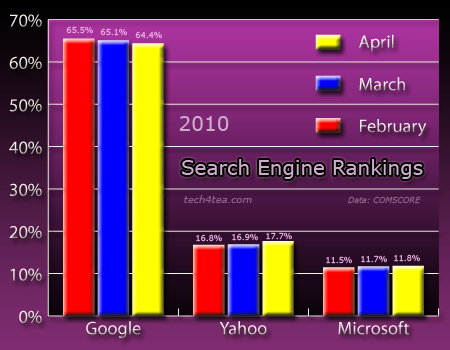
What are the market shares for the three main search engine giants on the internet for the 3 months from February to April of 2010? Here are some data from COMSCORE:

Chart of the market shares of the three top search engine from Feruary to April 2010

Search engine rankings from February to April 2010

Google continues to enjoy the lion’s share of the search market at around 65% for each of the three months from February to April 2010. Yahoo comes in second with about 17% while Microsoft’s Bing brings up the rear at 12% (percentages averaged and rounded).