Posts Tagged ‘Internet’

Social media coverage during SMRT disruptions

Monday, January 9th, 2012

During the three major SMRT disruptions in December 2011, Singaporeans flocked to online sites to share updates, find news and exchange views.

Experian Hitwise has released data about Singapore Internet users during that period.

Top search terms containing SMRT (Comparison between 24 rolling weeks ending 10 December and 24 December)

Top search terms containing SMRT (Comparison between 24 rolling weeks ending 10 December and 24 December)

Experian Hitwise found that top search variations used by Singaporeans include SMRT breakdown, SMRT twitter, SMRT CEO, SMRT CEO Saw Phaik Hwa, SMRT news, SMRT Facebook and SMRT disruption.

Variations for the word “SMRT” on all search engines in Singapore saw an increase of 38% in related search clicks on week ending 24 December, the week after the disruption of train services.

“SMRT” remained the key search term used by Singaporeans within the two weeks. Fast moving event-related search terms from the two periods include specific person searches, SMRT CEO and SMRT CEO Saw Phaik Hwa.

Websites receiving traffic from SMRT CEO related terms over 24 rolling weeks ending 24 December.

Websites receiving traffic from SMRT CEO related terms over 24 rolling weeks ending 24 December.

Ex-SMRT CEO, Saw Phaik Hwa, was widely discussed during the crisis.

Search terms around her name generated high online traffic in several social media websites and community forums including Facebook (17.98%) and Singapore HardwareZone Community (10.11%).

Top websites receiving traffic from terms in SMRT Disruption Period (Comparison between 24 rolling weeks ending 10 December and 24 December).

Top websites receiving traffic from terms in SMRT Disruption Period (Comparison between 24 rolling weeks ending 10 December and 24 December).

SMRT’s corporate site remained the top website receiving traffic from the search terms during and after the incident despite a 20% decline of search clicks share over the course.

However, traffic on social media and news websites increased the most over the course.

Akamai to acquire Cotendo

Tuesday, December 27th, 2011

Expected to happen in the first half of 2012, the combined technology and teams from the merger is expected to help accelerate pace of innovation in cloud and mobile optimisation.

Akamai has announced that it has signed an agreement to acquire Cotendo, a company that offers an integrated suite of Web and mobile acceleration services.

“By combining our innovative technology and employees with Akamai, we expect our customers and partners will gain access to a comprehensive, global platform and wider portfolio of leading-edge services supported by some of the most experienced providers in the industry,” said Ronni Zehavi, CEO and co-founder of Cotendo.Helping to mitigate the challenges of operating in a hyperconnected world, Akamai provides a secure platform over which businesses can engage users across the Web, mobile, cloud, or a mix of public and private network environments.

Cotendo, on the other hand, offers an integrated suite of Web and mobile acceleration services.

Founded in 2008, Cotendo is headquartered in Sunnyvale, CA, with a technology center in Israel. Cotendo currently has approximately 100 employees, with over 50 based in Israel.

The combination of the two companies’ technologies and teams is expected to increase the pace of innovation in the areas of cloud and mobile optimization.

Under terms of the agreement, Akamai will acquire all of the outstanding equity of Cotendo in exchange for a net cash payment of approximately $268 million, after expected purchase price adjustments, plus the assumption of outstanding unvested options to purchase Cotendo common stock.

The closing of the transaction, which is subject to customary closing conditions, including regulatory approvals, is expected to occur in the first half of 2012.

SingTel BroadBand on Mobile price plans

Tuesday, December 20th, 2011

SingTel has just launched its Prestige 75 LTE mobile broadband service.

The price plan for the BroadBand on Mobile (BBoM) Prestige 75 LTE is shown here.

SingTel Broadband on Mobile Prestige 75 LTE Price Plan
Price (including GST) $69.90/month
Data Bundle 50GB 3G data (21Mbps) + 10GB LTE data
Excess Charges $0.512/MB, Capped at $94.16/month
Download Speed Theoretical: 75Mbps
Typical range: 3.4Mbps to 12Mbps
Comes with free LTE dongle and free Wireless@SG (3Mbps)

For comparison, here are the price plans for its other BBoM packages.

3G Mobile broadband plan Theoretical speed Typical download speed range Price
Classic 3.6 3.6Mbps 0.8Mbps to 2.1Mbps $29.90
Priority 7.2 (with Priority Pass) 7.2Mbps 1.4Mbps to 3.7Mbps $40.00
Premium 21 (with Priority Pass) 21Mbps 1.7Mbps to 4.8Mbps $59.90

SingTel launches commercial LTE mobile broadband

Tuesday, December 20th, 2011

SingTel toady announced the commercial launch of the Mobile Prestige 75 (S$69.90 per mth), the first LTE service in Singapore for both consumer and business customers.

SingTel BBoM Prestige 75 will cover the CBD and more thEventually, coverage will grow to 80% of mobile data users by end 2012 and 95% by 2013.an 100 sites.

Eventually, coverage will grow to 80% of mobile data users by end 2012 and 95% by 2013.

Singapore Telecommunications Limited (SingTel) today announced the commercial launch of its 4G Long Term Evolution (LTE) BroadBand on Mobile (BBoM) service.

Fast speed

The service offers theoretical download speeds of up to 75Mbps and typical download speeds between 3.4Mbps and 12Mbps.

It provides mobile Internet access that is more than three times faster than existing 3G-based services, with only one-fifth of the network latency.

SingTel 4G LTE will enable many bandwidth-intensive applications, such as cloud storage, music/video/HDTV streaming, video conferencing, online gaming, mobile data networking, rich voice etc.

SingTel’s BBoM Prestige 75 LTE will provide performances and services approaching that of fixed line networks. For instance, it will take only 2 min 14s to stream a 3.5 min-long snippet of video from YouTube.

Coverage evolution

At launch, the service provides outdoor coverage in the central financial district and other areas that experience high data usage.

At launch, SingTel BBoM Prestige 75 will cover the CBD and more than 100 sites.

At launch, SingTel BBoM Prestige 75 will cover the CBD and more than 100 sites.

This includes Shenton Way, Orchard, City Hall, Marina Bay, River Valley, Tanglin, Newton, Novena, Kallang, Rochor, Outram, Tanjong Pagar, Jurong West, Boon Lay, Bukit Panjang, Bedok and Changi.

In-building coverage is available in major shopping malls such as Ngee Ann City, Plaza Singapura, Ang Mo Kio Hub, Tampines Mall, West Mall, Parkway Parade and Jurong IMM. Office buildings such as Republic Plaza and Temasek Tower are also covered.

The service falls back to SingTel’s 3G-based Premium 21 service when users roam outside the LTE coverage area.

USB dongle

USB dongle

Mr Yuen said that SingTel is progressively expanding its network, which is expected to be able to provide LTE coverage for 80 per cent of mobile data users by the end of 2012.

By 2013, coverage will be extended to 95 per cent.

BBoM plans

Broadband on Mobile Prestige 75 will initially be available for USB dongle modems only.

Support for LTE-enabled smartphones and tablets will only be available when these mobile devices become more readily available in the market later on in 2012.

Existing 21Mbps 3G Broadband on Mobile Premium 21 customers can upgrade to LTE with a top-up of $10 per month.

The price plans for SingTel’s various mobile broadband plans can be found here.

The State of the Internet 2Q 2011 report from Akamai

Monday, October 24th, 2011

Taiwan has beaten Myanmar and US as the top source of attack traffic on the Internet, while Asian cities maintain their dominance of having the fastest connection speeds in the world, with HK at the pinnacle.

Akamai State of the Internet report Q2 2011

This is the 4th year for the quarterly report.

Akamai has released its Q2 State of the Internet report for 2011. It is a leading provider of cloud optimisation services.

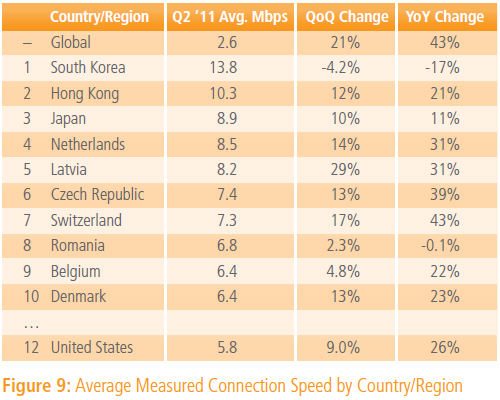
Average Connection Speed by Country/Region

Average Connection Speed by Country/Region

Based on data gathered from the Akamai Internet Platform, which carries between 15-30 percent of the world’s Web traffic, the report provides insight into key global Internet statistics such as the world’s fastest and slowest regions for connection speed, the most frequent origins of attack traffic, and the highest-performing geographies for mobile connectivity, as well as resulting trends over time.

It uses its globally distributed network of servers to gather massive amounts of information on many metrics about the Internet, such as connection speeds, attack traffic, and network connectivity/availability/latency problems, as well as traffic patterns on leading Web sites.

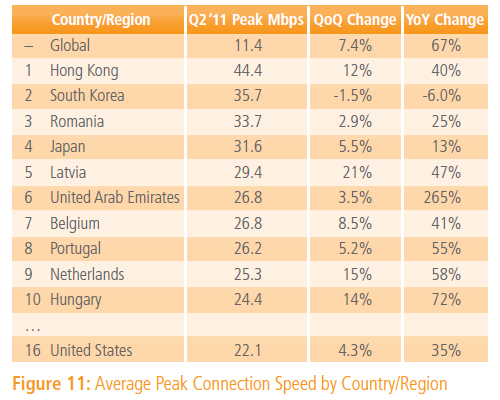
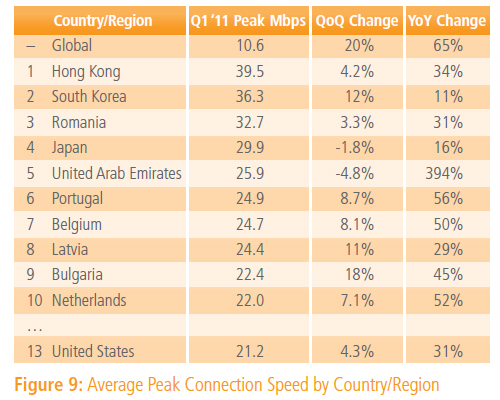
Average Peak Connection Speed by Country/Region

Average Peak Connection Speed by Country/Region

The Q2 report includes data gathered from across Akamai’s Intelligent Internet Platform during the second quarter of 2011 about attack traffic, broadband adoption, and mobile connectivity, as well as trends seen in this data over time.

In addition, this quarter’s report also includes insights into the state of IPv4 exhaustion, the impact of World IPv6 Day, the state of client-side SSL, and smartphone usage trends as observed by Akamai partner Ericsson.

The main highlights from the Q2 report paints the following picture:

Speed

  • Global average connection speed increased 43 percent year over year to 2.6 Mbps. South Korea again had the highest average connection speed at 13.8 Mbps. Singapore was ranked 29th at 4.5 Mbps.
  • Global average peak connection speed was 11.4 Mbps. Hong Kong has maintained its position as having the highest average peak connection speed at 44.4 Mbps. Singapore was 19th at 20.7 Mbps.
  • Globally, high broadband (>5 Mbps) adoption grew to 27%. At 68%, the Netherlands was the highest, pushing S Korea to third position. Hong Kong came in second, while Singapore was 20th at 33% adoption.
  • Gloobal broadband (>2 Mbps) adoption increased to 65%. Singapore was 48th at 67%.
  • Global narrowband (<256 kbps) adoption at 2.9% continued its decline. Lebanon, with its 56% narrowband adoption is the top laggard.
  • Cities in Asia again have the fastest connection speeds in the world. Out of the 100 fastest cities worldwide, 70 were from Asia, with Hong Kong, 59 cities in Japan and 10 cities in South Korea.
  • Brno, Czech is the fastest city in Europe, at number 55 out of 100.
  • 18 US cities made the top 100 list. 9th-placed San Jose’s 13.7 Mbps moved the US into the top 10 for the first time.

Security

Sources of top attack traffic

Sources of top attack traffic

Taiwan was the top source of attack traffic accounting for 10% of overall attack traffic. Myanmar and US together accounted for another 17%. Having made it debut as top attack traffic source in the last quarter, second-placed Myanmar has continued its attack activities showing its entrance into the ranks of top attack traffic sources was not a flash in the pan.

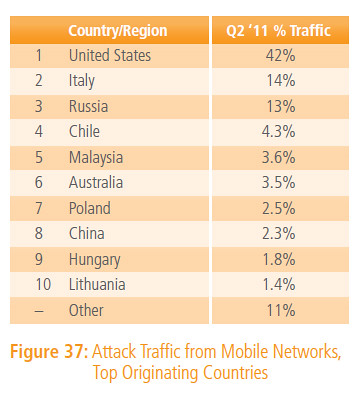
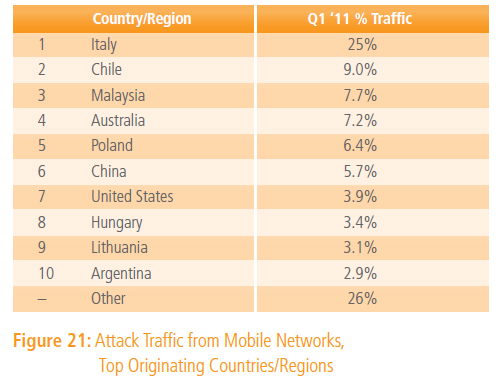
Attack traffic from mobile networks

Attack from mobile networks

With respect to attack traffic originating from mobile network providers, the US vaulted to the top of the list, generating 42% of the observed traffic. Italy has gone down to second place, after its observed attack traffic from was halved compared to the previous quarter. Russia took third place. The top three countries were responsible for almost 70% of observed attacks, while the top 10 countries accounted for nearly 90% of the observed attacks.

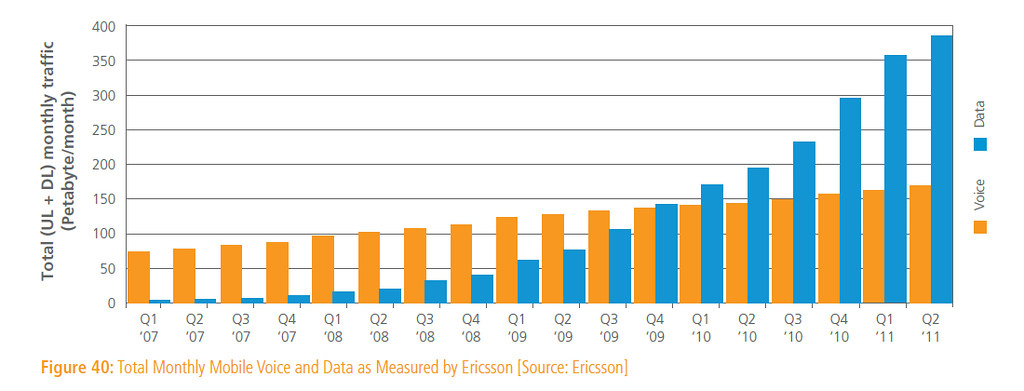
Exponential growth in mobile data traffic is outstripping linear growth of mobile voice traffic.

Exponential growth in mobile data traffic is outstripping linear growth of mobile voice traffic.

Previous SOTI reports from Akamai on tech4tea.com

1st Quarter, 2011 Report (Volume 4, Number 1)
4th Quarter, 2010 Report (Volume 3, Number 4)

Company byte: Akamai Technologies Inc

Tuesday, September 6th, 2011

Akamai (NASDAQ: AKAM) provides cloud-based services for optimizing Web and mobile content and applications, online HD video, and secure e-commerce.

Combining highly-distributed, energy-efficient computing with intelligent software, Akamai’s global platform aims to transform the cloud into a more viable place to inform, entertain, advertise, transact and collaborate.

Akamai has deployed a pervasive, highly distributed cloud optimisation platform with nearly 100,000 servers located in more than 650 cities, in 72 countries and within many of the key networks that make up the internet.

With more than 2,100 employees, annual revenue in 2010 was $1,023.6 million, up 19 percent from the previous year. Follow postings related to Akamai Technologies on tech4tea.com.

Akamai’s product portfolio includes:

Digital Asset Solutions – to manage, store and deliver exceptional digital media experiences across a wide range of platforms/devices around the world. These include Akaimai HD Network, Akamai Media Delivery and Electronic Software Delivery.

Dynamic Site Solutions – to spped up rich interactive content and accelerate all customer-driven transactions. These include Dynamic Site Accelerator and Dynamic Site Accelerator Enterprise.

Application Performance Solutions – enables the public Internet to be the platform for accelerating any critical enterprise application to anyone, anytime, anywhere. Akamai is the leading global service provider for accelerating content and business processes online.These include Web Application Accelerator and IP Application Accelerator.

Advertising Decision Solutions – to enable more relevant online advertising, using Predictive Segments.

Asian cities still the fastest, Myanmar now the most dangerous — says the Akamai Q1 2011 State of the Internet report

Sunday, July 31st, 2011

Asian cities again claim the fastest connection speeds in the world, with HK maintaining its lead in clocking the highest peak connection speed. Myanmar has pipped Russia to generate the most attack traffic.

Q1 2011 State of the Internet analysis from AkamaiAkamai has released its Q1 State of the Internet report for 2011. It is a leading provider of cloud optimisation services. Based on data gathered from the Akamai Internet Platform, which carries between 15-30 percent of the world’s Web traffic, the report provides insight into key global Internet statistics such as the world’s fastest and slowest regions for connection speed, the most frequent origins of attack traffic, and the highest-performing geographies for mobile connectivity, as well as resulting trends over time.

The main findings from the quarterly State Of The Internet (SOTI) report paints the following picture:

SpeedAverage measured connection speed by country/region

  • Global average connection speed increased 23 percent year over year to 2.1 Mbps.
  • Cities in Asia have the fastest connection speeds in the World. The 100 fastest cities worldwide is dominated by Asian countries, with 61 cities in Japan, five cities in South Korea, and Hong Kong. Lyse, Norway is the fastest city in Europe, at number 33 out of 100. 18 U.S. cities made the top 100 list, with Riverside in California ranking as the fastest U.S. city, at number 39 out of 100.
  • Average peak connection speed by country/regionSouth Korea has the highest level of “high broadband” (> 5 Mbps), with 60% of connections to Akamai at speeds above 5 Mbps.
  • South Korea has also achieved the highest average connection speed at 14.4 Mbps.
  • Hong Kong has maintained its position as having the highest average peak connection speed.
  • Other cities in Japan and South Korea continued to hold many of the top spots for highest average and average peak connection speeds by city.

Security

Attack traffic - top originating countries/regions

Attack traffic from mobile networks - top originating countries/regions

The latest findings reflected in the report show some significant changes in Q1 2011 related to sources of attack traffic. Most notably, Myanmar not only made its first appearance on the list, but also ranked #1 by generating 13 percent of attack traffic during this period.

Russia dropped from top into 4th place, accounting for 7.7 percent of global observed attack traffic, down from 10 percent in the previous quarter. Among other changes, the United States rose from 5th to 2nd, accounting for 10 percent of observed global attack traffic.

For attack traffic originating from mobile network providers, Italy remained in the top spot, responsible for 25 percent of observed attack traffic in the first quarter.

Mobile Consumption & Connectivity

In the first quarter of 2011, the average measured connection speed for known mobile providers worldwide ranged from a high of slightly more than 6 Mbps to a low of 163 kbps.  A service provider from Poland delivered the highest average mobile connection speed in the first quarter 2011, bumping last quarter’s fastest provider from Greece to the number two spot.

Akamai is the leading global service provider for accelerating content and business processes online.Consumption figures indicate that during Q1 2011, seven percent of the surveyed mobile providers consumed an average of 1 GB of content per month, while 73 percent consumed an average of 100 MB. The remaining 20 percent consumed less than 100 MB.

As a result of Akamai’s recently announced partnership with Ericsson, the report now includes data collected by the equipment provider. Overall mobile data traffic, as measured by Ericsson, experienced 130 percent yearly growth in the first quarter, and is now more than double the volume of voice traffic.

Akamai’s SOTI analysis

This is the fourth year that Akamai is publishing its quarterly analysis of Global Connectivity, Attack Traffic and Broadband Consumption.

More than 584 million unique IP addresses from 237 countries/regions connected to the Akamai Platform in Q1 2011. This represents 5.2 percent more IP addresses when compared with the fourth quarter of 2010, and an increase of 20 percent compared to the same quarter a year ago.

Consistent with last quarter’s report, the top ten countries/regions accounted for nearly 70 percent of the total IP addresses, indicating that the majority of the world’s unique IP addresses are concentrated within a relatively small number of geographies.  This quarter saw Italy enter the top ten with its 11 percent quarter-over-quarter growth while Canada dropped out of the top ten.

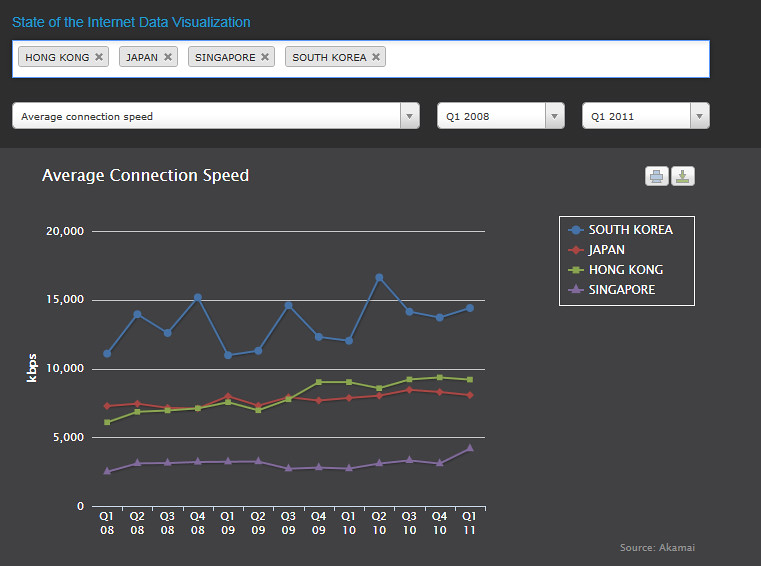
New data visualization tool show trends by geography in several measured categories.

New data visualization tool show trends by geography in several measured categories.

Akamai has also released a new data visualization tool showcasing trends by geography in several measured categories.  The tool allows users to generate and print/download graphs highlighting average connection speed, average peak connection speed, and high broadband/broadband/narrowband adoption rates.  In addition, the online tool offers quick, easy and customized views of trend data since the report was first published at the beginning of 2008.

Asian cities are fast, Russia is dangerous – says the Akamai Q4 2010 State of the Internet report

Thursday, May 5th, 2011

Asian cities have the fastest connection speeds in the world, with HK clocking the highest peak connection speed, and Japan having the highest level of broadband adoption. Russia generated the most attack traffic.

Basically, the Internet has become a faster and more dangerous place.

The State of the Internet report for Q4 2010

The State of the Internet report for Q4 2010

Akamai has released its Q4 State of the Internet report for 2010. It is a leading provider of cloud optimisation services. Based on data gathered from the Akamai Internet Platform, the report provides insight into key global Internet statistics such as the world’s fastest and slowest regions for connection speed, the most frequent origins of attack traffic, and the highest-performing geographies for mobile connectivity, as well as resulting trends over time.

Akamai is the leading global service provider for accelerating content and business processes online.Looking at the two main areas of speed and security, the State Of The Internet (SOTI) report paints the following picture:

Speed

  • Cities in Asia have the fastest connection speeds in the World.
    (top 40 cities are either in Japan or South Korea)
  • Hong Kong has the highest peak connection speed.
  • Japan has the highest level of broadband adoption.
  • Average peak connection speeds on mobile devices rose to 21.2Mbps globally.

Security

  • Russia is the number one country in terms of generating attack traffic, followed by Taiwan (2nd), China (4th), US (5th), Malaysia (25th), HK (47th), and Singapore (48th). 10% of all attack traffic originates from Russia.
  • The Akamai network saw more DDoS attacks in Q42010 than the previous three quarters combined.
  • In terms of mobile-generated attack traffic, the top ten countries are:
  1. Italy
  2. Chile
  3. UK
  4. Poland
  5. Malaysia
  6. China
  7. Russia
  8. US
  9. Hungary
  10. Lithuania

Akamai’s globally distributed network of servers allows it to gather massive amounts of information on many metrics, including connection speeds, attack traffic, and network connectivity/availability/latency problems, as well as traffic patterns on leading Web sites.

Each quarter, Akamai publishes a “State of the Internet” report. The 2010 Q4 report included data about attack traffic, broadband adoption, and mobile connectivity, as well as trends seen in this data over time.