As usual, Apple has revealed a slew of statistics to illustrate how it is leading the field. Here are some of the more interesting numbers from WWDC 2012.
Apple and WWDC 2012 in numbers
There are now 650,000 apps in the App Store, out of which 225,000 are specific to the iPad.
In its four years of existence, 30 billion apps have been downloaded from Apple’s App Store, with US$5 billion for all app sales.
There are 400 million iTunes accounts with credit card. 140 million iMessage users send > 1 billion messages a day.
There are 365 million iOS devices out there, with 80% of these on the current latest iOS 5.
Apple contrast this with the Android’s profile, where slightly less than three-quarters of Android devices are still on Android 2.3.
To date, 26 million copies of Lion OS have been sold. Overall, there are 66 million Mac users.
A year ago, Steve Jobs made his last appearance at an Apple WWDC. This year, Tim Cook helms his first WWDC as Apple’s CEO.
Apple's WWDC 2012 is from 11-15 June in San Francisco.
The annual Worldwide Developers Conference (WWDC) this year is being held from June 11 – 15 at San Francisco’s Moscone West. Tickets were sold out in a mere two hours when it went on sale in April.
Here’s a quick roundup of some of the revelations from the opening keynote presentation on first of the 5-day conference.
MacBooks / OS X Mountain Lion
Refreshed MacBook Air & Next-generation MacBook Pro ships today.
In comes Ivy Bridge processor and USB 3.0, out goes Ethernet and FireWire 800 ports, MacBook Air becomes thinner and lighter, MacBook Pro gets 60% faster graphics performance.
Retina display in MacBooks: 220ppi with 2880 x 1800 resolution.
Highest-resolution notebook display in the world.
Retina Display support: Final Cut Pro, Aperture and Diablo3 now supports 220ppi display.
AutoCad and Photoshop support in the works.
iPad-style Dictation is introduced to Mountain Lion for Macs.
Speak directly into native Apple software, Microsoft Word and Facebook.
Mac updates emails, notifications and photos, and backs itself up while charging.
OS X Mountain Lion available on Macs in July.
Free upgrade for new Mac purchases between now and arrival of the new OS.
iOS 6
iOS 6 unveiled Beta today, full release in the fall.
More than 200 improvements: launch apps with enhanced Siri, and it comes to iPads, FaceTime over cellular data.
Supported: iPhone 3GS and up, 2nd gen iPads and up, 4th gen iPod touch.
Enhanced Siri launches apps and comes to new iPads and eventually into cars.
Siri to get into the car with Eyes Free: demo: Toggle Siri on by tapping a button the steering wheel.
iOS 6 to get Do Not Disturb feature from Mountain Lion.
Select which push notifications to mute and which to stay on.
iOS 6 integrates more tightly with Facebook, Twitter and App Store.
Share directly from core apps like Maps, Photos and Safari.
Safari offers unified search across the web, browser history and bookmarks.
Following in Chrome’s footsteps.
iCloud Tabs syncs Safari web-browsing across all devices.
Simultaneously see all the tabs open on any device.“IOS 6 will include Apple’s own mobile mapping software to compete with software from Google. TomTom will supply Apple with map data and related content.” – statement from TomTom.
Enhanced Safari features.
Multitouch to help navigate tabs, upload images directly, Offline Reading List.
Passbook provides one-stop purchase of tickets and boarding passes.
No more paper QR-codes and tickets.
Apple replaces Google Maps with own Maps app.
Maps comes with Yelp integration and turn-by-turn navigation, and 3D.
Trend Micro has released the results of its study on the four main mobile operating systems in a report titled “Enterprise Readiness of Consumer Mobile Platforms”.
The security firm found the BlackBerry 7 OS the most secure mobile operating system, followed by iOS 5, Windows Phone 7.5, and Android 2.3.
Summary chart from “Enterprise Readiness of Consumer Mobile Platforms” White Paper by Trend Micro.
Android 2.3 was used in the study because it was the dominant installed/supplied version of Google’s mobile OS at the time of the research.
Below is an excerpt from the White Paper summarising the findings about the four mobile platforms.
Google and the Nelson Mandela Centre of Memory (NMCM) have launched archive.nelsonmandela.org which is freely accessible to the public.
The archives include never-seen sequel manuscripts to Mandela’s “Long Walk to Freedom” autobiography.
We should never allow ourselves to forget the struggles for such basic rights as racial equality and take racial harmony for granted.
When I was a youth, everybody knew who Nelson Mandela was and Apartheid was a must-study topic for the General Paper exam in school.
Who is Nelson Mandela?
Nelson Rolihlahla Mandela was born in 1918 and was the first South African president (1994-1999) to be elected in a fully representative democratic election.
Before his presidency, Mandela was a militant anti-apartheid activist leader. In 1962 he was arrested and convicted of sabotage and other charges, and sentenced to life in prison.
Mandela served 27 years in prison. He was released from prison in 1990, and led the movement in the negotiations that led to democracy in 1994.
I wonder how many of the current generation remember or know about the tumultuous struggles in South Africa to fight for what many in the rest of the world take for granted – racial equality.
Even today in Singapore, you have people posting insensitive remarks about other races and nationalities over Twitter.
In order to keep the memories of Nelson Mandela alive, Google gave a US$1.25m grant to Johannesburg-based NMCM last year.
The aim was to preserve and digitize thousands of archival documents, photographs and videos about Mr Mandela.
The new online multimedia archive includes Mr Mandela’s correspondence with family, comrades and friends, diaries written during his 27 years of imprisonment, and notes he made while leading the negotiations that ended apartheid in South Africa.
Search and browse the archives to explore different parts of Mr Mandela’s life and work in depth:
Start by looking at his Early Life, and take a peek into his personal memories of the time he was incarcerated during the Prison Years.
Read the handwritten notes on his desk calendars, which show, for example, that he met President F.W. De Klerk for the first time on December 13, 1989 for two and a half hours in prison; the Warrants of Committal issued by the Supreme Court which sent him to prison; the earliest known photo of Nelson Mandela’s prison cell on Robben Island circa 1971; and a personal letter written from prison in 1963 to his daughters, Zeni and Zindzi, after their mother was arrested, complete with transcript.
What was Apartheid
Apartheid was the official policy of the National Party, which came to power in 1948 in South Africa. It was the practice of official racial segregation.
Under apartheid everyone in South Africa had to be classified according to a particular racial group.
This determined where someone could be born, where they could live, where they could go to school, where they could work, where they could be treated if they were sick and where they could be buried when they died.
Only white people could vote and they had the best opportunities and the most money spent on their facilities.
Apartheid made others live in poverty.
Black South Africans’ lives were strictly controlled.
Many thousands of people died in the struggle to end apartheid.
Ever fancied taking an adventure tour of the Amazon River to explore its nature and culture? Now you can – right from your armchair in the comfort of your home.
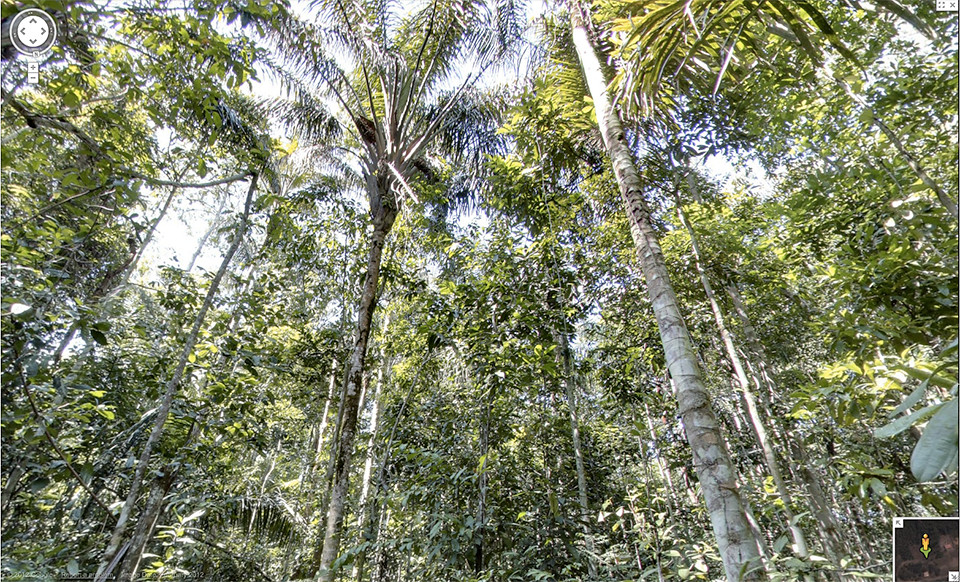
Armchair explorers can now trek through the forests of the Amazon Basin from the comfort of their home.
In conjunction with World Forest Day on 21 March, Google has brought more than 50,000 photos of the Amazon Basin onto your computer in the form of immersive, 360-degree panoramic views within Google Street View.
Spot a critter while cruising down the Amazon river.
Cruise down Amazon river, trek through the jungles, try to spot a forest critter, or peer into life in the local community.
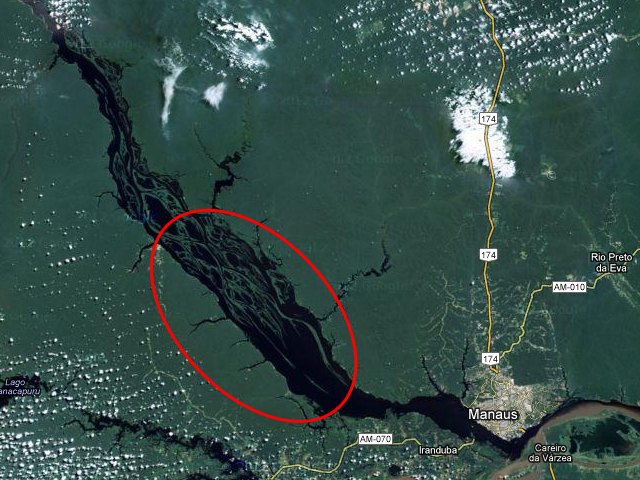
Many areas of the Amazon, including Rio Negro Reserve, are under the protection of the Brazilian government with restricted access to the public.
Many of us would therefore not have the chance to visit these areas even if we wanted to.
Google’s photographers were invited by Amazonas Sustainable Foundation (FAS), the local non-profit conservation organisation to collect ground-level images of the rivers, forest and communities in the Rio Negro Reserve.
Check out the depths of the Amazon via Google Maps Street View.
These images are now available in Google Maps via its Street View feature.
The images were collected by a Street View trike, and a tripod camera with a fisheye lens—typically used to capture imagery of business interiors —to capture both the natural landscape and the local communities.
The apparatus allows access to rugged terrain inaccessible to the usual Google Street cars.
Google has extended its search results by tapping into the data, photos, information and relationships in your Google+ and Picasa account — as long as you’re logged onto your Google account.
Google launched this extension to its existing search engine earlier this week. This opt-out integration will be gradually rolled out over the coming days for users using Google Search in English.
Prior to this extension, Google returned results based on its indexing engine of the public information available on the Internet and listed them in order of relevancy based on its Page Rank algorithm.
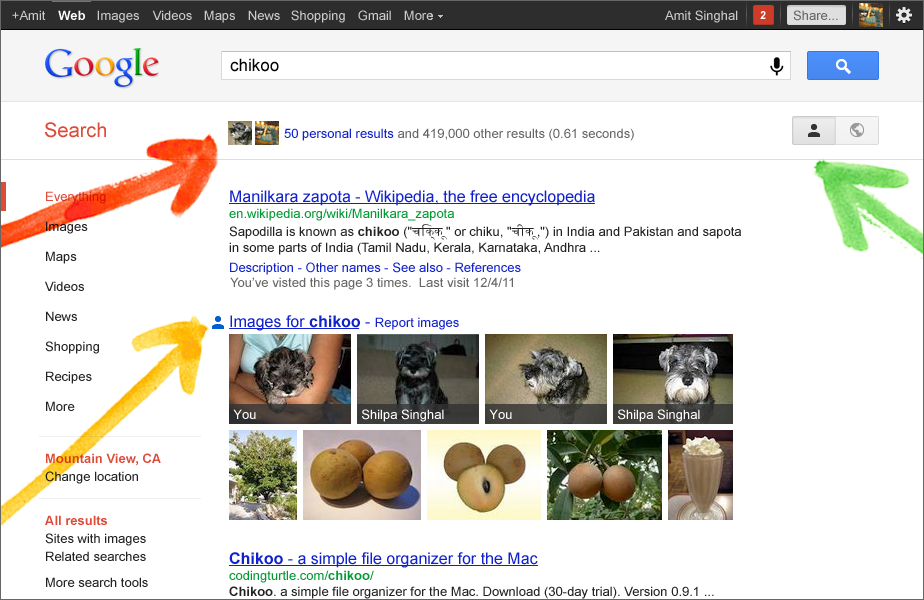
With Search Plus Your World – if you’re logged into your Google account – henever you do a search, Google Search will add three types of information to the search process and results listings:
Personal Results. Photos and posts, related to your search term, from Google+ and Picasa — both your own and those shared specifically with you, that only you will be able to see on your results page;
Profiles in Search. Helps you find people within your Google+ network or circles — both in autocomplete (as you type in the search term) and results listings;
People and Pages. Helps you find people’s profiles and Google+ pages related to a specific topic or area of interest — not just in your social circles, and enables you to follow them with just a few clicks. This is available even if you’re not logged into Google.
To me, this feature is an enhancement. Information is drawn from my own account, to which I have permission to access anyway. The information is not available to anyone else doing a similar search on Google as long as he is not logged into my account.
Screenshot from Google showing addition of personal results, photos and switch to turn off the feature.
It makes my search more relevant and it’s easier to do a comprehensive search that includes my Google+ and Picasa accounts (and perhaps other assets in the future).
The only problem is that it is now much easier for an intruder too, should my account ever be compromised or if I forget to log out of my account.
Note to self: Log out even if you’re stepping away for a coffee. What would have taken hours to consolidate across your different accounts can now be searched in one fell swoop while you’re raiding the fridge.
My wish? A truly interoperable search landscape which is non-exclusive will be the best case for users in the street.
Is it too unrealistic to hope that one day, my data in my Facebook, Twitter and Google+ (and any of the other mushrooming social networks out there) will be available to me only and those I’ve specifically allowed access and available when I do a search in ANY search engine?
I hope not.
I share many people’s laments that this extension of search into my own social networks is limited to my Google+ account and Google assets — and not my Twitter and Facebook accounts.
Both Twitter and Facebook have disallowed Google from crawling their content.
Facebook is keeping mum for the moment, but Twitter is crying foul — claiming that Google is leveraging unfair advantage by using its predominant Search presence to help its nascent Google+ network against other social networks. Two thirds of search in the US goes through Google Search.
Twitter used to allow Google to tap its data until recently, when it stopped the arrangement with Google but continued the partnership with Microsoft’s Bing search engine.
Search Plus Your World can be toggled on and off but it is default on at the start of every session. You need to go to Settings to permanently turn it off.
It’s beyond the man in the street to know if it was Twitter deliberately keeping Google out or whether it’s Google who preferred to be kept out so it’s Search Plus Your World is now “unfortunately” constrained to only Google+.
Only an investigation by the FTC can ascertain the posturing and vested interests involved, and organisations like the Electronic Privacy Information Center are already considering filing a anti-competitive complaint to the FTC regarding this.
The latest version of the TomTom App (V1.10) integrates TomTom navigation with Facebook and Twitter allowing users to navigate to friends, places and events more easily.
The new TomTom App will be available within Q1 2012. Customers who already have the App (V1.9) will be able to download the new features for free.
TomTom App for iPhone/iPad integrates with Twitter and Facebook.
The TomTom app uses social networks as a source for turn-by-turn navigation.
The TomTom App for iPhone and iPad will be the first to use social networks as a source for turn-by-turn navigation.
It can automatically plan routes based on information from Facebook events, places and friends.
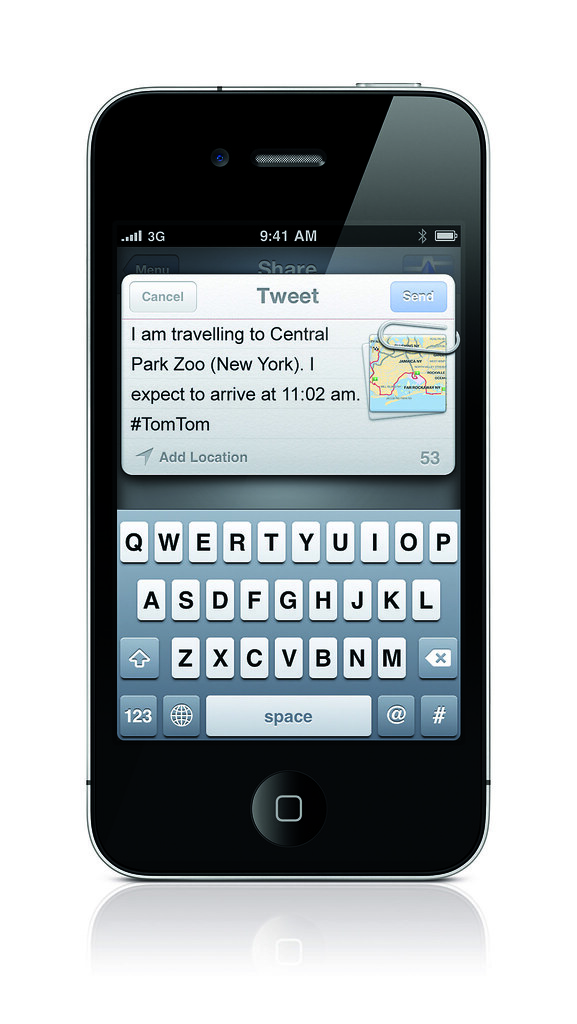
Drivers can also use the App to share their destination and arrival time on Twitter, Facebook, by email and SMS text.
The current TomTom App for iPhone/iPad (V1.9) already offers drivers:
The updated and accurate maps with no need for a mobile signal or data plan.
Free daily map changes from the TomTom community through Map Share.
Reliable arrival times at all times of day with IQ Routes.
Real-time camera alerts via TomTom Speed Cameras.
A powerful search with Google and Facebook.
Clear turn-by-turn guidance while on the phone thanks to iOS Multitasking support.
Seamless integration with contacts, photos, music, email and calendar.
“The 10 most-watched YouTube videos of 2011 show that around the world, whatever language we speak, there are certain things that bring us all together around a computer screen or mobile phone — adorable babies, talented performers, and clever advertising.” — YouTube Trends Manager Kevin Allocca.
Globally, the most-watched YouTube community videos in 2011 are:
In a year when YouTube reached 48 hours of content uploaded every minute, YouTube viewers in Singapore couldn’t get enough of global smashes from LMFAO, Jennifer Lopez and Bruno Mars, as well as viral hits like the comedic tunings of “Nice Guys” (finish last), and local YouTube hit Yam Ah Mee.
In Singapore, the most watched music videos from major music labels in 2011 are:
1. LMFAO – Party Rock Anthem ft. Lauren Bennett, GoonRock