Adobe Flash CS5 Professional

July 5th, 2010

Flash CS5 Professional was launched on 12 April 2010 as part of the Adobe CS5 Suite. It is the industry standard for adding animation, interactive content, videos and games to webpages.

New text engine in Flash CS5 Professional

New text engine in Flash CS5 Professional

Its top feature would have been its Packager for iPhone, which enables developers to write applications within Flash and then convert them into iPhone apps.

However, four days before its launch, and as part of Apple’s beta release of iPhone OS 4 Software Development Kit (SDK), Apple amended its developer licence agreement for iPhone developers to prohibit the use of third-party cross-platform development tools, like Flash, to produce iPhone apps.

Adobe has since announced that while it will ship the Packager as part of Flash CS5, it has stopped all new investments in this area.

Even without the Packager for iPhone, there are enough goodies within Flash CS5 Professional to entice code writers and designers. I will be delving into some of the main features below in more detail over the next few weeks. I also did a review of Adobe Flash CS5 Professional  in Digital Life on 2 Jun 2010.

For the Designer:

  • New text engine – Print-quality typographic control like in desktop publication software, Global language support, Advanced inline text editing, Advanced rendering support.
  • Spring for Bones – The Inverse kinematics feature is enhanced with a dynamic physics engine that simulates realistically the springy vibrational oscillations of a spring.
  • New Deco drawing tools – Dynamic Deco brush tools are extended with new brushes with additional shapes and animation effects.

For the Coder:

  • Code Snippets panel – Prebuilt codes that can be injected into projects for things like timeline navigation, actions, animation, audio and video, and event handlers. The snippets contain helpful comments and clear instructions for easy customisation for the inexperienced programmer.
  • Enhanced ActionScript editor – Custom class code hinting and code completion, and reference your own code or external code libraries more efficiently.
  • Flash Builder – Formerly Adobe Flex Builder, this coding tool is bundled with Flash CS5 Professional and both are tightly integrated with each other.

For all users:

  • Distribute content virtually anywhere – Deliver consistently across screens of virtually any size and use Adobe Device Central for enhanced device testing.
  • XML-based FLA source files – XFL offers improved cross-product integration and workflow productivity.
  • Improved Creative Suite integration – Tight integration with Photoshop, Illustrator, Flash Catalyst, Flash Builder, InDesign, Fireworks, and After Effects.
  • Video improvements – Streamline embedding and encoding processes with on-stage video scrubbing and the ability to define cue points directly in the Properties panel. Playback FLV video directly on the stage instead of testing the movie.

Photoshop CS5: Complex and hairy selections made easier

July 4th, 2010
Deer staring into headlights

Sharp edges along the horns and hairy edges elsewhere.

Photoshop CS5 has made it easier to make image selections and masks, speeding up the extraction of subjects from backgrounds and the creation of realistic composites.

Enhanced intelligent selection technology offers better edge detection and faster, more accurate masking results of complex subjects such as hair. Automatic color decontamination helps eliminate background color around the edges of a selection, resulting in more seamless compositions when placing extracted subjects on new backgrounds.

Dialog box with controls for Refine Edge

New controls can be found in the Refine Edge dialog

The enhanced controls are found in the Refine Edge dialog box when a selection is made.

The Smart Radius setting uses adaptive selection-edge modification approach to produce different types of selection edges on different parts of the subject’s outline, depending on the type of edges — whether the portion of the edge is fuzzy or sharp. This is based on the traditional best practice of using different techniques for different types of edges along the outline of the subject — one method for fuzzy hair and another for the clear edge of a building.

Selection outline in black and white

Selection outline in black and white

Additional view modes provide new ways of previewing the quality of the selections.

The Refine Radius and Erase Refinements tools allows the initial selection to be refined — be it to add more of the subject or to remove more of the background along the selection edge.

My article in Digital Life on 2 June 2010 (Not a hair out of place) illustrated the use of the enhanced selection controls to make a hairy selection round a starry-eyed deer in Miyajima, Japan.

Existing technology and setup is more than adequate to avert soccer controversies

July 3rd, 2010

Dear Sepp Blatter,

The use of technology to help referees and umpires in their jobs is not new. Other sports like cricket and tennis have enlisted the help of technology to determine whether the ball has gone out of play.

Even a sport as traditional as Sumo Wrestling and as steeped in ritual has integrated the use of video replays into their refereeing workflow.

Sepp Blatter - FIFA President

Sepp Blatter - FIFA President

In Sumo, two wrestlers grapple with each other within a 4.55 m diameter circle, under the watchful eye of an umpire. The first to step out of the circle or have any part of his body (except his sole) touch the ground is the loser.

You can imagine how difficult it is for the umpire to spot when a body part of wrestler brushes the ground, especially if his line of sight is obscured by the bulk of the other wrestler. The task is made even more challenging when both hulks fall to the ground and the umpire has to ascertain which one’s body part touches the ground first.

As a result, the umpire in the ring is assisted by 4 other umpires sitting around the ring, plus another two sitting in a video room who watches video replays whenever there is any uncertainty about the outcome of a bout. One of the 4 ringside umpires is the Chief Umpire who has an audio link with the video umpires, and who makes the final decision based on discussion with the other umpires, and advice from the video umpires.

Most of the time, the umpire in the ring makes the call and there is little interference from the ringside umpires and the video room umpires. Only when there is a very close call and there is strong belief that the umpire in the ring has made a wrong call does the arbitration from the other umpires kick in.

I believe FIFA can very easily adapt this arrangement to Soccer. And the technical setup is already there to be tapped – even for the ongoing World Cup in South Africa.

Instead of having additional referees on the ground with Mark II eyeballs who are subject to the same constraints as the existing referees, put those two in a room with the existing commercial video feeds that are already being shot and broadcast to the rest of the world.

Work out two simple SOPs (standard operating procedures) for the group of referees umpiring the match:

  1. Identify the decision maker among the group, whether it should be the main referee on the pitch, or to appoint one of the two video room referees when a controversial incident occurs.
  2. Delineate the types of occurrence to trigger a video referee interference. I’ve prioritised a list here and FIFA can decide which of these to be allowed to trigger interference:
  • Goal (whether the ball crossed the goal line)
  • Offside (when a goal is involved)
  • Infringements resulting in a goal (handballs, fouls etc)
  • Violent fouls, diving
  • Off-the-ball incidents

For a start, the interference could be limited to the first two types of controversies. For most of the match, there is no need for any interference. Some matches might not even result in any interference at all.

With the availability of video feeds, the setup would not incur much cost or effort, and it should not be difficult or time consuming to resolve a controversial occurence. The existing instant replays soccer fans watch today over the air is usually good enough to illustrate whether the referee made a terrible decision.

Mr Blatter, take a courageous step. Just do it. Don’t wait till after this World Cup. You never know what might happen during the semi-finals and the Final. Let soccer fans enjoy the game for its brillance and fair play, instead of suffering the frustration and outrage of injustice.

Is it a question of technology?

July 2nd, 2010

For a long time now, people in the soccer community have been wishing for the introduction of some form of technology to help referees on the pitch avoid major refereeing mistakes that can change the course of the game being played, or simply change the final score of the game.

Oh my God!

Lampard's legitimate goal was not awarded

Up till the ongoing World Cup tournament in South Africa, the landmark refereeing oversight has been the goal scored by the “hand of God”. Based on video and photographic evidence, Maradona, one of the best players in the game’s history had pushed the ball into the net with his left fist. The referee, who did not see the infringement, allowed the goal, which allowed Argentina to take a 1-0 lead over its opponent, England. Argentina then went on to win that quarter-finals match 2-1 and eventually won that World Cup in 1986.

FIFA, the world governing body of the game, has inexplicably resisted calls to introduce some form of technology to avert such mistakes. Suggestions include the use of video-playbacks, goal-line technology and embedded chip in the ball. Some even believe the reluctance could stem from the desire to keep soccer interesting by ensuring there is no lack of such controversies.

This world cup has had its share of such controversies. France managed to secure its place in S Africa at the expense of Ireland during a playoff match. Thierry Henry, the captain of the French team handled the ball illegally during the build-up to the scoring of the deciding goal by William Gallas, another French player.

In a single day on 27 June, both the quarter-finals match involved goal controversies which the victims believed played a significant role in their eventual loss of their matches.

In the England vs Germany match, Lampard’s shot at the German goal clearly crossed the goal line after it bounced off the cross-bar, before it bounced out of the goal again. It happened in a split-second and I don’t blame the referee for missing it. But live video replays showed millions of viewers worldwide that it clearly should have been a goal. England naturally believes if that goal had been rightfully awarded, they would have played the match differently and possibly could have won the match eventually.

In the Mexico vs Argentina match, the opening goal by Argentina’s Carlos Tevez should have been disallowed because he was offside – an infringement whereby the player is nearer to the opponent’s goal than any of the opponent’s players (except the goalkeeper) at the time the ball is passed to him. Video replays around the stadium showed clearly that Tevez was indeed offside and the Mexican players naturally remonstrated with the referee to nullify the goal. The referee, despite consulting with his assistant referees, allowed the goal and Argentina went on to score two more goals to win the match eventually.

If you ask me, I don’t blame the referees at all. Some of these infringements happen in the split of a second and it is entirely possible for the referees on the ground to miss it – since they are only human and they have to keep watch in many directions at once and sometimes from a distance. And I’m not sure they are encouraged to change their decisions based on video replays since the practice is not officially sanctioned.

Is it really impossible to eliminate these controversies? Is it really a question of technology? I provide some suggestions to Sepp Blatter, President of FIFA, in my next post tomorrow.

Apple sued for reception problems on iPhone 4

July 1st, 2010
Is iPhone 4 sweating yet"?

Is iPhone 4 sweating yet"?

Two separate complaints were filed against Apple Inc. in federal court in San Francisco on 30 June, accusing the company of unfair business practices and false and misleading advertising because of reception problems with its new iPhone 4.

The two lawsuits were filed separately by a New Jersey resident and a Massachusetts resident. They had bought the new iPhone 4 and seek to represent other buyers of the new mobile phone in a class action, or group, lawsuit.

The iPhone 4 was launched on 24 June but criticism surfaced over diminishing signal strength when users cover the bottom left corner of the phone with their palm.

Apple has sold 1.7 million iPhone 4 within the first three days of its launch, making it the fastest selling gadget Apple has launched to date.

Read the rest of this entry »

Steve Jobs at All Things Digital Conference in Los Angeles

June 2nd, 2010
Steve Jobs at D8 in Los Angeles on 1 Jun 2010

Steve Jobs at D8 in Los Angeles on 1 Jun 2010

Steve Jobs kicked off the 8th annual All Things Digital Conference in Los Angeles on 1 Jun 2010. The three-day tech event will feature other industry leaders including Microsoft CEO Steve Ballmer, AOL Chief Tim Armstrong and Facebook CEO Mark Zuckerburg. Steve Jobs last appeared in the series of conferences in 2007 alongside Bill Gates.

Here are Steve’s main bullets from his one-and-a-half hour interview with hosts Kara Swisher and Walt Mossberg.

  • Passing Microsoft in valuation was “surreal”.
  • Flash is a technology that’s waning.
  • HTML5 is starting to emerge as a rival to Flash.
  • Gaps on iPhone/iPads caused by HTML5 are getting solved.
  • The market will decide whether iPhone/iPads without Flash is viable.
  • There’s a debate about whether the lost iPhone prototype was left behind at the bar or stolen out of the Apple engineer’s bag.
  • The Foxconn suicides are troubling but the 400,000-employee Foxconn factory is not a sweatshop. Apple is trying to address the situation.
  • Apple has no plans to go into the search business because others do it well.
  • Google started the competition with Apple by moving into the mobile platform with the Android OS.
  • The iPhone OS was conceived for a tablet but the iPhone was rolled out first.
  • Consumers are likely to migrate away from the PC to tablets within the next 5 years due to the evolution of demographics and demand.
  • Rules for approving/rejecting an iPad App:
    • It has to do what it’s advertised to do
    • It has to not crash
    • It can’t use private APIs
    • It can’t defame other people
  • 95% of Apps are approved within 7 days.
  • The current Ad delivery system in the industry sucks and iAd hopes to do it better

Two million Apple iPads in less than 60 days

June 1st, 2010

Apple sold 2 million iPads in less than 60 days since the tablet’s launch on April 3, the company said. It took 2 years for the iPod to reach the 2-millionth mark, and about 4 months to sell its 2 millionth iPhone. In fact, it took the hugely successful iPhone 74 days just to reach the 1-millionth mark.

The Apple juggernaut is rolling on, leaving fellow tech companies in the dust. The shares are rising even as Microsoft, Google, HP, IBM, eBay, Amazon, Yahoo are diminishing in market value.

Apple sells 2 million iPads in less than 60 days

Apple sells 2 million iPads in less than 60 days

The company is hitting the headlines every few days. Apple first launched the iPad in the US on 3 Apr, achieved its first million sales of the iPad on 3 May after merely 28 days, released the iPad to 9 countries worldwide on 28 May, has now announced its two millionth iPad milestone on 31 May, will be speaking at the  All Things Digital D8 Conference in Los Angeles on 1 Jun, and will probably unveil the new iPhone during the WWDC on 7 Jun. The momentum of the steam engine that is Apple does not seem likely to ebb in the near future.

5000 new Apps have already been released for the iPad, while most of the more than 200,000 Apps already on the App Store can be run on the iPad, including those already purchased for the iPhone and iPod Touch.

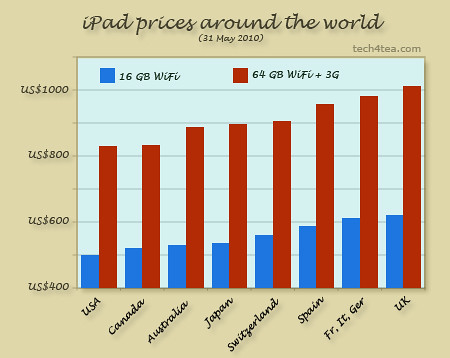
iPad costs a quarter more in the UK than in the US

May 31st, 2010

The ipad costs more outside of the US, Reuters said, citing  an Australian CommSec study.

Prices of the iPads were the cheapest in the US, while prices in Europe, especially the UK, were the highest – almost a quarter of the price higher.

Chart of Apple iPad prices across the world

Apple iPad prices varies worldwide

The prices of the entry level 16 GB WiFi only iPad and the top end 64 GB WiFi + 3G version were both collated and converted to the equivalent US Dollars.

The tablet device is targeted at the niche between a laptop and a smartphone, with a form factor suited for surfing the web, watching movies and reading electronic books. It can also run apps designed for the iPhone as well as apps specially customised for it.

The detailed data is tabulated below.

Read the rest of this entry »

Photoshop: Selecting objects with irregular outlines

May 30th, 2010

My article in Digital Life on 26 May 2010 (Choice selections) illustrated the use of the Lasso Tool, the Polygonal Lasso Tool and the Magic Wand Tool for making selections of objects or areas of the image with an irregular outline.

Red telephone booth amidst drab surroundings

Red telephone booth to be selected and preserved

Red telephone preserved while surroundings toned down to Black and White

Surroundings toned down to Black and White

Where there is a fair amount of contrast in colour between the object to be selected – such as the red telephone booth – and the surrounding pixels, you can also use the Magnetic Lasso Tool.

Just click anywhere on the edge of the object move the mouse along the edge of the object, in this case the booth. As the mouse moves along the edge, Photoshop will detect where the edge is by examining the contrast between the pixels on either side of the mouse cursor.

Photoshop will place anchor points along the edge as you go along. You don’t have to click the mouse button.

Read the rest of this entry »

Worldwide launch of iPad maintains Apple’s momentum

May 29th, 2010
Apple iPad goes on sale in 9 foreign countries on Friday 28 May 2010

Apple iPad went on sale in 9 foreign countries on Friday 28 May 2010

Apple shares continued its advance even though shares other companies including Microsoft, Google, HP, IBM, Yahoo, eBay, Adobe, Amazon fell. Apple now leads Microsoft by US$7 billion in terms of market capitalisation.

Maintaining the momentum through the anticipated release of the new iPhone at the WWDC on 7 June and further foreign release of the iPad in July, I won’t be surprised if Apple overtakes Exxon Mobil by then to become the most valuable company in the US.

The worldwide launch of the iPad saw the gadget released in 9 countries – UK, France, Germany, Italy, Spain, Switzerland, Japan, Australia and Canada – two months after its initial launch in the US.

The much awaited release saw the expected queues build up at  Apple stores in these countries more than a day before the 28 May Friday launch date.

The iPad will be released to a further 9 countries – Austria, Belgium, Ireland, Luxemburg, the Netherlands, Mexico, New Zealand, Hong Kong and Singapore – in July, and additional countries later this year.

Expect the same pent-up demand to build to the same frenzy when glazy-eyed fans vie to be the first in their respective countries to buy the iPad from a local store.