Archive for the ‘Technology’ Category

SingTel launches 4G service for smartphones

Monday, June 4th, 2012

SingTel officially launches Singapore’s first 4G service for smartphones and reins in data usage by reducing 12GB data limit.

Mr Yuen Kuan Moon, SingTel’s CEO Consumer Singapore briefing on the launch of the 4G services for smartphones.

Mr Yuen Kuan Moon, SingTel’s CEO Consumer Singapore briefing on the launch of the 4G services for smartphones.

SingTel is also introducing new Flexi and iFlexi plans with reduced data bundles from 1 July 2012.

From tomorrow (5 June 2012), customers who purchase a 4G-enabled handset with a SingTel Flexi and iFlexi plan will be able to enjoy the 4G service.

Three handsets will be available at launch: HTC One XL, LG Optimus LTE and Samsung Galaxy S2 LTE.

4G LTE network

SingTel’s 4G service will provide mobile Internet access that is up to five times faster than existing 3G-based smartphone services, with one-fifth of the network latency.

“We need to break away from the traditional one-size-fits-all approach, which is not sustainable in the long term. Today, 64 per cent of mobile data on our network is consumed by 10 per cent of our subscribers. This prevents the remaining 90 per cent from enjoying the full benefits of the network. With our tiered pricing model, subscribers will pay for what they use, and this ultimately allows us to keep prices for our plans the same over time despite rising network costs,” explained Yuen Kuan Moon, SingTel’s CEO Consumer Singapore.Users can enjoy theoretical download speeds of up to 75Mbps and typical download speeds between 3.4Mbps and 12Mbps.

SingTel will also introduce its Priority Pass traffic priority feature for the 4G service next year.

This will provide subscribers with priority for their data traffic when the network is loaded, thus ensuring smoother streaming and downloads.

Islandwide rollout of SingTel’s 4G network is expected to be completed in early 2013.

In areas where 4G has not yet been deployed, users will fallback to 3G connectivity with download speeds of up to 42Mbps.

Check the coverage diagrams at the end of this post to see when you will be enjoy LTE coverage.

Data bundle cutback

Data bundles for most of SingTel’s Flexi plans have been reduced drastically from 12GB to a range of 2GB to 12GB, although the number of bundled SMS has been increased.

“At the same time, heavy users will benefit from the significantly reduced excess usage rates. Data traffic on our mobile networks has been growing at 62 percent each year since 2010 due to the tremendous growth of smartphones, tablets and mobile content. By encouraging fair usage of the network, we will be able to deliver consistently high-quality services for our customers,” Yuen said.Charges for data usage beyond bundled allowances have been revised to $5.35 per gigabyte from 1 July to 31 December 2013, and subsequently to $10.70/GB from 1 January 2013.

Approximately 10 per cent of SingTel’s subscribers who are heavy SMS users will save from the new improved SMS bundles.

The plans will be available to all new and re-contracting customers from 1 July 2012, and will replace existing 3G Flexi and iFlexi plans.

So if you don’t want to relinquish the existing 12GB data bundle, you can let the existing contract run in perpetuity – but you’ll have to forego the handset subsidies that come with re-contracting.

Mr Yuen noted that based on current usage patterns, 90 per cent of subscribers should not incur higher charges, as their data consumption does not exceed the new bundles.

Read about StarHub’s response to SingTel’s launch below.
(more…)

Affordable cloud backup for small and medium businesses

Tuesday, May 15th, 2012

Kronicles has launched, in Singapore, a new Backup-as-a-Service solution for small and medium businesses (SMB).

The solution includes both on-site and off-site backup and promises enterprise-class reliability and fast recovery at affordable subscription-based pricing starting from S$5,000 per month (before government subsidy).

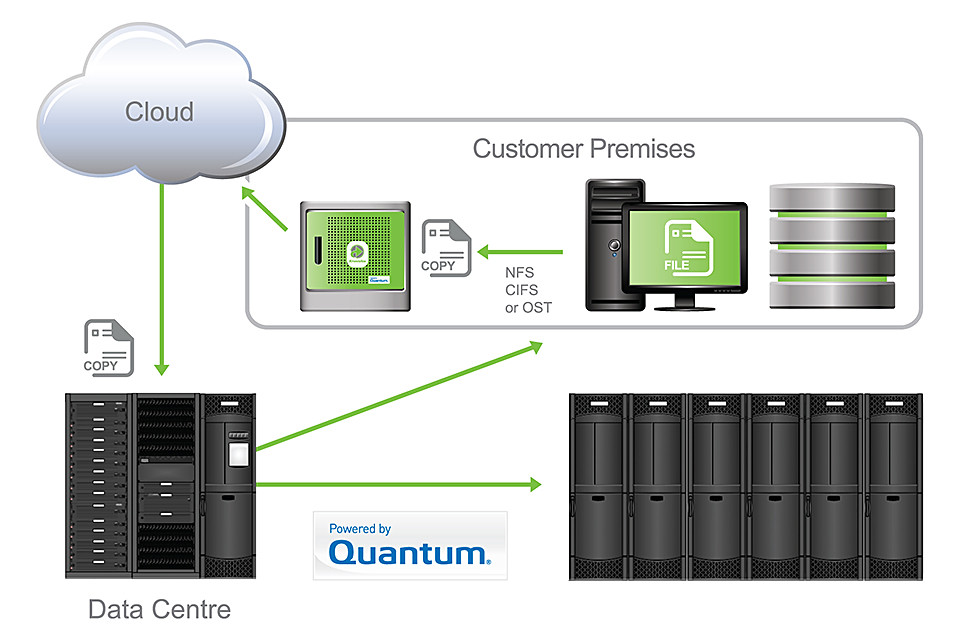
Kronicles BaaS includes both on-site and off-site backup.

Kronicles BaaS includes both on-site and off-site backup.

Only last week, I wrote about EMC’s “Disaster Recovery Survey 2012” which found that “81% of businesses in the Asia Pacific and Japan might NOT be able to recover lost data and systems in the event of a disaster”.

“71% of all organizations had lost data or suffered systems downtime in the last 12 months” – Vanson Bourne interview of 2,500 IT decision-makers.The results point to outdated backup and recovery infrastructure in businesses in Japan and the Asia Pacific.

Kronicles has come to the rescue with their new “Backup-as-a-Service” (BaaS), powered by technology from Quantum.

In the customer’s office, a POD (Periphery Onsite Device) backs up 30-days worth of data from a customer’s email and application servers.

The POD provides on-site backup for quick recovery.

The POD provides on-site backup for quick recovery.

The POD provides quick recovery of files over the local network, which is typically faster than an Internet connection.

Every day, during off-peak hours, data is copied over a dedicated link to Kronicles’ secure data facility for off-site protection.

In Singapore the data resides in-country within Starhub’s Tier 3 data center.

At the end of each month, Kronicles provides a copy of the data on an LTO tape, which can either be returned to the user or stored at a secure third=party location that can be returned on demand.

At any one time, there is a local copy of data for everyday operations, one stored on Kronicles’ cloud for business continuity, and one copy on tape for long-term archival.

Following today’s launch in Singapore, the service will be launched next in The Philippines and Malaysia.

Pricing

Three price packages are available. The basic Gold package – at S$5,000 per month – includes 200GB to 1TB of data backup, support for three to 10 Windows servers, up to 30-day history.

The Platinum package – at S$8,000 per month – includes 1TB to 2TB of data, three to 10 Windows servers, and up to 60-day history.

Customers with even more stringent requirements can discuss the Platinum Plus package with Kronicles.

Is the data secured? “Yes, data is encrypted with up to 256bit encryption when the data is ‘in flight’. At the data center itself, the data is not encrypted but protected,” says Pramotedham. The data on the back-up tapes are also not encrypted.A War Room for DR and BCP

Piti Pramotedham, Group CEO of Kronicles, described something that caught my attention during his presentation.

He described how a “War Room” can be set up in StarHub’s Media Centre should a customer’s premises be gutted by, say, a fire.

The customer, together with its partners, can set up shop in the War Room while their IT servers are re-constituted from the backup servers.

Is the data of one customer physically compartmentalised from that of another customer? “Yes, at the data center, it’s like a bank vault – so you see a whole wall of storage dedicated to one customer, separate from that of other customers,” say Piti.This can be completed in a matter of hours, after which, the customer and its partners can resume “business as usual”.

The aim is to suffer minimal disruption in times of disaster.

Pramotedham says that Kronicles insists that customers practise this once a year to ensure everything is well-rehearsed.

For SMBs that doesn’t yet have any Disaster Recovery (DR) and Business Continuity Plans (BCP), this is like having DR and BCP thrown in together with the BaaS.

Company Byte: Spirent Communications

Monday, May 7th, 2012

Spirent Communications is a multinational telecommunications and network testing company headquartered in the United Kingdom.

Spirent is a multinational telecommunications and network testing company headquartered in the United Kingdom.

With annual sales of US$528 million (US$160 million in APAC), it had a market capitalisation of US$1.7 billion as of May 2012.

Spirent Communications

Spirent Communications

Spirent is a global provider of performance analysis and service assurance solutions that enable the development and deployment of next-generation networking technologies.

It pioneered testing of Ethernet networks, IP Telephony and VoIP, VPNs, TriplePlay, CDMA applications and Location Based Services.

Today, the company is helping to test the first deployments of the next generation Internet or IPv6 networks in Asia, Europe and North America.

How Singapore IT practitioners perceive mobility risks

Thursday, March 1st, 2012

Singapore was one of 12 countries surveyed in a new “Global Study on Mobility Risks” conducted by Ponemon Institute. Out of the overall 4,640 IT and IT security practitioners surveyed, 259 respondents were from Singapore.

Perception of mobile phone use as a threat and presence of security controls to mitigate the risks.

Perception of mobile phone use as a threat and presence of security controls to mitigate the risks.

The study was sponsored by content security provider Websense Inc, and is designed to help IT security professionals plan for an increasingly mobile workforce.

“We asked thousands of IT security professionals and found mobile devices were overwhelmingly important to business objectives,” said Dr Larry Ponemon, chairman and founder of the Ponemon Institute.Corporate mobile devices and the bring-your-own-device (BYOD) phenomenon are rapidly circumventing enterprise security and policies.

In Singapore, 45 percent of respondents say that their organizations experienced a data breach due to insecure mobile devices, and 22 percent are unsure.

“However, mobile devices put organizations at risk — risks that they do not have the necessary security controls and enforceable policies to address. It’s also clear that employees are deliberately disabling security controls, which is a serious concern,” Dr Ponemon addedThis is slightly less than the overall proportion of 51 percent for all 12 countries.

Fifty-five percent say that their employees circumvent or disengage security features such as passwords and key locks – versus the overall 59 percent.

Below is the Executive Summary for the survey of IT & IT Security Practitioners in Singapore, which was extracted from the “Global Study on Mobility Risks”.

(more…)

BYOD causing security breaches

Thursday, March 1st, 2012

51 percent of organizations lose data through mobile devices, while 59 percent of employees dodge security controls, according to a new  “Global Study on Mobility Risks” unveiled at the RSA Conference in San Francisco, USA.

The “Global Study on Mobility Risks” by Ponemon Institute.

The “Global Study on Mobility Risks” by Ponemon Institute.

Mobile devices help business, but security is needed to prevent costly data loss.

Corporate mobile devices and the bring-your-own-device (BYOD) phenomenon are rapidly circumventing enterprise security and policies. This survey defines mobile devices as laptops, USB drives, smartphones, and tablets.

“IT has spent years working on desktop security and trying to prevent data loss over web and email channels—but mobile devices are radically changing the game,” said Tom Clare, senior director of Product Marketing Management.Seventy-seven percent of more than 4,600 respondents in 12 countries (Australia, Brazil, Canada, France, Germany, Hong Kong, India, Italy, Mexico, Singapore, United Kingdom, and the United States) surveyed agree that the use of mobile devices in the workplace is important to achieving business objectives.

But 76 percent also believe that these devices put their organizations at risk—and only 39 percent have the necessary security controls to address the risk.

The study was conducted by the Ponemon Institute and sponsored by content security provider Websense Inc, and is designed to help IT security professionals plan for an increasingly mobile workforce.

“Tablets and iOS devices are replacing corporate laptops as employees bring-their-own-devices to work and access corporate information. These devices open the door to unprecedented loss of sensitive data. IT needs to be concerned about the data that mobile devices access and not the device itself,” Clare added.The research shows that organizations often don’t know how and what data is leaving their networks through non-secure mobile devices.

Traditional static security solutions such as antivirus (AV), firewalls, and passwords are not effective at stopping advanced malware and data theft threats from malicious or negligent insiders.

To safely permit corporate use of mobile devices, Websense has released its new Websense TRITON Mobile Security solution.

Sixty-five percent of respondents are most concerned with employees taking photos or videos in the workplace—probably due to fears about the theft or exposure of confidential information.

Other unacceptable uses include downloading and using internet apps (44 percent) and using personal email accounts (43 percent).

IT Show 2012 (March 8-11) at SUNTEC Singapore

Sunday, February 26th, 2012

The first of four large annual IT exhibitions in Singapore begins next Thursday at the SUNTEC Singapore (Levels 1, 2, 3, 4 and 6).

For four days from March 8-11, the IT Show will open daily from 12 noon to 9 pm (admission FREE).

IT Show 2012 at Suntec Singapore from 8 - 11 March.

There will be more than 830 exhibitors in the 350,000 square feet of space distributed over five levels of Suntec Singapore. Here are links to information about the venue and the floor plans.

Looking ahead, the four major IT exhibitions in Singapore are:

Exhibition Dates Venue
IT Show 2012 8-11 Mar Suntec Singapore
PC Show 2012 7-10 Jun Suntec Singapore
COMEX 2012 30 Aug – 2 Sep Suntec Singapore
SITEX 2011 22-25 Nov Singapore Expo

CA Technologies Cross-Enterprise Application Performance Management

Saturday, February 25th, 2012

The new release of the CA Cross-Enterprise Application Performance Management (CA CE APM) promises business service innovation across the hybrid data center and the cloud.

CA Cross-Enterprise Application Performance Management (CA CE APM)

CA Cross-Enterprise Application Performance Management (CA CE APM)

CA Technologies today announced a new release of its CA CE APM which extends mainframe monitoring capabilities and provides richer information about the health and performance of key IT services.

“Our clients are focusing on how IT can be more strategic to the business by providing decision makers and IT staff with timely information about IT services, and how their predictability and availability impacts business outcomes,” said Dayton Semerjian, general manager, Mainframe, CA Technologies.CA CE APM monitors and collects information on the mainframe and integrates with CA APM to provide 24×7 monitoring of business transactions in a single pane of glass across mainframe, distributed and the cloud.

This  offers a business-level view of service performance that can be displayed on their mobile devices, via CA Executive Insight for Service Assurance, when executives need it

The enhanced capabilities provide deeper insight into customer-facing business transactions across increasingly complex IT environments, modernizing mainframe administration by simplifying and enhancing cross-platform management to help incorporate the mainframe into an organization’s broader enterprise IT strategy.

“This new release of CA CE APM offers IT staff more real-time visibility into the customer experience to help them optimize customer-facing applications and services, no matter where they reside,” Semerjian added.Advancing Service Assurance Across Mainframe, Distributed, Virtual and Cloud

With the rise of virtualisation and cloud computing and the complex mix of mainframe and distributed platforms in the evolving data center, IT staff needs to perform real-time “application triage” to quickly diagnose and fix problems that can impact the customer experience.

By providing a 360˚ view of all customer transactions, organisations can better understand the health, availability and business impact of critical business services to prioritize problem resolution and help assure that service performance meets SLAs.

To provide this level of visibility, new capabilities in CA CE APM and its integration with CA APM include:

  • Over 90 metrics for DB2 for z/OS, end-to-end IMS for z/OS and the mainframe network to provide richer data faster, and with less work, so IT organizations can more quickly resolve problems with mainframe-based business transactions.
  • Information about network traffic across mainframe and distributed platforms that helps pinpoint problems affecting the performance or availability of an application or service.
  • A virtual infrastructure view so staff can more easily diagnose problems in the virtual environment and resolve them faster.
  • Information on how well SaaS vendor-delivered applications are performing for end-users
  • Expanded information used to monitor cloud services efficiently.

Tata Communications wires up F1

Friday, February 24th, 2012

Singapore-headquartered Tata Communications is now designated a “Technology Supplier of Formula 1”, with category exclusive designations as “Official Connectivity Provider of Formula 1” and “Official Web Hosting and Content Delivery Network of Formula1.com”.

Vinod Kumar, MD and CEO of Tata Communications and Bernie Ecclestone, CEO of Formula One group announced the multi-year technology service and marketing agreement at a London press conference today. Photo from Tata.

Vinod Kumar, MD and CEO of Tata Communications and Bernie Ecclestone, CEO of Formula One group announced the multi-year technology service and marketing agreement at a London press conference today. Photo from Tata.

Tata Communications will deliver connectivity to all 20 Formula 1 race locations over its global network, the largest in the world.

“Formula 1 requires fast and secure connectivity, because even a split second of downtime can have huge repercussions for its business, brand and reputation,” says Vinod Kumar, Managing Director and CEO of Tata Communications.It will also provide hosting and content delivery services to Formula1.com, which is accessed by tens of millions of fans around the globe.

Formula One group businesses and race locations will now be connected to the Tata Global Network (TGN), supported by secure MPLS connectivity.

Formula One Management’s IT infrastructure and Formula1.com will be colocated and hosted in Tata Communications’ data centres.

Tata Communications’ capabilities in video and content delivery networks (CDN) will enable uninterrupted, high-quality connectivity to the multi-media portal on Formula1.com.

“Connectivity and content delivery are critical issues for Formula 1 and working with the best in the business is a priority for us,” says Bernie Ecclestone, CEO of Formula One group.The (TGN) has Trans-Atlantic and Trans-Pacific data transfer capacity of one terabit per second.

This capacity will ensure Tata Communications to fully support Formula1.com during race weekends, when the site gets on average four million unique visits per weekend, peaking at seven million over some events.

Tata Communications’ infrastructure will enable the sport’s official website to instantly scale up to cope with these significant and sometimes unpredictable traffic spikes.

Tata Communications is now the Official Connectivity Provider for Formula 1.Tata Communications will also provide Formula1.com with a new Managed Security Suite and will apply an additional layer of managed security monitoring to ensure an increased level of protection to Formula One Management’s IT infrastructure.

Looking ahead, Tata Communications and Formula One Management will also work in close collaboration on research and development around connectivity and the latest video technologies.

SolarWinds launches SeUM to Monitor Web Transactions

Thursday, February 16th, 2012

SolarWinds launches the industry’s­ first affordably-priced SaaS (Software as-a Service)-like product to monitor web transactions from cloud-based locations.

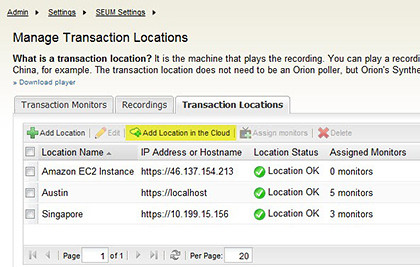
SeUM web console has wizards to guide the creation of Amazon EC2 Cloud Player instances.

SeUM web console has wizards to guide the creation of Amazon EC2 Cloud Player instances.

SolarWinds Synthetic End User Monitor (SeUM) v.1.5 works to streamline the process of monitoring websites and web based applications from the cloud, offering users the ability to monitor their web based services from various geographical locations around the globe.

Leveraging the cloud allows users to inexpensively monitor performance and availability from locations beyond their data center, central office, or remote office locations to where their mobile work force, home offices, or customers are located.

SeUM allows system administrators and application support staff to monitor response time proactively for multi-step web transactions.

The latest version of SeUM introduces the Cloud Player Portal that allows users to deploy transaction players easily to Amazon EC2.

New Features in v. 1.5

  • Cloud Player Portal: Easily deploys transaction players to Amazon EC2 to enable web transaction monitoring from cloud-based locations and does not require users to pay subscription fees.
  • Multi-Tenant UI: Monitors website and web application performance for large deployments or in MSP environments.
  • Rich Content Recording and Playback: Record and playback dynamic web pages to include support for Flash and Silverlight; also validates the existence or absence of text and other website content.
  • Firewall-Friendly Communication: Transaction players make their monitoring data available for polling from the SeUM server, eliminating any need to open in-bound Firewall connections.

(more…)

Akamai acquires Blaze

Friday, February 10th, 2012

Akamai has acquired Blaze Software Inc, a provider of frontend optimization (FEO) technology. This will complement Akamai’s site acceleration solutions with technology designed to optimize the speed at which a web page is rendered, regardless of end user device.

Akamai announced today that it has acquired Blaze.

Akamai announced today that it has acquired Blaze.

The synergy derived from the combining Blaze’s FEO and Akamai’s site acceleration solutions will improve the performance of customers’ web sites and applications

“We believe Blaze has developed a powerful solution for frontend optimization, and that its cloud-based services approach is synergistic with Akamai’s offerings,” said Rick McConnell, executive vice president of Products and Development, Akamai.Akamai is also in the process of acquiring Cotendo – a company that offers an integrated suite of Web and mobile acceleration services – in an effort to help accelerate its pace of innovation in cloud and mobile optimisation.

With the rapid adoption of rich Internet applications and the increase in mobile browsing, new performance bottlenecks are emerging.

Websites are becoming richer and more complex, with more compute requirements built into a single page, impacting performance in the browser or client device.

As a result, content providers are faced with a growing set of challenges in maintaining a high-performing site and assuring a superior end-user experience.

“Our technology is aimed at reducing the number of requests required to load a page, reducing the size of each request, and improving the browser rendering experience for our customers,” said Michael Weider, CEO of Blaze.Blaze provides technology designed to automatically optimize the code on a web page during the delivery process to ensure faster transmission of content and a faster rendering of the page, regardless of whether it is served to a PC, tablet or smartphone.

As a cloud-based service that requires no software or code changes by the customer, Blaze’s offering is designed to work with any web site.

Akamai plans to integrate the technology into its global cloud platform for helping enterprises provide secure, high-performing user experiences on any device, anywhere.