Archive for the ‘Microsoft’ Category

Behind-the-scenes story about Microsoft Kinect for Xbox 360

Saturday, July 9th, 2011

Dr Jamie Shotton had joined the Machine Learning & Perception group at Microsoft Research Cambridge (MSRC) in June 2008 as a post-doc for a few months when he was roped in by the Xbox product group to help launch the product by Christmas 2010.

He shared the experience with 4th year undergraduate Engineering students at the University of Cambridge Engineering Department earlier this year.

The body was divided into 31 different body parts to be recognised and reconstituted into a human pose.

The body was divided into 31 different body parts to be recognised and reconstituted into a human pose.

I was browsing through the university’s newsletter last week when I came upon this interesting story about some of the developmental challenges of the Microsoft Kinect for Xbox 360 and how they were surmounted. You can read the full original article here. Images used in this posting are from the original article.

The Kinect for Xbox 360 is a motion sensing input device for the Xbox 360 game console. Based around a webcam-style add-on accessory for the Xbox 360 console, it allows users to control and interact with the Xbox 360 without the need to touch or hold a game controller such as a joystick – depending instead on bodily gestures and spoken commands.

Dr Jamie Shotton from the Cambridge research laboratory in the UK

Dr Jamie Shotton from the Cambridge research laboratory in the UK.

Shotton now works for Microsoft at their Cambridge research laboratory in the UK. He had completed his PhD research in computer vision from 2003 to 2007. His initial research at the MSRC was on automatic visual object recognition – teaching computers how to recognise different types of objects in photographs such as cars, sheep and trees.

“Little did I know at that point how quickly I would get pulled into the frenzy of research and development around Kinect, and how this blue-skies research could be applied to such a practical problem,” Shotton recalled.

Enabling tools

At the point that Shotton was invited, Microsoft had already developed a few enabling tools.

Shotton's research into automatic visual object recognition trained computers to recognise different objects in photographs.

Shotton's research into automatic visual object recognition trained computers to recognise different objects in photographs.

Depth-sensing camera. The new Kinect camera worked at 320×240 pixels and 30 frames per second versus other depth cameras at very low resolutions of 10×10 pixels.  “You could even make out the nose and eyes on your face,” “Shotton observed. The better depth accuracy helped with human pose estimation by eliminating objects in the background since they were further away. The colour and texture of clothing, skin and hair could also be normalised away. The depth camera was “active”, illuminating the subject with its own structured dot pattern of infra-red light so that the camera worked even in the dark.

Prototype human tracking algorithm.  The algorithm constantly compares its predictions of the body’s movements with the actual movements and then makes adjustments to improve the accuracy of its predictions.

Showstoppers

The tracking algorithm suffered from three limitations. First, the subject had to stand in a T-pose for the algorithm to lock it in initially. Second, if the subject moved too erratically and therefore unpredictably, the algorithm would lose track and would not be able to recover until the subject returned to the T-pose for recalibration. This could happen as often as every 5-10 seconds. Finally, the algorithm only worked with the limited number of body sizes and shapes that it had been trained with. Shotton’s mission was to overcome these showstoppers.

Overcoming the limitations

To allow the algorithm to recognise a subject and its posture without having to start from a T-pose, Shotton leveraged a fellow researcher’s (Dr Stenger) technique called “chamfer matching”: the subject’s image was compared with a training database of body images and once the closest match was selected, the 3D data for that match could then be utilised as the human pose for the subject.

However, there was an astronomical number of human poses based on the different combinations of position and orientation of body parts such as the arms, legs, knees and ankles. Shotton divided up the body into 31 parts so that each of the parts could be matched independently before building up the skeleton and body pose from the position of these parts. This was where Shotton’s PhD work on object recognition came in handy.

Although this substantially reduced the size of the image database needed to train the algorithm, the training database was still huge. The team had recorded hours of footage at a motion capture studio with several actors doing “gaming” moves such as dancing, running, fighting and driving.

The millions of training images would have taken months to train the algorithm. The team got help from colleagues at Microsoft Research in Silicon Valley who had developed an engine called “Dryad” for efficient and reliable distributed computation. Using a cluster of 100 powerful computers, the training time was reduced to less than a day.

Read the details of Shotton’s experience in the full original article here.

Microsoft to release web-based Office to stave off Google

Tuesday, June 28th, 2011

Microsoft is offering for the first time a full Internet-based version of Office 2010, in an attempt to counter Google’s Apps for Business – the latter’s equivalent office productivity software online.

Office 365 - Full Microsoft Office on the cloud.Available today in 40 markets, the cloud-based Office 365 suite of programs will cost small businesses $6 per user per month for software that includes Office Web Apps and Exchange e-mail software. For an additional $12 a month, companies can add a full version of Office, including Word and Excel programs, reports Dina Bass in Seattle for Bloomberg. The full online version of Office is a follow-up to last year’s release of the more basic Office Web Apps.

Google charges companies an annual fee $50 per user for its office-productivity software – Apps for Business, and offers a free version for consumers.

Both Microsoft and Google are going after users who want to work on applications hosted on the Internet, rather than software installed on a local hard drive.

Microsoft claims that it has almost 50 million users for its consumer version of Office Web Apps, which are scaled-down versions of the Office applications. Google claims 30 million active users for it Google Apps. This includes some 3 million corporations and other organizations that use its Apps business software.

Work on your documents anytime, anywhere. Microsoft Office 365.

Work on your documents anytime, anywhere. Microsoft Office 365.

This update represents the first time Microsoft will sell a full version of Office through an Internet-based cloud service, and also marks the first time companies can license the programs on a per-user, per-month basis, said Wes Miller, an analyst at Directions on Microsoft in Kirkland, Washington.

For larger businesses, $2 is enough for just basic e-mail, whereas $24 a month will get a full copy of Office and other programs like social networking and videoconferencing. These software services are an update to an earlier product called Business Productivity Online Suite, or BPOS.

“Microsoft released Office 2010 a year ago, and said earlier this month that it’s being adopted by business customers five times faster than the previous version. Sales in the business division, which is mainly revenue from Office, rose to $5.27 billion last quarter, exceeding the $4.9 billion average of analysts’ estimates compiled by Bloomberg. The unit is Microsoft’s biggest in terms of revenue,” reports Bass.

Windows 8 previews by Microsoft

Friday, June 3rd, 2011

Windows President in Microsoft, Steven Sinofsky, previewed the next version of the Windows operating system that will likely premier in March 2012.

The radically revamped OS works on tablets with touch screens; runs on desktop and laptop computers with touchscreen, mouse or keyboards; runs existing Windows software and runs on both Intel and ARM chips.

Windows 8 is set to challenge the dominance of Apple’s iPad iOS and Google’s Android.

Sinofsky gave a preview of Windows 8 on a 10.6-inch touch-screen tablet during the AllThingsD’s D9 Conference in Rancho Palos Verdes, California.

A 30-minute demonstration was subsequently given at the Computex 2011 in Taiwan by Mike Angiulo, Microsoft corporate vice president.

In appearance, it resembles Windows Phone 7 – Microsoft’s operating system for smartphones – using “tiles” instead of icons to represent applications. The tiles on the computer’s start screen can be automatically updated to display the latest information from applications. For instance, a stock ticker app could display stock quotes right on the tile without requiring users to open the app.

Windows 8 will be the first full version of Windows capable of operating on ARM chips which has been the sole supplier of tablet CPUs since Apple launched its iPad in 2010.

Citing Jefferies Group, Bloomberg reports that the number of tablets sold globally will almost quadruple this year to 70 million units from 18 million in 2010. This will more than double to 158 million in 2012. Apple, which will control some 64 percent of the 2011 tablet market, will see its market share fall to 41 percent in 2012.

Computex Taipei 2011 draws tablet watchers and stake holders

Monday, May 30th, 2011

The 5-day annual trade show in Taipei will see more tablet models based on Google’s Android and a preview of Microsoft’s next Windows platform for tablets – one year after Apple’s game changing iPads grab the lion’s share of the tablet market.

COMPUTEX Taipei, or Taipei International Information Technology Show (台北國際電腦展), will be held from May 31 to June 4, 2011 in Taipei. Taiwan based Acer and Asustek had first showed off their low-cost but trend-setting netbooks at the Computex in 2007 and 2008.

Investors and analysts will be watching to see if new Android based tablets can challenge Apple’s iPad. Non-iPad tablet competitors are expected to halve Apple’s 100 percent dominance of the tablet market to 50 percent next year, iSuppli predicted on April 21. The iPad had cordoned off the entire tablet market when it was first launched in June last year because of the absence of competitors.

Computex Taipei 2011 from May 31 to June 4, 2011

Computex Taipei 2011 from May 31 to June 4, 2011.

Both Google and Microsoft will send executives to the event to brief the media on their plans. Intel, the world’s largest chipmaker, and ARM, whose chip designs are licensed by Qualcomm and Nvidia to power tablets, will also be vying for tablet manufacturers to select their chips.

Global shipments of tablets will increase almost twelve times to 215 million units in 2015 from 17 million last year, Toni Sacconaghi, a New York-based analyst at Sanford C. Bernstein & Co., wrote in a May 26 report.

Computer sales growth will be reduced by 2 percent annually between 2010 and 2015, Sacconaghi wrote, because fifteen percent of all tablets will cannibalize the sale of consumer PCs.

Bloomberg reports that Microsoft will “preview its operating system designed for tablets this week, using hardware with ARM-based chips”. The current Windows 7 operating system from Microsoft is not compatible with the ARM chips used in tablets from manufacturers such as Samsung and Motorola.

IBM overtakes Microsoft in market capitalisation

Tuesday, May 24th, 2011

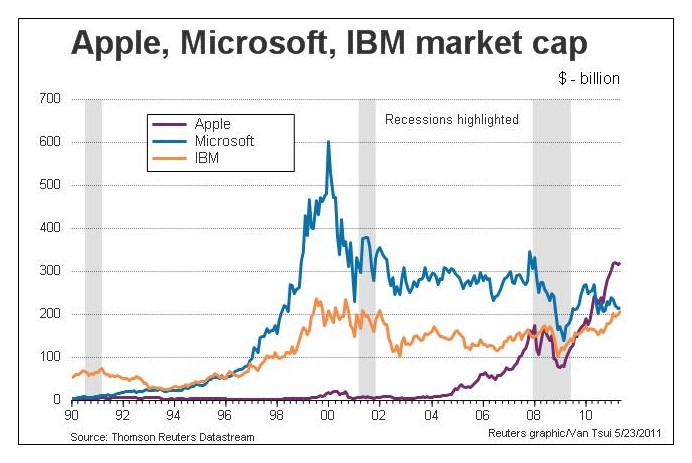
For the first time in 15 years, since 1996, IBM has overtaken Microsoft in market value. It is now the second largest US tech company behind Apple, while Microsoft has dropped to third.

Only a year after Apple had surged past Microsoft in market value, IBM has also powered past Microsoft.

Market capitalisation of Apple, IBM and Microsoft over the past 20 years

Market capitalisation of Apple, IBM and Microsoft over the past 20 years

IBM had been the dominant company in the computer industry for decades until it selected Microsoft to supply the operating system for its personal computers in the eary 80s. Bill Gates managed to turn that opportunity into a dominance of the operating systems market.

Rank Company Market cap 

(billion)

1 Exxon Mobil $397.4
2 Apple $309.2
3 General Electric $205.6
4 IBM $203.8
5 Microsoft $203.7

At its zenith just before the turn of the millennium, Microsoft’s market capitalisation was three times that of IBM’s. It was also the biggest US company then. Now it is the third biggest technology company and fifth biggest US company.

Microsoft is facing challenges in many of its business sectors. Its dominance of the operating systems market, is being challenged by the advent of tablets and Google’s newly introduced Chrome OS, while it has lost its market share in the smartphone market to RIM’s BlackBerry devices, Apple’s iPhones and recently Android based phones.

Microsoft’s decline since 2000 coincides with the burst of the Internet technology bubble and the tenure of Bill Gates’ successor Steve Ballmer as the CEO.

IBM, on the other hand, has reinvented itself from being a predominantly hardware manufacturer into a specialist in enterprise software, servers and consulting. It has even offloaded its PC business to Lenovo in 2002.

Bill Rigby of Reuters observes that “an investor putting $100,000 into both stocks 10 years ago would now have about $143,000 in IBM stock and about $69,000 in Microsoft stock.”

Google to unveil Chromebooks

Tuesday, May 10th, 2011

Google will reveal its first Chrome-based notebooks from Acer and Samsung at the Google I/O conference in San Francisco. They will be available for order online from June 15.

The Samsung Chromebook will cost $429 for the Wi-Fi only version and $499 for the 3G version, while Acer’s Wi-Fi only Chromebook will cost $349.

It’ll be interesting whether consumers will bite, considering that you can buy a decent Netbook or an iPad the $499 price-tag for the 3G Samsung Chromebook.

Acer Chromebook, available from June 15, 2011

Acer Chromebook

Chromebooks will be available online June 15 in the U.S., U.K., France, Germany, Netherlands, Italy and Spain. More countries will follow in the coming months. In the U.S., Chromebooks will be available from Amazon and Best Buy and internationally from leading retailers.

Equipped with dual-core processors from Intel, the Chromebooks boast all-day battery life, and instant-on ability and built-in Net connectivity. Chromebooks will get updates and patches automatically every few weeks, like its browser cousin Chrome.

A special pricing is available for schools – Google will charge $20 a month for each Chromebook. The price will include hardware, administrative support, hardware upgrades, and warranty.

With this long awaited foray, Chromebooks will be taking on the tablet market dominated by Apple’s iPads, and the PC market dominated by both Microsoft and Apple.

Samsung Chromebook, available from June 15, 2011

Samsung Chromebook

The Chromebooks will run a new new bare-bones operating system that is basically a web browser that allows users to access applications like email, wordprocessors and spreadsheets directly on the web, instead of installing software such as Outlook or Office directly on the computer’s harddisks.

Users can also store their music and documents in the cloud for access from other computers as long as there is an Internet connection. Naturally, that means that a lot of the functionality may likely be unavailable or crippled offline.

Google has been touting Chrome as an alternative to Microsoft Windows for some two years now, but it has encountered delays producing computers designed to use the software.