Posts Tagged ‘lens’

Company byte: Leica Camera

Sunday, June 26th, 2011

Leica Camera is a German optics company that has a long heritage of over 162 years in quality German engineering. Leica makes cameras, high quality lenses and sport optic tools.

Leica Camera AGThe company has been in the forefront of photojournalism and related activities – having been bestowed the Oskar Barnack Award for high quality reportage photography.

Leica Camera has presented photographs taken by international photographers through its galleries offering access to life’s hidden stories.

Follow articles related to Leica on tech4tea.com.

Carl Zeiss joins the Micro Four Thirds Standard

Monday, February 7th, 2011
Another high-end lens maker, Carl Zeiss, has joined the Micro Four Thirds System Standard Group. More choice for users of Panasonic or Olympus Micro Four Thirds digital cameras.

Logo of Carl Zeiss Carl Zeiss has joined the “Micro Four Thirds System Standard Group”, announced Olympus in its press release.

Logo of Micro Four Thirds

Initiated by Olympus and Panasonic in 2008, the Micro Four Thirds (MFT) is a standard for lens mounts that is tailored to digital system cameras. The standard defines the sensor size, the lens mount together with the communication protocol, the aspect ratio and the flange back distance, as well as the optical requirements for production and construction.

Distagon lens from Carl Zeiss
The renowned lens-maker will make lenses designed specifically for MFT cameras, providing direct compatibility for MFT users, instead of depending on lens-mount adapters.

Carl Zeiss AG is a 165 year-old manufacturer of optical systems, based in Germany and founded in 1846 by Carl Zeiss.

Micro Four Thirds vs Four Thirds

Saturday, February 5th, 2011
Ever wondered what’s the difference between Four Thirds and the newer Micro Four thirds? Here’s a really quick comparison.

Flangeback distance: MFT only 50% of FT

The Four Thirds system is a standard created by Olympus and Kodak in 2001 for digital single-lens reflex camera (DSLR) design and development. Unlike older SLR systems, Four Thirds has been designed from the ground up to be entirely digital.

The Micro Four Thirds system was developed in 2008 by Olympus and Panasonic.

The Four Thirds System standard offers the benefits of compact, lightweight performance, and the new Micro Four Thirds System standard takes this still further to enable development of new ultra-compact interchangeable lens type digital camera systems.

The image sensor diagonal dimensions are the same for both Four Thirds System and Micro Four Thirds System standards.

Mount electrical contacts: MFT(11) vs FT(9)

The Micro Four Thirds System standard enables users to enjoy the same high image quality of the Four Thirds System’s 4/3-type image sensor in a much more compact body, and also take advantage of significantly more compact lenses, particularly in the wide-angle and high-power zoom range.

The new Micro Four Thirds System standard also incorporates a greater number of lens-mount electrical contacts (increased from 9 to 11) for the support of new features and expanded system functionality in the future.

Lens mount diameter: MFT is 6mm smaller than FT

Other primary distinguishing features of the Micro Four Thirds System standard (when compared to the Four Thirds System standard) are:

Approximately 50% shorter flangeback distance (mount-to-sensor distance).

Lens mount outer diameter approximately 6mm smaller.

Schneider Kreuznach joins the Micro Four Thirds Standard

Friday, February 4th, 2011
Users of Panasonic or Olympus Micro Four Thirds digital cameras can now look forward to new lens options from Schneider-Kreuznach, the German maker of high performance lenses.
Logo of Schneider Kreuznach
Schneider-Kreuznach has joined the “Micro Four Thirds System Standard Group”.

Logo of Micro Four Thirds Developed by Olympus and Panasonic, “Micro Four Thirds” is a standard for lens mounts that is tailored to digital system cameras. The standard defines the sensor size, the lens mount together with the communication protocol, the aspect ratio and the flange back distance, as well as the optical requirements for production and construction.

Any member in the consortium of companies in the Group can make and distribute accessories for the system that meet the standard. Users can therefore use and combine components from different manufacturers.

Lens from Schneider Kreuznach The Schneider Group specializes in developing and producing high-performance photographic lenses, cinema projection lenses, as well as industrial optics and precision mechanics.


The group was founded in Bad Kreuznach (Germany) in 1913 with subsidiaries in Göttingen, Dresden, New York, Los Angeles, Seoul, Hong Kong and Shenzhen. It has around 620 employees worldwide, with 330 based in its German headquarters.

C.J.P.C. Camera Grand Prix 2010 Award Winners

Thursday, May 20th, 2010
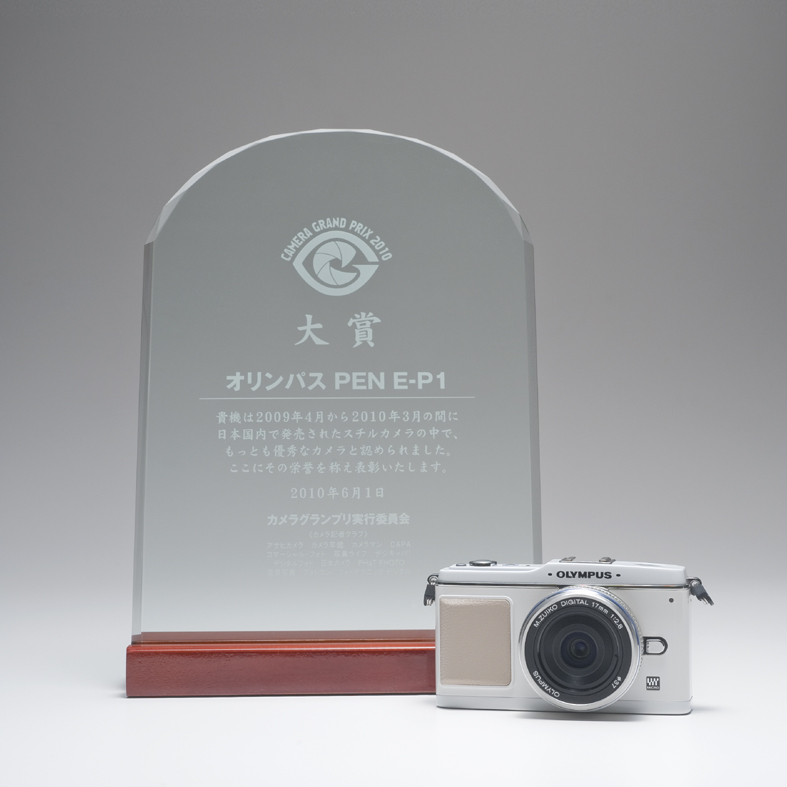
Olympus PEN E-P1: CJPC 2010 "Camera of the Year" & "Readers Award"

Olympus PEN E-P1: CJPC 2010 "Camera of the Year" & "Readers Award"

The winners of the annual C.J.P.C. (Camera Journal Press Club) awards have been released. The Olympus PEN E-P1 has won both the top awards of “Camera of the Year” as well as “Readers Award”. The “Editors Award” went to the Canon EF 100mm F2.8L Macro IS USM and Sony back-illuminated CMOS Sensor “Exmor R”.

Olympus PEN E-P1: CJPC 2010 "Camera of the Year" & "Readers Award"

Olympus PEN E-P1: CJPC 2010 "Camera of the Year" & "Readers Award"

The Olympus PEN E-P1 was selected from a shortlist of 199 cameras introduced in Japan between 1 April, 2009 and 31 March, 2010. This is the first Olympus camera to receive the Japan Camera Journal Press Club’s highest honor since the inception of the Japan Camera Grand Prix awards in 1984. Previous “Camera of the Year” winners include the Canon EOS 5D Mark II in 2009 and the Nikon D3 in 2008.

(more…)