Archive for the ‘Facebook’ Category

Facebook to buy Instagram photo app for US$1 billion

Tuesday, April 10th, 2012

US$100 billion Facebook Inc has agreed to fork out US$1 billion in cash and stock to acquire the photo-sharing application for smartphones. The deal is expected to be completed this quarter.

Is Instagram worth one-hundredth of Facebook?

Is Instagram worth one-hundredth of Facebook?

Facebook is probably looking at attracting the users of mobile devices through its acquisition of Instagram – its biggest acquisition yet.

“Instagram, owned by San Francisco-based Burbn Inc, was valued at $500 million after raising about $60 million last week from investors,” Bloomberg was told.The idea is to attract the advertisers interested in reaching the mobile users.

Instagram started out as the top free photo-sharing app on Apple’s App Store with more than 30 million users.

Only last week, the company introduced the app for Android devices as well.

Instagram has only 13 employees so the offer works out to some US$76 million per employee, according to the Los Angeles Times.

“We need to be mindful about keeping and building on Instagram’s strengths and features rather than just trying to integrate everything into Facebook. That’s why we’re committed to building and growing Instagram independently,” – Zuckerberg wrote on his Facebook fanpage.Instagram was launched in October 2010 by Kevin Systrom and Mike Krieger with a seed funding of about US$500,000.

It subsequently raised US$7 million in 2011, when it had 1.75 million users, according to Bloomberg.

California-based Facebook is the biggest social-networking service today and intends to raise US$5 billion in its initial public offering (IPO) – which is to date the biggest IPO for an Internet company, valuing it at US$100 billion.

Facebook’s CEO, Mark Zuckerberg, said it plans to let Instagram retain its independence, in an effort to reassure Instagram users and potential advertisers.

Twitter reaches 500 million users

Thursday, February 23rd, 2012

Twitter now has more than 500 million users, according to twopcharts.com, although only 100 million are active accounts.

Websense illustrates “some of the not-so-high Twitter highlights of the last 5 years”.

Websense illustrates “some of the not-so-high Twitter highlights of the last 5 years”.

Started in 2006, Twitter had hit 300 million users back in May 2011.

Commenting on the situation, Mr. Carl Leonard, Senior Manager, Websense Security Labs said: “… what’s in a number? Twitter is free to use, easier to abuse and is constantly targeted by malware authors and spammers. It’s nothing new; not all Twitter users are who they claim to be. Let’s see this more than just a numbers game and focus on keeping users safe in real-time so they are not just another statistic.”Twitter estimated that only ten percent of its active users have sent more than 100 tweets, while only 20 percent of users have sent more than ten tweets.

Facebook hit 500 million ACTIVE users back in July last year.

Launched in 2004, Facebook now has more than 845 million monthly active users, according to its statistics.

The number of DAILY active Facebook users is roughly half that number, at 483 million.

The popularity of Twitter has made it a fertile hunting ground for abuse by spammers and bot networks.

New iPad app: Blum Connect

Sunday, January 22nd, 2012

Redesign your home and plan for new furniture with the help of information and visuals from this new free iPad app.

Blum Connect is a new free iPad app for home renovation ideas and guide.

Blum Connect is a new free iPad app for home renovation ideas and guide.

Thinking of rebuilding your kitchen? Check out this free iPad app from Blum.

Developed by Apostrophe Digital, the app serves as a guide for consumers, designers and reference for the sales team for Blum.

Blum Connect is a free iPad app on iTunesThere is a gallery of product and lifestyle images for the kitchen, living room, bedroom, bathroom, children’s room and study. Double-click to zoom in.

Related brochures, prices, memos, videos, press information, and pricing can be easily accessed and shared with friends and family via email or Facebook.

The brochures and memos, containing detailed information for each product or product category can be downloaded and stored as iBooks.

A list of authorised Blum Design & Build partners, carpenters and dealers is also provided.

Search, plus your world — by Google

Friday, January 13th, 2012

Google has extended its search results by tapping into the data, photos, information and relationships in your Google+ and Picasa account — as long as you’re logged onto your Google account.

Google launched this extension to its existing search engine earlier this week. This opt-out integration will be gradually rolled out over the coming days for users using Google Search in English.

Prior to this extension, Google returned results based on its indexing engine of the public information available on the Internet and listed them in order of relevancy based on its Page Rank algorithm.

With Search Plus Your World – if you’re logged into your Google account – henever you do a search, Google Search will add three types of information to the search process and results listings:

  1. Personal Results. Photos and posts, related to your search term, from Google+ and Picasa — both your own and those shared specifically with you, that only you will be able to see on your results page;
  2. Profiles in Search. Helps you find people within your Google+ network or circles — both in autocomplete (as you type in the search term) and results listings;
  3. People and Pages. Helps you find people’s profiles and Google+ pages related to a specific topic or area of interest — not just in your social circles, and enables you to follow them with just a few clicks. This is available even if you’re not logged into Google.

To me, this feature is an enhancement. Information is drawn from my own account, to which I have permission to access anyway. The information is not available to anyone else doing a similar search on Google as long as he is not logged into my account.

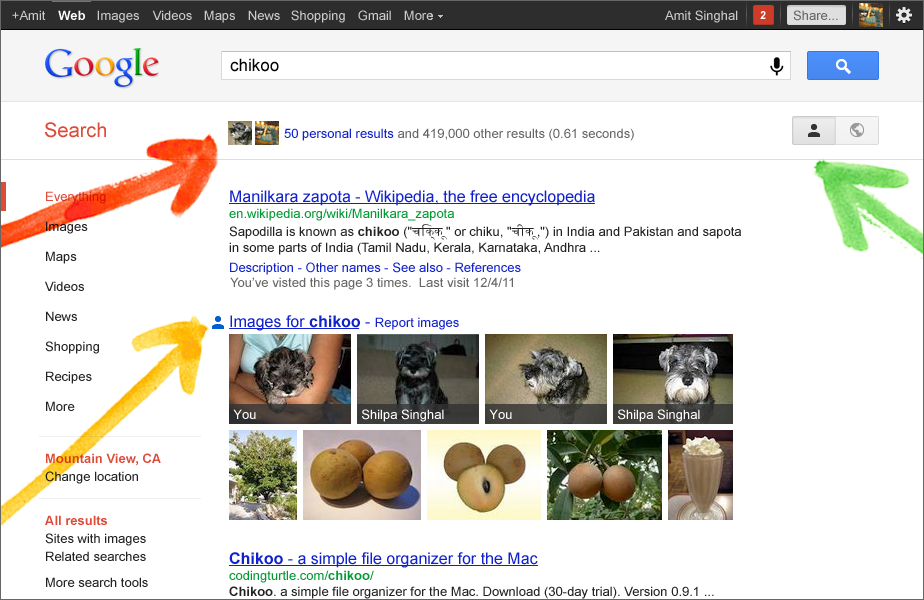
Screenshot from Google showing addition of personal results, photos and switch to turn off the feature.

Screenshot from Google showing addition of personal results, photos and switch to turn off the feature.

It makes my search more relevant and it’s easier to do a comprehensive search that includes my Google+ and Picasa accounts (and perhaps other assets in the future).

The only problem is that it is now much easier for an intruder too, should my account ever be compromised or if I forget to log out of my account.

Note to self: Log out even if you’re stepping away for a coffee. What would have taken hours to consolidate across your different accounts can now be searched in one fell swoop while you’re raiding the fridge.

I share many people’s laments that this extension of search into my own social networks is limited to my Google+ account and Google assets —  and not my Twitter and Facebook accounts.

Both Twitter and Facebook have disallowed Google from crawling their content.

Facebook is keeping mum for the moment, but Twitter is crying foul — claiming that Google is leveraging unfair advantage by using its predominant Search presence to help its nascent Google+ network against other social networks. Two thirds of search in the US goes through Google Search.

Twitter used to allow Google to tap its data until recently, when it stopped the arrangement with Google but continued the partnership with Microsoft’s Bing search engine.

Search Plus Your World can be toggled on and off but it is default on at the start of every session. You need to go to Settings to permanently turn it off.

Search Plus Your World can be toggled on and off but it is default on at the start of every session. You need to go to Settings to permanently turn it off.

It’s beyond the man in the street to know if it was Twitter deliberately keeping Google out or whether it’s Google who preferred to be kept out so it’s Search Plus Your World is now “unfortunately” constrained to only Google+.

Only an investigation by the FTC can ascertain the posturing and vested interests involved, and organisations like the Electronic Privacy Information Center are already considering filing a anti-competitive complaint to the FTC regarding this.

By the way, here’s how to turn off the Google’s Search plus Your World permanently if you wish to do so.

Social media coverage during SMRT disruptions

Monday, January 9th, 2012

During the three major SMRT disruptions in December 2011, Singaporeans flocked to online sites to share updates, find news and exchange views.

Experian Hitwise has released data about Singapore Internet users during that period.

Top search terms containing SMRT (Comparison between 24 rolling weeks ending 10 December and 24 December)

Top search terms containing SMRT (Comparison between 24 rolling weeks ending 10 December and 24 December)

Experian Hitwise found that top search variations used by Singaporeans include SMRT breakdown, SMRT twitter, SMRT CEO, SMRT CEO Saw Phaik Hwa, SMRT news, SMRT Facebook and SMRT disruption.

Variations for the word “SMRT” on all search engines in Singapore saw an increase of 38% in related search clicks on week ending 24 December, the week after the disruption of train services.

“SMRT” remained the key search term used by Singaporeans within the two weeks. Fast moving event-related search terms from the two periods include specific person searches, SMRT CEO and SMRT CEO Saw Phaik Hwa.

Websites receiving traffic from SMRT CEO related terms over 24 rolling weeks ending 24 December.

Websites receiving traffic from SMRT CEO related terms over 24 rolling weeks ending 24 December.

Ex-SMRT CEO, Saw Phaik Hwa, was widely discussed during the crisis.

Search terms around her name generated high online traffic in several social media websites and community forums including Facebook (17.98%) and Singapore HardwareZone Community (10.11%).

Top websites receiving traffic from terms in SMRT Disruption Period (Comparison between 24 rolling weeks ending 10 December and 24 December).

Top websites receiving traffic from terms in SMRT Disruption Period (Comparison between 24 rolling weeks ending 10 December and 24 December).

SMRT’s corporate site remained the top website receiving traffic from the search terms during and after the incident despite a 20% decline of search clicks share over the course.

However, traffic on social media and news websites increased the most over the course.

Facebook versus newsfeed porn

Wednesday, November 16th, 2011

Facebook has identified perpetrators of the recent flood of violent photos and hardcore porn in some users’ newsfeeds.

“We’ve built enforcement mechanisms to quickly shut down the malicious Pages and accounts that attempt to exploit it,” Facebook told Bloomberg.Facebook said that it is now working with its legal team to “ensure appropriate consequences follow.”

This was after porn images of extreme violence, and fake photographs of celebs including Justin Bieber in sexual situations inundated the profiles of some Facebook users.

Exploiting a browser vulnerability, users were tricked into pasting malware into their browsers, which resulted in sharing the offensive content.

Digital Life study by TNS uncovers Internet pollution by digital waste

Thursday, November 10th, 2011

You’ve heard of “environmental pollution” and “noise pollution”, as well as “toxic waste” and “hazardous waste”. Now it’s time to add “Internet pollution” and “digital waste” to your lexicon.

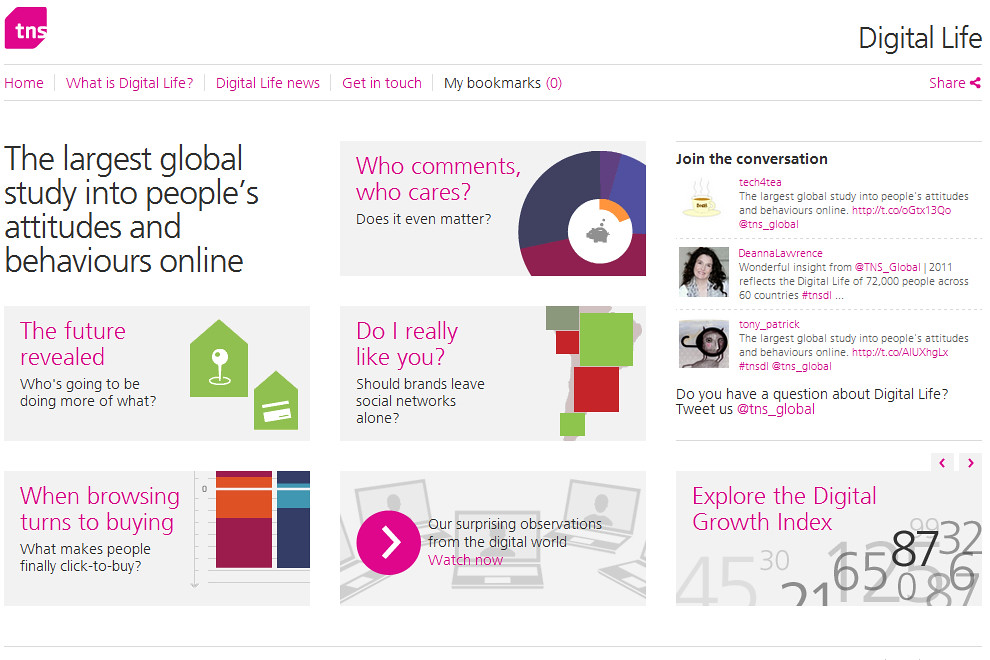
Digital Life 2011 study by TNS

Digital Life 2011 study by TNS

TNS today published their study of the modern digital lifestyle in today’s Internet age. The extensive survey was based on conversations with over 72,000 people in 60 countries. Digital Life’s size, scale and detail make it the most comprehensive view of consumer attitudes and behaviour online, on a global and local level.

“Digital waste is the accumulation of thousands of brands rushing online without thinking who they want to talk to – and why. Whilst many brand owners understand the value and relevance of the vast online world, many fail to understand the audience they are connecting with,” said Arnaud Frade, Regional Director Digital Strategy, TNS APAC.Inaugurated in 2010, today’s 2011 report is the second iteration of the annual study.

One of this year’s key findings is that businesses are generating much “digital waste” by way of electronic marketing material on the Internet that no one is interested in perusing.

For instance, even though brands are scrambling to inundate social networks such as Facebook and YouTube with their online presence, Digital Life showed that 43% of Singapore consumers actually don’t want to be bothered in social networks.

The global average for consumers who don’t want to engage with brands via social media is even higher at 57% for developed markets such as US (60%), UK (61%), Japan, Australia, Hong Kong and Taiwan.

“Control is firmly in the hands of consumers. The goal should therefore be to understand your target audience intimately, enabling your brand to connect openly and with integrity. This also means that selecting the right online approach and focusing on efficient messaging are critical to be relevant” Frade added.Brands that persist in spamming these consumers are not only wasting their marketing resources, but polluting the Internet instead. In the worst case, mis-targeted consumers may even resent the invasion of their social networks by the uninvited attention.

Businesses should therefore study these demographics and their details in order to tailor a marketing campaign that targets the right audience on the Internet.

The Digital Life study aims to provide these knowledge to brands looking for growth opportunities in the online world.

Digital Life applies TNS’s long-established expertise and deep consumer understanding to develop insights and address the key questions that inform marketing investment.

Some of these questions include:

  • How can I use digital channels to help grow my business?
  • Who can I reach through digital platforms?
  • How do I build my brand through engagement with new and existing consumers online?
  • How do I identify and cultivate brand advocates online?
  • How do I target potential customers online?

Digital Life also introduces the Digital Growth Index, a single number score defining the opportunity across product categories and countries for growth through digital channels, and showing the diversity of opportunities available in the online world.

An interactive data visualisation of the key findings can be found at www.tnsdigitallife.com.

About TNS

TNS Global Market ResearchTNS advises clients on specific growth strategies around new market entry, innovation, brand switching and stakeholder management, based on long-established expertise and market-leading solutions.

With a presence in over 80 countries, TNS has more conversations with the world’s consumers than anyone else and understands individual human behaviours and attitudes across every cultural, economic and political region of the world.

TNS is part of Kantar, one of the world’s largest insight, information and consultancy groups.