Posts Tagged ‘Apple’

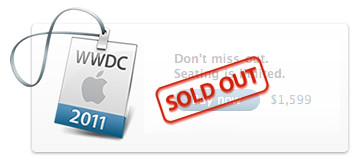
Apple WWDC 2011 sold out almost immediately

Tuesday, March 29th, 2011
As expected, tickets for the Worldwide Developers Conference (WWDC) this year were sold out even faster than last year’s 8 days. Tickets, priced at US$1,599, were sold out almost immediately when sales commenced.
Apple WWDC 2011 tickets sold out
Slated to be held from June 6 – 10 at San Francisco’s Moscone West, there is much speculation on whether the iPhone 5 will be launched during the conference. There is also chatter on whether the iOS5 and new Mac OS Lion will be released during the conference. 

At any rate, the rapid sell-out of the tickets indicate that the popularity of the Apple ecosystem is showing no signs of losing its momentum, even in the face of competition from Android-based devices and the resurgence of devices based on Windows Phone 7, HP’s webOS and RIM’s BlackBerry Playbook.

Apple WWDC 2011 to kick off June 6 in San Francisco

Monday, March 28th, 2011
Last year’s conference tickets were sold out in a record 8 days. I expect the tickets will sell out even faster given its focus on the iOS and the Mac OS, and how to harness them for churning out sizzling hot apps.

The annual Worldwide Developers Conference (WWDC) will be held this year from June 6 – 10 at San Francisco’s Moscone West.

Apple Worldwide Developers Conference 2011 June 6 - 10Apple announced that during the five-day conference, it “will unveil the future of iOS and Mac OS, including exciting demonstrations of the new kinds of apps that developers can build using Apple’s advanced frameworks.”

“At this year’s conference we are going to unveil the future of iOS and Mac OS,” said Philip Schiller, Apple’s senior vice president of Worldwide Product Marketing. “If you are an iOS or Mac OS X software developer, this is the event that you do not want to miss.”

Mobile developers will be able to explore the latest innovations and capabilities of iOS and learn how to enhance the functionality, performance and design of their apps. Mac developers will see and learn how to develop Mac OS X Lion applications using its latest technologies and capabilities. Developers can bring their code to the labs and work with Apple engineers, applying development techniques and best-practices to enhance their apps.

Activities at Apple’s WWDC 2011 include:

  • more than 100 technical sessions presented by Apple engineers on a wide range of technology-specific topics for developing, deploying and integrating the latest iOS and Mac OS technologies.
  • over 1,000 Apple engineers providing developers with code-level assistance, insight into optimal development techniques, and guidance on how they can make the most of iOS and Mac OS technologies in their apps.
  • the opportunity to connect with thousands of fellow iPad, iPhone and Mac developers from around the world.
  • Apple Design Awards which recognize iPad, iPhone and Mac apps that demonstrate technical excellence, innovation and outstanding design.

Tickets are priced at US$1,599 – same as last year. Go to the Apple Worldwide Developers Conference 2011 website to purchase tickets, as well as for updates and more information.

Flash-to-HTML5 conversion tool from Adobe

Wednesday, March 9th, 2011
At long last, Adobe has released an experimental piece of software codenamed Wallaby that can convert Flash files into HTML5. It’ll be interesting to see how the Flash vs HTML5 rivalry pens out.

HTML5 logoThis tool was first demo-ed at Adobe Max 2010 developer conference in October last year. The cross-platform AIR app is available for free download as a technology preview for developers.

Wallaby allows Flash developers to deployFlash content on Apple iOS devices like iPads and iPhones, which has banned Flash on Steve Jobs’ accusations that it is vulnerable to exploits, battery draining, and prone to frequent crashes.

Flash logoFLA files from Flash can be instantly converted to HTML5 by a simple drag-and-drop. The HTML can then be edited in Dreamweaver or any HTML authoring tool.

Tom Barclay, senior product manager for Flash pointed out that not all elements from Flash files will make it into HTML5. Although the overall look and feel can be ported, much will be discarded in the migration.

The Wallaby Release Notes describe what features are supported, what differences we have already discovered between the various browsers, what device variations have been found, and any currently known issues.
Adobe logo What is thrashed: audio, video, ActionScript, as well as blend modes and filters (apart from simple alpha), dynamic masks, some Text Layout Framework text, and 3D tweens and transforms.

What is supported: vector art and images, classic text, keyframes, MovieClips and graphics, classic motion and shape tweens, rollover buttons, and instance names.

Immediate application of the tool would mainly be for making basic banner ads and animations, especially if the FLA files have already been developed.

iAds ProducerApple had released iAd Producer in December last year. It is a free tool “for online advertisers to create content for Apple’s iAd platform, helping the company to establish HTML5 as a viable alternative to Adobe Flash technology on mobile devices,” wrote Daniel Ionescu of PCWorld.

iAd Producer is a visual HTML5 authoring tool, available to Apple developers for producing advertisements for iOS devices, using a combination of HTML5, Javascript and CSS3.

Steve Jobs launches the Apple iPad 2

Thursday, March 3rd, 2011
Steve Jobs emerges from medical leave to unveil the iPad 2, an evolutionary upgrade of its predecessor, making it thinner, lighter and faster.

The iPad 2 now comes in white, and its thinner, lighter and faster.The iPad 2 was unveiled as anticipated on 2 Mar at the Yerba Buena Center for the Arts in San Francisco. Specifications were in line with virulent speculations prior to the event. What was more uncertain was whether Steve Jobs would helm the launch.

He did, and Apple’s stock price rose $2.81 to $352.12 on the Nasdaq in a sign of investor confidence. The stock has risen 9.2% this year.

Steve Jobs has been on medical leave since 17 Jan but had stated that he would still “be involved in major strategic decisions for the company.” He is on his third period of medical leave in seven years and there has been rife rumours about how dire his health has become. For some, his attendance at the event was as important as the launch of the new tablet.

The cover is attached using magnets and doubles up as a stand.With 350,000 apps on the Apps Store, with 65,000 dedicated to the iPad 2, the tablet will hit US shelves on 11 March and ship internationally on 25 March. The $499 starting price is the same as the original iPad when it was first launched in Apr 2010.

Competitors already in the market include the Samsung Galaxy and Motorola Xoom – both Android-based tablets. Research In Motion plans to release four versions of its Playbook this year while HP will roll out the WebOS-based Touchpad.

Here are the more noteworthy features of the iPad 2:
The cover comes in 10 colours.

  • It’s available in white.
  • Has 2 cameras for video conferencing: one front (VGA-quality), one back(720p).
  • Faster: New A5 dual-core processor claimed to be twice as fast as the previous iPad.
  • Faster: Graphics performance nine times faster than before.
  • Thinner: by one-third to 8.8mm.
  • Lighter: 1.3 pounds from 1.5 before.

Optional extras:

  • Optional $39 HDMI adaptor that connects the iPad’s 30-pin port to an external display so that iPad’s display is mirrored on the external display.
  • New magnetic protective case that puts the iPad to sleep when it is closed. Bendable and doubles up as an iPan stand. Comes in 10 colours (plastic ones: $39, leather: $69).
  • iMovie and Garageband as Apps at $4.99 each on the Apps store

Pricing (original iPads are now $100 cheaper):

Attached using magnets, the flexible cover puts the iPad 2 to sleep when covered.1. Wi-Fi only versions:
  • 16GB: $499
  • 32GB: $599
  • 64GB: $699

2. Wi-Fi/3G devices:

  • 16GB: $629
  • 32GB: $729
  • 64GB: $829

Apple updates MacBook Pro line of notebooks

Friday, February 25th, 2011
Ten months after its last revamp in Apr 2010, Apple updates its premium line of notebooks with groundbreaking Thunderbolt technology and more powerful graphics engine, and doubles processor speed across the board.

Apple's revamped MacBook Pro family of products

MacBook Pro is the first computer on the market to implement the new Thunderbolt I/O technology which promises blistering data transfer speeds of up to 10 Gbits/s with high performance external devices. This is 20 times faster than the ubiquitous USB2.0.

Ports for the MacBook Pro notebook

Note the single Thunderbolt port (fourth from the left) labeled with the symbol of the lightning bolt.

Developed by Intel with collaboration from Apple, and previously code-named “Light Peak”, Thunderbolt allows multiple devices to be daisy-chained together, without bandwidth and power attenuation concerns.

This enhances the expandability of the notebooks as the daisy-chained devices can be connected to the single Thunderbolt port, without having to build multiple USB ports on the notebook, where space comes at a premium.

A FaceTime HD camera is now built into the MacBook Pro.

Oblique view showing the ports at the side
The 13-in MacBook Pro comes standard with a dual-core i5 processor and Intel’s integrated graphics chipset

The larger 15- and 17-in models runs on a quad-core i7 and comes with AMD’s Radeon HD 6490M or 6750M discrete graphics. Apple claims that these were three times faster than the Nvidia graphics chips in the older models.

It also claims that all MacBook Pros are “up to twice as fast as their predecessors.”

Pricing & Availability for Singapore

The new 13-inch MacBook Pro, 15-inch MacBook Pro and 17-inch MacBook Pro will be available in the week of March 6 through the Apple Store and Apple Authorized Resellers.

Front view of the MacBook ProThe 13-inch MacBook Pro is available in two configurations: one with a 2.3 GHz Dual-Core Intel Core i5 and 320GB hard drive starting at S$1,648 ; and one with a 2.7 GHz Dual-Core Intel Core i5 and 500GB hard drive starting at S$2,048.

The new 15-inch MacBook Pro is available in two models: one with a 2.0 GHz Quad-Core Intel Core i7, AMD Radeon HD 6490M and 500GB hard drive starting at S$2,488 and one with a 2.2 GHz Quad-Core Intel Core i7, AMD Radeon HD 6750M and 750GB hard drive starting at S$2,988.

The new 17-inch MacBook Pro features a 2.2 GHz Quad-Core Intel Core i7, AMD Radeon HD 6750M and 750GB hard drive and is priced at S$3,398.

Configure-to-order options include faster quad-core processors up to 2.3 GHz, additional hard drive capacity up to 750GB, solid state storage up to 512GB, more memory up to 8GB DDR3, antiglare and high-resolution display options and AppleCare® Protection Plan. Additional technical specifications and configure-to-order options and accessories are available online at its website.

93% of 4.5 million tablets sold in 2010Q3 were iPads

Friday, February 25th, 2011

This is hardly surprising since the iPad has been the only tablet around for most of last year, until Samsung’s Galaxy Tab.

ABI ResearchAccording to data from ABI Research, of the approximately 4.5 million tablets sold in the third quarter of 2010, about 93 percent were Apple iPads.

The original iPad went on sale on 3 April 2010. Reports anticipate the announcement of the iPad 2 next week on 2 Mar 2011.

Samsung’s well-received Android-based Galaxy Tab was launched late last year, while Motorola’s Xoom Android-based tablet became available yesterday. Research In Motion plans to release four versions of its Playbook this year.

iPad 2 launch on 2 Mar?

Thursday, February 24th, 2011

Have you received the invitation from Apple?

Apple's invitation for the 2 March event

Apple emailed the invitation to a media event in San Francisco that showed a calendar page with the date 2 March and the top right corner of the page peeling back to reveal an iPad underneath. The peek-a-boo iPad suggests that Apple may unveil its new version of the iPad during the event.

Earlier reports from Taiwan-based Yuanta Securities had surmised that the iPad launch might be delayed to June this year because of production bottlenecks at the China production line of Hon Hai – Apple’s Taipei-based contract manufacturer.

Will the iPad 2 be announced on 2 Mar?Indulging in my own bit of speculation, both schools of thought may not be untrue. We might actuallly see an iPad announcement on March 2 followed by the taking of orders, with deliveries only materialising in June, probably staged out based on country.

What with the legion of Android tablets being unveiled by the day, with specs that trounce the year old iPad, any delay in unveiling the upgraded specs of iPad 2 could create a negative impression in people that the iPad is inferior to Android tablets.

The announcement of iPad2 with all the specs that has been rumoured to ship with it should maintain its aura of invincibility that over challengers.

Apple certainly won’t want to announce the iPad 2 in June only to have people yawn at its specs, since by then it may already have been featured on the Android tablets out there.

Samsung’s Android-based Galaxy Tab was launched last year and was well-received. Motorola’s Xoom Android-based tablet goes on sale today, while Research In Motion plans to release four versions of its Playbook this year.

The original iPad went on sale on April 3. Announcing the iPad 2 on March would mean that it will follow an annual cycle of updates like the iPhone and iPod.

Apple Subscriptions versus Google One Pass

Friday, February 18th, 2011

Here’s a quick view of how the two newly announced subscription platforms from Apple and Google stack up against each other. Either way, it’s a good thing for consumers in terms of both choice and convenience.

Platform Apple Subscriptions Google One Pass
Viewable on Web browsers: smartphones, tablets, computers.

iOS: iPad, iPhone, iPod Touch

Commission Apple keeps 30% Google keeps 10%
Billing system Apple App Store Google Checkout
Link to website subscription outside App Not allowed Yes
Share customer info with publishers Opt-in by subscribers Opt-out by subscribers
Subscribe from Almost global US, UK, Canada, Germany, France, Spain for customers,
Publish from Almost global Wherever Google Checkout is available
Content Magazines, newspapers, video, music etc. Magazines, newspapers.

Unveiled Google One Pass to rival and undercut Apple Subscriptions

Thursday, February 17th, 2011
A day after Apple unveiled its new Subscriptions billing system for content-based apps, Google announced its One Pass service for publishers to sell their content.

Google One passGoogle takes 10% off the bill and lets publishers keep 90% of the subscription. This undercuts the 30% that Apple demands from publishers participating in Apple’s subscription platform.

Payment will use Google Checkout which will cover publishers’ e-commerce and payment processing requirements, removing any need to build a third-party payment system into publishers sites.

Google One Pass is currently intended for periodicals, such as news and magazines, but can be used for other types of content, according to its FAQ on the One Pass website.

Publishers decide the price and terms of the content they choose to sell through Google One Pass. They determine the duration and extent of access to their content. For instance, this may include setting a one-week or 30-day limit on the accessibility of a given article. Partners control what content is accessed through Google One Pass and what content is free to users.

Google One Pass will enable users to access content on connected, browser-enabled devices and from mobile apps where the mobile OS terms permit publishers to access the web via the app for Google One Pass transaction or authentication services.

Content purchased through One Pass will be accessible on smartphones, tablets and computers that are browser-enabled and connected to the Internet. Syncing between devices, will be via Google One Pass transaction or authentication services.

Publishers who have committed to One Pass include Axel Springer AG, Focus Online (Tomorrow Focus), Stern.de, Media General, NouvelObs, Bonnier’s Popular Science, Prisa and Rust Communications.

Google CheckoutOne Pass is currently available in Canada, France, Germany, Spain, the U.K. and the United States.

However, publishers in any country where Google Checkout is available can implement Google One Pass.

Apple’s new subscription service for content-based apps.

Wednesday, February 16th, 2011

Subscriptions for content-based apps – magazines, newspapers, video, music etc – can be purchased from within Apple’s App Store using the same billing system that has thus far been used for normal apps and In-app purchases.

Apple will get 30% of the subscription for purchases through its App Store – the same share that it charges today for other In-App Purchases.

Apple launches subscriptions in App StoreThe billing model is the same as the digital subscription billing service that Apple recently launched with News Corp.’s “The Daily” app.

Publishers set the price and length of subscription (weekly, monthly, bi-monthly, quarterly, bi-yearly or yearly). Customers pick the length of subscription and are automatically charged based on their chosen length of commitment.

Customers can review and manage all of their subscriptions from their personal account page, including canceling the automatic renewal of a subscription.

“Our philosophy is simple—when Apple brings a new subscriber to the app, Apple earns a 30 percent share; when the publisher brings an existing or new subscriber to the app, the publisher keeps 100 percent and Apple earns nothing,” said Steve Jobs, Apple’s CEO.

“All we require is that, if a publisher is making a subscription offer outside of the app, the same (or better) offer be made inside the app, so that customers can easily subscribe with one-click right in the app.”

Publishers who use Apple’s subscription service in their app can also leverage other methods for acquiring digital subscribers outside of the app.

For example, publishers can sell digital subscriptions on their web sites, or can choose to provide free access to existing subscribers. Since Apple is not involved in these transactions, there is no revenue sharing or exchange of customer information with Apple. Publishers must provide their own authentication process inside the app for subscribers that have signed up outside of the app.

However, Apple does require that if a publisher chooses to sell a digital subscription separately outside of the app, that same subscription offer must be made available, at the same price or less, to customers who wish to subscribe from within the app.

In addition, publishers may no longer provide links in their apps (to a web site, for example) which allow the customer to purchase content or subscriptions outside of the app.