Archive for the ‘Olympus’ Category

Olympus SZ-10 main specs

Wednesday, February 9th, 2011

This compact superzoom is targeted for shooting travel and sports activities. 18x ultra-zoom gets the photographer up close to the action while auto-focus tracking keeps up with the fast pace of sports events.

At an estimated street retail price of S$320, the SZ-10 will be available from March 2011 in either black or silver.

SZ-10 (Black)

SZ-10 (Black)

SZ-10 (Silver)

SZ-10 (Silver)

The 18x superzoom goes from 28mm to 504mm (35mm equivalent) and uses a 14 megapixels CCD sensor.

A dedicated REC button initiates recording of 1280 x 720 HD movies in MPEG-4 AVC/H.264 format.

SZ-10 (top view)

SZ-10 (top view)

Eight Magic Filters add special effects (Pop, Pin Hole, Fisheye, Sketch, Soft Focus, Punk, Watercolor and Sparkle) to both stills and video. These include two new filters: Water Color and Sparkle.

Lens aperture ranges from 3.1 to 4.4.

Dual IS (image stabilisation) promises up to 4 stops of compensation. A sensor shift image stabilisation mechanism is used in conjunction with a high ISO of up to 1600. This allows the use of a fast shutter speed even in low-light conditions to freeze actions or to minimise camera shake – so as to reduce blurring.

It features a large three-inch 460 thousand dot LCD monitor and a 3D capture mode that shoots 3D photos that can be viewed on compatible TVs and computers.

AF tracking locks on to a moving subject and follows it, continuously adjusting focus and brightness.

SZ-10 (back)

SZ-10 (back)

SZ-10 (front)

SZ-10 (front)

Panorama mode snaps three shots of the scene and stitches them together in-camera. Just press the shutter release button and pan slowly through the scene.

Alternatively, use the included Olympus [ib] software to stitch up to 10 images together into a panorama. The software allows organising, browsing and editing of photos.

Other camera features include face detection, shadow adjustment technology to increase dynamic range of photos taken under high contrast situations, and an Intelligent Auto mode that picks the most suitable scene mode to use under the prevalent lighting conditions.

There’s even a Pet Mode that recognises the faces of certain breeds of cats and dogs so that the camera can automatically detects, tracks and focuses on them for shooting.

Olympus launches 4 new digital compact cameras.

Tuesday, February 8th, 2011
Olympus has just unveiled 4 new digital compacts. This is close on the heels of last months launch of 7 models.

All four cameras are compacts and offer different specs for users with different emphasis on what they are looking for. Prices are to be announced and the cameras will go on sale in Singapore within the next two months.

Olympus SZ-10

Olympus SZ-10

Olympus VG-110

Olympus VG-110

Olympus VR-310

Olympus VR-310

Olympus VR-330

Olympus VR-330

The four models and their main highlights are listed below:
Model
Date available
Estimated price
Colours
Highlights
SZ-10
March 2011
S$320
Colours:
Black
Silver
– 14 megapixels CCD.
– Targeted for travel and sports events. Superzoom yet compact, it features a hefty 18x ultra-zoom lens from 28 to 504 mm (35mm equivalent).
– Shoots 720p HD movies.
– 460k dot 3” LCD monitor.
– 3D capture mode and AF tracking.
– 8 Magic Filters includes 2 new filters: Water Color and Sparkle filters.
VG-110
February 2011
S$115
Colours:
Black
Silver
Red
– 12 megapixels CCD.
– This budget compact features 4X optical zoom lens from wide angle of 27mm to 108mm.
– Records VGA movies.
– 230k dot 2.7” LCD monitor.
– 7 Magic Filters include the new Sparkle filter.
VR-310
April 2011
S$285
Colours:
Black
Silver
Red
Purple
– 14 megapixels CCD.
10X optical zoom lens from wide angle of 24 to 240 mm.
– Shoots HD movies.
– Large-screen 230k dot 3” LCD monitor.
– 7 Magic Filters include the new Sparkle filter.
VR-330
April 2011
S$330
Colours:
Black
Silver
Red
Blue
– 14 megapixels CCD.
– 12.5X optical zoom lens from a wide angle of 24 to 300 mm.
– Shoots HD movies.
– Large-screen 460k dot 3” LCD monitor.
– Shoots 3D photos viewable on compatible TV sets.
– 7 Magic Filters include the new Sparkle filter.

Carl Zeiss joins the Micro Four Thirds Standard

Monday, February 7th, 2011
Another high-end lens maker, Carl Zeiss, has joined the Micro Four Thirds System Standard Group. More choice for users of Panasonic or Olympus Micro Four Thirds digital cameras.

Logo of Carl Zeiss Carl Zeiss has joined the “Micro Four Thirds System Standard Group”, announced Olympus in its press release.

Logo of Micro Four Thirds

Initiated by Olympus and Panasonic in 2008, the Micro Four Thirds (MFT) is a standard for lens mounts that is tailored to digital system cameras. The standard defines the sensor size, the lens mount together with the communication protocol, the aspect ratio and the flange back distance, as well as the optical requirements for production and construction.

Distagon lens from Carl Zeiss
The renowned lens-maker will make lenses designed specifically for MFT cameras, providing direct compatibility for MFT users, instead of depending on lens-mount adapters.

Carl Zeiss AG is a 165 year-old manufacturer of optical systems, based in Germany and founded in 1846 by Carl Zeiss.

Micro Four Thirds vs Four Thirds

Saturday, February 5th, 2011
Ever wondered what’s the difference between Four Thirds and the newer Micro Four thirds? Here’s a really quick comparison.

Flangeback distance: MFT only 50% of FT

The Four Thirds system is a standard created by Olympus and Kodak in 2001 for digital single-lens reflex camera (DSLR) design and development. Unlike older SLR systems, Four Thirds has been designed from the ground up to be entirely digital.

The Micro Four Thirds system was developed in 2008 by Olympus and Panasonic.

The Four Thirds System standard offers the benefits of compact, lightweight performance, and the new Micro Four Thirds System standard takes this still further to enable development of new ultra-compact interchangeable lens type digital camera systems.

The image sensor diagonal dimensions are the same for both Four Thirds System and Micro Four Thirds System standards.

Mount electrical contacts: MFT(11) vs FT(9)

The Micro Four Thirds System standard enables users to enjoy the same high image quality of the Four Thirds System’s 4/3-type image sensor in a much more compact body, and also take advantage of significantly more compact lenses, particularly in the wide-angle and high-power zoom range.

The new Micro Four Thirds System standard also incorporates a greater number of lens-mount electrical contacts (increased from 9 to 11) for the support of new features and expanded system functionality in the future.

Lens mount diameter: MFT is 6mm smaller than FT

Other primary distinguishing features of the Micro Four Thirds System standard (when compared to the Four Thirds System standard) are:

Approximately 50% shorter flangeback distance (mount-to-sensor distance).

Lens mount outer diameter approximately 6mm smaller.

Schneider Kreuznach joins the Micro Four Thirds Standard

Friday, February 4th, 2011
Users of Panasonic or Olympus Micro Four Thirds digital cameras can now look forward to new lens options from Schneider-Kreuznach, the German maker of high performance lenses.
Logo of Schneider Kreuznach
Schneider-Kreuznach has joined the “Micro Four Thirds System Standard Group”.

Logo of Micro Four Thirds Developed by Olympus and Panasonic, “Micro Four Thirds” is a standard for lens mounts that is tailored to digital system cameras. The standard defines the sensor size, the lens mount together with the communication protocol, the aspect ratio and the flange back distance, as well as the optical requirements for production and construction.

Any member in the consortium of companies in the Group can make and distribute accessories for the system that meet the standard. Users can therefore use and combine components from different manufacturers.

Lens from Schneider Kreuznach The Schneider Group specializes in developing and producing high-performance photographic lenses, cinema projection lenses, as well as industrial optics and precision mechanics.

The group was founded in Bad Kreuznach (Germany) in 1913 with subsidiaries in Göttingen, Dresden, New York, Los Angeles, Seoul, Hong Kong and Shenzhen. It has around 620 employees worldwide, with 330 based in its German headquarters.

Specifications for Olympus XZ-1

Tuesday, February 1st, 2011
Here are the specifications for the new flagship compact digital camera from Olympus XZ-1. The high end specs challenges the specs for even some entry-level DSLRs.

It is a 10-megapixel high-end compact with 4x optical zoom from 28mm to 112mm (35mm equivalent). It records HD movies, has a 610k dots OLED display and features 6 Art Filters that can be applied to movies recorded. The camera comes in black or white.

Listed here are some earlier write-ups on the Olympus XZ-1:
Photo reviewFull review |Main selling points

The detailed specifications of the Olympus XZ-1 are tabulated below:

Main Specs
Price (Singapore) S$748 (incl 7% GST)
Effective megapixels 10
Optical zoom 4x
Focal length (35mm equiv) 28 – 112 mm
Maximum aperture range F1.8 – 2.5
Monitor 610k dots OLED
Body Black or White aluminium and plastic
Sensor 1/1.63″
Lens i.Zuiko
Movie – HD 1280 x 720 @ 30fps (16:9)
– SD 640 x 480 @ 30fps (4:3)
The juicy details
Image stabilisation – Photos: Sensor-shift (up to 2 EV stops)
– Video: Digital
File format (Photos) JPEG, RAW (12 bit)
File format (Video) AVI Motion JPEG
Image processor engine TruePic V
Auto focus 11-area multiple AF
(CCD contrast detection)
Focus modes – iESP
– Spot
– Face detection
– Auto tracking AF
– Manual Focus with magnified view
– Macro and Super Macro
AF assist lamp Yes
Exposure modes iAuto, P, A, S, M, Low Light, Art Filter, SCN, Custom
Sensitivity – Auto: ISO 100 – 800
– Manual: ISO 100 – 6400
(adjustable in 1/3 EV step)
Metering modes Digital ESP, Centre-weighted, Spot
AE Bracketing 3 frames
Exposure compensation -2 to +2 EV in 0.3 EV steps
Shutter speed – 1/2000 sec to 60 sec
– Bulb (up to 16 min)
WB Auto, Sunny, Shadow, Cloudy, Incandescent, Fluorescent, Underwater, Manual
Art filters 6 (Pop Art, Soft Focus, Grainy Film, Pin Hole, Diorama, Dramatic)
Scene modes 18
Continuous shooting – Sequential (2 fps)
– High-Speed1 (7fps for 20 frames)
– High-Speed2 (15fps)
– Raw (8 frames)
Self-timer 2 or 12 sec
Flash Built-in pop-up, hotshoe for external flash
Viewfinder Optional EVF (VF-2), no OVF
Orientation sensor Yes
Storage SD (SDHC, SDXC)
Internal memory 55 MB
Dimensions 110.6 x 64.8 x 42.3 mm (4.4 x 2.6 x 1.7″)
Weight (excl battery and card) 275g / 9.2oz. (incl. Battery and card)
In the box Li-ion battery LI-50B, USB cable, AV cable, Shoulder strap, F-2AC AC/USB charging adapter, Software CD-ROM, Instruction manual.
Image aspect ratio – 4:3
– 3:2
– 16:9
– 1:1

Olympus launches new flagship compact XZ-1

Wednesday, January 5th, 2011

The Olympus XZ-1 seeks to bridge the gap between a compact point-and-shoot and the digital single lens reflex (DSLR) camera. It will go on sale at an estimated S$699 by end January 2011.

The XZ-1 was first announced in September 2010 during the biennal Photokina 2010, the world’s largest visual equipment exhibition held in Cologne, Germany.

It is a 10-megapixel high-end compact with 4x optical zoom from 28mm to 112mm (35mm equivalent). It records HD movies, has a 610k dots OLED display and features 6 Art Filters that can be applied to movies recorded. The camera comes in black or white.

The Olympus XZ-1 comes in Black or White

The XZ-1 hopes to produce good image quality approaching those of DSLRs whilst sporting a compact body. Olympus hopes this will appeal to compact point-and-shoot users aspiring for greater manual control and image quality without having to lug a bulky camera around. The camera also targets the more seasoned DSLR user as a more compact secondary camera.

Previously, Olympus had filled this niche with the Pen series of Micro Four Thirds mirrorless interchangeable-lens cameras. The XZ-1 aims to augment this niche by providing a lower priced, more compact, fixed lens alternative.

The main selling points of the camera are listed below:

1. i.ZUIKO DIGITAL 4X zoom lens — the first time Olympus has equipped a camera in its compact range with its premium lens. The lens has a large aperture of f1.8 at its widest angle of 28mm (35mm equivalent). Even at its telescopic end at 112mm, the maximum aperture is a large f2.5. This allows low-light photography to be done at faster shutter speeds to reduce camera shake during exposure. It also enables a shallower depth of field.

2. A  large 1/1.63-inch high-sensitivity 10 megapixel (effective) CCD sensor to achieve high picture quality and shallow depth of field close to that available from SLR cameras. Compared to previous sensors which cramms 14 megapixels in a smaller 1/2.33-inch, the new CCD sensor has double the light receiving area per pixel – achieving higher picture quality and sensitivity.

3. TruePic V image processing engine — the same as used in the OLYMPUS PEN series — optimizes picture quality, while 6 pre-canned Art Filters provide in-camera special effects on photos taken without the need to use complicated photo-editing software on a computer. The Art Filters include the new Dramatic Tone filter recently introduced in the E-5, Olympus’ flagship DSLR.

Back view of the XZ-1 showing the 610k dots OLED display4. Live Guide interface guides novice users through various expert photographic techniques to help achieve the desired image, while the interface for advanced users provides direct control over camera functions using the control ring and control dial.

5. The 3-inch OLED (Organic Light Emitting Diode) display can display VGA picture data with 610,000-dot pixels. The display is capable of expressing deeper black than LCD because it can implement zero light emission status for expressing black. The wide angle of view ensures high visibility even during high- or low-angle shooting.

6. Dedicated movie button for instant start of HD movie recording (AVI Motion JPG 1280 x 720, 30 fps)

Listed here are some earlier write-ups on the Olympus XZ-1:
Photo reviewFull review | Detailed specs

Olympus announces E-5, its new flagship DSLR

Tuesday, September 14th, 2010

The latest top-of-the-line DSLR for Olympus was announced today in Cologne at the biennal Photokina, the world’s biggest trade fair for the photography and imaging industries.

Olympus E-5

Olympus announces E-5, its new flagship DSLR

This successor to the almost-three-year old E-3 is a much awaited update and suggests that Olympus has not abandoned its Four Thirds standard in favour of its newer but wildly successful Micro Four Thirds standard.

Whether the future of Olympus DSLR camera will retain both these standards or whether they will be merged into a single Live View only mirrorless line is by no means a foregone conclusion, and is a matter of intense speculation among the DSLR community.

For the moment, Olympus positions the Pen series Micro Four Thirds mirrorless cameras as a secondary camera for professional photographers and personal camera for general users.

Olympus E-5 DSLROlympus E-5 DSLROlympus E-5 DSLR

The E-5, priced at US$1,699 and available from October 2010, is based on the weather-sealed body of the E-3. It sports a 12.3 megapixel Live MOS sensor, 3-inch 921,000 pixel LCD, Live View with Contrast AF, HD video recording and shutter speeds of up to 1/8000th second.

For comparison, the E-3 has a 10.1 megapixel sensor, 2.5-inch 230,000 LCD, no video recording and shutter speeds of up to 1/8000 second. The TruPic III image processing engine has also been updated to the TruPic V+ engine to enhance image quality. Maximum ISO sensitivity has also increased from 3200 to 6400.

The E-5 now features Scene Modes, as well as 10 Art Filter to produce in-camera special effects like Soft Focus, Cross-process and Dramatic Tone.

In terms of physical looks, both cameras look similar. The larger LCD screen of the E-5, however, has necessitated the rearrangement of some of the buttons as compared with the layout in the E-3.

C.J.P.C. Camera Grand Prix 2010 Award Winners

Thursday, May 20th, 2010
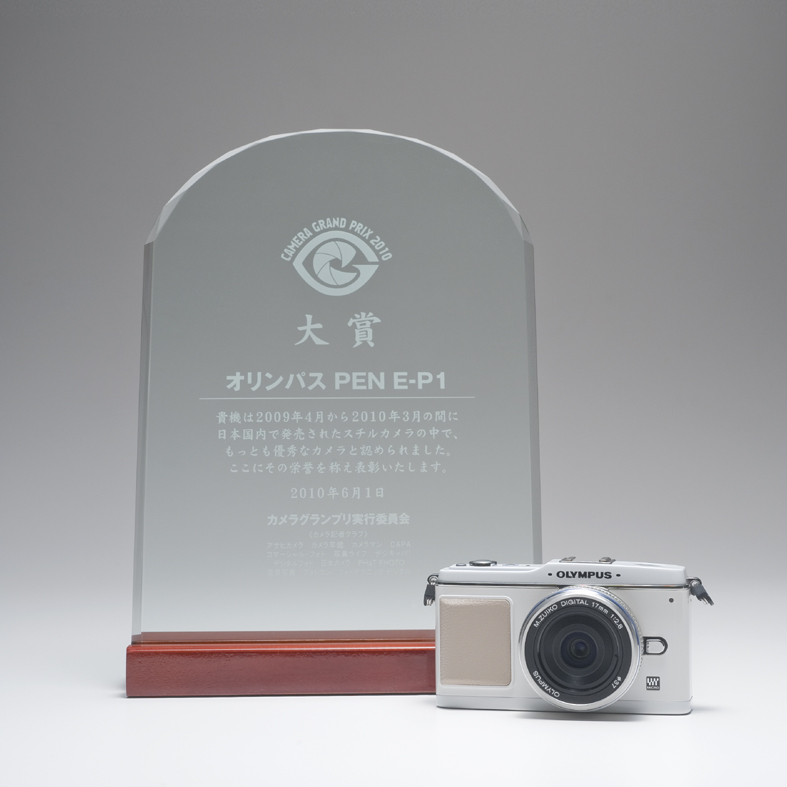
Olympus PEN E-P1: CJPC 2010 "Camera of the Year" & "Readers Award"

Olympus PEN E-P1: CJPC 2010 "Camera of the Year" & "Readers Award"

The winners of the annual C.J.P.C. (Camera Journal Press Club) awards have been released. The Olympus PEN E-P1 has won both the top awards of “Camera of the Year” as well as “Readers Award”. The “Editors Award” went to the Canon EF 100mm F2.8L Macro IS USM and Sony back-illuminated CMOS Sensor “Exmor R”.

Olympus PEN E-P1: CJPC 2010 "Camera of the Year" & "Readers Award"

Olympus PEN E-P1: CJPC 2010 "Camera of the Year" & "Readers Award"

The Olympus PEN E-P1 was selected from a shortlist of 199 cameras introduced in Japan between 1 April, 2009 and 31 March, 2010. This is the first Olympus camera to receive the Japan Camera Journal Press Club’s highest honor since the inception of the Japan Camera Grand Prix awards in 1984. Previous “Camera of the Year” winners include the Canon EOS 5D Mark II in 2009 and the Nikon D3 in 2008.

(more…)