Taiwan has beaten Myanmar and US as the top source of attack traffic on the Internet, while Asian cities maintain their dominance of having the fastest connection speeds in the world, with HK at the pinnacle.
This is the 4th year for the quarterly report.
Akamai has released its Q2 State of the Internet report for 2011. It is a leading provider of cloud optimisation services.
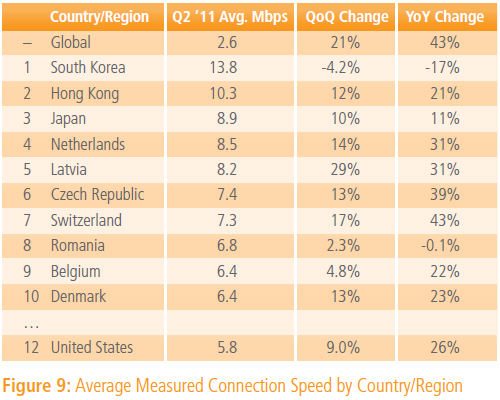
Average Connection Speed by Country/Region
Based on data gathered from the Akamai Internet Platform, which carries between 15-30 percent of the world’s Web traffic, the report provides insight into key global Internet statistics such as the world’s fastest and slowest regions for connection speed, the most frequent origins of attack traffic, and the highest-performing geographies for mobile connectivity, as well as resulting trends over time.
It uses its globally distributed network of servers to gather massive amounts of information on many metrics about the Internet, such as connection speeds, attack traffic, and network connectivity/availability/latency problems, as well as traffic patterns on leading Web sites.
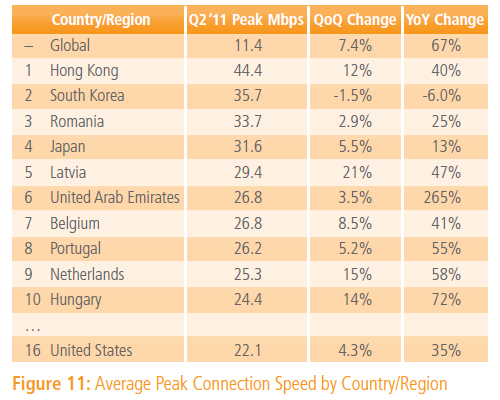
Average Peak Connection Speed by Country/Region
The Q2 report includes data gathered from across Akamai’s Intelligent Internet Platform during the second quarter of 2011 about attack traffic, broadband adoption, and mobile connectivity, as well as trends seen in this data over time.
In addition, this quarter’s report also includes insights into the state of IPv4 exhaustion, the impact of World IPv6 Day, the state of client-side SSL, and smartphone usage trends as observed by Akamai partner Ericsson.
The main highlights from the Q2 report paints the following picture:
Speed
- Global average connection speed increased 43 percent year over year to 2.6 Mbps. South Korea again had the highest average connection speed at 13.8 Mbps. Singapore was ranked 29th at 4.5 Mbps.
- Global average peak connection speed was 11.4 Mbps. Hong Kong has maintained its position as having the highest average peak connection speed at 44.4 Mbps. Singapore was 19th at 20.7 Mbps.
- Globally, high broadband (>5 Mbps) adoption grew to 27%. At 68%, the Netherlands was the highest, pushing S Korea to third position. Hong Kong came in second, while Singapore was 20th at 33% adoption.
- Gloobal broadband (>2 Mbps) adoption increased to 65%. Singapore was 48th at 67%.
- Global narrowband (<256 kbps) adoption at 2.9% continued its decline. Lebanon, with its 56% narrowband adoption is the top laggard.
- Cities in Asia again have the fastest connection speeds in the world. Out of the 100 fastest cities worldwide, 70 were from Asia, with Hong Kong, 59 cities in Japan and 10 cities in South Korea.
- Brno, Czech is the fastest city in Europe, at number 55 out of 100.
- 18 US cities made the top 100 list. 9th-placed San Jose’s 13.7 Mbps moved the US into the top 10 for the first time.
Security

Sources of top attack traffic
Taiwan was the top source of attack traffic accounting for 10% of overall attack traffic. Myanmar and US together accounted for another 17%. Having made it debut as top attack traffic source in the last quarter, second-placed Myanmar has continued its attack activities showing its entrance into the ranks of top attack traffic sources was not a flash in the pan.
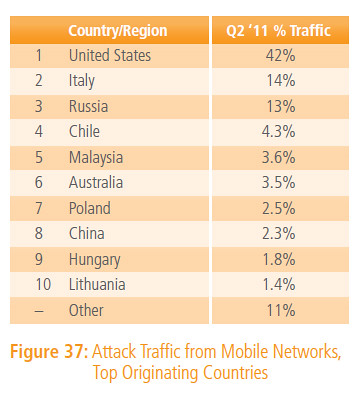
Attack from mobile networks
With respect to attack traffic originating from mobile network providers, the US vaulted to the top of the list, generating 42% of the observed traffic. Italy has gone down to second place, after its observed attack traffic from was halved compared to the previous quarter. Russia took third place. The top three countries were responsible for almost 70% of observed attacks, while the top 10 countries accounted for nearly 90% of the observed attacks.
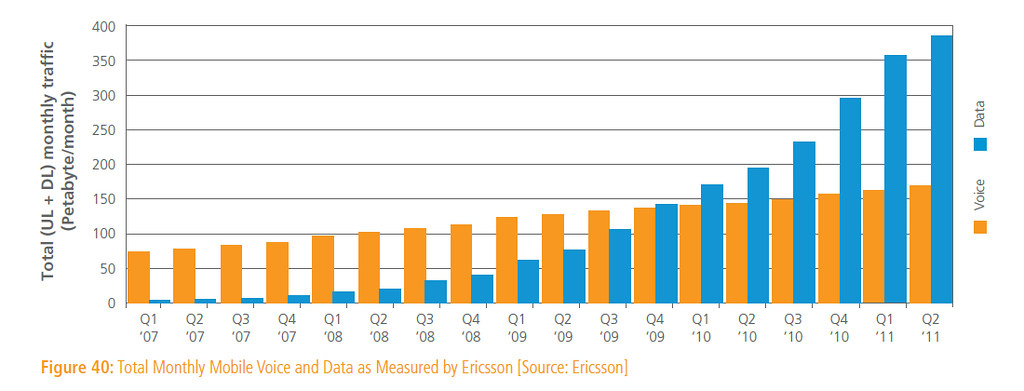
Exponential growth in mobile data traffic is outstripping linear growth of mobile voice traffic.
Previous SOTI reports from Akamai on tech4tea.com
1st Quarter, 2011 Report (Volume 4, Number 1)
4th Quarter, 2010 Report (Volume 3, Number 4)
Tags: Akamai, broadband, Internet, mobile, security, speed, statistics